This is not an isolated technical pullback. Four structural pressures are acting on AI semiconductor valuation logic in sync: the reshaping of China’s domestic semiconductor supply chain, the repricing of credit risk for NVIDIA, the challenge that AI model efficiency improvements pose to the logic of expanding compute capacity, and capital retreat amid crowded high-valuation trades. Below is a breakdown, one by one.
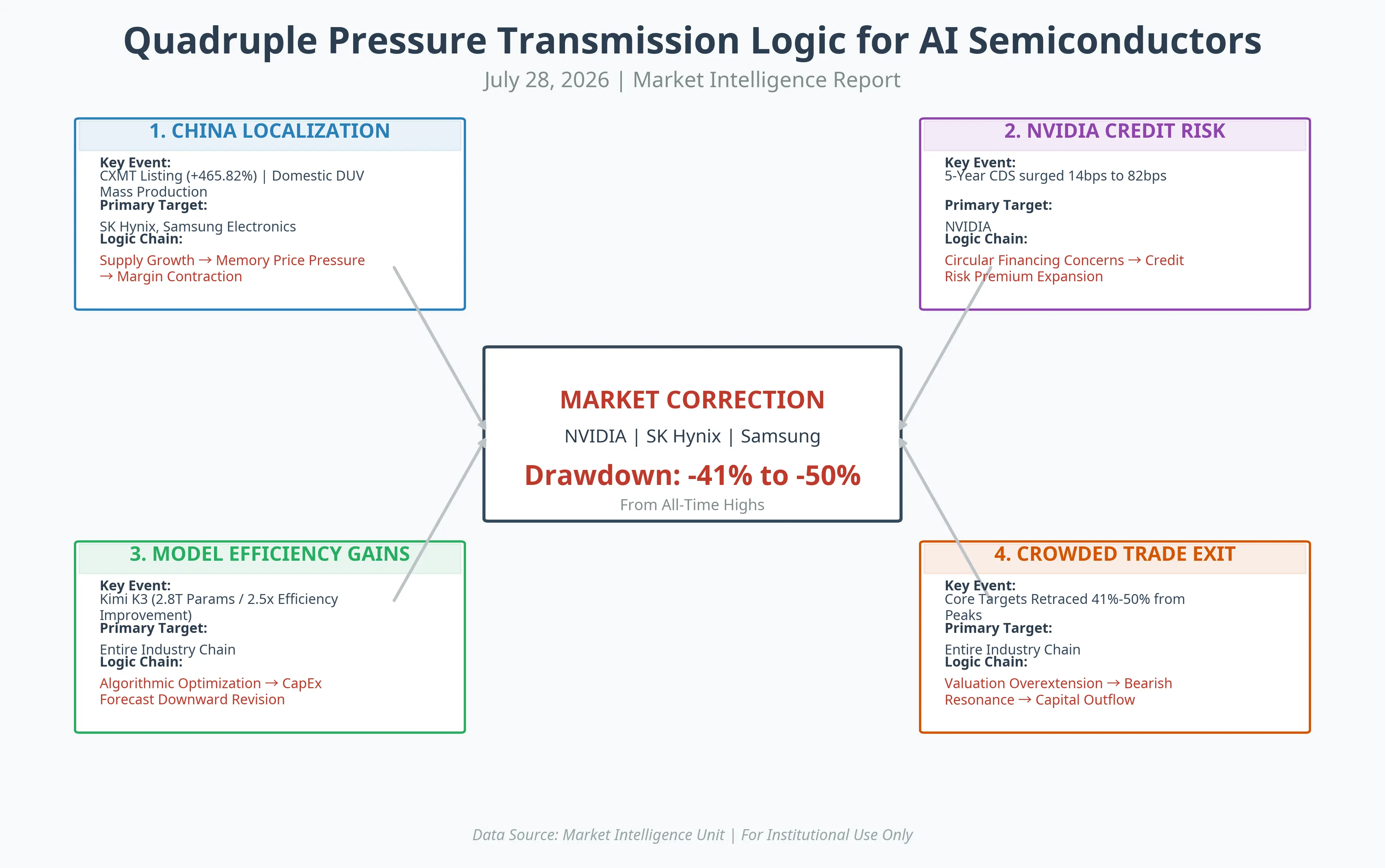
Four-Pillar Transmission Logic Chart for AI Semiconductor Pressure
A China semiconductor domestic breakthrough sparks a global supply-chain revaluation
On July 27, China’s DRAM leader ChangXin Memory (CXMT) listed on the Shanghai Stock Exchange’s STAR Market. Its closing price was 49.00 yuan, up 466% versus an issue price of 8.66 yuan. The company’s single-day market value reached 3.28 trillion yuan (about $484.6 billion), briefly surpassing Tencent and Intel to become the No. 1 market-cap stock on A-shares. Single-day trading value topped 140 billion yuan, setting a historical record for A-shares. The UK’s Financial Times reported that CXMT has become the “world’s fourth-largest DRAM producer.”
Meanwhile, market rumors circulated: a company with a state-owned enterprise background in Shanghai has begun mass production of immersion DUV lithography machines. This year it plans to produce about 5 units; next year, the target is raised to about 20 units. The first batch of equipment will be delivered to Semiconductor Manufacturing International Corporation (SMIC), HuaHong Semiconductor, and ChangXin Memory. Although the planned 5 units of domestic equipment in 2026 are only 3.8% of ASML’s 131-unit shipment volume in 2025, what the market is trading is not short-term replacement capability—it is a change in the long-term supply landscape.
The key narrative of the past two years has been: AI chip demand growth → global supply tightness → Samsung, SK Hynix, and Micron earning excess profits. CXMT’s listing, together with domestic lithography mass production, points to an opposite expectation: China’s supply chain improves → global supply increases → pressure on storage prices → margin declines. CXMT has lifted the yield of 17nm DDR5 process chips to 90%. Domestic DRAM demand accounts for one quarter of the global total; once domestic capacity forms at scale, the impact on the global storage supply-demand structure will be structural.
This expectation is directly reflected in the drawdowns in the memory sector. Since their June highs, SK Hynix and Samsung Electronics have pulled back about 50% and 41%, respectively—far exceeding the Philadelphia Semiconductor Index’s 21% decline over the same period. The market is not trading “this year replacing ASML” equipment; it is trading the longer-term scenario that “global storage supply will be reshaped in three to five years.”
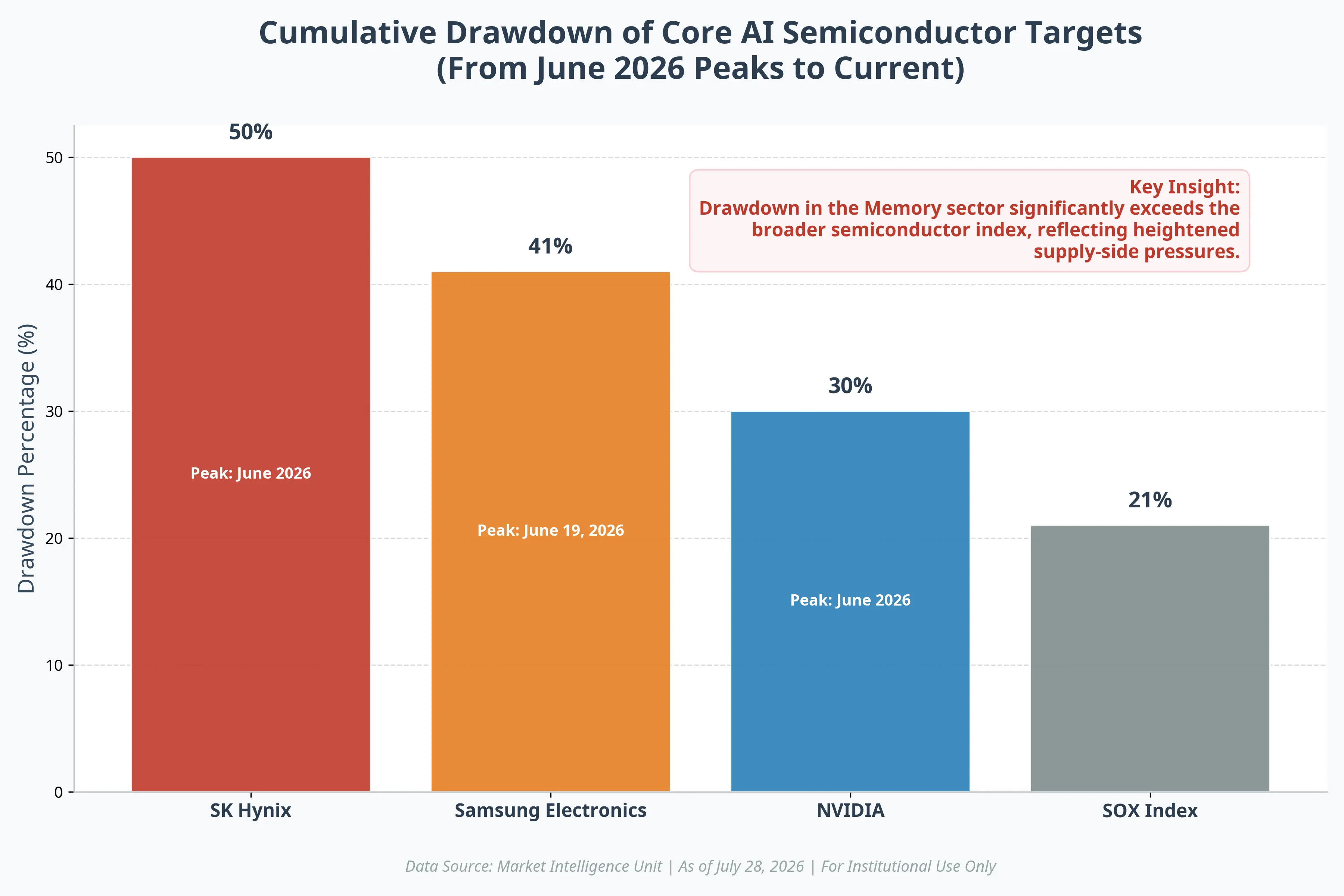
Comparison of cumulative drawdowns from June highs for key AI semiconductor targets
Repricing NVIDIA’s credit risk
On July 27, NVIDIA’s five-year credit default swap (CDS) briefly rose by about 14 basis points, peaking at roughly 82 basis points per year—its biggest single-day gain since the contract began active trading in November 2025. A CDS can be viewed as default insurance for corporate debt—when the price rises, it indicates the market believes the issuer’s credit risk has increased.
The direct trigger for the surge in CDS spreads was market concern about NVIDIA’s “circulating financing” model. On July 24, NVIDIA and South Korea’s SK Group announced an AI cooperation agreement worth more than $50 billion. At the same time, NVIDIA is negotiating to provide OpenAI with up to $47.6k in guarantees to help it lease data center compute power. Reports also said NVIDIA is discussing financing for OpenAI’s $49.5k U.S. project to procure NVIDIA chips. The projects above total more than $32.8k.
Critics have warned for months that these kinds of deals are circular: NVIDIA provides financing or equity to some companies, and those companies typically buy or use NVIDIA chips. Michael Ball, a macro strategist at Bloomberg, noted that these massive infrastructure agreements have reignited market doubts about the “circular cash-flow” logic behind AI capital expenditures: NVIDIA’s revenue growth depends heavily on the financing capacity of downstream customers, and money cycles within the industry chain. If financing conditions change, the entire AI spending pipeline faces contraction risk.
Notably, the surge in CDS spreads is not unique to NVIDIA. Data from the London Stock Exchange Group shows that CDS for AI giants including Oracle, SpaceX, Alphabet, Amazon, Meta, and Broadcom have recently risen to record highs. Oracle’s five-year CDS quote on July 27 was 215 basis points, far above 144 basis points at the start of the year. S&P Global Ratings previously downgraded Oracle to BBB- due to its $70 billion data center investment plan.
The market is asking an even deeper question: Is NVIDIA truly a “GPU supplier,” or is it an “AI infrastructure finance participant”? If it is the latter, the quality and sustainability of its revenue need to be reassessed.
AI model efficiency improvements challenge the logic of compute expansion
On July 28, Moonshot Dark side officially open-sourced the Kimi K3 model, while releasing a technical report and model weights. Kimi K3’s parameter scale is about 2.8 trillion, roughly three times that of the previous Kimi K2.5. But more importantly, the key data is this: through technology innovations such as Kimi Delta Attention, Attention Residuals, and MoonEP, its scalable efficiency improves by about 2.5 times—meaning that, in terms of “optimal compute,” the unit compute output of intelligence is roughly 2.5 times the original. The technical report shows that KDA linear attention replaces 75% of traditional attention layers, the KV cache is compressed by 75%, and decoding speed for long texts improves by 6.3 times.
Kimi K3 is not a standalone case. Open-source models such as DeepSeek are also exploring the boundaries of algorithmic efficiency. These developments have brought the market back to a core question: does stronger AI inevitably require more GPUs and larger data centers?
The logic most of the market previously accepted was the “Scaling Law”—bigger models, more data, and stronger compute are linearly and positively correlated. But Kimi K3 demonstrates a different path: when compute resources are limited, architecture innovation can deliver a major increase in intelligence output per unit compute. If algorithm optimization can partially substitute for stacking more compute, then expectations for GPU demand growth, data center investment returns, and the capital expenditure pacing of cloud providers all need to be recalibrated.
Of course, this logic is controversial. Views from Citi and Bank of America Securities lean toward denial: efficiency gains may release more usage volume via the “Jevons paradox,” thereby increasing total resource consumption. As the cost per unit of intelligence declines, companies may deploy more always-on agents, long-context analysis, code automation, and real-time multimodal services. But regardless, open-sourcing Kimi K3 at least proves one point: compute efficiency improvement paths are real, and that route was unclear 12 months ago. The market needs two-way scenario analysis for the “compute demand curve,” not a one-direction extrapolation.
Crowded high-valuation trades as profits get taken
Over the past two years, the AI semiconductor sector accumulated massive gains. Market valuations of core names such as NVIDIA, SK Hynix, Broadcom, Micron, and ASML had already priced in expectations for AI growth over the coming years. When multiple negative factors appeared at the same time—China supply-chain competition, NVIDIA credit risk, and model efficiency improvements—capital chose to reduce risk exposure.
The U.S. stock market on July 27 clearly demonstrated this “high-cut, low-rotate” rotation: the Philadelphia Semiconductor Index fell nearly 5% at one point during the morning session, and ultimately closed down 2.23%. Meanwhile, Apple rose 1.17%, Google - A rose 2.13%, Microsoft rose 1.94%, SAP rose 6.90%, and Salesforce rose 6.04%. After excluding AI-related stocks, the S&P 500 rose 0.80%, performing noticeably better than the index overall.
Goldman Sachs analyst Chris Hussey noted that the S&P 500’s lagging performance over the past two months has the root cause in the market’s doubts about the sustainability of AI infrastructure investment—not macro factors such as oil prices or interest rates. Thomas Martin, senior portfolio manager at Globalt Investments, said bluntly that signs of an AI bubble “deflating” are emerging.
From the perspective of fund flows, the market is shifting from semiconductor upstream names with high valuations and heavy reliance on forward expectations, toward consumer technology and enterprise software with stronger earnings certainty and more stable cash flows. This is not a denial of AI’s long-term trend; it is a correction of the gap between short-term valuations and forward expectations.
Conclusion
On July 28, 2026, the global AI semiconductor sector’s collective plunge is a concentrated release, within the same time window, of four structural pressures.
China’s semiconductor self-reliance—CXMT’s listing and the mass production of DUV lithography—triggered the market’s long-term reassessment of the global memory supply structure. The record surge in NVIDIA’s CDS reveals the market’s repricing of credit risk under its “circulating financing” model. The open-sourcing of Kimi K3, with 2.5x efficiency gains in data, challenges the linear narrative that “stronger AI equals more compute.” And the fund rotation under crowded high-valuation trades is the inevitable market-capital translation of the three pressures above.
These four pressures are not independent. The rise of China’s supply chain could suppress memory prices, thereby affecting earnings expectations for SK Hynix and Samsung. An increase in NVIDIA’s credit risk could raise financing costs for AI infrastructure, thereby dampening the growth rate of compute demand. If improvements in model efficiency continue to be validated, they could change the capital expenditure structure of cloud providers, affecting the order cycle across the entire semiconductor equipment and chip ecosystem. Together, they form an interlocking logic closed loop that reinforces itself.
For investors, what needs distinguishing now is not whether the “long-term AI trend” is valid, but whether the assumptions embedded in existing valuation models remain effective. When compute supply curves, financing cost curves, and algorithm efficiency curves all shift at the same time, valuation models based on extrapolating a single variable need to be recalibrated.
FAQ
Q1: What are the main reasons for NVIDIA’s stock plunge?
NVIDIA closed down 4.99% on July 27, and the immediate trigger was market concerns about its “circulating financing” model. NVIDIA is pushing forward AI infrastructure deals worth more than $500B, including a cooperation worth over $350B with SK Group and providing financing guarantees for OpenAI. The market is worried that NVIDIA’s revenue growth depends heavily on the financing capacity of downstream customers; if financing conditions change, the entire chain of AI spending will contract. NVIDIA’s five-year CDS jumped 14 basis points in one day to 82 basis points, its largest historical increase.
Q2: Why did SK Hynix and Samsung Electronics fall much more than NVIDIA?
SK Hynix fell 14.65%, while Samsung Electronics fell 13.39%—significantly more than NVIDIA’s 4.99%. The core reason is that the memory sector is directly hit by China’s semiconductor self-reliance push—CXMT’s stock surged 466% on its listing day, and domestic DUV lithography machines entered mass production. The market is concerned that China’s memory capacity expansion will increase global supply and pressure memory prices, while memory businesses are exactly the core profit sources for SK Hynix and Samsung. Since their June highs, both companies have retreated about 50% and 41%, respectively.
Q3: How does the open-sourcing of Kimi K3 affect AI semiconductor investment logic?
Kimi K3 has a parameter scale of about 2.8 trillion, and achieves scalable efficiency improvements of about 2.5x through architecture innovation. This challenges the traditional narrative that “stronger AI equals more GPUs + larger data centers.” If algorithm optimization can continuously improve unit compute intelligence output, then expectations for GPU demand growth, data center investment returns, and cloud providers’ capital expenditure pacing may all need to be re-evaluated. Of course, efficiency improvements could also release more usage via the “Jevons paradox”—but at minimum, the market needs to leave room for pricing the scenario that “compute demand may grow nonlinearly.”
Q4: How big is the impact of China’s semiconductor self-reliance on the global memory market?
The short-term impact is limited—domestic DUV lithography machines planned for 2026 are only 5 units, equivalent to 3.8% of ASML’s annual shipment volume. But what the market is trading is a change in the long-term landscape: CXMT has become the world’s fourth-largest DRAM producer, and 17nm DDR5 chip yields have reached 90%. Domestic DRAM demand accounts for one quarter of the global total. If self-reliance continues to break through, the global memory supply structure will shift from “three-player dominance” to “four-strong competition,” changing the long-term pricing logic for memory.