The crypto derivatives exchange BitMEX announced on July 24 that it plans to shut down, with trading scheduled to stop on September 23. After the news broke, the price of BitMEX’s utility token BMEX plummeted by more than 90%. Restructuring advisor Roshan Dharia said the top five platforms control around 80% of global spot trading volume, leaving less and less profit margin for mid-sized and regional exchanges.
BitMEX Announces Trading Will Stop on September 23, BMEX Token Crashes More Than 90%
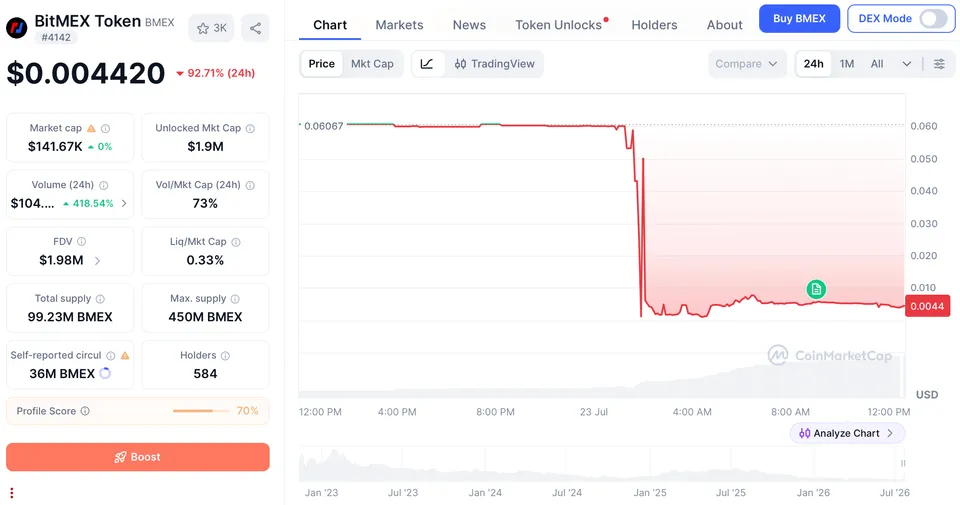 (Source: CMC)
BitMEX announced on Thursday that trading will be halted on September 23, 2026, after its parent company HDR Global Trading completed a strategic assessment. After the news was released, BitMEX’s utility token BMEX price fell by more than 90%, according to CoinMarketCap data.
BitMEX was founded in 2014 by Arthur Hayes, Ben Delo, and Samuel Reed. It was one of the earliest crypto derivatives exchanges to pioneer perpetual contracts, helping lay the groundwork for digital asset derivatives trading.
BitMEX’s Market Share Decline
According to CryptoQuant data, BitMEX’s Bitcoin futures daily trading volume began to weaken after hitting a peak of $1 billion to $5 billion per day in 2020, then continued to decline from around May 2021 and never recovered. Specific market share figures: in August 2023, CoinGecko ranked BitMEX ninth among derivatives exchanges, accounting for 0.9% of trading volume; by 2025, BitMEX had fallen out of CoinGecko’s top ten perpetual contract exchanges—despite these platforms’ year-over-year perpetual contract trading volume rising by 47.4% over the same period, reaching a record $86.2 trillion.
Structural Consolidation in the Crypto Derivatives Market: Top Five Control 80% of Volume
Restructuring advisor Roshan Dharia told Cointelegraph that BitMEX’s shutdown reflects structural pressure facing mid-sized CEXs—liquidity is increasingly concentrated among the biggest exchanges in the industry, while compliance costs tied to regulation continue to rise.
He said: “Right now, the top five platforms control about 80% of global spot trading volume, which keeps shrinking the profit space for mid-sized and regional exchanges, and there’s no feasible path to expand… these headwinds are structural, not cyclical.”
Rise of Licensed Competitors
Since 2026, multiple licensed exchanges have entered markets previously dominated by offshore platforms like BitMEX:
Coinbase (US): In May 2026, after obtaining a CFTC exemption, launched perpetual futures through a CFTC-regulated exchange.
Kalshi (US): Approved by the CFTC to launch Bitcoin perpetual futures.
Kraken (US): In June 2026, via its newly acquired Bitnomial exchange, rolled out CFTC-regulated perpetual futures to eligible U.S. traders.
Coinbase (UK): In July 2026, received a UK investment services license, enabling it to expand its derivatives business before new crypto regulatory frameworks take effect.
FAQ
When did BitMEX announce it would shut down, and when would trading stop?
BitMEX announced on July 24, 2026 (Thursday) that it would be shutting down, with trading scheduled to stop on September 23, 2026. Previously, its parent company HDR Global Trading completed a strategic assessment. After the announcement, the BMEX utility token plunged by more than 90%.
How do analysts interpret the industry significance of BitMEX’s shutdown?
Restructuring advisor Roshan Dharia noted that currently the top five platforms control about 80% of global spot trading volume, and liquidity is highly concentrated. Combined with continuously rising regulatory compliance costs, the survival space for mid-sized exchanges is being squeezed. He emphasized that these pressures are “structural, not cyclical,” and BitMEX’s closure is a concrete manifestation of this trend.
Which licensed exchanges entered the crypto perpetual futures market in 2026?
In 2026, Coinbase launched perpetual futures in May via a CFTC-regulated exchange; Kalshi received CFTC approval to launch Bitcoin perpetual futures; and Kraken launched CFTC-regulated perpetual futures in June through its acquisition of Bitnomial. Coinbase also obtained a UK investment services license this month, which will allow it to expand its derivatives business.


