The Kimi K3 of Moonshot AI (Moonshot AI) was crowned champion of the “Frontend Code Arena” by Arena.ai on July 16, with an Elo score of 1,679, surpassing Anthropic’s Claude Fable 5 and OpenAI’s GPT-5.6 Sol.
Arena.ai’s Frontend Code Arena Scoring Mechanism
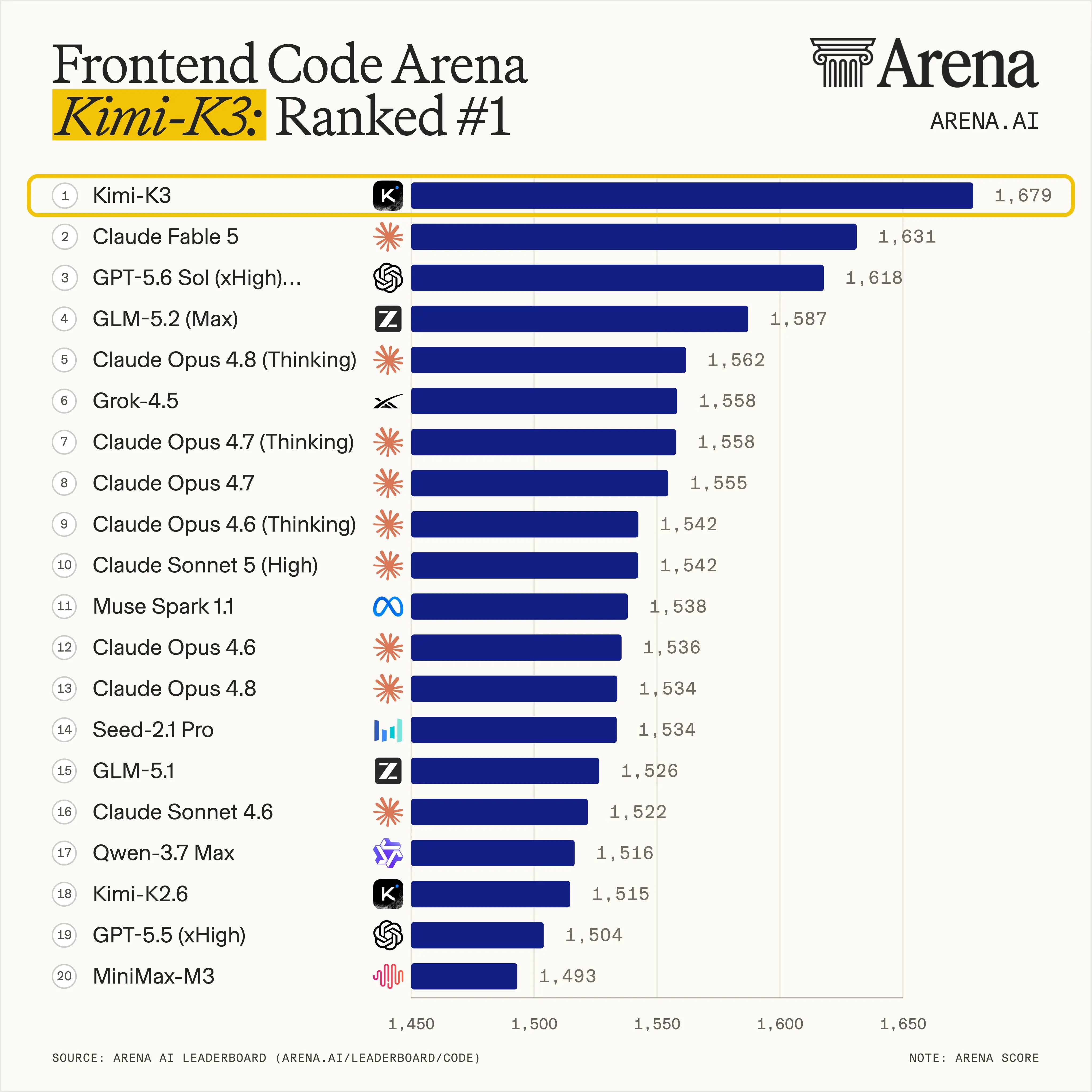 (Source: Arena.ai)
Arena.ai’s “Frontend Code Arena” ranking logic differs from typical AI benchmark leaderboards: the evaluation has no fixed question bank, and it does not use machine-based automatic scoring. The scoring process is as follows: real users submit a frontend development requirement, and the platform has two anonymous models, each of which generates an executable webpage. After users try them, they vote for the better result; the platform then uses an Elo system to convert points based on the win/loss relationships between the models.
The higher the score, the more often the model beats its opponent in real human blind tests. This mechanism measures performance on the concrete task of “understanding the requirement and generating a usable webpage,” and it does not cover backend logic, algorithm efficiency, or full-stack system design.
Kimi K3’s Performance Breakdown Across Seven Subdomains
In an official Arena.ai announcement, the performance of Kimi K3 in seven specialized frontend code domains is as follows:
Brand & Marketing: 1st place
Reference-Based Design: 1st place
Data & Analytics: 1st place
Consumer Products: 1st place
Simulation: 1st place
Content Creation Tools: 1st place
Gaming: 2nd place (lost to Claude Fable 5)
Kimi K3’s Open-Source Statement
With 2.8 trillion parameters, VentureBeat’s report says that Moonshot AI’s official materials describe it as the first “open 3T class” model and claim it is the largest open-source model in history. However, the complete model weights have not yet been actually released. According to the official timeline, the full weights will be formally released on July 27, 2026.
Moonshot AI’s self-evaluation benchmark results show that Kimi K3 can match Claude Opus 4.8 max and GPT-5.5 high in most evaluation items, but still falls behind Claude Fable 5 and GPT-5.6 Sol in some areas. The above self-evaluation data are performance results published by the vendor itself, not from neutral third-party tests.
API Pricing Adjustment: K3 Charges $3 per Million Tokens for Input
Kimi K3’s API pricing is $3 per million input tokens and $15 per million output tokens, placing it in the same price tier as the Anthropic Claude Sonnet series. The previous-generation model K2.6 was priced at $0.95 per million input tokens and $4 per million output tokens. In the past, Moonshot AI used low pricing as a market-entry strategy, but Kimi K3’s pricing has now become one of the highest among China’s AI labs.
At present, the only available inference capacity tier that Kimi K3 offers is the “max” setting, which is the option with the highest token consumption.
FAQ
How is the Elo score of Arena.ai’s Frontend Code Arena calculated?
Arena.ai uses a human blind-test mechanism: real users submit a frontend development requirement, two anonymous models each generate an executable webpage, and after users vote, the platform uses the Elo mechanism to convert points based on the win/loss relationships between the models. Kimi K3’s 1,679 score is the value as of the Arena.ai announcement on July 16, and there is no guarantee it won’t be updated later as new match data comes in.
When will the full model weights of Kimi K3 be officially open-sourced?
According to Moonshot AI’s official announcement, the full model weights of Kimi K3 are set to be formally released on July 27, 2026. As of the Arena.ai announcement on July 16, they have not yet been actually open-sourced.
By how much has Kimi K3’s API pricing changed compared with the previous generation K2.6?
Kimi K3’s API pricing is $3 per million input tokens and $15 per million output tokens; K2.6’s pricing is $0.95 per million input tokens and $4 per million output tokens. Input-side pricing increased by about 3.2x. Moonshot AI’s pricing strategy has shifted from targeting the low-end market to positioning in the mid-to-high-end tier.


