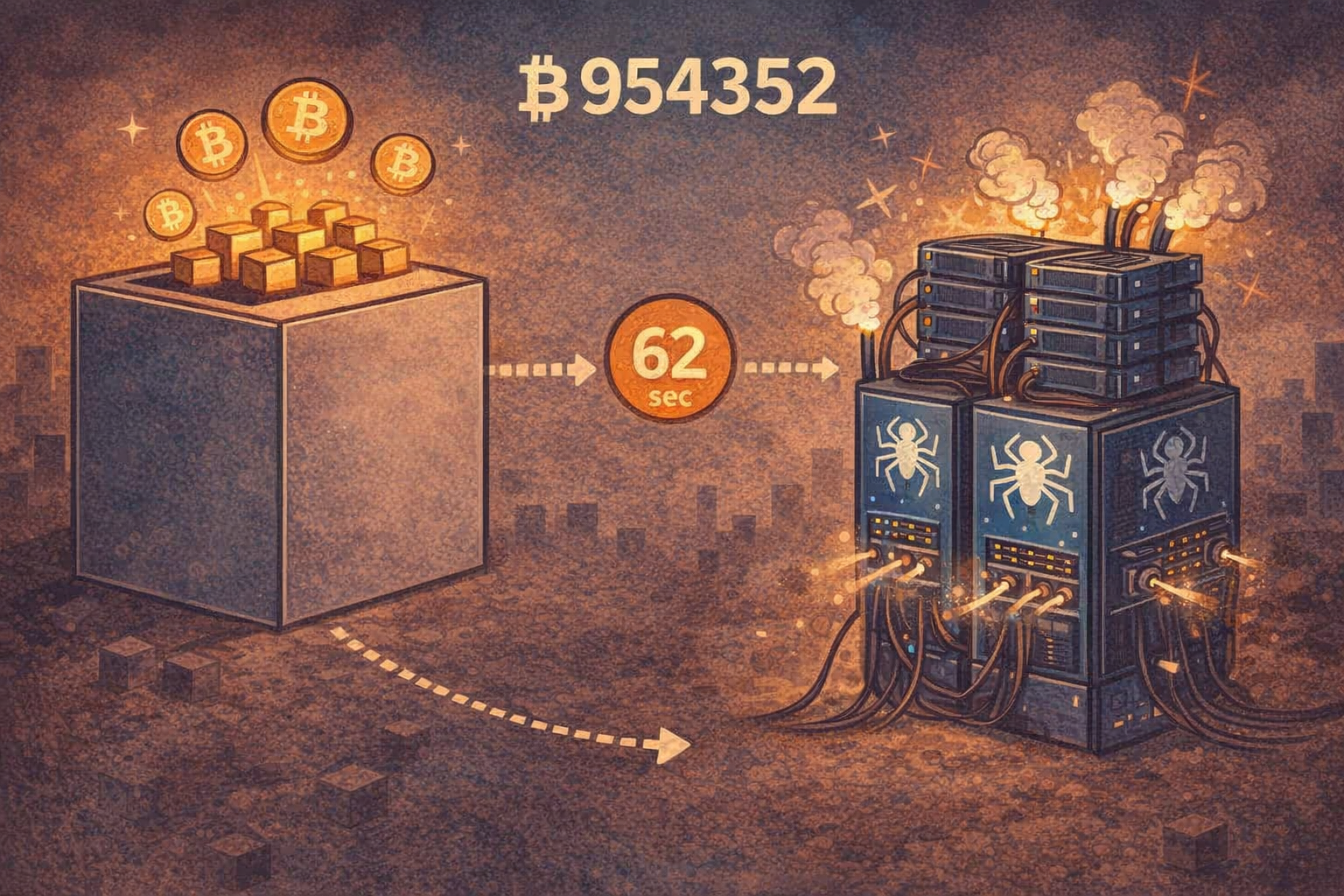
Bitcoin mining pool SpiderPool mined an empty block at block height 954,352 on June 19. The block contains only Coinbase transactions (miner rewards) and no user transactions. Mempool data shows the block weight was 1.16 kWU, and the interval with the previous Bitcoin block was about 62 seconds.
SpiderPool Mines Block 954,352: Timestamp 04:27, Block Weight 1.16 kWU
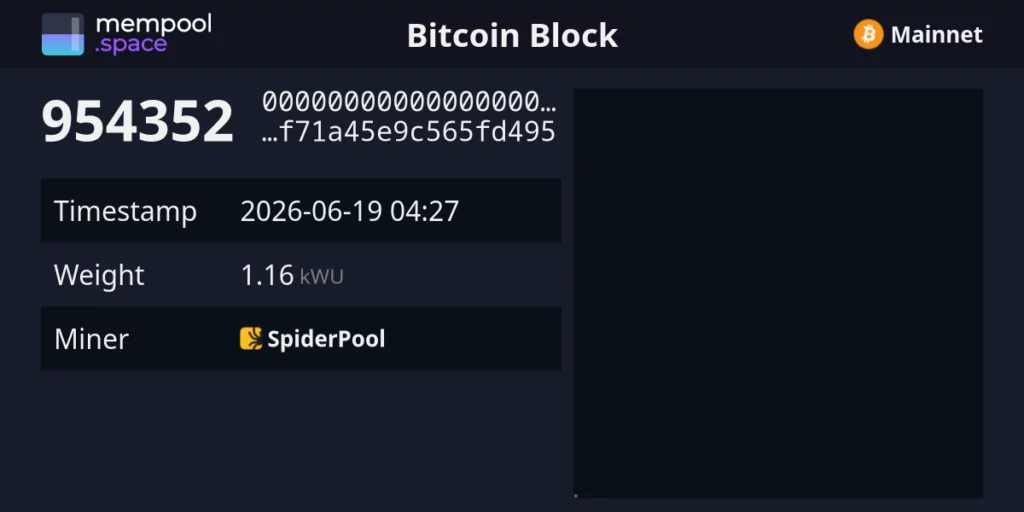 (Source: Mempool)
Based on Mempool’s on-chain data, the confirmation details for Bitcoin block 954,352 are as follows: the mining pool was SpiderPool, timestamp was 2026-06-19 04:27, block weight was 1.16 kWU, the interval with the previous block was about 62 seconds, and the block contents: it contains only Coinbase transactions and no user transactions.
By mining this empty block, SpiderPool gave up the transaction fee revenue from that block (the Coinbase reward is its only source of income).
Technical explanation for the 62-second block interval: a known mechanism of fast templates leading to empty blocks
According to Crypto.news, the 62-second fast block interval is the key technical background for this empty block. Miners typically need to receive the complete transaction template containing pending transactions in order to package user transactions into a block. When the block interval is extremely short (such as 62 seconds), a more complete transaction template may not yet have arrived at the miner hardware, leaving miners only able to use a smaller, faster Coinbase-based empty template.
This is a known technical mechanism in Bitcoin mining. The resulting empty block is a valid and legitimate block. It does not violate consensus rules, and it will not roll back or prevent any transaction settlement.
Mempool Research’s 2024 study: historical context of empty blocks and what repeated occurrences may mean
A June 2024 study by Mempool Research said that mining pools may send empty templates because they are smaller and faster to transmit, but the cost is that miners lose the transaction fees for that block. Empty blocks have appeared multiple times in Bitcoin’s history, but this situation is currently relatively rare.
Crypto.news noted that a single empty block does not indicate problems with the Bitcoin network; only if empty blocks keep appearing could it trigger further attention regarding miners’ time-selection strategies—especially whether they sacrifice transaction fee revenue to chase speed.
Frequently Asked Questions
Do empty blocks pose a threat to normal operation of the Bitcoin network?
According to Crypto.news, a single empty block does not indicate that the Bitcoin network has a problem. It does not involve breaking consensus rules, does not prevent transaction settlement, and does not cancel any transactions. A mining pool mining an empty block is a known phenomenon in the Bitcoin network, stemming from template transmission time limits caused by fast block intervals. Only when empty blocks repeatedly occur could they potentially lead to further scrutiny of miners’ behavior.
What economic loss does SpiderPool’s mining of an empty block cause?
The mining pool that mines the empty block (SpiderPool) gives up all transaction fee revenue from that block and only receives the Coinbase block reward (currently the post-halving reward of 3.125 BTC). Because the empty block contains no user transactions, there is no transaction fee revenue. Therefore, the trade-off of SpiderPool choosing to use an empty template (smaller size, faster transmission) is that it actively sacrifices the potential transaction fee income from this mining.
What is the relationship between Bitcoin empty blocks and Selfish Mining?
According to Crypto.news, empty blocks are not the same as Selfish Mining. Selfish Mining is a strategic behavior in which miners intentionally hide blocks they have mined to gain a competitive advantage; empty blocks are typically a technical outcome under fast block intervals. Crypto.news said that while empty blocks provide data points for analysts to observe miner behavior, block 954,352 should best be viewed as a “rare but known mining event,” unless this pattern continues to occur.


