On June 22 local time, SpaceX (SPCX) stock closed at $154.6, with a daily drop of 16.43%, and its market capitalization was wiped out by about $400 billion. This is the stock’s third consecutive day of decline. Since June 17, the cumulative drop has exceeded 23%, and cumulative market-cap erosion has been more than $600 billion.
SPCX’s share price not only fell below the $160.95 IPO first-day closing price, but also pulled back more than 30% from the $225.64 all-time intraday high set on June 16. Is this plunge a short-term washout of sentiment, or a reappraisal of valuation logic?
Why Debt Issuance Became the Spark for the Stock Plunge
The immediate trigger for this round of selling was SpaceX’s announcement that it would launch its first investment-grade bond issuance. In the company’s 8-K filing, SpaceX said it has started the offering process for the first batch of senior unsecured notes, with an expected fundraising size of at least $20 billion. The proceeds will mainly be used to repay a temporary bridge loan of a similar scale—this loan was borrowed by SpaceX in March this year to take on the debt of the former Twitter (now the X platform) and xAI.
From a capital-structure perspective, this debt issuance came only a little over a week after the IPO. The IPO itself already provided SpaceX with nearly $86 billion in financing. Entering the debt market for large-scale funding again in such a short period has prompted the market to reassess funding needs. Analysts noted that net debt is expected to increase by more than $400 billion by 2031, a figure far above the debt levels of nearly all U.S. companies.
After the debt-issuance news was released, an ETF that was shorting SpaceX with leverage surged more than 32% on the day, reflecting the rapid congregation of short-selling forces. Investors’ core concern is this: why does a company that has just completed what is described as the largest IPO in human history need to borrow heavily immediately? Does this imply that existing funds cannot support its expansion plans?
Can Fundamentals Support the Current Market Cap?
SpaceX’s financial condition is a hard constraint that the market cannot ignore. Based on public data, in full-year 2025 the company posted net losses of $4.94 billion; in Q1 2026, revenue was $4.7 billion, but net losses widened further to $4.3 billion. Since being founded in 2002, SpaceX’s cumulative losses have totaled about $41.3 billion. In its prospectus, the company has already warned investors that it may still be unable to achieve overall profitability in the future.
With losses of this scale against a market capitalization of $2.02 trillion, the gap between valuation and fundamentals is extremely pronounced. On a price-to-sales basis, after the listing, SpaceX’s multiple versus 2025 revenue is over 100x. Analysts at Barron’s Technology pointed out even before the IPO that SpaceX’s price-to-sales multiple versus expected 2026 sales was already 40x, and its EBITDA multiple was as high as 175x.
The primary source of losses is the expansion cost of the AI business line. xAI, which was folded in during February 2026, drove operating losses of up to $6.36 billion in 2025. In Q1 2026, the company’s operating loss was $1.943 billion, while net losses were $4.276 billion—nearly matching the full-year level of 2025. Soaring expansion costs for AI data centers are the core drag. Although the company’s long-term target gross margin is 70% and its GAAP net profit margin target is about 45%, management has not provided specific time frames for achieving these targets.
Why the Valuation Debate Is So Extreme
Market disagreement over SpaceX’s valuation has reached an unusually extreme level. The divide between bulls and bears reflects this company’s unique pricing logic.
On the bearish side, Morningstar used a discounted cash flow model and concluded that SpaceX’s fair value is only $780 billion—less than half of the IPO pricing. Morningstar analysts argued that the xAI business could become a “value-destroying factor.” Valuation authority Aswath Damodaran of New York University anchored fair value at $1.3 trillion and said SpaceX’s estimate of the AI market size—$2.6 trillion—is overly aggressive. Noted short-seller Cernow C. Chanos broke it down from a business-logic perspective as well: while the overall potential market for space is infinite, the risk of randomness in space is also infinite.
The bulls also have plenty of supporters. ARK Invest’s internal model is highly optimistic about SpaceX’s valuation in 2030. ARK’s chief futurist said that even Starlink alone can support a valuation of more than $2 trillion for SpaceX. The core logic is that Starlink has already built notable first-mover advantages and scale moats in the low-earth orbit satellite internet space. Goldman Sachs’ bull model also predicts SpaceX’s revenue could reach $474 billion by 2030.
As of June 16, six analysts had published research reports: five issued buy ratings and one (CFRA) issued a sell rating. KeyBanc provided a neutral rating of “in line with the sector,” arguing that most of the long-term value has already been captured by the current share price. This extreme split in itself suggests that SpaceX’s valuation is no longer based on today’s financial data, but is essentially a bet on a future vision.
How Liquidity Structure Amplifies Volatility
The liquidity structure during SpaceX’s initial trading phase is the key variable for understanding the fierce volatility this round. At the time of listing, shares that were actually freely tradable were only about 4% of total outstanding shares; the rest were subject to staggered lockup periods. This extremely thin float has a classic double-edged effect: it propelled the share price sharply higher in the first three trading days, at one point pushing toward a $3 trillion market cap; but when sentiment reverses, the same liquidity structure accelerates the downside.
Retail participation hit a record high and further magnified the effect. According to Vanda Research data, retail investors posted cumulative net purchases of $405 million in the first five trading days after SpaceX’s listing—setting a retail participation record for recent IPOs. Last week, retail buying of SpaceX even exceeded the total retail net purchases across the “Magnificent Seven” in the same period of U.S. stocks.
A Jones Trading analyst said, “Everyone who wants to buy SpaceX has already entered in the first few days after listing, and now it looks like the buy-side is clearly exhausted.” When incremental buying dries up and selling pressure begins to release, the low-float structure makes the price discovery process especially violent.
How the Macroeconomic Environment Impacts Overvalued Tech Assets
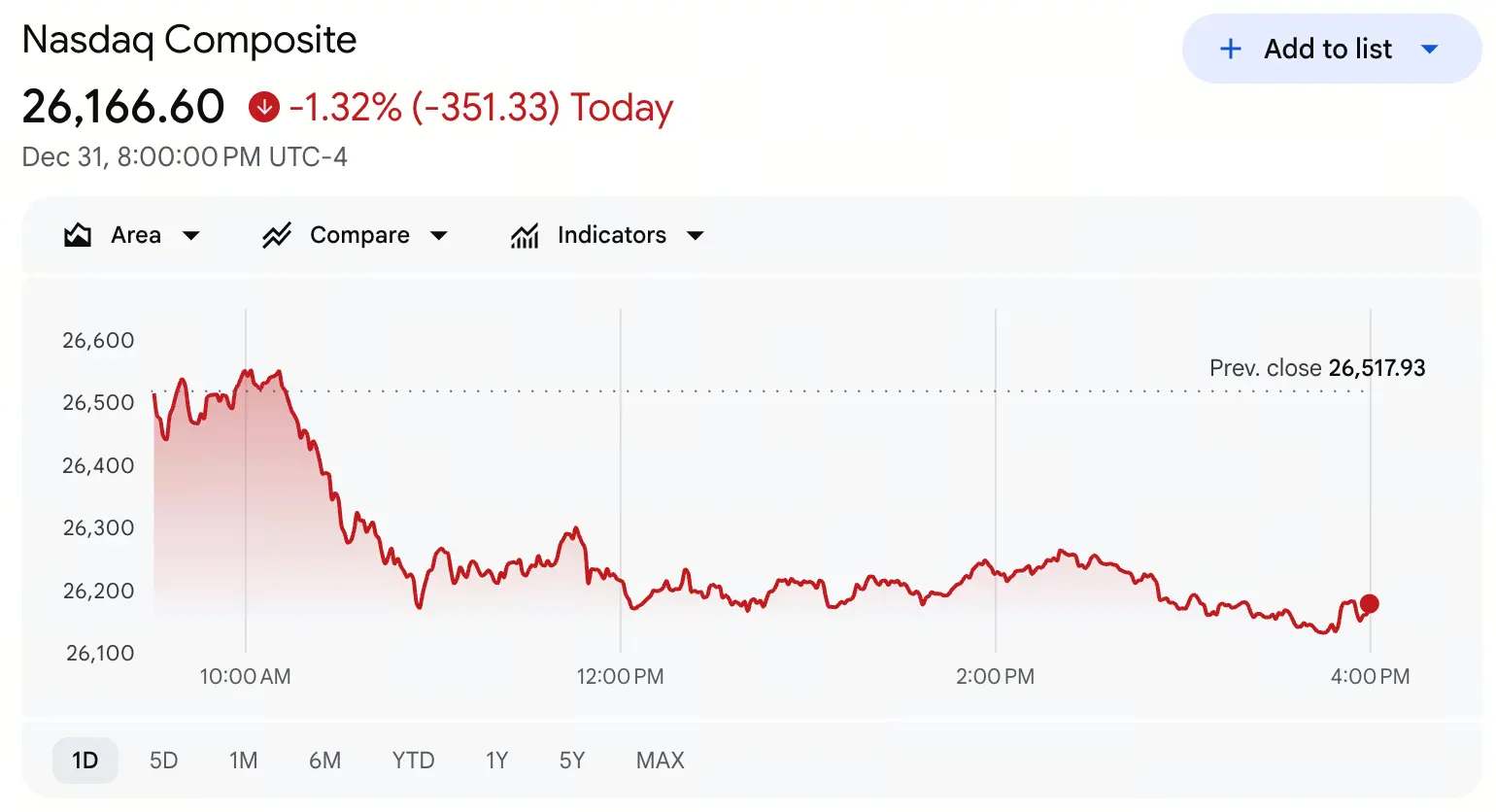
This round of SpaceX’s selloff is not an isolated event—it is happening amid broader shifts in the macro environment. On June 22, the Nasdaq Composite fell 1.32%, Google slid nearly 5%, Amazon dropped more than 4%, and Microsoft fell more than 3%. Large-cap tech stocks faced collective pressure against the backdrop of a shift in expectations for Federal Reserve monetary policy.
In recent remarks, Fed Chair Powell was explicit about fighting inflation. The latest interest-rate dot plot shows that among 18 officials submitting rate forecasts, 9 expect rates to be higher than the current level by the end of the year—sharply contrasting with the March outlook, when no officials predicted a rate hike. The market is currently pricing in the possibility of rate-hike action as early as September. Two-year Treasury yields—the most sensitive to monetary policy—rose to 4.23% on Monday, the highest level in more than a year.
Rising yields are especially unfavorable for overvalued tech stocks. SpaceX trades at a price-to-sales multiple of more than 100x, and its valuation depends heavily on discounting future cash flows—every 1 percentage-point rise in rates reduces the present value of forward cash flows accordingly. As expectations for rate hikes build, valuation re-ratings pressure on overvalued tech assets is being amplified systemically.
Key Variables to Watch for SpaceX’s Outlook
Taking the above analysis together, SpaceX’s direction will depend on the evolution of several key variables:
First, the commercialization progress of Starship. Starship plans to enter commercial operations in the second half of 2026. SpaceX’s commercial blueprint heavily relies on stable orbital insertion of Starship, and the subsequent launch and deployment of Starlink V3 satellites also depends on Starship’s capacity. Any technical delay could have a major impact on valuation.
Second, the monetization ability of the AI business. SpaceX has reached third-party compute power contracts with Anthropic and Google, with a total value of $75 billion. The company recently also signed with AI startup Reflection AI, which is said to generate $150 million per month starting in July, with the cooperation running through the end of 2029. The actual execution of these contracts will be an important test of the AI valuation logic.
Third, the cost and timing of debt financing. Moody’s and Fitch have assigned SpaceX debt ratings of Baa1 and BBB+, respectively, both three notches above junk level. In a higher-rate environment, the cost of large-scale debt financing will directly erode profitability. The market will closely watch the final pricing of bond issuance and subscription results.
Fourth, the schedule of unlocks from lockup periods. The 42% stake in SpaceX held by Musk is locked until June 2027. But as time passes, other shareholders’ lockups will gradually expire, and potential supply pressure is a major variable hovering over the market.
Fifth, the Starship flight test on June 29. This is the most closely watched event in the near term. The test results will directly affect market expectations for Starship’s commercialization timeline.
FAQ
Q: What is the direct cause of SpaceX’s decline this round?
The announcement of its first investment-grade bond issuance and financing of at least $20 billion are the direct triggers. The market worries about why the company still needs to borrow at a large scale after completing a record IPO, prompting a reassessment of funding needs and valuation sustainability.
Q: What is SpaceX’s financial condition?
Net losses were $4.94 billion for full-year 2025 and net losses were $4.3 billion for Q1 2026; cumulative losses since the company’s founding are about $41.3 billion. Losses mainly come from AI data center expansion costs.
Q: Why is there a huge disagreement in the market over SpaceX’s valuation?
Bears say fair value is only $780 billion (Morningstar) to $1.3 trillion (Damodaran); bulls say Starlink alone can support a valuation of more than $2 trillion (ARK). The root of the disagreement lies in different expectations for the company’s AI business and its space commercialization prospects.
Q: How does a low float affect the stock price?
In the early stage after listing, only about 4% of shares can be traded freely. This structure amplifies gains when the market is rising, and similarly amplifies declines when the market is falling—especially when the buy-side dries up and selling pressure is released.
Q: Which upcoming points should be watched most?
The Starship flight test on June 29, the final pricing and subscription results of the bond issuance, the actual execution progress of AI compute power contracts, and the supply pressure that could emerge from subsequent lockup unlocks.


