










#HoldUSD1EarnYield
The Dollar You Hold Today Can Earn More Than Your Bank Will Ever Pay
Stablecoin Economy Growth
On June 20, 2026, the stablecoin economy has reached a scale that traditional finance cannot ignore.
Total stablecoin market capitalization has surpassed $310 billion, with Tether's USDT commanding $186 billion in circulation and Circle's USDC at $78.5 billion.
These are no longer just trading rails between volatile crypto positions.
They have become settlement infrastructure, cross-border payment plumbing, and treasury management tools for institutions and individuals alike.
The most compelling shift in 2026, however, is the yield layer that has grown atop these dollar-pegged assets.
The Yield Comparison
Consider the baseline comparison.
The average U.S. money market account rate sits at 0.47% APY, with the best available rate reaching 5.00% at select online institutions, according to Curinos data published June 18.
Meanwhile, stablecoin yield strategies in 2026 span from 4.1% to 11.8% APY across mainstream tiers.
The spread reflects genuine differences in collateral quality, custody arrangements, and liquidity risk.
The yield landscape has stratified along a recognizable curve:
• Tokenized Treasury bill funds anchor the low-risk baseline at 4.1 to 4.5%
• DeFi lending protocols like Aave offer 4.67% APY on USDC with no lock-up
• CeFi platforms deliver 6.5 to 8.5% on USDT
• Delta-neutral basis strategies push toward 11.8% for sophisticated allocators
Gate's Yield Approach
Gate's own yield product, GUSD, exemplifies the accessible middle tier.
Users stake USDT or USDC at a 1:1 ratio and receive GUSD as a receipt token, earning 4.4% APR with daily auto-compounding.
Yields are distributed directly to spot accounts, redemption is fast, and there are no subscription fees.
The design prioritizes simplicity and capital efficiency over exotic risk-taking.
For a portfolio allocating $20 out of every $100 to yield-bearing stable positions, GUSD provides a conservative anchor that compounds passively while the trader's active allocation works across BTC, ETH, and other volatile assets.
The Macro Tailwind
The structural tailwind for stablecoin yield in 2026 comes from the Federal Reserve itself.
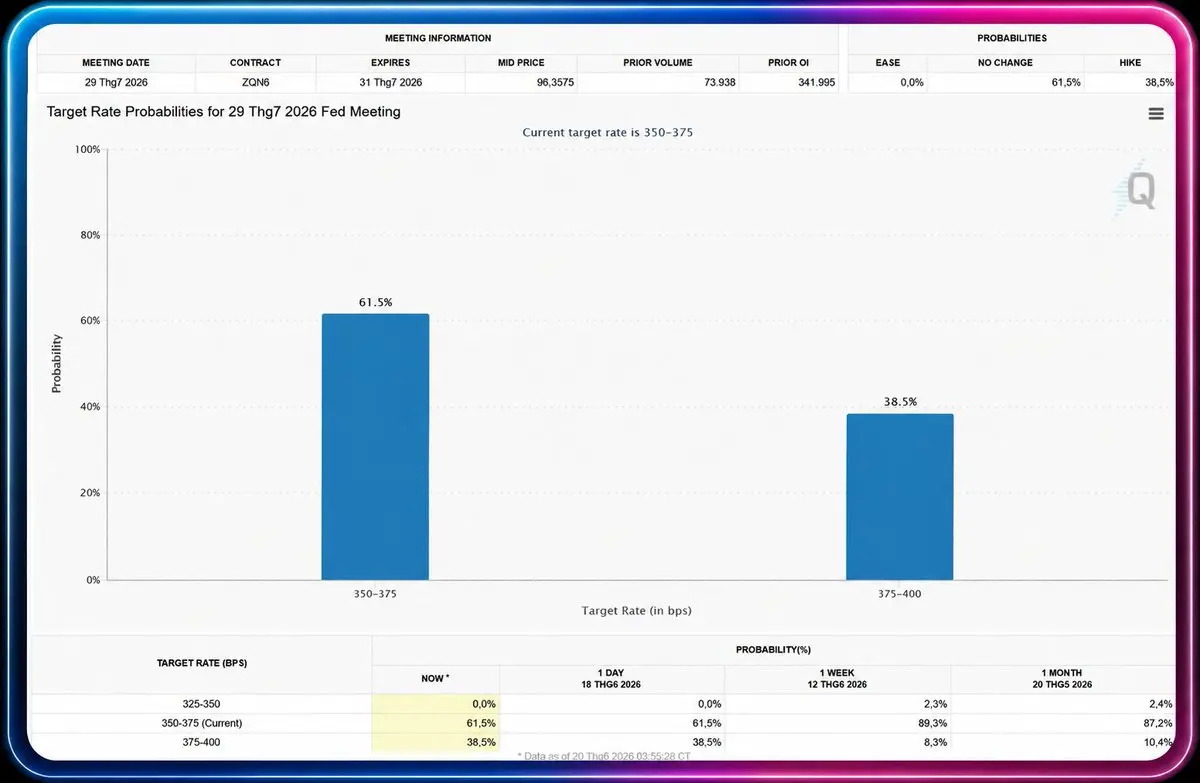
Chairman Warsh's inaugural FOMC meeting concluded June 17 with rates unchanged and a hawkish tilt signaling potential hikes ahead.
The 2-year Treasury yield has risen to 4.189%, the highest in over a year.
Higher-for-longer rates increase borrowing demand across crypto-collateralized lending markets, which in turn pushes DeFi lending yields upward.
Aave's $40 billion in total value locked is absorbing this demand, and its USDC lending rate has already climbed from sub-3% levels seen in early 2025 to the current 4.67%.
The macro environment is mechanically expanding the yield available to stablecoin holders.
The Bigger Market Shift
Yield-bearing stablecoins themselves have grown from $1.5 billion in early 2024 to over $11 billion by mid-2025, now representing approximately 5% of total stablecoin supply.
Tokenized Treasury products have outpaced stablecoin growth for the first time in Q1 2026, adding $2.12 billion versus $1.19 billion for stablecoins.
This signals that institutional capital is increasingly treating onchain dollar products as a legitimate fixed-income allocation.
Ethereum lost over $8 billion in stablecoin supply in Q1 2026, the worst result since Q2 2022.
But yield-bearing variants like sUSDe, sUSDS, and sFRAX have partially offset outflows from plain USDT and USDC by routing basis trades, savings rates, and AMO mechanisms into single ERC-20 wrappers.
Practical Allocation Strategy
For the individual allocator, the practical strategy is tiered diversification.
• Anchor 40% of your stable allocation in low-risk products like GUSD at 4.4% APR for daily compounding and instant redemption
• Deploy 30% into DeFi lending on Aave or Compound at 4 to 5% APY for flexible exit
• Allocate 20% to CeFi yield accounts at 6.5 to 8.5% for higher returns with institutional custody
• Reserve 10% for tactical basis strategies if you have the operational capability
This layered approach produces a blended yield of approximately 5.5 to 6.5% APY while maintaining liquidity across all tiers and limiting concentration risk in any single protocol or platform.
Final Thought
The dollar you hold is no longer inert.
In 2026, it compounds.
#MyGateTradeStory
@Gate_Square
The Dollar You Hold Today Can Earn More Than Your Bank Will Ever Pay
Stablecoin Economy Growth
On June 20, 2026, the stablecoin economy has reached a scale that traditional finance cannot ignore.
Total stablecoin market capitalization has surpassed $310 billion, with Tether's USDT commanding $186 billion in circulation and Circle's USDC at $78.5 billion.
These are no longer just trading rails between volatile crypto positions.
They have become settlement infrastructure, cross-border payment plumbing, and treasury management tools for institutions and individuals alike.
The most compelling shift in 2026, however, is the yield layer that has grown atop these dollar-pegged assets.
The Yield Comparison
Consider the baseline comparison.
The average U.S. money market account rate sits at 0.47% APY, with the best available rate reaching 5.00% at select online institutions, according to Curinos data published June 18.
Meanwhile, stablecoin yield strategies in 2026 span from 4.1% to 11.8% APY across mainstream tiers.
The spread reflects genuine differences in collateral quality, custody arrangements, and liquidity risk.
The yield landscape has stratified along a recognizable curve:
• Tokenized Treasury bill funds anchor the low-risk baseline at 4.1 to 4.5%
• DeFi lending protocols like Aave offer 4.67% APY on USDC with no lock-up
• CeFi platforms deliver 6.5 to 8.5% on USDT
• Delta-neutral basis strategies push toward 11.8% for sophisticated allocators
Gate's Yield Approach
Gate's own yield product, GUSD, exemplifies the accessible middle tier.
Users stake USDT or USDC at a 1:1 ratio and receive GUSD as a receipt token, earning 4.4% APR with daily auto-compounding.
Yields are distributed directly to spot accounts, redemption is fast, and there are no subscription fees.
The design prioritizes simplicity and capital efficiency over exotic risk-taking.
For a portfolio allocating $20 out of every $100 to yield-bearing stable positions, GUSD provides a conservative anchor that compounds passively while the trader's active allocation works across BTC, ETH, and other volatile assets.
The Macro Tailwind
The structural tailwind for stablecoin yield in 2026 comes from the Federal Reserve itself.
Chairman Warsh's inaugural FOMC meeting concluded June 17 with rates unchanged and a hawkish tilt signaling potential hikes ahead.
The 2-year Treasury yield has risen to 4.189%, the highest in over a year.
Higher-for-longer rates increase borrowing demand across crypto-collateralized lending markets, which in turn pushes DeFi lending yields upward.
Aave's $40 billion in total value locked is absorbing this demand, and its USDC lending rate has already climbed from sub-3% levels seen in early 2025 to the current 4.67%.
The macro environment is mechanically expanding the yield available to stablecoin holders.
The Bigger Market Shift
Yield-bearing stablecoins themselves have grown from $1.5 billion in early 2024 to over $11 billion by mid-2025, now representing approximately 5% of total stablecoin supply.
Tokenized Treasury products have outpaced stablecoin growth for the first time in Q1 2026, adding $2.12 billion versus $1.19 billion for stablecoins.
This signals that institutional capital is increasingly treating onchain dollar products as a legitimate fixed-income allocation.
Ethereum lost over $8 billion in stablecoin supply in Q1 2026, the worst result since Q2 2022.
But yield-bearing variants like sUSDe, sUSDS, and sFRAX have partially offset outflows from plain USDT and USDC by routing basis trades, savings rates, and AMO mechanisms into single ERC-20 wrappers.
Practical Allocation Strategy
For the individual allocator, the practical strategy is tiered diversification.
• Anchor 40% of your stable allocation in low-risk products like GUSD at 4.4% APR for daily compounding and instant redemption
• Deploy 30% into DeFi lending on Aave or Compound at 4 to 5% APY for flexible exit
• Allocate 20% to CeFi yield accounts at 6.5 to 8.5% for higher returns with institutional custody
• Reserve 10% for tactical basis strategies if you have the operational capability
This layered approach produces a blended yield of approximately 5.5 to 6.5% APY while maintaining liquidity across all tiers and limiting concentration risk in any single protocol or platform.
Final Thought
The dollar you hold is no longer inert.
In 2026, it compounds.
#MyGateTradeStory
@Gate_Square