The Solana ecosystem yield protocol RateX has announced the RTX tokenomics, with a total supply of 100 million tokens, of which 44.18% is allocated to the community. RateX splits its yield products into Principal Tokens (PT) and Yield Tokens (YT), allowing users to trade YT to speculate on yield rate changes, with a maximum leverage of 10 times. The protocol was launched in 2024 on Solana.
How does RateX redefine yield trading?
The core innovation of RateX lies in the “structuring” of traditional yield-bearing assets. Taking USDE as an example, this stablecoin currently has an annualized return of about 15%. In traditional DeFi, users can only passively hold and wait for yield accumulation. However, RateX splits it into two independently tradable tokens: Principal Token (PT) represents the original invested USDE value, while Yield Token (YT) represents the right to claim all interest income during this period.
This split creates three brand new yield strategies. The first is fixed income locking: Suppose Xiaoming holds USDE and is concerned that future market conditions may adversely affect yields, he can directly purchase PT Tokens with USDE and hold them until maturity. This way, he locks in the current yield in advance, similar to buying bonds; regardless of how the market fluctuates in the future, his yield remains unaffected.
The second type is leveraged interest rate speculation: If Xiaoming expects the yield of USDE to rise, he can directly purchase YT to achieve the purpose of leveraged interest rates. Since the price of YT is far lower than the complete USDE asset, the same amount of capital can buy more YT. When the yield rises, the price of YT will increase significantly, achieving a leverage effect of up to 10 times. This is similar to interest rate swap transactions, but the operation is simpler and does not require the complex contracts of traditional finance.
The third type is liquidity mining enhancement: If Xiao Ming does not want to speculate on interest rate fluctuations but wishes to earn additional income, he can use USDE to provide liquidity for the PT/YT trading pair, thus earning trading fees while maintaining exposure to the original asset. These three strategies can be combined to derive more complex yield optimization schemes.
44.18% Community Distribution Tokenomics Ambition
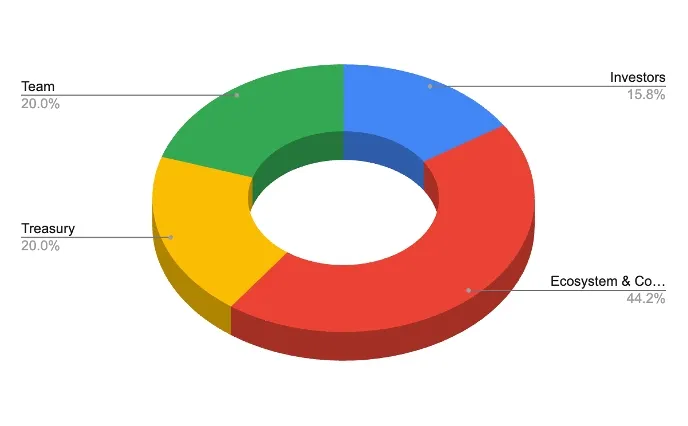
The biggest highlight of the RTX tokenomics is the community and ecosystem allocation of up to 44.18%, which is extremely rare among mainstream DeFi projects. In contrast, many projects allocate over 50% of tokens to teams and investors, resulting in significant selling pressure immediately after launch. RateX's allocation structure demonstrates its commitment to long-term community building: 20% allocated to the team (locked for 3 to 6 months), 20% for the treasury (protocol operations and development), and 15.82% allocated to early investors including GSR and Echo Capital.
RateX Token Distribution and Unlock Mechanism
Ecosystem and Community (44.18%): Reward liquidity providers, traders, and governance participants, gradually releasing to promote long-term participation and avoid short-term sell-offs.
Team Allocation (20%): Locked for 3 to 6 months after TGE, adjusting development incentives to ensure the team's long-term interests are aligned with the project.
Treasury Reserve (20%): Used for protocol upgrades, marketing, strategic partnerships, and unexpected expenses, determined by community governance.
Investor Allocation (15.82%): Early supporters such as GSR and Echo Capital typically have longer lock-up periods and linear unlocking mechanisms.
The underlying logic of this distribution structure is to give control of the protocol to actual users rather than speculators. RTX holders possess governance rights over the fee structure, asset listings, and protocol upgrades, meaning the community can directly influence the development direction of RateX. The 44.18% community distribution ensures the decentralization of governance rights, preventing a few large holders from manipulating proposal outcomes.
Mooncake Sub-protocol: A Leverage Revolution with No Liquidation Risk
The sub-protocol Mooncake of RateX offers a rare innovation in the crypto market: leveraged token trading with no liquidation risk. The biggest pain point of traditional leveraged trading (such as perpetual contracts or margin trading) is the liquidation risk—when the market fluctuates dramatically, leveraged positions may be forcibly liquidated within minutes, resulting in users losing their entire margin. Mooncake addresses this issue through an innovative funding rate model.
On Mooncake, users can trade leveraged tokens with 3x Bitcoin exposure without facing liquidation. These leveraged tokens use a dynamic rebalancing mechanism: when the market rises, the system automatically increases exposure to maintain 3x leverage; when the market falls, it automatically decreases exposure. The cost of this design is the funding rate—leveraged holders pay or receive fees based on market trends. In a bull market, longs need to pay the funding rate to shorts; in a bear market, the opposite is true.
This model is extremely friendly to retail investors. Traditional leveraged trading requires users to constantly monitor their positions, set stop losses, and manage margins; a small mistake can lead to liquidation. Mooncake's leveraged Token allows users to hold leveraged exposure just like holding regular Tokens, without the nightmare of being liquidated in the middle of the night. This lowers the threshold for leveraged trading, enabling more users to participate in yield optimization strategies.
Dual-chain Expansion and Cross-chain Yield Opportunities
RateX adopts a dual-chain architecture, launching on Solana in 2024, with plans to expand to BNB Chain in April 2025. The choice of Solana as the primary chain is due to its low transaction fees and high throughput, which are crucial for yield optimization strategies that require frequent trading. The cost of each transaction on Solana is typically less than $0.001, and the confirmation time is just a few seconds, allowing users to flexibly adjust their PT and YT positions without worrying about gas fees eroding profits.
The strategic significance of expanding to the BNB Chain lies in accessing the liquidity of the Ethereum ecosystem. Although the BNB Chain is technically an independent blockchain, it is highly integrated with the Ethereum ecosystem, with many Ethereum DeFi protocols deployed on the BNB Chain. Through cross-chain bridging, RateX enables Ethereum users to seamlessly utilize its yield trading features while enjoying much lower transaction costs compared to the Ethereum mainnet.
RateX utilizes a Uniswap V3 style concentrated liquidity AMM to facilitate the trading of yield tokens and leveraged assets. This design allows liquidity providers to concentrate their funds in specific price ranges, significantly improving capital efficiency. For assets like PT and YT, which have relatively predictable price volatility, concentrated liquidity is especially effective as liquidity providers can precisely target price ranges to earn higher fee income.
Disclaimer: The information on this page may come from third parties and does not represent the views or opinions of Gate. The content displayed on this page is for reference only and does not constitute any financial, investment, or legal advice. Gate does not guarantee the accuracy or completeness of the information and shall not be liable for any losses arising from the use of this information. Virtual asset investments carry high risks and are subject to significant price volatility. You may lose all of your invested principal. Please fully understand the relevant risks and make prudent decisions based on your own financial situation and risk tolerance. For details, please refer to
Disclaimer.


