
Analysis
El Salvador, the first country in the world to recognize Bitcoin as legal tender, was seen by many in the industry as a pioneer. In 2025, the small country’s Bitcoin ambitions met reality.
The Central American country made waves in 2021 when the Legislative Assembly approved a bill that required all merchants, stores and places of business to accept Bitcoin (BTC) as a form of payment. Proponents believed it would set off a chain of Bitcoin adoption and be a boon for the country’s economy.
Ambitious adoption plans, including the issuance of bonds to fund a “Bitcoin City,” met lukewarm adoption from Salvadorans. Adoption was further muddied by concerns from the International Monetary Fund (IMF).
These worries came to a head in 2025, when El Salvador had to take a second look at its Bitcoin policy.
Bitcoin adoption in El Salvador off to a lukewarm start
The passage of El Salvador’s Bitcoin Law was quickly followed by the rollout of the Chivo Wallet, the official Bitcoin wallet of El Salvador. Citizens were even incentivized to sign up with addresses pre-loaded with $30 of Bitcoin. But for many, they just took the free money and ran, never using the app again.
By law, Bitcoin should be accepted everywhere, but attempts to use Bitcoin in El Salvador were met with limited success by those who tried.
On-the-ground adoption concerns aside, there was one other looming issue, and that was El Salvador’s debt and the IMF’s position on Bitcoin and cryptocurrencies.
El Salvador was seeking a $1.4-billion loan from the IMF, as its public finances and debt needed reinforcement to be sustainable. Its external reserves and economic buffers were also wearing thin and needed strengthening against potential shocks.
The IMF didn’t want El Salvador to recognize Bitcoin as legal tender amid concerns about its risks to financial stability. It stated that widespread government use of Bitcoin, like El Salvador’s Bitcoin buying plan, can expose the state budget to contingent liabilities that depend on BTC price movements.
Bukele makes “deal with the devil” but keeps buying Bitcoin
Amid these concerns, the IMF made granting the requested loan conditional on El Salvador narrowing the scope of its Bitcoin Law. El Salvador’s economic needs were greater than the government’s Bitcoin ideals, and it repented.
In January, El Salvador made accepting Bitcoin voluntary and ensured taxes would only be paid in US dollars, the country’s de facto currency.
Many crypto industry observers were despondent. Kadan Stadelmann, chief technology officer of Komodo Platform, wrote in an opinion article for Cointelegraph that “the revolution is dead in El Salvador” after President Nayib Bukele made a “deal with the devil” — i.e., the IMF.
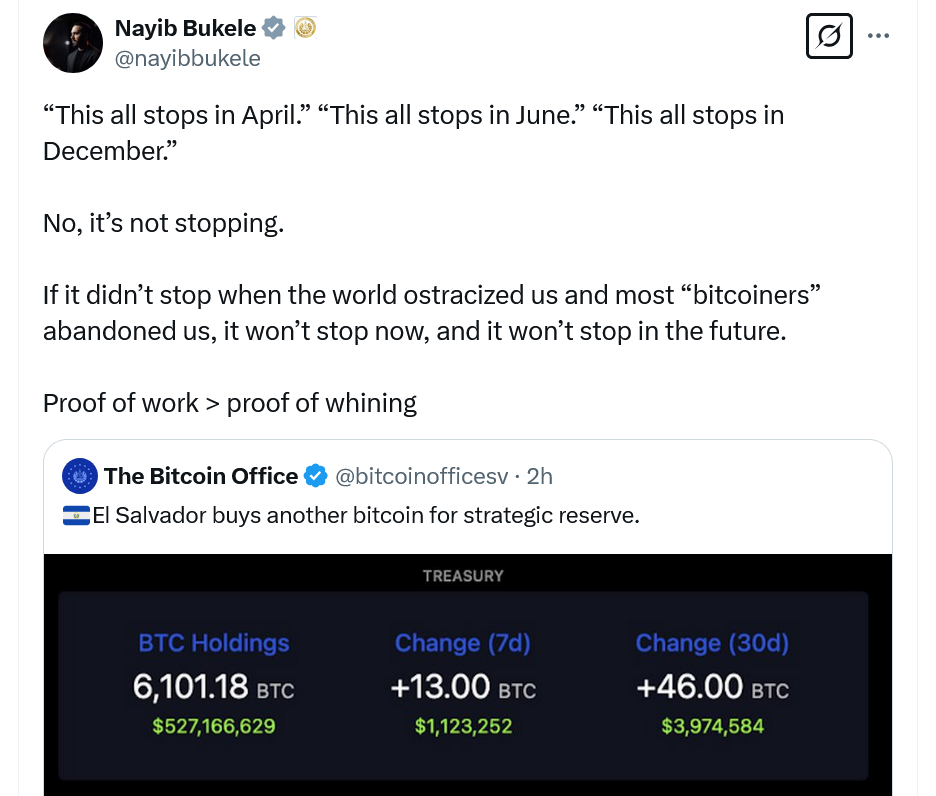
Bukele didn’t walk back his orange-pilled position entirely. In March, despite several requests from the IMF that El Salvador cease its Bitcoin purchases, El Salvador steamed ahead. Bukele wrote on X at the time:
_Source: _Nayib Bukele
Observers like John Dennehy, an El Salvador-based Bitcoin activist and educator, said this could be the government making its last accumulations before the IMF deal goes into effect. Anonymous financial commentator Unseen Finance suggested there could be “some remaining pools of funds, maybe allocated in the government in some subaccounts of different agencies, entities, maybe even some state-owned-enterprises, that had kind of been pre-allocated and set aside.”
**Related: **__How can Bukele still stack Bitcoin after IMF loan agreement?
The question of how El Salvador could continue its Bitcoin purchases despite the IMF deal would resurface several more times. In April, El Salvador bought seven BTC, but Rodrigo Valdes, director of the Western Hemisphere Department at the IMF, said that the country was still in compliance. By May, when the IMF delivered the first $120 million of its loan, it said that El Salvador must make efforts to stop purchasing Bitcoin.
El Salvador apparently didn’t hear this because just a month later, it bought 240 BTC. Anndy Lian, author and intergovernmental blockchain adviser, told Cointelegraph at the time, “The IMF’s ‘flexible interpretation’ suggests purchases may involve non-public sector entities or reclassified assets, maintaining technical compliance.” This alternative approach allowed the country to continue purchasing Bitcoin.
By November, when El Salvador bought around $100 million in Bitcoin, the IMF told Cointelegraph it was “not going to provide a running commentary on each Bitcoin-related announcement.” A spokesperson said they’d address El Salvador’s commitments “in due course.”
As of Dec. 12, El Salvador holds 6,367 BTC, according to DropsTab’s El Salvador portfolio tracker. It’s worth over $588 million and is $267 million in profit.
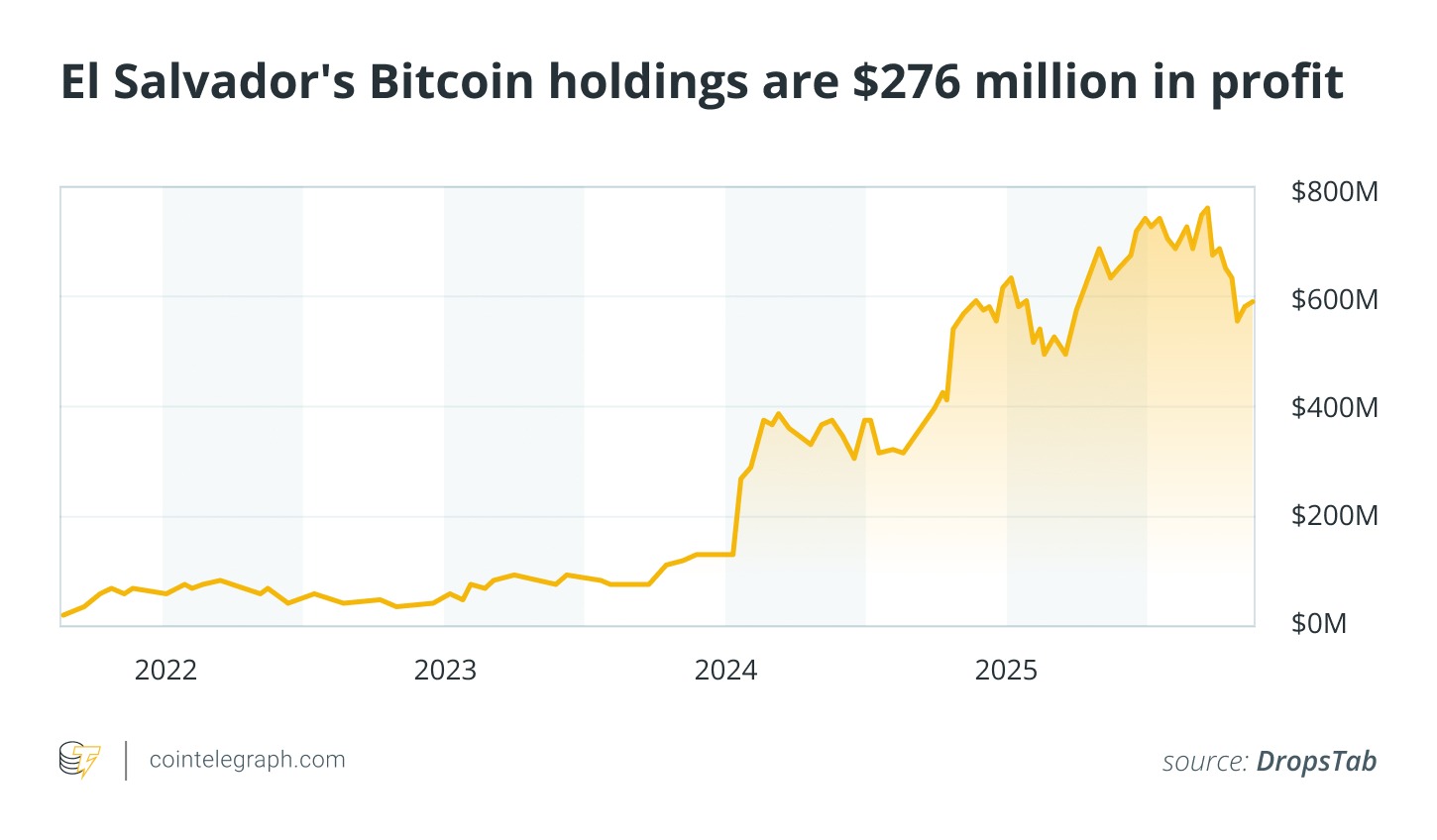
Data current as of Dec. 12, 2025.
What’s ahead for the Bitcoin business in El Salvador?
On-the-ground Bitcoin adoption may have slowed to a crawl, but some crypto businesses still find El Salvador a friendly place to do business.
In January, both Tether and Bitfinex Derivatives announced they’d be moving offices to El Salvador after securing the necessary licensing from local authorities. Tether said it chose the country for its “forward-thinking policies, favorable regulatory environment, and … growing Bitcoin-savvy community.” Bitfinex Derivatives similarly lauded the government’s pro-crypto policies in its announcement.
In August, Juan Carlos Reyes, president of El Salvador’s Commission of Digital Assets, said that investment banks that wanted to hold Bitcoin were moving to El Salvador.
He told Cointelegraph at the time, “The new Investment Banking Law allows private investment banks to operate in legal tender and foreign currencies for ‘Sophisticated Investors’ and to engage in digital assets like Bitcoin with a Digital Asset Service Provider (PSAD) license. With a PSAD license, a bank could choose to operate entirely as a Bitcoin bank.”
**Related: **__Pro-Bitcoin restaurant Steak 'n Shake announces El Salvador expansion
El Salvador has also influenced its neighbors. In July, the Central Bank of Bolivia signed a memorandum of understanding with El Salvador to accelerate crypto adoption. Bolivia’s central bank called crypto a “viable and reliable alternative” to fiat currency.
In May, Panama City Mayor Mayer Mizrachi hinted at the idea of establishing a Bitcoin reserve after meeting with Max Keiser and Stacy Herbert, two El Salvador-based Bitcoin policy leaders.
Who benefits from El Salvador buying Bitcoin?
Crypto businesses may still be attracted to El Salvador’s forward-thinking crypto policies, even after they revised the Bitcoin Law. The government may also be finding a way to have its cake and eat it, too: receiving the IMF loan and continuing to stack BTC.
Quentin Ehrenmann, general manager at My First Bitcoin — a non-governmental organization focused on Bitcoin adoption — said that continued accumulations, without education or adoption, don’t help anyone.
“Since the government entered into this contract with the IMF, Bitcoin is no longer legal tender, and we haven’t seen any other effort to educate people. The government, apparently, continues to accumulate Bitcoin, which is beneficial for the government — it’s not directly good for the people.”
Whether Bukele’s Bitcoin policy is good for the people, the government or Bitcoin adoption, it’s unlikely to change soon. Reforms to the presidential elections in 2025 have allowed Bukele to run for election indefinitely.
Opposition lawmaker Marcela Villatoro said this “brings an accumulation of power and weakens democracy … there’s corruption and clientelism because nepotism grows and halts democracy and political participation.”
In 2025, the scope of El Salvador’s Bitcoin ambitions narrowed. Part of this was due to the necessary politics of dealing with the IMF. How and at what rate actual Bitcoin adoption will continue in 2026 depends on whether they are willing to educate and foster everyday people on how to use it.
**Magazine: **__Big questions: Would Bitcoin survive a 10-year power outage?


