Stablecoins are becoming the most important liquidity vehicle in the cryptocurrency market. The latest data shows that the total market capitalization of stablecoins has risen to approximately $309 billion to $310 billion around December 24, setting a new all-time high. Compared to less than $5 billion in 2018, the current stablecoin market has achieved a leap in scale, marking a more mature stage in the crypto financial system.
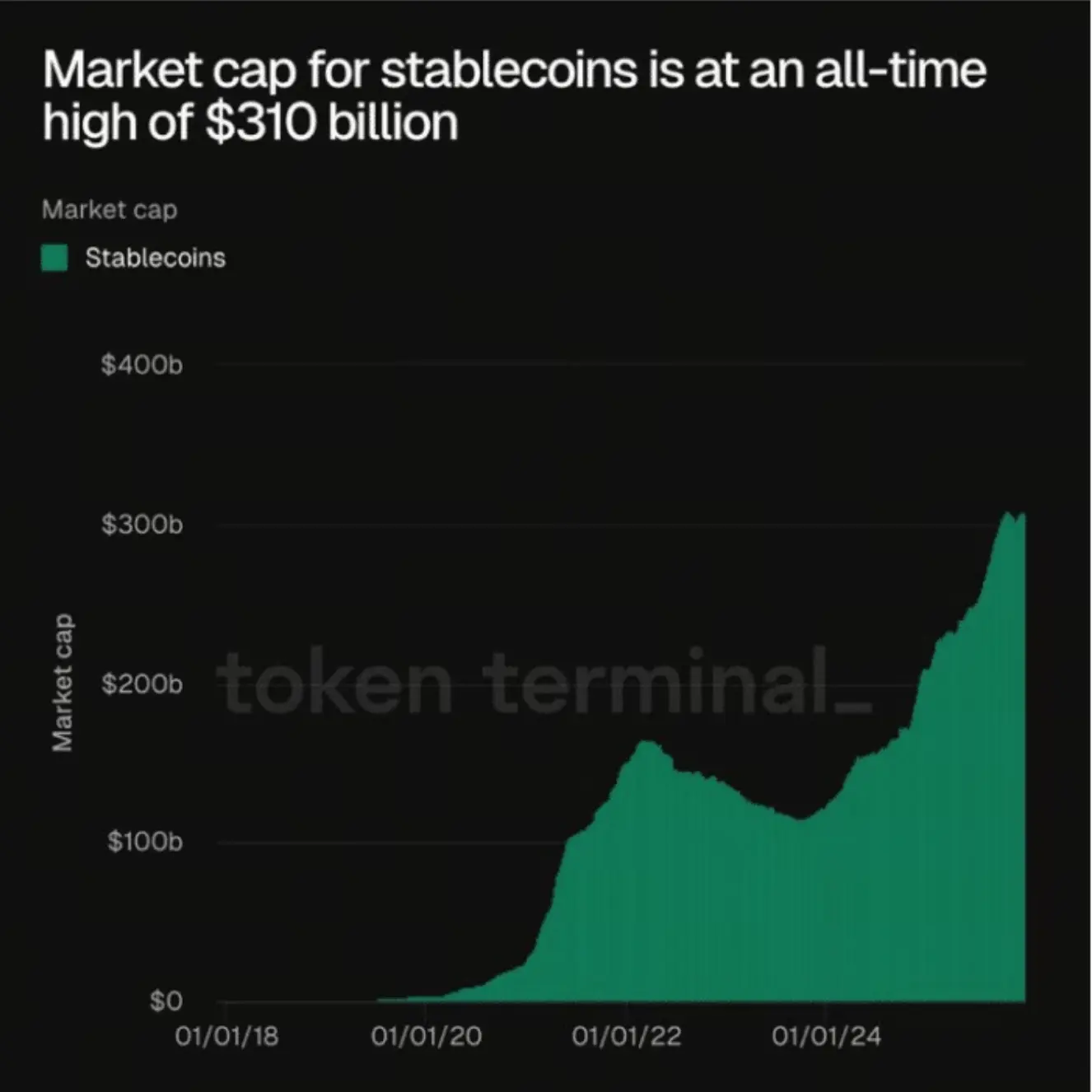
(Source: Token Terminal)
Unlike the sharp price volatility, the current crypto market exhibits characteristics of “low volatility, high liquidity.” Market participants are not rushing to chase high-risk assets but are more inclined to maintain capital flexibility and defensiveness through stablecoins. This trend indicates that investor behavior is shifting from short-term speculation to strategies that focus more on fund management and allocation efficiency.
Structurally, USDT remains the core of the stablecoin ecosystem. Data shows that the market cap of USDT has surpassed $187 billion for the first time, accounting for over 60% of the total stablecoin supply, solidifying its foundational position in centralized exchanges and the DeFi ecosystem. In terms of blockchain distribution, Ethereum remains the primary settlement layer, carrying about 54% of the stablecoin supply; Tron follows with approximately 26%, reflecting ongoing market demand for low-cost, high-frequency transfer scenarios.
It is worth noting that the expansion of stablecoin market cap has not simultaneously translated into a broad increase in risk assets. Multiple on-chain and trading data indicate that a large amount of stablecoins are still in a “pending deployment” state. This means investors are not panicking and exiting but are waiting for clearer macro signals and market directions. Liquidity is more of a “preparation phase” rather than aggressive rotation.
Meanwhile, the growth of tokenized real-world assets (RWA) further strengthens on-chain dollar demand. Token Terminal data shows that the total market cap of tokenized assets has approached $325 billion, with stablecoins holding an absolute dominant position. The tokenized US Treasuries amount to nearly $7.5 billion, also indicating that market interest in compliant, yield-oriented on-chain assets is heating up.
Looking ahead, Bitwise analysts estimate that by 2026, stablecoin supply could approach $500 billion. As stablecoins accelerate their use in emerging markets and cross-border payments, their impact on the global dollar liquidity landscape will become increasingly significant. This trend not only reinforces the infrastructure attributes of the crypto market but may also trigger more stringent macro regulatory discussions. The next phase of stablecoins may no longer be just a topic within the crypto market but a variable that the global financial system cannot ignore.
Disclaimer: The information on this page may come from third parties and does not represent the views or opinions of Gate. The content displayed on this page is for reference only and does not constitute any financial, investment, or legal advice. Gate does not guarantee the accuracy or completeness of the information and shall not be liable for any losses arising from the use of this information. Virtual asset investments carry high risks and are subject to significant price volatility. You may lose all of your invested principal. Please fully understand the relevant risks and make prudent decisions based on your own financial situation and risk tolerance. For details, please refer to
Disclaimer.
Related Articles
A Certain CEX Founder CZ Reviews Crypto Industry Development: From a 200-Person Conference to Billion-Dollar Assets
At DC Blockchain Summit 2026, CZ reviewed the evolution of the digital assets industry, emphasizing the shift from being overlooked to widespread acceptance, mentioning early conferences' small scale and Vitalik Buterin's participation, with Ethereum now becoming a multi-billion dollar asset.
GateNews2h ago
ETH 15-minute gain of 0.79%: Strengthened buying pressure and warming ETF inflows drive spot price rally
Between 2026-03-19 19:00 and 2026-03-19 19:15 (UTC), the ETH spot market recorded a +0.79% return, with prices ranging from 2125.0 to 2152.0 USDT, and volatility reaching 1.27%. During this period, market attention increased, with volatility expanding slightly, and buying pressure showed initial advantage.
The main drivers of this fluctuation were strengthened buying pressure in the spot market and improved capital inflows into ETFs. Specifically, although exchange net inflows were positive (37,644 ETH net inflow for the day), this theoretically brought certain selling pressure.
GateNews3h ago
ETH Breaks Through 2150 USDT
Gate News bot message, Gate market display shows ETH breaking through 2150 USDT, current price 2150.55 USDT.
CryptoRadar3h ago
Ethereum Continues to Recover, Analysts Discuss Whether It Can Return to $4000 in Q2
Gate News reported that on March 19, Ethereum (ETH) continues to recover following recent market volatility. Analysts are discussing whether Ethereum can climb back to the $4,000 mark in Q2 2026.
GateNews3h ago
Four Linked Wallets Acquire Over 86000 ETH Worth 187M USDT Since March
_Four linked wallets have bought 86,268 ETH for $187.31M USDT since March 10, after selling 53,799 ETH at higher prices last year._
Four connected crypto wallets bought more than 86,000 ETH since March 10. The total value of these transactions is about 187.31 million USDT.
The scale and
LiveBTCNews4h ago


