As Christmas week begins, the first answers from the global markets do not belong to the crypto market. Against the backdrop of a weakening US dollar and falling US Treasury yields, risk aversion sentiments have rapidly intensified. Gold and silver have taken the lead, continuously hitting record highs and becoming the hottest destinations for capital.
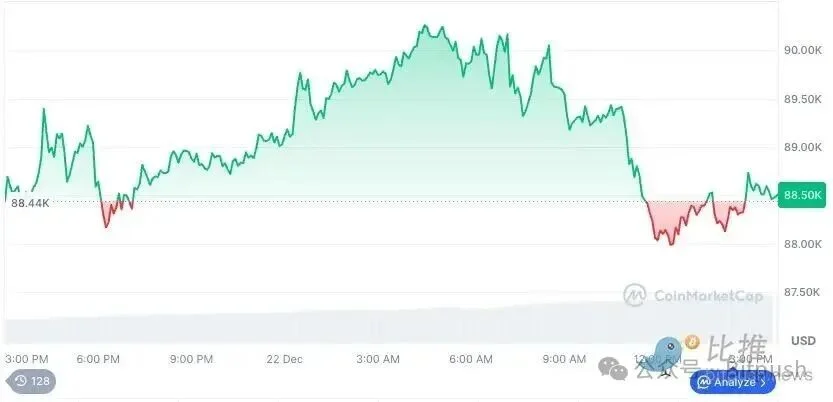
 In contrast, the crypto market appears unusually quiet. Bitcoin has not followed the macroeconomic tailwinds to surge but remains in the 88,000-89,000 USD range, lacking the offensive posture expected before the holidays.
It is precisely under this stark contrast that the question of “Will Bitcoin experience a Santa Rally?” has once again become a recurring topic of market discussion. The so-called Santa Rally is a seasonal phenomenon in traditional financial markets, referring to a period of upward movement in risk assets driven by improved sentiment and liquidity around Christmas. However, in the crypto market, this pattern has never been considered stable. Whether Bitcoin this year is “falling behind” amid rising risk aversion or quietly accumulating within a high range still requires looking back at real price behaviors and capital structures for answers.
In contrast, the crypto market appears unusually quiet. Bitcoin has not followed the macroeconomic tailwinds to surge but remains in the 88,000-89,000 USD range, lacking the offensive posture expected before the holidays.
It is precisely under this stark contrast that the question of “Will Bitcoin experience a Santa Rally?” has once again become a recurring topic of market discussion. The so-called Santa Rally is a seasonal phenomenon in traditional financial markets, referring to a period of upward movement in risk assets driven by improved sentiment and liquidity around Christmas. However, in the crypto market, this pattern has never been considered stable. Whether Bitcoin this year is “falling behind” amid rising risk aversion or quietly accumulating within a high range still requires looking back at real price behaviors and capital structures for answers.
 The macro environment is in a “waiting for validation” phase, with capital flowing out of risk assets.
Gabriel Selby, Head of Research at CF Benchmarks, pointed out that until the Federal Reserve receives consistent and clear data indicating a continued decline in inflation for several months, market participants are unlikely to significantly increase their allocation to risk assets like Bitcoin. In his view, the current macro environment remains in the “waiting for validation” stage.
This cautious sentiment is closely related to investors’ high concern over a series of upcoming US economic data releases. The Q3 GDP data will be announced soon, with the market generally expecting an annualized growth rate of about 3.5%, slightly lower than Q2’s 3.8%. Meanwhile, indicators such as consumer confidence and weekly initial jobless claims will provide more clues about the labor market. The results of these data points will directly influence market judgments on the Federal Reserve’s policy path and further affect overall risk appetite.
From other macro factors, the weakening dollar and falling US Treasury yields indeed create a theoretically favorable environment for risk assets. However, actual capital choices tell a very different story.
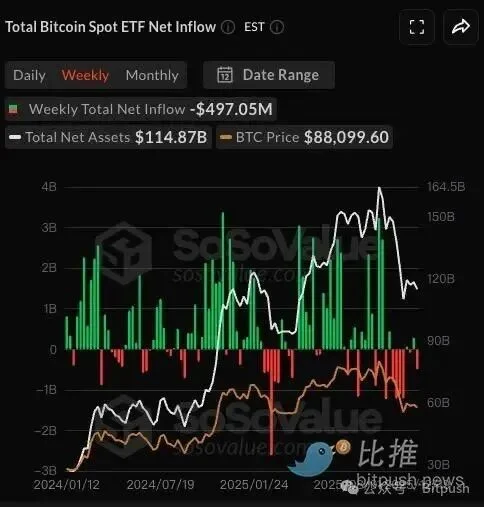
According to SoSoValue’s statistics, recent ETF activity shows clear divergence: Bitcoin ETFs experienced approximately $158.3 million in net outflows, Ethereum ETFs about $76 million; in contrast, XRP and Solana ETFs saw modest inflows of about $13 million and $4 million respectively, indicating internal market adjustments and ongoing structural shifts.
The macro environment is in a “waiting for validation” phase, with capital flowing out of risk assets.
Gabriel Selby, Head of Research at CF Benchmarks, pointed out that until the Federal Reserve receives consistent and clear data indicating a continued decline in inflation for several months, market participants are unlikely to significantly increase their allocation to risk assets like Bitcoin. In his view, the current macro environment remains in the “waiting for validation” stage.
This cautious sentiment is closely related to investors’ high concern over a series of upcoming US economic data releases. The Q3 GDP data will be announced soon, with the market generally expecting an annualized growth rate of about 3.5%, slightly lower than Q2’s 3.8%. Meanwhile, indicators such as consumer confidence and weekly initial jobless claims will provide more clues about the labor market. The results of these data points will directly influence market judgments on the Federal Reserve’s policy path and further affect overall risk appetite.
From other macro factors, the weakening dollar and falling US Treasury yields indeed create a theoretically favorable environment for risk assets. However, actual capital choices tell a very different story.
According to SoSoValue’s statistics, recent ETF activity shows clear divergence: Bitcoin ETFs experienced approximately $158.3 million in net outflows, Ethereum ETFs about $76 million; in contrast, XRP and Solana ETFs saw modest inflows of about $13 million and $4 million respectively, indicating internal market adjustments and ongoing structural shifts.
 Looking at broader digital asset investment products, CoinShares’ latest weekly fund flow report indicates that last week saw approximately $95.2 million in net outflows from digital asset investment products, marking the first net redemption after four consecutive weeks of inflows. CoinShares attributes this outflow partly to regulatory uncertainties caused by the slowing pace of the US Clarity Act, leading institutional investors to reduce risk exposure in the short term.
Technical Structure: Range-bound
From a technical perspective, Bitcoin’s current trend is not clearly bearish, but it cannot be considered strong either. The 88,000 to 89,000 USD range has become the core oscillation zone for short-term validation, with the key resistance at 93,000 to 95,000 USD that bulls must break through.
Several traders pointed out that if Bitcoin cannot effectively break this resistance zone during Christmas week, even a short-term rebound is more likely to be viewed as a technical correction rather than a trend reversal. Conversely, if prices continue to hover at high levels, it indicates the market is waiting for new drivers rather than actively choosing a direction.
The structure of derivatives markets also partly explains why Bitcoin appears particularly restrained during Christmas week. This Friday, Bitcoin will face the largest options expiration in history, with a total value of up to $24 billion. Currently, both bulls and bears are engaged in fierce battles at key levels:
Looking at broader digital asset investment products, CoinShares’ latest weekly fund flow report indicates that last week saw approximately $95.2 million in net outflows from digital asset investment products, marking the first net redemption after four consecutive weeks of inflows. CoinShares attributes this outflow partly to regulatory uncertainties caused by the slowing pace of the US Clarity Act, leading institutional investors to reduce risk exposure in the short term.
Technical Structure: Range-bound
From a technical perspective, Bitcoin’s current trend is not clearly bearish, but it cannot be considered strong either. The 88,000 to 89,000 USD range has become the core oscillation zone for short-term validation, with the key resistance at 93,000 to 95,000 USD that bulls must break through.
Several traders pointed out that if Bitcoin cannot effectively break this resistance zone during Christmas week, even a short-term rebound is more likely to be viewed as a technical correction rather than a trend reversal. Conversely, if prices continue to hover at high levels, it indicates the market is waiting for new drivers rather than actively choosing a direction.
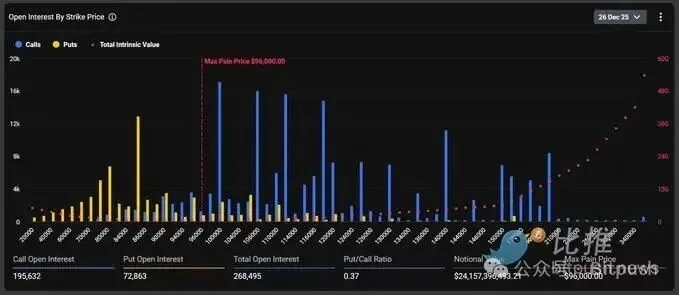
The structure of derivatives markets also partly explains why Bitcoin appears particularly restrained during Christmas week. This Friday, Bitcoin will face the largest options expiration in history, with a total value of up to $24 billion. Currently, both bulls and bears are engaged in fierce battles at key levels:
- Bulls: betting on BTC breaking through $100,000;
- Bears: defending the $85,000 level;
- Key level: $96,000 is seen as a watershed for this trend. Holding above it can sustain rebound momentum; otherwise, the market will continue to face downward pressure.
 What do analysts think?
Several market observers suggest that this year’s Christmas week is more like a “structural test” rather than a window for sentiment-driven one-sided moves.
Gabriel Selby, Head of Research at CF Benchmarks, recently stated in an interview that Bitcoin’s current price behavior does not match typical Santa Rally characteristics. In his view, genuine holiday rallies are usually accompanied by sustained buying and trend continuation, rather than oscillations within a high range. “What we’re seeing now is more like the market digesting previous gains rather than preparing for the next surge.” This judgment also aligns with the reality of persistently low trading volumes.
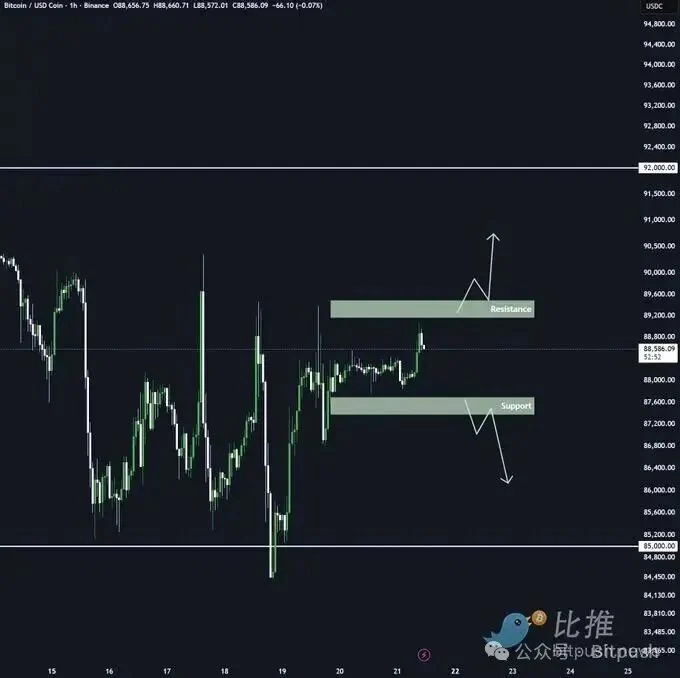
Crypto analyst DrBullZeus said that BTC continues to fluctuate between the same support and resistance levels, with no clear breakout yet. Until a significant breakout occurs, prices are likely to remain range-bound. Breaking resistance could open the way to $92,000, while falling below support might lead to a retreat toward $85,000.
What do analysts think?
Several market observers suggest that this year’s Christmas week is more like a “structural test” rather than a window for sentiment-driven one-sided moves.
Gabriel Selby, Head of Research at CF Benchmarks, recently stated in an interview that Bitcoin’s current price behavior does not match typical Santa Rally characteristics. In his view, genuine holiday rallies are usually accompanied by sustained buying and trend continuation, rather than oscillations within a high range. “What we’re seeing now is more like the market digesting previous gains rather than preparing for the next surge.” This judgment also aligns with the reality of persistently low trading volumes.
Crypto analyst DrBullZeus said that BTC continues to fluctuate between the same support and resistance levels, with no clear breakout yet. Until a significant breakout occurs, prices are likely to remain range-bound. Breaking resistance could open the way to $92,000, while falling below support might lead to a retreat toward $85,000.
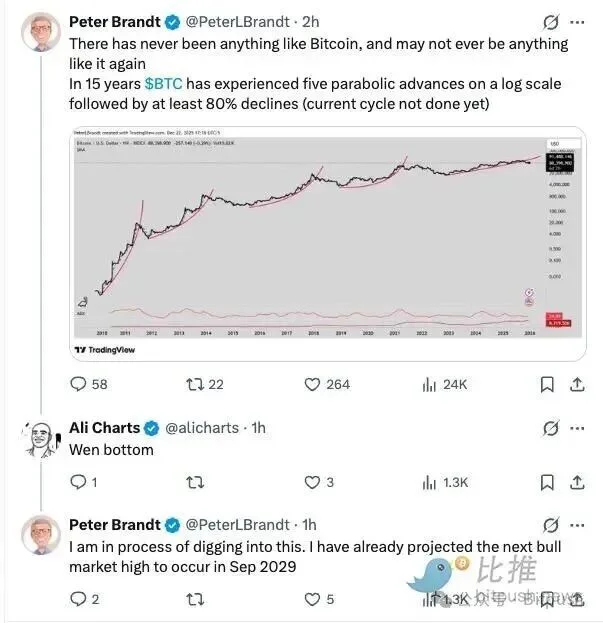
 Legendary trader Peter Brandt recently reviewed and pointed out that Bitcoin has experienced five cycles over 15 years of “parabolic growth followed by an 80% retracement,” and the current cycle’s correction has not yet bottomed out. Despite the harsh short-term规律, he predicts, through cycle analysis, that the next bull market peak will arrive in September 2029.
Brandt emphasizes that assets like BTC are inherently destined to reach new highs amid extreme shakeouts.
Legendary trader Peter Brandt recently reviewed and pointed out that Bitcoin has experienced five cycles over 15 years of “parabolic growth followed by an 80% retracement,” and the current cycle’s correction has not yet bottomed out. Despite the harsh short-term规律, he predicts, through cycle analysis, that the next bull market peak will arrive in September 2029.
Brandt emphasizes that assets like BTC are inherently destined to reach new highs amid extreme shakeouts.
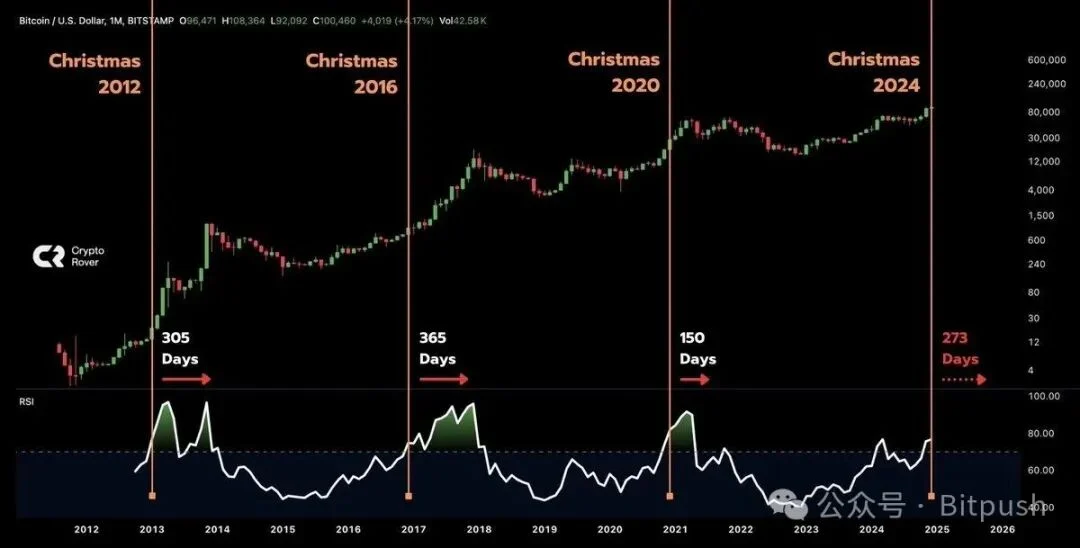
 Overall, Bitcoin’s “Santa Rally” has historically been unpredictable. Looking back, there are dazzling performances such as 33% and 46% gains during holiday periods in 2012 and 2016, but also years of flat or declining prices. Statistically, since 2011, Bitcoin has averaged about 7.9% gains during Christmas.
 However, from the current market landscape, it seems unlikely that a typical “Christmas rebound” will recur this year. The strength of gold and silver more reflects the market’s concentrated risk aversion; in contrast, Bitcoin’s relative “calm” again highlights that it is still widely regarded as a risk asset in the current global asset allocation.
Therefore, rather than simply attributing Bitcoin’s current performance to “falling behind,” it is more accurate to say it is at a critical and delicate juncture: on one hand, the lack of sufficient macro tailwinds prevents it from entering a new upward trajectory; on the other hand, there are no clear signs of breakdown or weakness.
The key factor in whether Bitcoin can break out of its independent trend at year-end is not the “Christmas” label itself, but whether market funds are willing to re-enter at current levels. Until this is clearly confirmed, narrow-range oscillation may remain the main theme of this Christmas week.
However, from the current market landscape, it seems unlikely that a typical “Christmas rebound” will recur this year. The strength of gold and silver more reflects the market’s concentrated risk aversion; in contrast, Bitcoin’s relative “calm” again highlights that it is still widely regarded as a risk asset in the current global asset allocation.
Therefore, rather than simply attributing Bitcoin’s current performance to “falling behind,” it is more accurate to say it is at a critical and delicate juncture: on one hand, the lack of sufficient macro tailwinds prevents it from entering a new upward trajectory; on the other hand, there are no clear signs of breakdown or weakness.
The key factor in whether Bitcoin can break out of its independent trend at year-end is not the “Christmas” label itself, but whether market funds are willing to re-enter at current levels. Until this is clearly confirmed, narrow-range oscillation may remain the main theme of this Christmas week.
Disclaimer: The information on this page may come from third parties and does not represent the views or opinions of Gate. The content displayed on this page is for reference only and does not constitute any financial, investment, or legal advice. Gate does not guarantee the accuracy or completeness of the information and shall not be liable for any losses arising from the use of this information. Virtual asset investments carry high risks and are subject to significant price volatility. You may lose all of your invested principal. Please fully understand the relevant risks and make prudent decisions based on your own financial situation and risk tolerance. For details, please refer to
Disclaimer.
Related Articles
Charlie Lee cảnh báo nguy cơ lượng Bitcoin của Satoshi bị tấn công lượng tử
Charlie Lee warns that Satoshi Nakamoto's estimated 1.1 million BTC could be at risk from future quantum computing attacks. He highlights vulnerabilities in early Bitcoin wallets and urges the crypto community to adopt long-term security measures.
TapChiBitcoin12m ago
Stanley Druckenmiller:稳定币或在 10-15 年内成为全球支付体系核心
亿万富翁Stanley Druckenmiller在接受采访时指出,区块链和稳定币可能将在未来10至15年内成为全球支付体系基础设施,认为其效率和成本优于传统法币支付系统。但他对加密货币作为价值储存工具持保留态度,偏好黄金。
GateNews1h ago
Bittensor (TAO) Surges Past $230 as AI Tokens Rally With Bitcoin
Key Insights
Bittensor surged above $230 after a 13 percent daily gain as Bitcoin approached $72,000, triggering a coordinated rally across AI-focused crypto assets.
AI tokens including Render, FET and Internet Computer recorded double-digit gains as traders increased exposure to
CryptoFrontNews1h ago
Strategy 公司 STRC 本周交易量创新高,推算对应约 3.9 万枚 BTC 潜在购买规模
加密分析师Ragnar指出,Strategy公司的永续优先股STRC本周创下7.45亿美元的单日交易量,预计可能对应约3.9万枚比特币的购买规模。尽管市场潜力巨大,但当前加密市场结构尚未完全转向牛市,比特币与纳斯达克100指数相关性较高,可能面临市场回调风险。
GateNews1h ago
交易所比特币储备占比降至 2017 年 11 月以来最低水平
Gate News 消息,3 月 14 日,链上分析平台 Santiment 在 X 平台发文表示,根据可追踪钱包数据,目前存放在交易所中的比特币占比已降至 2017 年 11 月以来最低水平。在过去超过八年的时间里,加密市场及全球宏观环境均发生了巨大变化,而交易所比特币储备比例持续下降,通常被市场视为长期持有倾向增强、可流通抛压减少的信号之一。
GateNews1h ago


