Author: Frank, PANews
As the narrative benefits in the crypto market gradually fade, funds are searching for the next definitive exit. Recently, prediction markets have emerged strongly, not only because of their independent performance amid turbulent conditions but also due to a series of high-return “smart money” strategies behind them, making them widely regarded as one of the most explosive tracks by 2026.
However, for most onlookers, prediction markets still appear as a black box wrapped in blockchain technology. Although built on smart contracts, oracles, and stablecoins, their core mechanisms differ significantly from traditional “speculation” logic. Here, it’s not about candlestick charts, but about probabilities; not storytelling, but facts.
For newcomers, questions abound: How exactly do these markets operate efficiently? What are the fundamental differences from traditional crypto trading? What unknown arbitrage models does the legendary “smart money” master? And, does this seemingly feverish market truly have the capacity to carry trillions of dollars?
With these questions in mind, PANews conducted a panoramic survey of the current prediction markets. We will peel back the “gambling” facade, delve into the underlying mechanisms and on-chain data, deconstruct this mathematical war of cognition monetization, and reveal overlooked risks and opportunities.
Data Truth: The Night Before the Prediction Market Explosion
From actual development, prediction markets are indeed one of the few “bullish” tracks in 2025 (similar to stablecoins). Despite the overall crypto market downturn in recent months, prediction markets led by Polymarket and Kalshi continue to grow rapidly and wildly.
This trend is clearly visible in trading volume. In September this year, Polymarket’s average daily trading volume remained between $20 million and $30 million, with Kalshi similar. After the entire crypto market started declining in mid-October, the trading volumes of these two leading prediction platforms surged. On October 11, Polymarket’s daily volume hit $94 million, and Kalshi exceeded $200 million. The increase was roughly 3 to 7 times, and they remain at high levels with soaring growth.
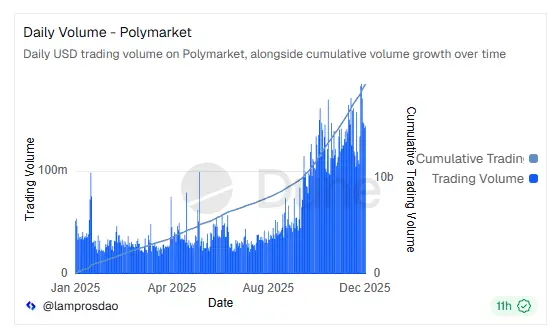
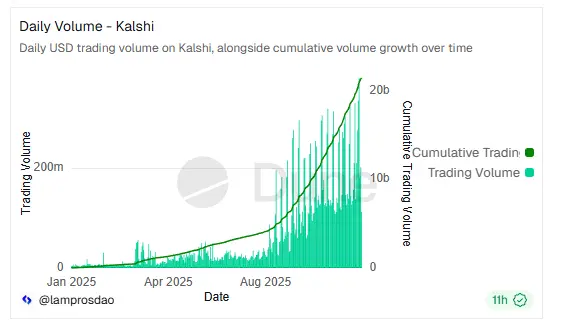
However, in terms of scale, prediction markets are still in an early stage. The combined total trading volume of Polymarket and Kalshi is only about $38.5 billion. This total is smaller than Binance’s daily trading volume, and an average daily volume of $200 million ranks only around 50th among all exchanges.
Nevertheless, with the 2026 FIFA World Cup approaching, the market generally expects the prediction market’s size to further expand. Citizens Financial Group predicts that by 2030, the overall scale could reach trillions of dollars. Eilers & Krejcik ( forecast that by the end of this decade (around 2030), annual trading volume could reach $1 trillion. Based on this scale, there is still dozens of times growth potential, and several institutional reports also mention that the 2026 World Cup will serve as a catalyst and stress test for this market’s growth.
) Deconstructing Smart Money: Analyzing Eleven Arbitrage Strategies
In this context, the most attractive recent surge in prediction markets still revolves around the timeless “wealth stories.” After seeing these stories, many people’s first instinct is to copy or follow. However, exploring the core principles, implementation conditions, and underlying risks of these strategies may be a more reliable approach. PANews summarizes ten popular prediction market strategies currently discussed in the market.
1. Pure Mathematical Arbitrage
Logic: Exploit the imbalance where Yes + No probabilities are less than 1. For example, if the Yes probability on Polymarket is 55%, and the No probability on Kalshi is 40%, the total is 95%. Placing opposite bets on Yes and No on both sides costs 0.95, but regardless of the outcome, you will receive 1, creating a 5% arbitrage opportunity.
Conditions: Requires strong technical skills to quickly identify such opportunities, as only a few can do so efficiently.
Risks: Different platforms may have varying criteria for event resolution. Ignoring these can lead to double losses. For instance, @linwanwan823 pointed out during the US government shutdown in 2024, arbitrageurs found that Polymarket settled on “shutdown occurred” (YES), while Kalshi settled on “shutdown did not occur” (NO). The reason was Polymarket’s settlement standard was “OPM issued shutdown notice,” whereas Kalshi required “actual shutdown exceeding 24 hours.”
2. Cross-Platform/Cross-Chain Hedging Arbitrage
Logic: Exploit pricing discrepancies for the same event across different platforms (information islands). For example, Polymarket and Kalshi might have different odds for “Trump winning.” For instance, one side at 40%, the other at 55%. You buy different positions on both sides to hedge.
Conditions: Similar to the first, requiring advanced technical tools to scan and detect.
Risks: Same as above, watch out for different event resolution criteria across platforms.
3. High-Probability “Bond” Strategy
Logic: Treat highly certain events as “short-term bonds.” When an event’s outcome is clear (e.g., before the Federal Reserve rate decision, market consensus is 99%), but prediction market prices stay at 0.95 or 0.96 due to capital costs, it’s a “time interest” arbitrage.
Conditions: Large capital size is necessary, as low yields per trade require bigger funds for meaningful profit.
Risks: Black swan events. If a rare reversal occurs, losses can be substantial.
4. Initial Liquidity Sniping
Logic: Exploit the “vacuum period” when a new market is created and has no sell orders. The first person to place an order has absolute pricing power. Use scripts to monitor on-chain events. At market open, place many very low-priced buy orders (e.g., $0.01–$0.05). After liquidity normalizes, sell at higher prices, often $0.5 or more.
Conditions: Due to competition, servers should be hosted close to nodes to reduce latency.
Risks: Similar to meme coin launch sniping—if your speed advantage isn’t enough, you may end up buying at the top.
5. AI Probability Modeling Trading
Logic: Use AI large models to analyze market depth and find conclusions different from the market. When arbitrage opportunities exist, buy accordingly. For example, AI analysis shows the true probability of “Real Madrid winning” is 70%, but the market price is only 0.5, so you buy.
Conditions: Complex data analysis tools and machine learning models; AI computing costs are high.
Risks: AI prediction errors or unexpected events can lead to losses.
6. AI Information Edge Model
Logic: Leverage “machine reading speed > human reading speed” time advantage. Obtain faster information than ordinary users and buy before market moves.
Conditions: Expensive information sources, possibly requiring paid institutional APIs and precise AI recognition algorithms.
Risks: Fake news attacks or AI hallucinations.
7. Causal Market Arbitrage
Logic: Exploit lag in causal chains between related events. The main event’s price changes instantly, but secondary related events respond with delay. For example, “Trump wins the election” vs. “Republicans win the Senate.”
Conditions: Deep understanding of political or economic logical links, and monitoring hundreds of markets for price correlations.
Risks: Failure of event correlation, e.g., Messi missing a match not necessarily correlating with team losing.
8. Automated Market Making and Incentives
Logic: Act as “the seller of shovels.” Do not bet on direction, only provide liquidity, earning spreads and platform rewards.
Conditions: Professional market-making strategies and substantial capital.
Risks: Trading fees, black swan events.
9. On-Chain Copy Trading and Whale Tracking
Logic: Trust “smart money” with insider info. Monitor high-success addresses; when whales make large positions, bots follow immediately.
Conditions: On-chain analysis tools, data cleaning to exclude test or hedge orders, and rapid response capability.
Risks: Whales’ reverse harvesting and hedging intentions.
10. Exclusive Research “Information Arbitrage”
Logic: Possess “private information” unknown to the market. For example, during the 2024 US election, trader Théo in France used “neighbor effect” to identify “hidden voters” and took contrarian positions when odds were bearish.
Conditions: Exclusive research plans and high costs.
Risks: Research errors leading to wrong “insider info,” resulting in heavy losses in the wrong direction.
11. Oracle Manipulation
Logic: About who is the referee. Due to the complexity of events in prediction markets, their resolution cannot be simply decided by algorithms. External oracles are needed. Currently, Polymarket uses UMA’s Optimistic Oracle. After each event, a human submits a ruling to the UMA protocol. If within 2 hours, the voting exceeds 98%, the result is accepted. Disputed results require further community voting. However, this mechanism has vulnerabilities and manipulation risks. For example, in July 2025, “Did Zelensky wear a suit before July?” Although multiple media reported Zelensky wore suits, four large token holders voted over 40% to declare “NO,” causing about $2 million in losses for betting opponents. Similar manipulations occurred in events like “Did Ukraine sign a rare earth mineral agreement with the US” or “Did Trump’s government declassify UFO files in 2025.” Many users believe relying on a token worth less than $100 million (UMA) to arbitrate such markets is unreliable.
Conditions: Large UMA holdings or controversial resolution conditions.
Risks: Oracle upgrades aim to close such loopholes. In August 2025, MOOV2 (Managed Optimistic Oracle V2) was introduced, restricting proposals to a whitelist and reducing spam/malicious proposals.
Overall, these strategies can be categorized into technical players, capital players, and professional players. Regardless of type, they rely on asymmetric advantages to build profit models. However, such strategies may only be effective during the early, immature stage of this market (similar to early crypto arbitrage). As secrets are exposed and the market matures, most arbitrage opportunities will diminish.
Why Prediction Markets Can Become the “Cure” of the Information Age
Behind market growth and institutional optimism, what kind of magic do prediction markets hold? The mainstream view is that prediction markets solve a core pain point: in an era of information explosion and fake news, the cost of truth is rising.
There are three main reasons behind this perspective:
-
“Real money” voting is more reliable than surveys. Traditional market research or expert predictions often lack actual costs, and the authority to make predictions is concentrated in certain influential individuals or institutions. This results in many predictions lacking confidence. Prediction markets, however, aggregate the results of multiple investors’ monetary bets, creating a form of collective intelligence. Money voting also adds weight to predictions. From this angle, prediction markets address the societal “truth problem,” which itself has value.
-
Convert personal expertise or information advantage into money. This is well exemplified by top “smart money” addresses in prediction markets. Although their strategies vary widely, their success often hinges on possessing specialized knowledge or information advantage. For example, some may have deep understanding of a sports event, giving them an edge in predicting various factors. Others use technical means to verify event outcomes faster than others, enabling arbitrage in the final stages. Compared to traditional finance and crypto markets, capital is no longer the biggest advantage; technology and capability are. This attracts many talented individuals to prediction markets, and successful cases garner more attention.
-
The simple binary options logic, with lower entry barriers than speculation. Essentially, prediction markets are binary options—betting on “YES” or “NO.” The trading threshold is lower, with less need to consider price directions, trends, or complex technical indicators. The underlying assets are usually straightforward and easy to understand. For example, “Which team will win?” rather than “What is the technical principle of this zero-knowledge proof project?” This broad accessibility likely results in a user base much larger than that of crypto markets.
Of course, prediction markets also have drawbacks, such as short cycle durations, low liquidity in niche markets, insider and manipulation risks, and regulatory issues. The most important reason is that, at this stage, prediction markets seem to be filling the “narrative vacuum” in the boring crypto space.
The essence of prediction markets is a pricing revolution about “the future.” It stitches together countless individual fragments of cognition into a puzzle closest to reality through monetary bets.
For spectators, it’s the “truth machine” of the information age. For participants, it’s an ongoing, smoke-free mathematical war. As 2026 approaches, this trillion-dollar track is just beginning to unfold. Regardless of how algorithms evolve or strategies iterate, the most fundamental truth of prediction markets remains unchanged: there are no free lunches, only the ultimate reward for cognition monetization.


