Against the backdrop of a weakening US dollar and rising expectations of Federal Reserve rate cuts, the market is beginning to reassess the medium- to long-term prospects of Bitcoin and cryptocurrencies. Analysts generally believe that 2026 could become a pivotal turning point for the digital asset market.
(Background summary: Investment bank Cantor Fitzgerald: Bitcoin entering a “crypto winter” may continue to face pressure, but institutional players are lighting the way for industry transformation)
(Additional context: Bloomberg strategist Mike McGlone warns: Bitcoin may first drop to $50,000 next year before ultimately crashing to $10,000)
Table of Contents
- Bitcoin enters consolidation, unable to keep pace with precious metals rally
- US dollar experiences largest annual decline in years, rate cuts become market consensus
- Divergence within Federal Reserve, interest rate policy remains uncertain
- Rising political uncertainty, US dollar dominance under scrutiny
- Analysts: Loose monetary environment benefits crypto assets
After experiencing a turbulent and underperforming year, Bitcoin and the overall cryptocurrency market are standing at a new crossroads. According to Forbes, as market expectations for future Fed rate cuts heat up and signs of a weakening dollar emerge, many analysts believe these macro factors could bring a new wave of upward momentum for Bitcoin in 2026.
Bitcoin enters consolidation, unable to keep pace with precious metals rally
Recently, gold and silver prices have continued to rise, but Bitcoin’s performance has been relatively weak, with prices lingering around $90,000 for a long period without a clear breakout. The market generally interprets this as investors still observing the Fed’s policy direction and whether global liquidity conditions are about to undergo a substantial change.
US dollar experiences largest annual decline in years, rate cuts become market consensus
Analysis indicates that the dollar has fallen nearly 10% against a basket of major currencies this year, marking the most dramatic annual decline since 2017. The market believes this trend is closely related to expectations of future rate cuts by the Fed.
In this regard, ING Chief International Economist James Knightley states that compared to other major central banks, the Fed still maintains a relatively dovish stance and remains in a “loose monetary policy” mode. Against this backdrop, the potential for further dollar weakening has become a key focus for investors.
Divergence within Federal Reserve, interest rate policy remains uncertain
The latest Federal Reserve meeting minutes show that even though officials have decided to cut rates, there are still clear disagreements within the Fed about whether to continue adjusting interest rates afterward. Some policymakers believe that after this (December) adjustment, rates may need to remain unchanged for a period to observe economic data.
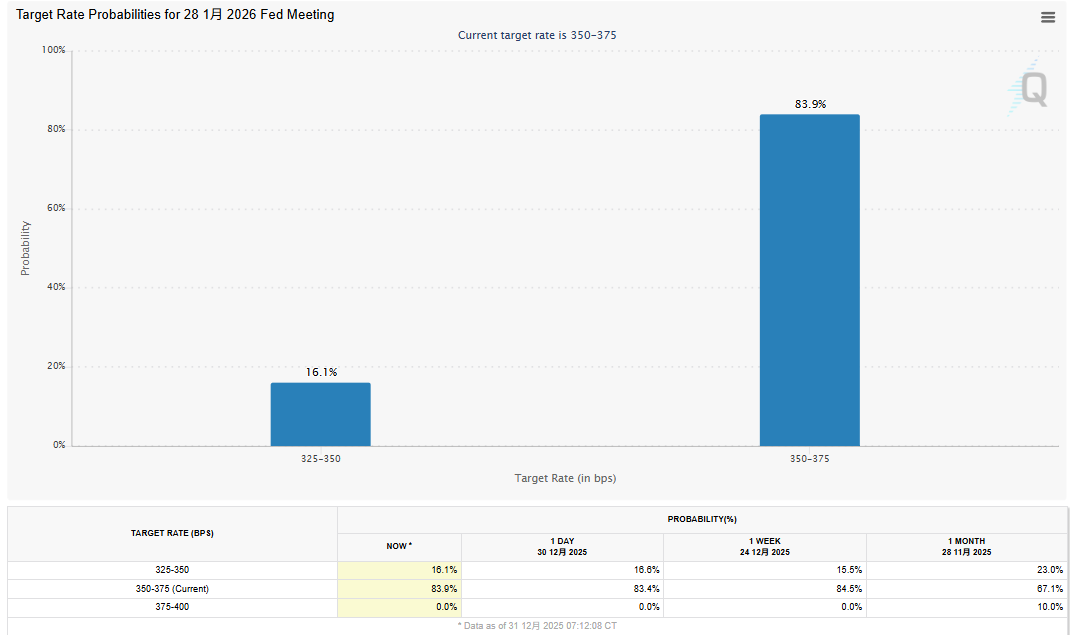
Meanwhile, according to CME FedWatch tool, investors currently assign over an 80% probability that the Fed will hold steady at the January meeting, but other prediction platforms suggest the possibility of another rate cut before mid-2026 remains high.
Rising political uncertainty, US dollar dominance under scrutiny
In addition to monetary policy itself, US political factors have also become variables in the market. Recently, US President Trump has again pressured the Fed, sparking discussions about the independence of the central bank and its policy direction.
Former US Treasury official and think tank OMFIF President Mark Sobel pointed out that the influence of political factors on the dollar’s international status may be a long-term and slow process, but it is enough to exert pressure on market psychology.
Analysts: Loose monetary environment benefits crypto assets
Several cryptocurrency market participants believe that once the Fed officially enters a rate-cutting cycle, lower funding costs will benefit risk assets, with Bitcoin often seen as a primary beneficiary.
Timot Lamarre, Head of Market Research at crypto custody firm Unchained, stated that a shift to dovish monetary policy means more ample dollar liquidity in the market, and Bitcoin typically reacts first in such an environment.
Owen Lau, Managing Director of Clear Street, also pointed out that rate cuts could become a significant catalyst for the crypto market in 2026, potentially attracting retail investors back and increasing institutional participation in crypto assets.

Disclaimer: The information on this page may come from third parties and does not represent the views or opinions of Gate. The content displayed on this page is for reference only and does not constitute any financial, investment, or legal advice. Gate does not guarantee the accuracy or completeness of the information and shall not be liable for any losses arising from the use of this information. Virtual asset investments carry high risks and are subject to significant price volatility. You may lose all of your invested principal. Please fully understand the relevant risks and make prudent decisions based on your own financial situation and risk tolerance. For details, please refer to
Disclaimer.
Related Articles
Bitcoin ETFs will surpass Gold ETFs in scale, according to James Seyffart
James Seyffart predicts that Bitcoin spot ETFs may surpass gold ETFs in assets under management as investor demand evolves. Bitcoin is seen as a versatile investment option, while gold remains traditional. Despite recent declines, both asset classes have seen significant fund flow activity.
TapChiBitcoin9m ago
Bitcoin ETFs 'will be larger' than gold ETFs: Analyst
Spot Bitcoin exchange-traded funds (ETFs) could surpass gold ETFs in total assets under management (AUM) as investor demand expands beyond the traditional “digital gold” narrative, according to ETF analyst James Seyffart.
“There are just more use cases of why somebody would put a Bitcoin ETF in a p
Cointelegraph26m ago
Fidelity Investments: Bitcoin testing long-term support—are bullish divergences signaling a potential base being formed?
Fidelity Investments’ chief macroeconomic officer, Jurrien Timmer, analyzes Bitcoin’s price action and believes it is finding support in the $65k to $70k range, showing strong technical signals. Bitcoin is currently at relatively low levels versus the power-law support line and the Golden Ratio Z-score, which could be setting up a bullish divergence. If it can hold steady, the market may correct and rebound, but investors need to watch out for inflation and liquidity risks.
ChainNewsAbmedia1h ago
XRP Faces Selling Pressure While Key Support Near $1.28 Holds
Key Insights:
XRP continues forming lower highs and lows, while price remains below major moving averages, reinforcing a sustained bearish structure across timeframes.
Open interest spikes during volatility signaled speculative trading, yet declining levels now reflect reduced risk
CryptoNewsLand8h ago
Cardano Price Near $0.245 Level as Market Momentum Weakens
Cardano's price is stabilizing around the $0.245 support level amid market consolidation and declining momentum. The inability to break resistance at $0.268 raises concerns about upward strength. Meanwhile, development of the new node version 10.7.0 is in testing, promising enhancements for the ecosystem.
CryptoNewsLand8h ago
Dogecoin Holds Near $0.09 as April Pattern Shapes Outlook
Key Insights
Dogecoin maintains stability above the $0.09 support, with buyers defending the level despite consistent selling pressure that limits strong upward momentum in early April trading sessions.
April performance remains historically mixed, with past rallies and declines shaping
CryptoNewsLand8h ago


