Against the backdrop of a weakening US dollar and rising expectations of Fed rate cuts, the market is beginning to reassess the medium- to long-term prospects of Bitcoin and cryptocurrencies. Analysts generally believe that 2026 could become a pivotal turning point for the digital asset market.
(Background briefing: Investment bank Cantor Fitzgerald: Bitcoin entering a “crypto winter” may continue to face pressure, but institutional interest is lighting the way for industry transformation)
(Additional context: Bloomberg strategist Mike McGlone warns: Bitcoin may first drop to $50,000 next year before crashing to $10,000)
Table of Contents
- Bitcoin enters consolidation, unable to keep pace with precious metals rally
- US dollar experiences largest annual decline in years, rate cuts become market consensus
- Divergence within Fed officials, interest rate policy remains uncertain
- Rising political uncertainty, US dollar dominance under scrutiny
- Analysts: Loose monetary environment benefits crypto assets
After experiencing a turbulent and underperforming year, Bitcoin and the overall cryptocurrency market are standing at a new crossroads. According to Forbes, as market expectations for future Fed rate cuts heat up and signs of a weakening dollar emerge, many analysts believe these macro factors could spark a new wave of upward momentum for Bitcoin in 2026.
Bitcoin enters consolidation, unable to keep pace with precious metals rally
Recently, gold and silver prices have continued to rise, but Bitcoin’s performance has been relatively weak, with prices lingering around $90,000 for a long time without a clear breakout. The market generally interprets this as investors still observing the Fed’s policy direction and whether global liquidity conditions are about to undergo a substantial change.
US dollar experiences largest annual decline in years, rate cuts become market consensus
Analysis indicates that the dollar has fallen nearly 10% against a basket of major currencies this year, marking the most dramatic annual decline since 2017. The market believes this trend is closely related to expectations of possible future rate cuts by the Fed.
In this regard, ING Chief International Economist James Knightley states that compared to other major central banks, the Fed remains relatively dovish in its policy stance, still operating in a “loose monetary mode.” Under this context, the potential for further dollar weakening has become a key focus for investors.
Divergence within Fed officials, interest rate policy remains uncertain
The latest Fed meeting minutes show that even though officials have decided to cut rates, there are clear disagreements within the Fed regarding whether to continue adjusting interest rates in the future. Some policymakers believe that after this (December) adjustment, rates may need to remain unchanged for a period to observe economic data changes.
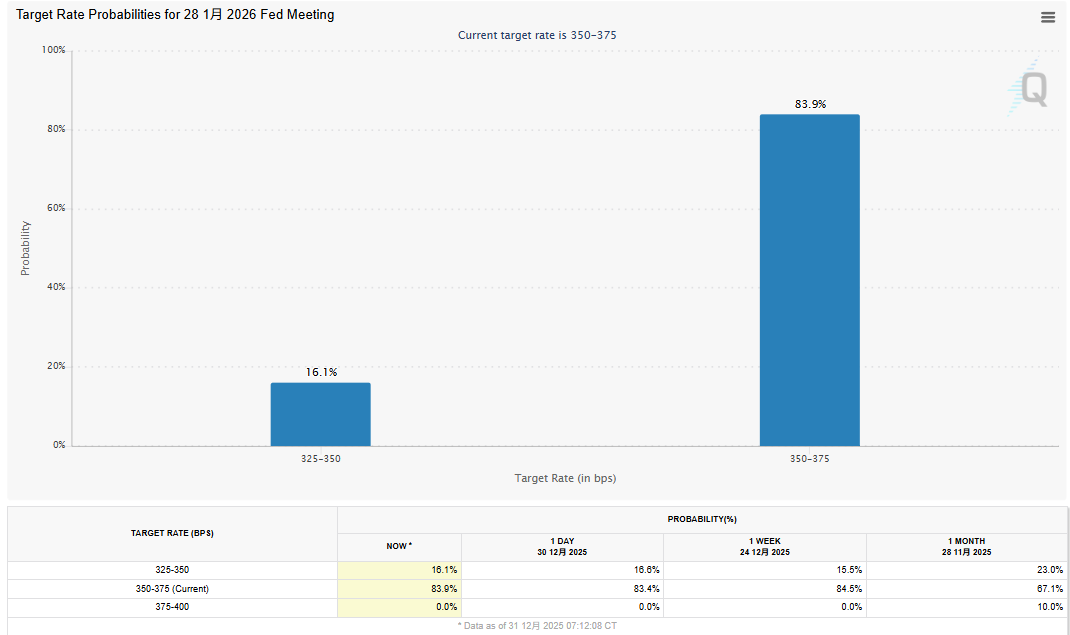
Meanwhile, according to CME FedWatch tool, investors currently assign over an 80% probability that the Fed will hold steady at the January meeting, but other prediction platforms suggest the possibility of another rate cut before mid-2026 remains high.
Rising political uncertainty, US dollar dominance under scrutiny
In addition to monetary policy itself, US political factors have also become a market variable. Recently, US President Trump has again pressured the Fed, sparking discussions about the independence of the central bank and its policy direction.
Former US Treasury official and think tank OMFIF US Chairman Mark Sobel pointed out that the influence of political factors on the dollar’s international status may be a long-term and slow process, but it is enough to exert pressure on market psychology.
Analysts: Loose monetary environment benefits crypto assets
Several crypto market participants believe that once the Fed officially enters a rate-cutting cycle, lower funding costs will benefit risk assets, with Bitcoin often seen as a primary beneficiary.
Timot Lamarre, Head of Market Research at crypto custody firm Unchained, stated that a shift to dovish monetary policy means more ample dollar liquidity in the market, and Bitcoin typically reacts first in such an environment.
Owen Lau, Managing Director of Clear Street, also pointed out that rate cuts could become a significant catalyst for the crypto market in 2026, potentially attracting retail inflows and increasing institutional participation in crypto assets.

Disclaimer: The information on this page may come from third parties and does not represent the views or opinions of Gate. The content displayed on this page is for reference only and does not constitute any financial, investment, or legal advice. Gate does not guarantee the accuracy or completeness of the information and shall not be liable for any losses arising from the use of this information. Virtual asset investments carry high risks and are subject to significant price volatility. You may lose all of your invested principal. Please fully understand the relevant risks and make prudent decisions based on your own financial situation and risk tolerance. For details, please refer to
Disclaimer.
Related Articles
Dogecoin Price Jumps as Derivatives Demand Signals Breakout
Key Insights
Dogecoin surged to a weekly high of $0.103 as improving market sentiment and strong derivatives demand encouraged traders to position for further gains.
Futures data from CoinGlass showed a positive funding rate, indicating long traders are paying premiums while positioning for
CryptoFrontNews39m ago
Hidden "Death Spiral" Risk! Ethereum and Bitmine targeted by short-selling institutions
Ethereum is about to undergo a major upgrade, and the market is highly focused on it. However, short-selling firm Culper Research believes that the Ethereum economic model is failing and warns of a potential "death spiral." They point out that a significant drop in transaction fees and shrinking staking rewards will impact network security. The report also mentions Vitalik Buterin selling Ethereum and questions the market fundamentals, suggesting that Ethereum is facing a new reality.
区块客1h ago
Retail investors are not trading cryptocurrencies but stocks? Cryptocurrency market liquidity is moving to the US stock market, AI helps interpret financial reports and boosts confidence
Wintermute's research indicates that retail cryptocurrency funds are flowing heavily into the US stock market, reversing the correlation to become negatively correlated. As liquidity in the crypto market declines, retail investors prefer mature stock markets, aided by generative AI enhancing their investment capabilities. Cryptocurrencies are gradually becoming part of asset allocation.
CryptoCity3h ago
ETH drops 1.36% in 15 minutes: Deteriorating macro sentiment and liquidity crunch trigger spot selling pressure
From 02:45 to 03:00 on March 8, 2026 (UTC), ETH prices fluctuated sharply within the range of 1,936.0 to 1,969.18 USDT. The 15-minute candlestick yield was -1.36%, with an amplitude of 1.68%. The short-term downtrend intensified, market attention significantly increased, trading activity was high, and panic sentiment dominated.
The main driver of this anomaly was the widespread decline in global risk assets and escalating extreme panic sentiment. Major US stock indices experienced a sharp pullback, and the VIX fear index soared to 29.49 (+24.17%), leading to
GateNews5h ago


