Zama officially launched its mainnet on Ethereum, marking a major breakthrough for blockchain privacy. The launch enabled the first fully confidential stablecoin transaction on Ethereum Layer 1 using encrypted USDT (cUSDT), completed at a gas cost of just $0.13.
The milestone demonstrates that confidential transactions on public blockchains are now practical, affordable, and production-ready, potentially removing one of the largest barriers to institutional adoption of onchain finance.

(Sources: Zama Website)
Zama and the FHE Breakthrough Powering Confidential Onchain Finance
At the core of Zama is Fully Homomorphic Encryption (FHE), widely regarded as the “holy grail” of cryptography. Unlike traditional encryption schemes that require data to be decrypted before computation, FHE allows computations to be performed directly on encrypted data.
This means that with Zama, onchain data remains encrypted at all times—including during execution—without sacrificing correctness or verifiability.
(Sources: Zama Website)
Through FHE, Zama enables:
- End-to-end confidentiality for balances and transaction amounts
- Selective disclosure for compliance and regulatory oversight
- Native execution on Ethereum without relying on privacy sidechains or mixers
The successful cUSDT transfer on mainnet confirms that Zama’s FHE stack is no longer theoretical—it is operating under real-world conditions on Ethereum L1.
Solving Blockchain’s Transparency Problem Without Breaking Compliance
Public blockchains are transparent by design, a feature that supports auditability but discourages institutional participation. Trading strategies, treasury balances, payroll flows, and governance decisions are fully visible, exposing users to front-running, competitive intelligence risks, and regulatory uncertainty.
Zama addresses this paradox by introducing compliant confidentiality.
Unlike privacy mixers that obscure fund origins and have drawn regulatory backlash, Zama allows developers to define explicit access controls. Authorized entities—such as auditors or regulators—can decrypt specific data points without exposing full transaction histories.
This makes Zama uniquely suited for regulated finance, bridging the gap between public blockchains and institutional requirements.
How the Zama Protocol Works Across L1 and L2
The Zama Protocol is designed to enable confidentiality on any Layer 1 or Layer 2 blockchain, starting with Ethereum.
Its architecture includes:
- fhEVM Executor: Emits encrypted state changes while keeping Ethereum execution lightweight
- FHE Coprocessors: Off-chain networks that handle heavy encrypted computation and return encrypted results
- Key Management Service (KMS): MPC-based key distribution eliminating single points of trust
- Solidity-level Access Control: Developers define who can decrypt what, and when
By offloading FHE computation from the base chain, Zama keeps gas costs low while maintaining public verifiability, a critical requirement for decentralized systems.
Performance: Privacy at Ethereum Speed—and Beyond
The inaugural mainnet transaction cost $0.13, underscoring Zama’s focus on affordability alongside privacy.
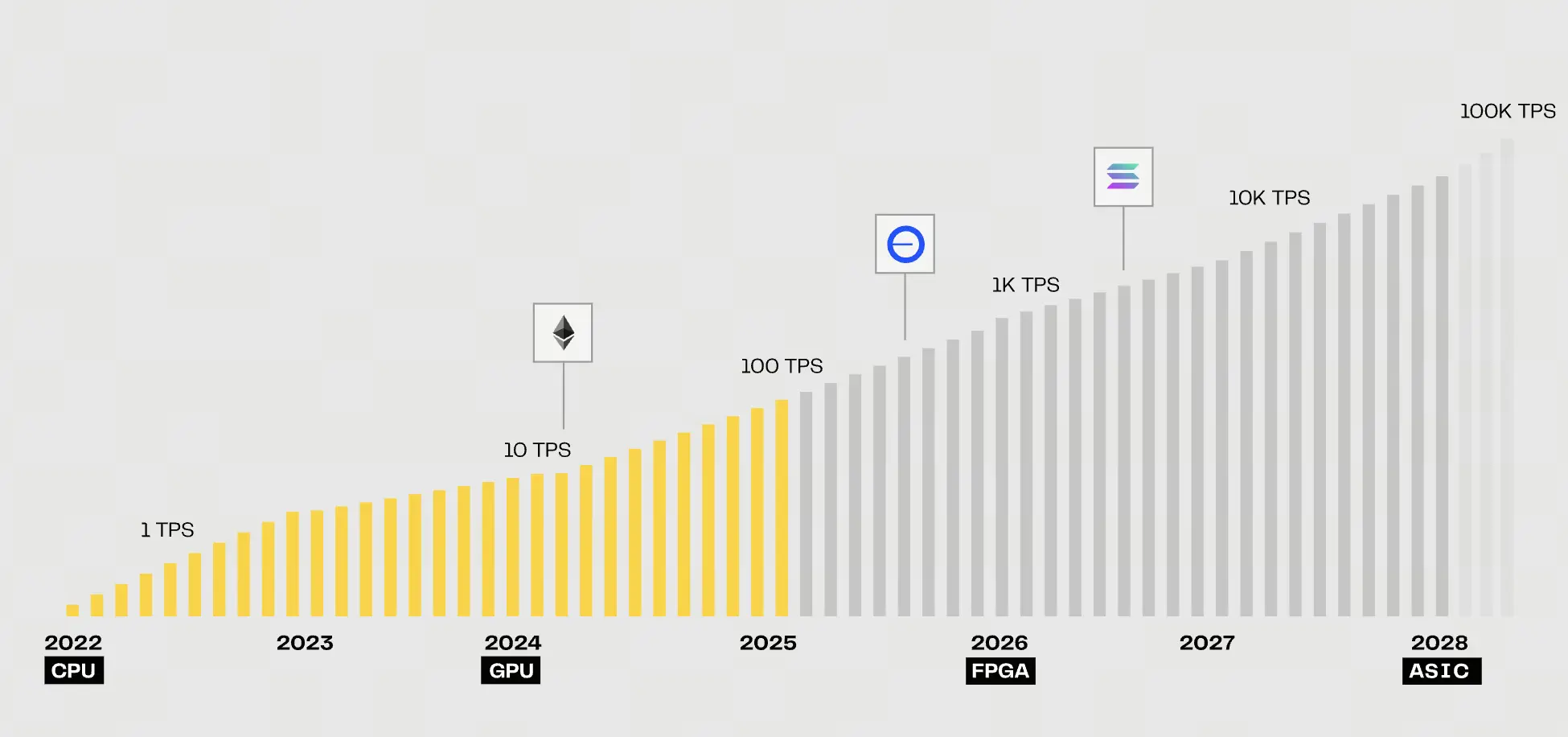
Currently, Zama can already process approximately 20 transactions per second per chain—fast enough to support Ethereum-scale activity under encrypted execution.
According to the roadmap:
- GPU acceleration is expected to push throughput beyond 100 TPS
- FPGA optimization targets 500–1,000 TPS in the near term
- Dedicated FHE ASICs are projected to unlock 10,000+ TPS long term
Zama is partnering with multiple hardware companies to develop these ASICs, positioning itself as the fastest FHE protocol currently available.
Use Cases: Where Zama Brings Confidentiality Onchain
Zama’s design supports a wide range of onchain applications where privacy is essential:
- DeFi: Confidential swaps, lending, and yield strategies
- Payments: Stablecoin transfers with encrypted amounts
- Banking: Self-custodial onchain banking with full confidentiality
- Tokens: Private token launches, vesting schedules, airdrops, and governance
- RWA Tokenization: Confidential and compliant real-world asset issuance
- Sealed-bid Auctions: Fair auctions that eliminate front-running
Early ecosystem projects building on Zama include Zaiffer, TokenOps, Bron Wallet, and Raycash.
Notably, Zama’s own token auction in January 2026 uses FHE-based sealed bids, keeping all bids private until the final clearing price is determined.
How Zama Compares to Other Privacy Technologies
Compared with existing privacy approaches:
- Zero-knowledge proofs verify statements but lack general encrypted computation
- MPC distributes trust but does not natively preserve encrypted state
- Privacy-first chains fragment liquidity by creating new ecosystems
- Mixers obscure flows but face regulatory pressure
Zama combines FHE, MPC, and programmable access control, offering confidentiality without sacrificing composability, liquidity, or compliance.
Risks and Open Questions
Despite the milestone, challenges remain:
- FHE is computationally heavier than plaintext execution
- Coprocessor decentralization must continue improving
- Regulatory treatment of onchain privacy varies globally
- Adoption depends on developer and institutional uptake
Still, Zama’s approach avoids many pitfalls that have plagued earlier privacy solutions.
Beyond Crypto: Zama’s Broader Vision
While blockchain is the initial focus, Zama’s FHE technology extends far beyond Web3, with applications in:
- Private cloud computing
- Healthcare data processing
- Defense and secure analytics
- Encrypted AI training and inference
With more than $150 million in funding and unicorn status, Zama is widely viewed as the leading commercial player in FHE.
Conclusion: Zama Positions Confidentiality as Core Web3 Infrastructure
With its Ethereum mainnet launch, Zama transforms privacy from a niche feature into core onchain infrastructure.
At $0.13 per confidential transaction on Ethereum L1, encrypted finance is no longer impractical or experimental.
By combining selective disclosure, scalability, and compliance, Zama is positioning itself as the “HTTPS layer” of blockchain—potentially becoming the default standard for confidential Web3 applications in the years ahead.
Disclaimer: The information on this page may come from third parties and does not represent the views or opinions of Gate. The content displayed on this page is for reference only and does not constitute any financial, investment, or legal advice. Gate does not guarantee the accuracy or completeness of the information and shall not be liable for any losses arising from the use of this information. Virtual asset investments carry high risks and are subject to significant price volatility. You may lose all of your invested principal. Please fully understand the relevant risks and make prudent decisions based on your own financial situation and risk tolerance. For details, please refer to
Disclaimer.


