Raydium is one of the most prominent decentralized exchanges (DEX) and automated market makers (AMM) built on the Solana blockchain.
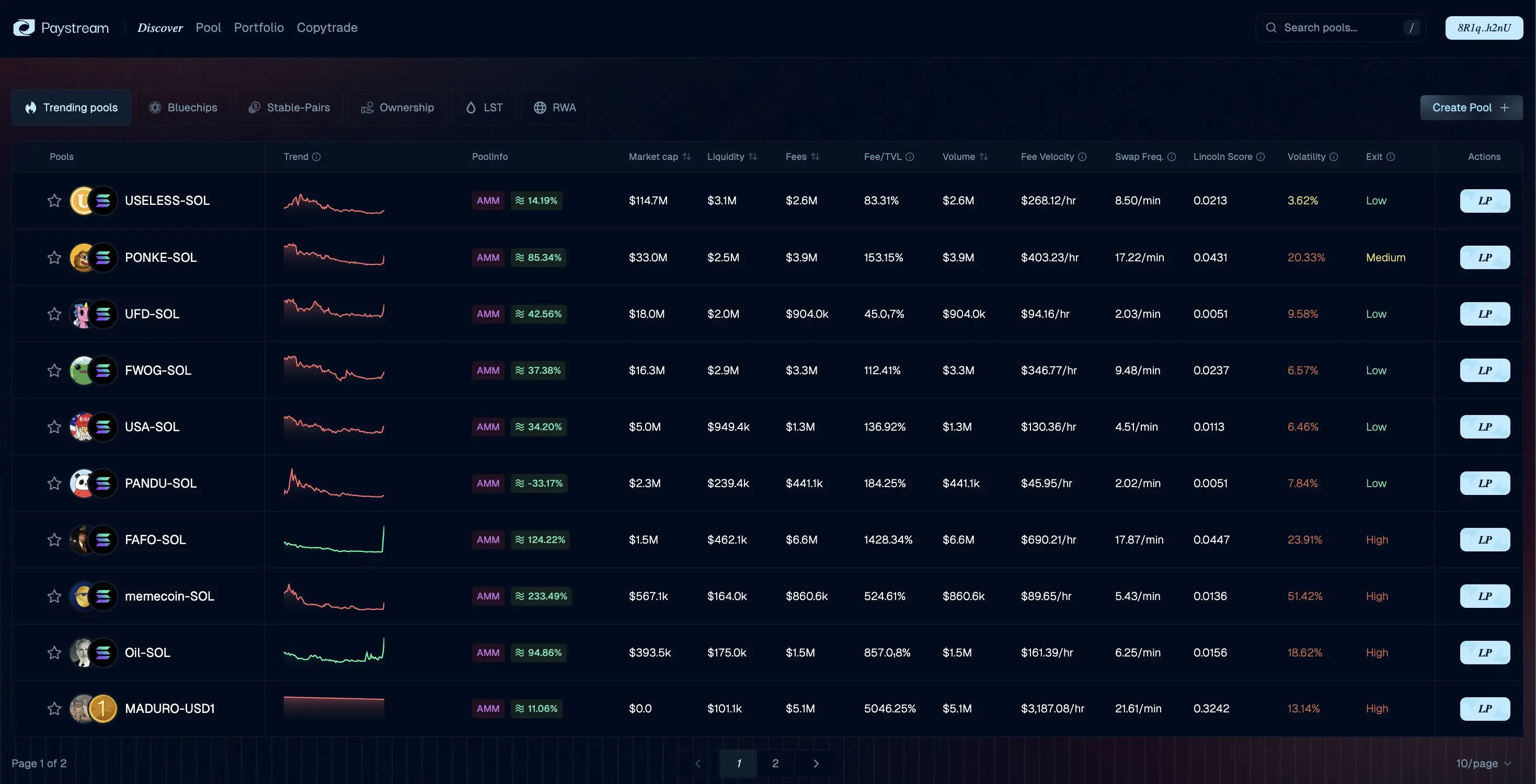
(Sources: Paystream)
Launched to solve common pain points of Ethereum-based AMMs—such as high gas fees and slow transaction speeds during congestion—Raydium combines an AMM model with Serum’s central limit order book (CLOB) to deliver near-instant swaps, shared liquidity across the Solana ecosystem, and low-cost trading.
Beyond swaps, Raydium offers yield farming, liquidity pools, money markets, and the AcceleRaytor launchpad for new token sales. Its native governance and utility token, RAY, powers staking rewards, yield farming incentives, IDO participation, and protocol governance. By leveraging Solana’s high throughput and Serum’s order book, Raydium has become a cornerstone of Solana DeFi, enabling efficient, trustless, and non-custodial trading for users and projects alike.
Raydium Powers Fast, Low-Cost DeFi on Solana with Deep Serum Integration
- Raydium is a Solana-native DEX + AMM that integrates with Serum’s CLOB for shared liquidity.
- Offers ultra-fast, low-fee token swaps, yield farming, fusion pools, and the AcceleRaytor IDO platform.
- Native RAY token used for rewards, staking, governance, and launchpad access.
- Non-custodial and trustless design—no intermediaries or centralized custody.
- Addresses Ethereum AMM limitations: high fees, slow speeds, and siloed liquidity.
Explore Raydium & Solana DeFi! Access real-time prices, advanced charts, and proprietary KO Scores at KnockoutStocks.com—the data-driven platform ranking every asset by quality and breakout potential.
Why Raydium Was Built: Solving Ethereum DeFi Pain Points
Traditional Ethereum DEXs and AMMs suffer from network congestion, elevated gas fees, and fragmented liquidity confined to individual pools. Raydium was designed to overcome these constraints by running on Solana—a high-throughput blockchain capable of thousands of transactions per second at minimal cost.
Through its tight integration with Serum DEX, Raydium accesses ecosystem-wide liquidity via Serum’s on-chain central limit order book, enabling better pricing and deeper markets than isolated AMM pools alone.
Core Components of the Raydium Ecosystem
Raydium operates as a multi-product DeFi suite:
- Raydium AMM & Token Swaps — Users swap SPL tokens instantly using liquidity pools routed through Serum’s CLOB for optimal execution.
- Liquidity Pools & Yield Farming — Standard farms reward LPs with RAY and trading fees; fusion pools offer project-specific tokens for bootstrapping new launches.
- Money Markets — LPs can stake assets to earn tokenized rewards, creating independent lending-like markets.
- AcceleRaytor Launchpad — Vetted Solana projects conduct IDOs, leveraging Raydium’s user base to bootstrap liquidity and achieve economic viability.
The Role of the RAY Token
RAY is the native utility and governance token of Raydium:
- Earned through liquidity provision and yield farming.
- Staked to participate in AcceleRaytor IDOs and receive allocations.
- Used for protocol governance by stakers and community participants.
Holding and staking RAY aligns incentives between users, liquidity providers, and the long-term health of the platform.
Raydium vs. Other Solana DEXs
While Serum provides the underlying CLOB and Bonfida offers additional tools, Raydium stands out for combining AMM simplicity with order-book depth, shared liquidity, and a full suite of DeFi products (farming, launchpad, money markets).
Its non-custodial, trustless architecture ensures users retain full control of assets at all times.
Looking Ahead: Raydium’s Place in Solana’s Maturing Ecosystem
As Solana continues to scale and attract developers, Raydium remains one of the most used entry points for trading, liquidity provision, and new project launches. While some argue Solana DeFi remains somewhat siloed from Ethereum’s broader ecosystem, Raydium’s speed, low costs, and composability position it to benefit significantly as Solana matures into a major DeFi hub.
With ongoing integrations, new farming opportunities, and AcceleRaytor-backed launches, Raydium continues to drive liquidity and innovation across the Solana network.
Disclaimer: The information on this page may come from third parties and does not represent the views or opinions of Gate. The content displayed on this page is for reference only and does not constitute any financial, investment, or legal advice. Gate does not guarantee the accuracy or completeness of the information and shall not be liable for any losses arising from the use of this information. Virtual asset investments carry high risks and are subject to significant price volatility. You may lose all of your invested principal. Please fully understand the relevant risks and make prudent decisions based on your own financial situation and risk tolerance. For details, please refer to
Disclaimer.
Related Articles
Solana Foundation Updates Validator Delegation Program Participation Requirements, Effective May 1st
BlockBeats News: On March 26, according to SolanaFloor, the Solana Foundation announced updates to the participation requirements for its validator delegation program, with the new rules taking effect on May 1, 2026. The latest requirements mandate that validators comply with fair transaction ordering rules, must not censor transactions, and must adhere to stricter block production time standards, while being subject to limitations on Autonomous System Number (ASN) and data center concentration to reduce centralization risks in network infrastructure.
BlockBeatNews6m ago
The Solana Foundation will implement new validator delegation program requirements on May 1st.
Gate News, on March 26, Solana Foundation announced that starting May 1, 2026, it will implement new validator delegation program requirements, with a focus on transaction ordering fairness, censorship resistance, stricter timing rules, and limiting ASN and data center concentration. This adjustment aims to enhance network performance and user experience, and the monitoring platform Ghost will assist in tracking and publishing network health metrics.
GateNews37m ago
Anza ends Solana leader monopoly; 50ms multi-proposer protocol officially debuts
Anza has introduced the Constellation Protocol, aimed at eliminating monopolies held by Solana's rotating leaders through a multi-concurrent proposer system and mandatory inclusion thresholds, ensuring transaction ordering is no longer controlled by a single leader. The protocol will feature economic cycles as short as 50 milliseconds and redesign fee structures to eliminate maximum extractable value (MEV) opportunities. Anza plans to launch the Alpenglow mainnet in 2026, further advancing blockchain decentralization.
MarketWhisper49m ago
US stock market close: crypto sector rebounds collectively, Solana up more than 7%
On March 26, the US stock market closed with the Dow Jones up 0.66%, S&P 500 up 0.54%, and Nasdaq up 0.77%. The crypto sector rallied broadly, with Solana up 7.46% and Circle up 2.66%. msx.com is a decentralized RWA trading platform.
GateNews1h ago
Solana Foundation: Has Processed 15 Million On-Chain AI Payments, Stablecoins Becoming Default Settlement Tool
Solana's Chief Product Officer stated that the Solana network has processed 15 million on-chain payments from AI agents, with stablecoins becoming the primary settlement tool. The programmable nature of AI payments gives them an advantage in cryptocurrency payments, and it is expected that most crypto transactions will be initiated by large language models in the future.
BlockBeatNews1h ago


