![]() Trusted Editorial content, reviewed by leading industry experts and seasoned editors. Ad Disclosure
Bitcoin literacy and community growth are accelerating in West Virginia, and it’s starting to reshape how communities across the state engage with digital finance. What was once viewed as a niche interest among tech enthusiasts is now gaining traction across broader segments of the state’s population. As residents become more curious about digital assets, conversations are shifting from speculation to understanding how BTC works and what it could mean for personal and regional economic resilience.
Trusted Editorial content, reviewed by leading industry experts and seasoned editors. Ad Disclosure
Bitcoin literacy and community growth are accelerating in West Virginia, and it’s starting to reshape how communities across the state engage with digital finance. What was once viewed as a niche interest among tech enthusiasts is now gaining traction across broader segments of the state’s population. As residents become more curious about digital assets, conversations are shifting from speculation to understanding how BTC works and what it could mean for personal and regional economic resilience.
Bitcoin As A Tool For Regional Economic Growth
West Virginia has been making headlines in the Bitcoin space recently, particularly with fresh legislative moves as of January 2026. MartyParty revealed on X that the biggest current development is Senator Bill 143 (SB143), which was introduced this week by State Senator Chris Rose.
Related Reading: Here’s Why Bitcoin Still Dominates As The Premier Store Of Value In Digital AssetsThis is officially titled the Inflation Protection Act of 2026, which would allow the state’s Board of Treasury Investment to allocate up to 10% of public funds into precious metals like gold, silver, and platinum. The bill requires any qualifying digital asset to have maintained an average market capitalization of at least $750 billion over the prior year, which qualifies only BTC. In addition, the bill also allows for regulated stablecoins, but only the US federal or state regulators can approve the assets.
![Bitcoin]() Source: Senator Bill 143 from MartyParty on XHowever, the bill frames this as a hedge against inflation and currency depreciation, and empowering the state treasurer to invest in BTC without directly naming it in most of the statute. Although the purpose section explicitly mentions empowering investment in gold, silver, and BTC. These assets would need to be made through qualified custodians, ETFs, or other secure frameworks.
Source: Senator Bill 143 from MartyParty on XHowever, the bill frames this as a hedge against inflation and currency depreciation, and empowering the state treasurer to invest in BTC without directly naming it in most of the statute. Although the purpose section explicitly mentions empowering investment in gold, silver, and BTC. These assets would need to be made through qualified custodians, ETFs, or other secure frameworks.
What Pension Funds And Endowments Think About Bitcoin
The Bitcoin price prediction by funds indicates a bullish outlook for 2026. CryptoRank.io has mentioned that the institutional analysts are pricing in a bullish scenario for BTC in 2026. The average target across the forecasts shown is around $150,000 per BTC, implying roughly 75% upside from current levels.
Related Reading: Bitcoin Institutional Shift: CLARITY Act Nears Senate ReviewAt the same time, longer-term valuation models assume a more gradual growth path. Popular asset manager VanEck predicts BTC could reach approximately $2.9 million by 2050, which equates to around 15% annualized growth broadly in line with the BTC historical long-term performance as a macro asset.
In contrast to institutional forecasts, prediction markets maintain a more conservative outlook. On Polymarket, the pricing base-case range between $110,000 to $130,000. This consensus could shift toward the institutional targets if spot ETF inflows remain strong and if the US regulatory uncertainty continues to decline, including initiatives such as the Blockchain Regulatory Certainty Act.
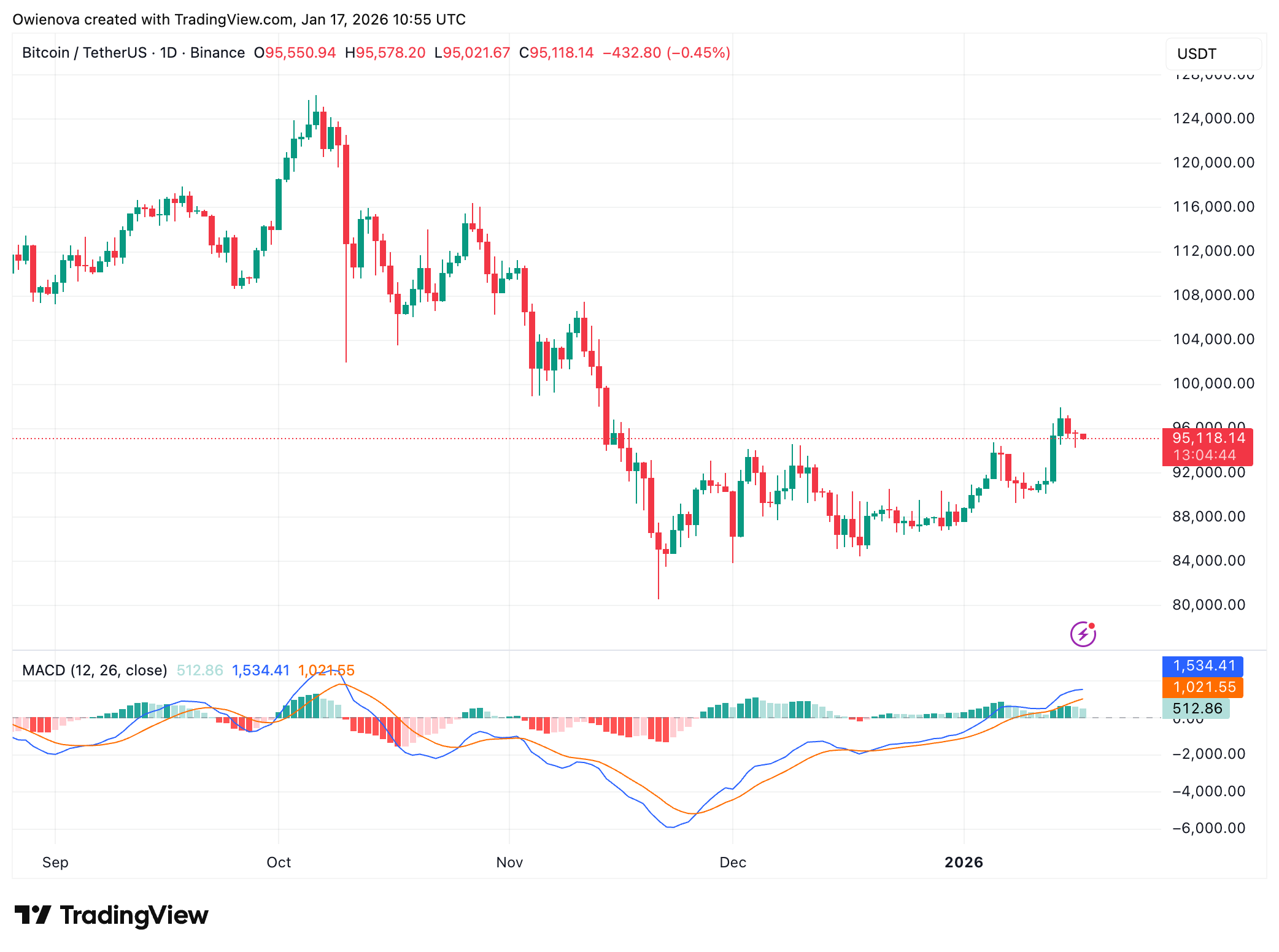 BTC trading at $95,118 on the 1D chart | Source: BTCUSDT on Tradingview.comFeatured image from Pngtree, chart from Tradingview.com
![]() Editorial Process for bitcoinist is centered on delivering thoroughly researched, accurate, and unbiased content. We uphold strict sourcing standards, and each page undergoes diligent review by our team of top technology experts and seasoned editors. This process ensures the integrity, relevance, and value of our content for our readers.
Editorial Process for bitcoinist is centered on delivering thoroughly researched, accurate, and unbiased content. We uphold strict sourcing standards, and each page undergoes diligent review by our team of top technology experts and seasoned editors. This process ensures the integrity, relevance, and value of our content for our readers.
Disclaimer: The information on this page may come from third parties and does not represent the views or opinions of Gate. The content displayed on this page is for reference only and does not constitute any financial, investment, or legal advice. Gate does not guarantee the accuracy or completeness of the information and shall not be liable for any losses arising from the use of this information. Virtual asset investments carry high risks and are subject to significant price volatility. You may lose all of your invested principal. Please fully understand the relevant risks and make prudent decisions based on your own financial situation and risk tolerance. For details, please refer to
Disclaimer.
Related Articles
Over the past 24 hours, the entire network has experienced liquidations of $205 million, with both longs and shorts being wiped out.
According to CoinGlass data, on March 11, the total liquidation amount in the cryptocurrency market over the past 24 hours reached $205 million, involving both long and short positions. Both BTC and ETH experienced significant liquidations, affecting 95,427 people, with the largest single liquidation valued at nearly $2 million.
GateNews11m ago
S&P Global Finds Bitcoin’s Evolving Role in Markets
Editor’s note: S&P Global today releases Bitcoin volatility and market dynamics findings, highlighting Bitcoin’s shift from a niche asset to a market-connected instrument. The full report, Bitcoin Volatility Trends: A Deep Dive into Market Dynamics and Risk, examines price patterns, volatility, and
CryptoBreaking12m ago
Bitcoin ETF Records $238.46M Daily Inflow While Ethereum and Solana ETFs See Outflows on March 11
Gate News bot message, according to March 11 update data, Bitcoin ETFs recorded a daily net inflow of 3,392 BTC ($238.46 million) and a 7-day net inflow of 3,543 BTC ($249.1 million).
Ethereum ETFs showed a daily net outflow of 1,207 ETH ($2.49 million) and a 7-day net outflow of 21,846 ETH ($45 m
GateNews38m ago
BTC 15-minute increase of 0.63%: Derivatives market liquidations as the core driver, on-chain large transfers resonate and amplify volatility
From 14:15 to 14:30 on March 11, 2026 (UTC), Bitcoin (BTC) experienced a short-term fluctuation. The candlestick data shows a return of +0.63% within 15 minutes, with a price range of 70170.3 to 70694.9 USDT and an amplitude of 0.75%. Market attention increased during this period, volatility intensified, and both bulls and bears participated actively in short-term trading.
The main driver of this fluctuation was a liquidation event in the derivatives market. Historical experience indicates that when large-scale liquidations occur in the futures and perpetual contracts markets,
GateNews55m ago


