Key Notes
- EigenLayer’s EigenCloud will continue supporting Mantle’s perpetuals and prediction market infrastructure.
- The migration follows Mantle’s September 16, 2025, upgrade to OP Succinct, which introduced ZK proofs for state validation.
- Ethereum blob data is retained for approximately 18 days before deletion, presenting a tradeoff versus off-chain storage.
Mantle Network announced a strategic migration to Ethereum blobs as its primary data availability layer on Jan. 22, initiating a shift from a Validium configuration toward a full ZK rollup architecture secured directly by Ethereum. Mantle did not specify a completion timeline for the migration.
The distinction matters for users: Validiums store transaction data off-chain through third-party providers, while ZK rollups post data directly to Ethereum, inheriting the base layer’s security protections. The migration would give Mantle users stronger guarantees that their transaction records remain tamper-proof.
Related article: Vitalik Buterin Compares Ethereum to BitTorrent and LinuxThe move follows the successful deployment of Ethereum’s Fusaka upgrade in December 2025, which delivered up to an eightfold increase in theoretical blob throughput. Mantle
MNT
$0.88
24h volatility:
0.3%
Market cap:
$2.86 B
Vol. 24h:
$95.32 M
currently holds $1.51 billion in total value secured, making it one of the larger Layer 2 networks by assets. It currently ranks 5th behind Arbitrum, Base, Optimism and Polygon.
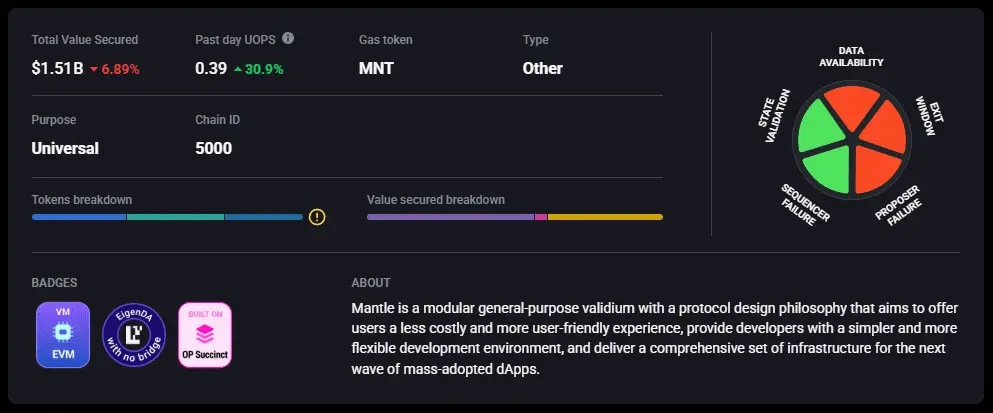 L2BEAT currently classifies Mantle as “Other” due to its reliance on EigenDA for data availability | Source: L2BEAT
Joshua Cheong, Head of Product at Mantle, described the shift as a natural progression enabled by Ethereum’s maturing blob infrastructure. The network’s ecosystem is anchored by the MNT token within Bybit, with core products including the mETH liquid staking protocol.
Fusaka Enables the Shift
The Fusaka upgrade activated on the Ethereum mainnet on Dec. 3, 2025, introducing PeerDAS technology that allows network computers to verify data by checking samples rather than downloading everything. The upgrade expanded Ethereum’s capacity to handle more Layer 2 data.
The expanded blob capacity reduces the cost and space constraints that previously made third-party data availability providers more attractive for high-throughput networks.
EigenLayer Partnership Continues
The network remains committed to its partnership with EigenLayer despite the data availability migration, according to the announcement. Mantle will continue utilizing EigenCloud for specialized use cases including perpetuals, prediction markets, and AI agent infrastructure. Ecosystem shared security through the mETH protocol will also remain on EigenCloud.
The migration builds on Mantle’s Sept. 16, 2025, upgrade to OP Succinct, which integrated ZK proofs for state validation. That upgrade contributed to MNT reaching record highs in October 2025.
Ethereum blob data is retained for approximately 18 days before deletion. The temporary storage window presents a tradeoff: users gain Ethereum-native security but lose long-term data access compared to off-chain alternatives. According to Mantle post-Fusaka blob pricing remains at a competitive baseline, creating a favorable cost window for the migration.
nextDisclaimer: Coinspeaker is committed to providing unbiased and transparent reporting. This article aims to deliver accurate and timely information but should not be taken as financial or investment advice. Since market conditions can change rapidly, we encourage you to verify information on your own and consult with a professional before making any decisions based on this content.
Disclaimer: The information on this page may come from third parties and does not represent the views or opinions of Gate. The content displayed on this page is for reference only and does not constitute any financial, investment, or legal advice. Gate does not guarantee the accuracy or completeness of the information and shall not be liable for any losses arising from the use of this information. Virtual asset investments carry high risks and are subject to significant price volatility. You may lose all of your invested principal. Please fully understand the relevant risks and make prudent decisions based on your own financial situation and risk tolerance. For details, please refer to
Disclaimer.
Related Articles
Bitcoin ETF Records $238.46M Daily Inflow While Ethereum and Solana ETFs See Outflows on March 11
Gate News bot message, according to March 11 update data, Bitcoin ETFs recorded a daily net inflow of 3,392 BTC ($238.46 million) and a 7-day net inflow of 3,543 BTC ($249.1 million).
Ethereum ETFs showed a daily net outflow of 1,207 ETH ($2.49 million) and a 7-day net outflow of 21,846 ETH ($45 m
GateNews13m ago
ETH 15-minute increase of 0.83%: Whales' capital inflow and DeFi lending demand resonate to drive the price
Between 13:30 and 13:45 (UTC) on March 11, 2026, ETH experienced a short-term fluctuation. The candlestick data shows a return of +0.83%, with a price range of 2046.07 to 2082.31 USDT, and an amplitude of 1.77%. Market activity increased during this period, with trading volume significantly higher than the previous cycle, and volatility exceeding the intraday average, attracting widespread market attention.
The main drivers of this fluctuation were the rapid inflow of large on-chain funds and active institutional accounts. Between 13:32 and 13:43,
GateNews1h ago
A certain address deposited 28,970 ETH into a CEX, with a value of approximately 59.05 million US dollars.
Gate News Report, March 11 — According to Lookonchain monitoring, a Gnosis Safe Proxy multi-signature wallet address 0x23A5 just deposited 28,970 ETH into a CEX, worth approximately $59.05 million.
GateNews1h ago
USDC and CCTP officially launch on Ethereum L2 network Morph
USDC and the cross-chain transfer protocol CCTP are now live on the Ethereum L2 network Morph, supporting payments, remittances, and DeFi transactions. CCTP enables cross-chain transfer of USDC between Morph and other blockchains. The first batch of integrated partners includes a CEX, Bulba, and Stargate.
GateNews3h ago
Ethereum on-chain activity explodes: daily active addresses approach 2 million, smart contract calls exceed 40 million for a new high, but ETH drops 30% and transaction fees lose to Tron
CryptoQuant March Report indicates that Ethereum on-chain activity has reached a record high, but ETH prices have fallen 30% over the past six months, and transaction fee revenue has lagged behind other public chains. The report analyzes that the factors driving ETH prices have shifted from on-chain usage to capital flows, prompting the market to reconsider Ethereum's value proposition.
動區BlockTempo3h ago


