Author: Nancy, PANews
A dark horse has emerged in the open-source world. In just three months, OpenClaw has become the most popular and fastest-growing open-source project in history, becoming a new favorite among developers.
This wave of intelligent agents, sparked by Peter Steinberger, has not only made him a top AI influencer but also gained a large number of “lobster followers” worldwide. However, this hotshot lobster guru has a strong aversion to the crypto industry and has publicly criticized it multiple times. Such a stance undoubtedly brings more negative public opinion to cryptocurrencies.
Reaching the Top of GitHub Stars, Urgently “Avoiding Suspicion” in Crypto Projects
Undoubtedly, AI has become a golden narrative for capital and talent migration. Its rapid rise has led many to see AI as a hope to revive the crypto industry, and it has become a new opportunity for many in the community to ride the wave or seek investment.
Especially the recently trending OpenClaw. According to the latest data, OpenClaw has surpassed 250,000 stars on GitHub, overtaking Linux and React, making it one of the most popular open-source projects and setting a record for the fastest growth in open source history.
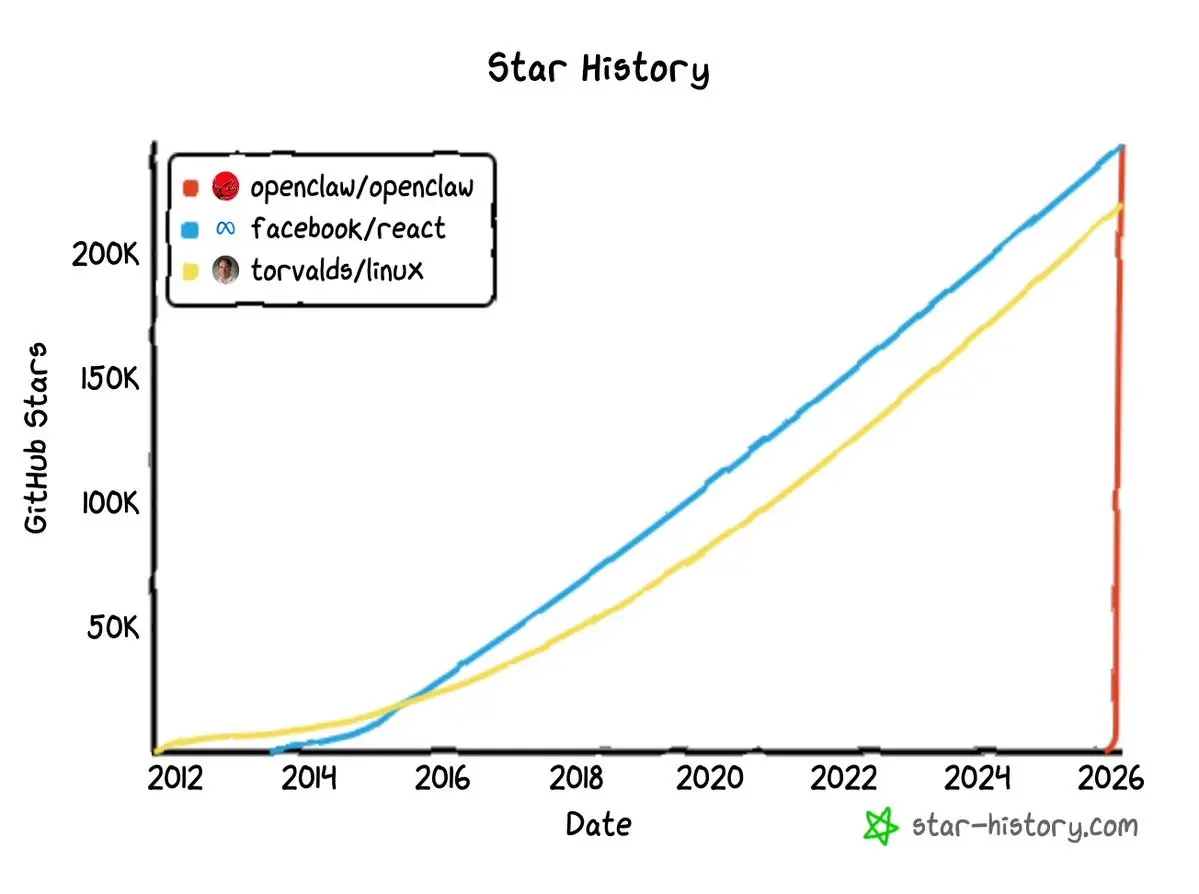
As “lobster farming” becomes popular worldwide, tutorials, monetization cases, and user experiences around OpenClaw are continuously emerging. Some even install OpenClaw on-site to profit from it. From independent developers to large companies and offline services, OpenClaw’s “selling shovels” business is booming.
The crypto market naturally wouldn’t miss this hot topic. Recently, Venice, an AI project on Base chain, became a recommended model provider for OpenClaw and the only native crypto project. With the hype around top AI projects, Venice’s token surged, with a market cap once exceeding $900 million. This news quickly attracted attention and shares from industry insiders.

Venice is described as a generative AI project focused on privacy protection and content censorship resistance, integrating various open-source large models. It was founded in 2024 by Erik Voorhees, a crypto OG and founder of ShapeShift, who has recently gained attention due to the Agent privacy craze.
However, Steinberger clearly does not agree with this kind of bundled hype. He immediately clarified publicly, “This was an oversight in previous documents; we want to remain neutral on this matter.” At the same time, OpenClaw promptly removed the related recommendation content.
In other words, OpenClaw’s “avoiding suspicion” this time is not about denying or devaluing Venice’s actual value and technical advantages, but rather proactively removing the “official key recommendation” label that could be over-interpreted, to avoid unnecessary narrative manipulation and profit speculation. Especially since it’s an open-source agent framework and its founder has joined OpenAI, OpenClaw needs to maintain technical neutrality and avoid any suspicion of conflicts of interest.
Choosing to Part Ways Due to Crypto “Sting Operations,” Considering Abandoning the Project
Unlike AI leaders like OpenAI’s Sam Altman and Elon Musk, co-founder of xAI, who hold positive or even open attitudes toward crypto, Steinberger adopts a “no entry for non-fans” stance. This avoidance has also caused some in the crypto community to feel “offended.”
In fact, Steinberger, who is not interested in crypto, strongly opposes the “sting operation” phenomenon in the crypto scene. Since last year, he has issued dozens of public statements expressing strong dissatisfaction with crypto speculation culture, even outright saying “stay away.”
Especially after OpenClaw became popular, in January this year, the project’s hype rose. However, due to a trademark dispute between its original name Clawdbot and Anthropic’s AI model Claude, Steinberger received a cease-and-desist letter from legal teams. He then renamed the project twice, finally settling on OpenClaw.
However, this renaming wave was quickly exploited by crypto speculators.
During the renaming process, some snipers used automation scripts to hijack accounts, impersonate the official team, and issue fake tokens like CLAWD. Some of these tokens’ market caps soared to tens of millions of dollars, attracting many investors.
In response to market hype, Steinberger quickly stated publicly that he would never issue tokens and emphasized that any project issuing tokens in his name is a scam. This caused the prices of these tokens to plummet, with many retail investors suffering heavy losses.
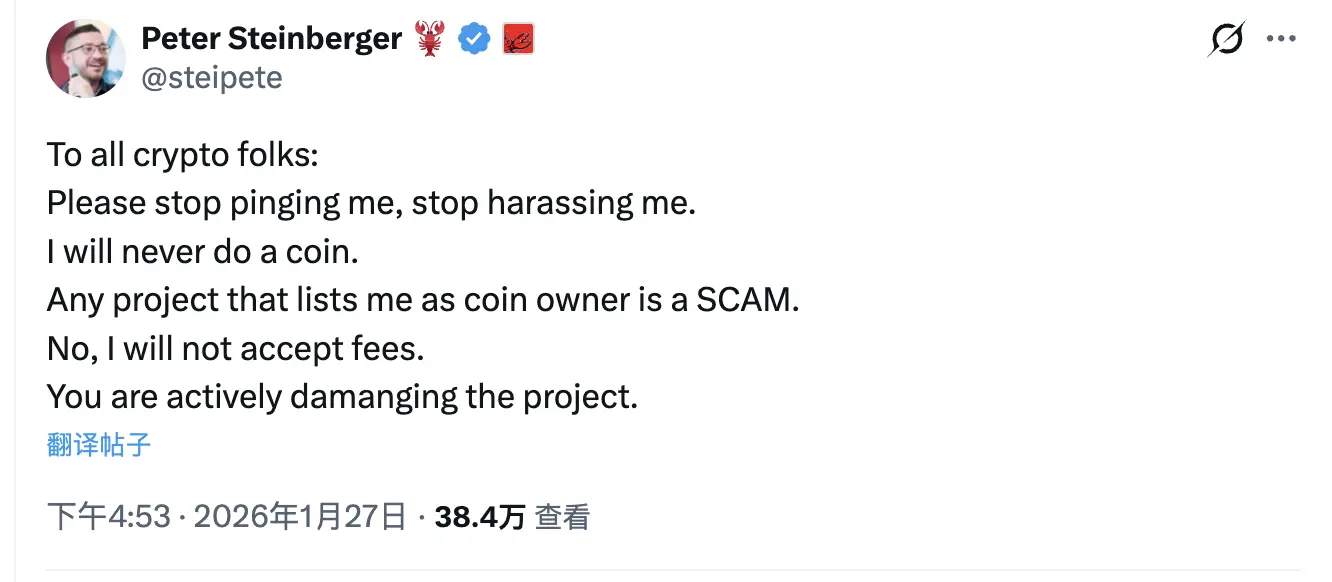
If this crypto drama only made Steinberger feel disgusted, then the damage to the community ecosystem made him furious.
As OpenClaw continued to rise in popularity, a large number of crypto enthusiasts flooded into related communities. Some even maliciously submitted code, sent insulting private messages, and demanded that Steinberger claim transaction fees or turn the project into a crypto asset.
In response, the OpenClaw official Discord server began to ban mentions of Bitcoin, Crypto, and related keywords entirely, even in neutral technical discussions. For example, a user was removed for referencing Bitcoin block height for benchmarking.
“I underestimated these people,” Steinberger openly admitted in a recent interview, pointing out that the crypto community is a very unique subculture that quickly tokenizes anything trending. But he has already achieved financial freedom and has no desire to support such (crypto) things. The noise from crypto makes it almost impossible for him to see any genuine project discussions; the speculation is damaging the project.
Due to the harassment from the crypto community, this talented developer even considered abandoning the entire project. He strongly does not want the project to become a tool for crypto hype.
Recently, Steinberger also publicly advised young people, “Don’t waste time on cryptocurrencies,” further revealing his dissatisfaction with the crypto industry.
This clash between the open-source world and the crypto community is not just about self-preservation for a hot project but also reflects the current AI wave’s unresolved tension between technological purity and capital hype.
Related Articles
Tom Lee’s BitMine Acquires 60,976 ETH, Holdings Now $10.3B
Bitmine Immersion Technologies reports total assets of $10.3 billion, including 4.53M ETH. With 3.04M ETH staked, it generates $174M annually at a 2.91% yield. The firm seeks to reach 5% of total ETH supply and is expanding its staking infrastructure.
CryptoFrontNews3h ago
Hong Kong family office plans to increase allocations to cryptocurrencies and private markets over the next three years
Multiple family offices in Hong Kong plan to increase investments in private equity and digital assets over the next three years, with wealthy families expected to show a significant rise in interest in these assets. The government aims to attract more high-net-worth individuals and their families to invest, and it is projected that by the end of 2025, the number of single-family offices in Hong Kong will grow to 3,384.
GateNews5h ago
IOTA Co-Founder Highlights Trade Finance Innovation With TWIN
IOTA founder Dominik Schiener says TWIN supports digital trade records, faster checks, and smoother data sharing across cross-border finance networks.
TWIN has been linked to Kenyan pilots, Rwanda trade finance use cases, and live consignments on the IOTA mainnet.
IOTA co-founder Dominik Sch
CryptoNewsFlash5h ago
Hangzhou Xiaoshan issues development policies supporting OpenClaw, offering free deployment and token consumption subsidies
Xiaoshan District, Hangzhou City, has issued policies to support the development of OpenClaw and OPC-STC, encouraging the establishment of intelligent agent service zones, free deployment of related technologies, and providing subsidies. Companies using intelligent agents to invoke models can receive a 30% subsidy on the costs, with a maximum annual subsidy of 100,000 yuan.
GateNews5h ago
Northwestern Mutual Survey: About 32% of Generation Z have invested or are considering investing in cryptocurrencies
Gate News Announcement, March 10 — Northwestern Mutual released a research report indicating that many Generation Z investors tend to choose high-risk assets to achieve their financial goals. The survey data shows that about 80% of Generation Z respondents feel financially behind and believe that speculative investments can accumulate wealth more quickly than traditional investment strategies. Among them, approximately 32% have already invested or are considering investing in cryptocurrencies, while a similar proportion of respondents are involved in prediction market investments.
GateNews6h ago
Liquid Capital founder suggests improving crypto VC exit mechanisms to activate capital and promote industry innovation
Yili Hua pointed out that the decline in innovation in the crypto industry stems from tightening US policies and exchange lock-up mechanisms, which impose additional risks on VCs. He recommends improving exit mechanisms, stimulating investment, and promoting industry innovation and the listing of high-quality assets.
GateNews6h ago


