
London-based fintech company Revolut, valued at $75 billion, announced on Thursday that it has submitted applications for a national bank charter to the Office of the Comptroller of the Currency (OCC) and the Federal Deposit Insurance Corporation (FDIC), aiming to establish “Revolut Bank US, NA” in the United States. This marks Revolut’s second attempt after its 2021 application was blocked.
Strategic Shift After 2021 Obstacle: From State-Level to Federal Path
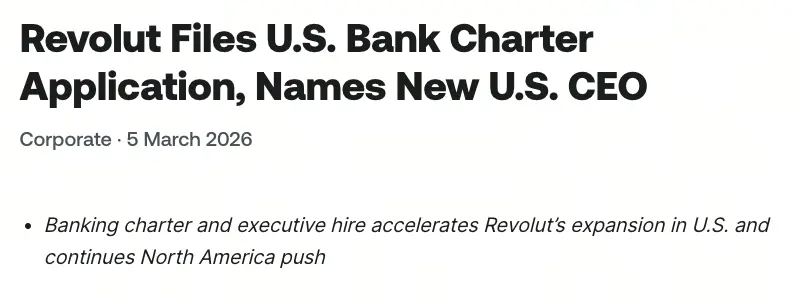 (Source: Revolut)
In 2021, Revolut applied for a U.S. banking license through California regulators but withdrew the application in 2023 due to regulatory hurdles and internal control issues. This direct application to the OCC for a national bank charter represents a fundamental shift from the previous approach and also indicates a move away from expanding through acquiring existing U.S. banks.
Revolut founder and CEO Nik Storonsky stated, “The U.S. is a key pillar in our global growth strategy. Applying for a national bank charter is a significant milestone in our vision to build the world’s first truly global banking platform.”
New U.S. Country Manager Setin Duran-Soy, with over twenty years of experience in banking, payments, and technology, previously served as CEO of fintech platform Raisin’s U.S. operations, bringing extensive cross-market financial institution experience.
Core Business Benefits of OCC National Bank Charter
If approved, “Revolut Bank US, NA” will gain the following key capabilities, which are the main reasons for Revolut abandoning the previous state-by-state application approach:
- Unified Federal Regulatory Framework for All 50 States: Replaces the current fragmented state-by-state licensing process, significantly reducing compliance costs.
- Direct Access to Fedwire and ACH Payment Systems: Gains direct access to the Federal Reserve’s core clearing networks, eliminating reliance on intermediary banking partners.
- FDIC-Insured Deposits: Offers federally protected deposit accounts to U.S. customers, greatly enhancing compliance and user trust.
- Expansion into Lending Products: Opens opportunities for personal loans and credit card services, beyond the current focus on payments and foreign exchange.
- OCC Application Wave: Revolut joins a growing trend of fintech companies seeking OCC national bank charters in the U.S.
Revolut’s application is part of a broader global trend among fintech and crypto firms actively pursuing OCC national bank charters. In January, Brazilian digital bank Nubank received conditional approval from the OCC; Crypto.com also received similar approval in February. In December 2025, the OCC conditionally approved applications from Circle, Ripple, BitGo, Fidelity Digital Assets, and Paxos, indicating increasing regulatory openness toward such applications.
Revolut currently serves over 70 million customers worldwide across 40 markets. Its secondary stock offering completed in November 2025 valued the company at $75 billion.
Frequently Asked Questions
How does Revolut’s second application for a U.S. bank license differ from the first?
The initial application in 2021 was submitted through California regulators via a state-level route and was withdrawn in 2023 due to regulatory and internal control issues. The current application directly to the OCC for a national bank charter adopts a federal-level approach, allowing operations across all 50 states, far surpassing the scope of state licenses.
What are the most significant business impacts if Revolut obtains the OCC license?
The key benefits include direct access to Fedwire and ACH payment networks, FDIC-insured deposits, and a unified federal regulatory framework across all 50 states. These capabilities will enable Revolut to operate similarly to a traditional bank without relying on state licenses or banking partners.
Which other institutions have already received or are applying for OCC bank charters?
Institutions with conditional approval include Nubank (approved in January 2026), Crypto.com (approved in February 2026), and a batch of approvals in December 2025 for Circle, Ripple, BitGo, Fidelity Digital Assets, and Paxos. This reflects a broad trend of global fintech and crypto firms expanding into the U.S. banking sector.
Disclaimer: The information on this page may come from third parties and does not represent the views or opinions of Gate. The content displayed on this page is for reference only and does not constitute any financial, investment, or legal advice. Gate does not guarantee the accuracy or completeness of the information and shall not be liable for any losses arising from the use of this information. Virtual asset investments carry high risks and are subject to significant price volatility. You may lose all of your invested principal. Please fully understand the relevant risks and make prudent decisions based on your own financial situation and risk tolerance. For details, please refer to
Disclaimer.


