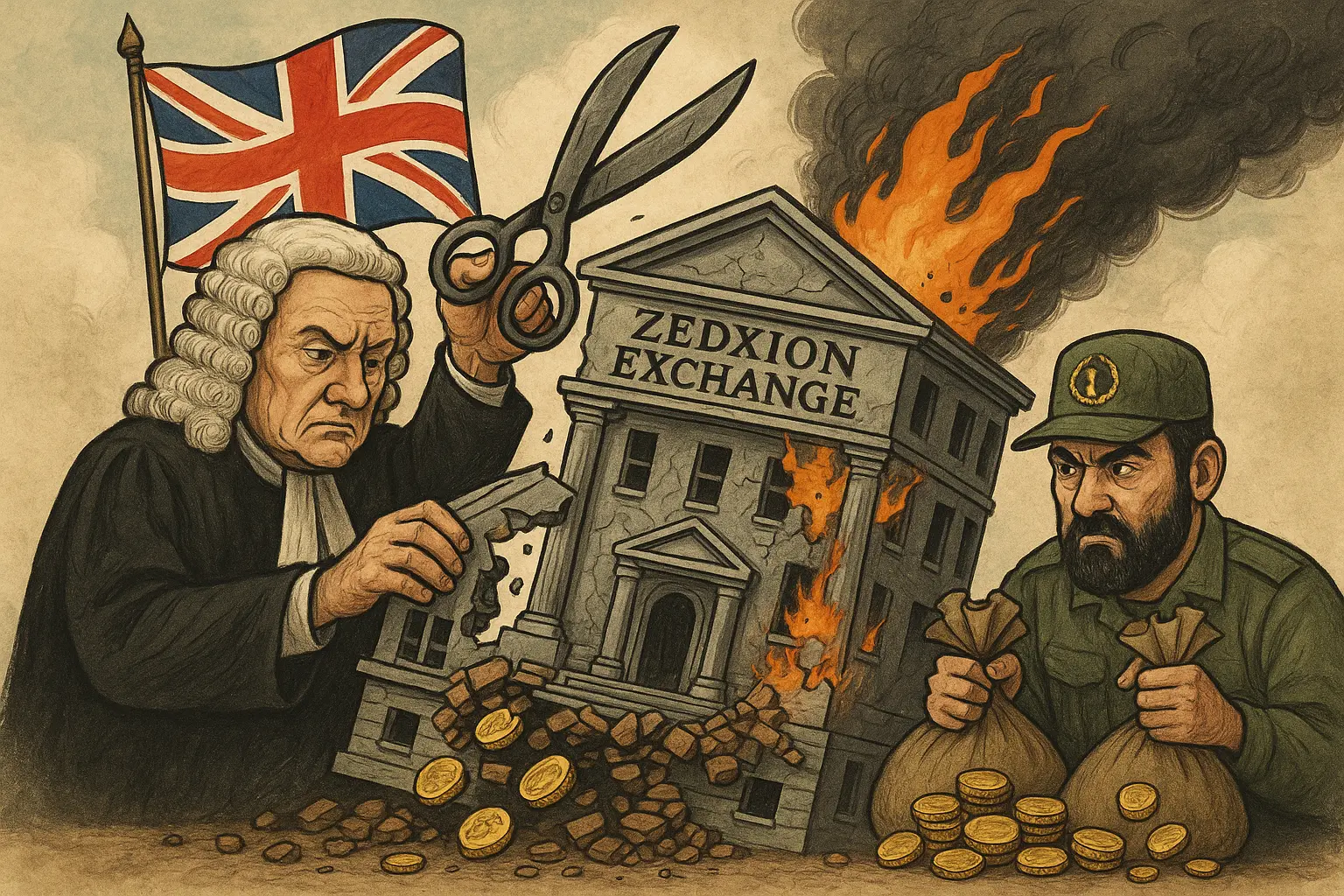
The UK Companies House has officially initiated the dissolution process of Zedxion Exchange Ltd., citing the submission of “misleading, false, or deceptive” information in the company’s registration application. Blockchain analytics firm TRM Labs’ on-chain data shows that Zedxion and Zedcex together processed approximately $1 billion related to funds associated with the Islamic Revolutionary Guard Corps (IRGC), accounting for about 56% of their total transaction volume.
The UK Companies House Dissolution Action and the Suspicion of Document Falsification
The dissolution notice issued by the UK Companies House directly points to systemic falsification in Zedxion Exchange’s company registration documents.
Investigators from the Organized Crime and Corruption Reporting Project (OCCRP) previously uncovered a key clue: the registered director and main controller of Zedxion, “Elizabeth Newman” (noted as a Dominican citizen in the documents), is likely a fictitious identity. They found that the company even used stock images in promotional materials to represent this “director,” a typical shadow identity forgery operation.
More notably, early registration records of the company reveal further details. Zedxion Exchange Ltd. was established in May 2021. By October of the same year, a person named “Babak Morteza” was listed as a director and a person with significant control. According to UK Companies House documents, the personal information related to “Morteza” closely matches that of Iranian businessman Babak Zanjani—who has long been accused of manipulating sanctions evasion. “Morteza” suddenly disappeared from the list of significant controllers in August 2022, and in the same month, “Newman” was appointed as a director, a timing that raises questions.
This dissolution action is also the latest case demonstrating the UK Companies House exercising expanded regulatory powers under the “2023 Economic Crime and Corporate Transparency Act.” Since November 2025, the UK has mandated all company directors and persons with significant control to verify their identities. The fraudulent activities of Zedxion were ultimately uncovered under this stricter scrutiny mechanism.
Zanjani’s Behind-the-Scenes Role and Sanctions Evasion Network
Babak Zanjani is a key figure in understanding the Zedxion Exchange case. He was sanctioned by the US and the EU in 2013 for laundering billions of dollars in oil revenues for Iranian state entities, including the IRGC. In 2016, he was sentenced to death in Iran for embezzling national oil funds, but his sentence was reduced after he repaid the funds in 2024.
In 2025, Zanjani reappeared publicly as a businessman and established new connections related to projects in Saudi Arabia. He currently controls DotOne Holdings Group, which operates in cryptocurrency, foreign exchange, logistics, aviation, and telecommunications—all of which are typical infrastructure for sanctions evasion networks. TRM Labs’ analysis shows that in 2024, funds related to the IRGC accounted for up to 87% (about $619.1 million) of Zedxion’s total transaction volume, but this proportion decreased to about 48% in 2025 due to increased other transaction activities.
Frequently Asked Questions
Q: After Zedxion Exchange was dissolved by the UK, what will happen to user funds on the platform?
Dissolution of the company does not automatically mean that user funds are frozen or confiscated. Under UK company law, dissolution mainly terminates the company’s legal existence; if assets are to be seized, separate criminal proceedings or civil asset freezing orders are usually required. However, since US sanctions already cover Zedxion and its related entity Zedcex, any institutions or individuals using these platforms may also face legal risks of OFAC sanctions.
Q: Why has the UK become a tool for Iran sanctions evasion?
The UK’s company registration process is relatively simple and has historically had vulnerabilities in substantive review, making it a target for sanctions evaders to create shell companies. The false identity operations in the Zedxion case exploited these systemic weaknesses. The “2023 Economic Crime and Corporate Transparency Act” was enacted in response, mandating identity verification to close such loopholes.
Q: How large is Iran’s use of cryptocurrencies to evade sanctions?
According to the latest data from Chainalysis, in 2025, illegal crypto addresses related to the IRGC received at least $154 billion in digital assets, a 162% increase year-over-year. After the US and Israel launched military actions against Iran, Chainalysis recorded about $10.3 million in crypto outflows from February 28 to March 2, but the extent to which these involve state-supported funds reallocation remains unclear.
Disclaimer: The information on this page may come from third parties and does not represent the views or opinions of Gate. The content displayed on this page is for reference only and does not constitute any financial, investment, or legal advice. Gate does not guarantee the accuracy or completeness of the information and shall not be liable for any losses arising from the use of this information. Virtual asset investments carry high risks and are subject to significant price volatility. You may lose all of your invested principal. Please fully understand the relevant risks and make prudent decisions based on your own financial situation and risk tolerance. For details, please refer to
Disclaimer.


