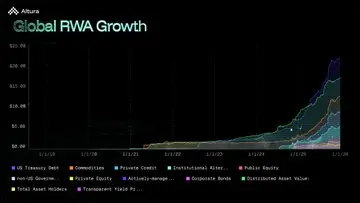
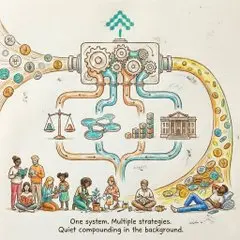
Ok

vip
Age 7.6 Yıl
Peak Tier 4
No content yet
Playing with NFTs for a long time reveals a real issue: many platforms actually don't give you much room for choice. How prices move and how transactions happen are mostly passively accepted by you. @spaace_io The interesting part is that it deliberately gives some "pricing power" back to users, rather than letting the system decide everything.
Through Advanced Bidding Mechanism and more flexible order structures, you're not forced to buy or sell in a black-and-white manner. Instead, you can use different strategies to gradually probe market depth. Some choose to place low bids and wait for se
View Original
post-image
  • Reward
  • Comment
  • Repost
  • Share
Why are NFTs in games just static images after purchase? @alturax We want to break this fixed mindset — turning game assets into interactive, changeable digital items, not just collectibles to look at. Smart NFTs can update attributes, images, or even names via API anytime after minting, making equipment, skins, and similar items more “alive” rather than dead data.
Its backend supports multiple main chains, usable in multi-chain environments, so there's no need to choose different chains just to get on the blockchain. Developers can quickly integrate NFT assets into their games using its SDK a
COOKIE1,7%
View Original
post-image
  • Reward
  • Comment
  • Repost
  • Share
.@MultichainZ_ 's gameplay is very down-to-earth. Unlike many DeFi projects that focus on riding the hype, it first solves the most basic problem: how to lend and borrow multi-chain assets without losing track. If you have ETH, NFTs, or tokenized real-world assets, you don't need to worry about which chain they are on. The system helps you manage them uniformly, providing an experience like operating within a single account.
Its technical highlight is packaging cross-chain synchronization, liquidation logic, and interest rate adjustments in the background. What you see are only the available b
ETH-1,13%
View Original
post-image
  • Reward
  • Comment
  • Repost
  • Share
.@bluwhaleai The truly impressive part is turning chaotic data in Web3 into usable assets. It consolidates wallet activities, transactions, and traditional financial signals across multiple chains into structured information, enabling AI to directly analyze, generate reports, or perform risk assessments without developers having to piece together data themselves.
Most practically, it packages these capabilities into APIs that enterprises and project teams can directly integrate and use. WhaleScore, asset health analysis, risk assessment—all can be implemented, no longer just concepts or model
BLUAI2,02%
View Original
post-image
  • Reward
  • Comment
  • Repost
  • Share
Many people, upon first seeing @OstiumLabs, will instinctively think it's just another perpetual contract DEX.
But upon closer inspection, it’s more like doing the dirty, hard work—bringing the rules traditionally monopolized by brokers and CFD platforms directly onto the blockchain.
Traditional stock, forex, and commodity contract trading have an old problem:
You can't see the prices clearly, you can't understand the liquidation, and ultimately, the platform always holds the final say.
Ostium simply doesn't explain—
Pricing is done with on-chain oracles,
Margin rules are written i
View Original
post-image
  • Reward
  • Comment
  • Repost
  • Share
.@apecoin The biggest historical burden is not the price, but "many people but not concentrated." The community is large, and the IP is well-known, but user behavior has been long dispersed across various chains and platforms, and APE itself has relatively low engagement. This is also why, when the market cools down, the ecosystem immediately appears hollow.
.@ApeChainHUB Since its emergence, the strategy has clearly changed. It is not rushing to generate buzz but focusing on consolidating. Whether it's games, events, or staking, the core goal is only one—making every user operation as related
APE0,73%
View Original
post-image
  • Reward
  • Comment
  • Repost
  • Share
.@MultichainZ_ is the kind of protocol that makes you think "Wow, I didn't know it could be done this way". It not only supports lending of ordinary coins but also allows you to use NFTs and real-world assets (tokenized RWA) as collateral to borrow money. Unlike many projects that focus solely on expanding within the crypto world assets in DeFi, it has also brought in off-chain assets.
The key is that it combines these gameplay elements into a cohesive logic across multiple chains. You can stake on one chain and borrow money on another chain. This cross-chain operation looks complex, but @
View Original
  • Reward
  • Comment
  • Repost
  • Share
Here's a practical perspective: @bluwhaleai actually aims to turn the "fragmented financial world" in Web3 into a scenario that can truly be utilized by AI, rather than just promoting models or shouting concepts. It organizes on-chain + off-chain Wallet activities and asset data into a unified large map (indicators like WhaleScore are based on this), allowing developers/companies to run intelligent services based on this data, such as personalized credit, insurance, yield optimization, and even behavioral insights.
It is no longer a blank slate: there are over 3.6M+ users, thousands of bus
BLUAI2,02%
View Original
post-image
  • Reward
  • Comment
  • Repost
  • Share
Some projects immediately want to teach you "how to earn more", while @HyperCroc seems to be solving another problem: how to avoid complicating things. It integrates the fragmented operations in DeFi into a single process, so you don't need to jump back and forth between different protocols; you just hand over your funds to a system that can operate continuously.
One practical point is that it emphasizes executing discipline. It's not about rushing in where the returns are high, but rather about following the rules, only acting when conditions are met, and not acting when they are not
View Original
post-image
  • Reward
  • Comment
  • Repost
  • Share
To be honest, @MultichainZ_ is much more reliable than those projects that only shout about TVL/炒概念. What it really wants to solve is the issue of "how to lend and borrow multi-chain assets without confusion." It’s not just talk about cross-chain interoperability; it truly standardizes the lending and collateralization models between chains, creating a protocol layer that can be directly used, allowing you to lend and borrow on different chains without having to bridge assets back and forth. This is a substantial improvement for user experience.
Interestingly, it not only supports ordinary cur
View Original
post-image
  • Reward
  • Comment
  • Repost
  • Share
Many DeFi products have issues not with the technology but with being too cumbersome. @Hypercroc_xyz is taking a different approach; it cares more about whether you can use it sustainably in the long term.
It turns the strategy execution into a backend process. What you see in the frontend is just a result-oriented entry. No need for frequent authorizations, no need to switch protocols back and forth, and no need to worry every day about whether you've missed a certain window period. This design is very user-friendly for those with limited time.
There's one more practical point: it ass
View Original
post-image
  • Reward
  • Comment
  • Repost
  • Share
Many Web3 products are not actually difficult to use, but rather "discourage users right from the first step." After connecting your wallet, you have to decide where to go, what to click, and whether you'll make mistakes—all of which can be very stressful for new users. @spaace_io clearly takes a more realistic approach in this regard. Its product-level design features a Progressive Onboarding Flow, not throwing all functionalities at you at once, but guiding you step by step into the experience.
When you first enter, you see the most essential operation path, backed by Context-Aware UI Logic.
View Original
post-image
  • Reward
  • Comment
  • Repost
  • Share
.@On_Veera Recently, what they are doing is somewhat like quietly transforming the "user and chain interaction habits." When you usually open your mobile wallet, switch chains, authorize, wait for confirmation—these operations are so many that they become annoying. Veera's approach is very straightforward: delegate these repetitive tasks to the system so you only need to tap.
Their core technology is called Multi-Session Orchestrator. It can manage multiple chains and the call order of multiple dApps within the same session. It works together with the State Prefetch Engine, which preloads on-c
View Original
post-image
  • Reward
  • Comment
  • Repost
  • Share
  • Pin

Trade Crypto Anywhere Anytime
qrCode
Scan to download Gate App
Community
  • 简体中文
  • English
  • Tiếng Việt
  • 繁體中文
  • Español
  • Русский
  • Français (Afrique)
  • Português (Portugal)
  • Bahasa Indonesia
  • 日本語
  • بالعربية
  • Українська
  • Português (Brasil)