As the digital economy advances, the interaction between consumers and enterprises is undergoing a transformation. Users may discover brands through search engines, engage with content on social media, make purchases via mobile apps, and receive after-sales support through online channels. In this multi-channel environment, businesses must precisely understand user needs and quickly generate personalized content, positioning digital experience management platforms as essential infrastructure for enterprise digital transformation.
The rise of generative AI is further accelerating these changes. AI not only assists companies in creating marketing content, but also analyzes user behavior, forecasts market trends, and optimizes business decisions. Adobe is integrating Experience Cloud, Firefly, and enterprise-level AI capabilities to connect content creation, data analytics, and business conversion—building a forward-looking, intelligent marketing ecosystem.
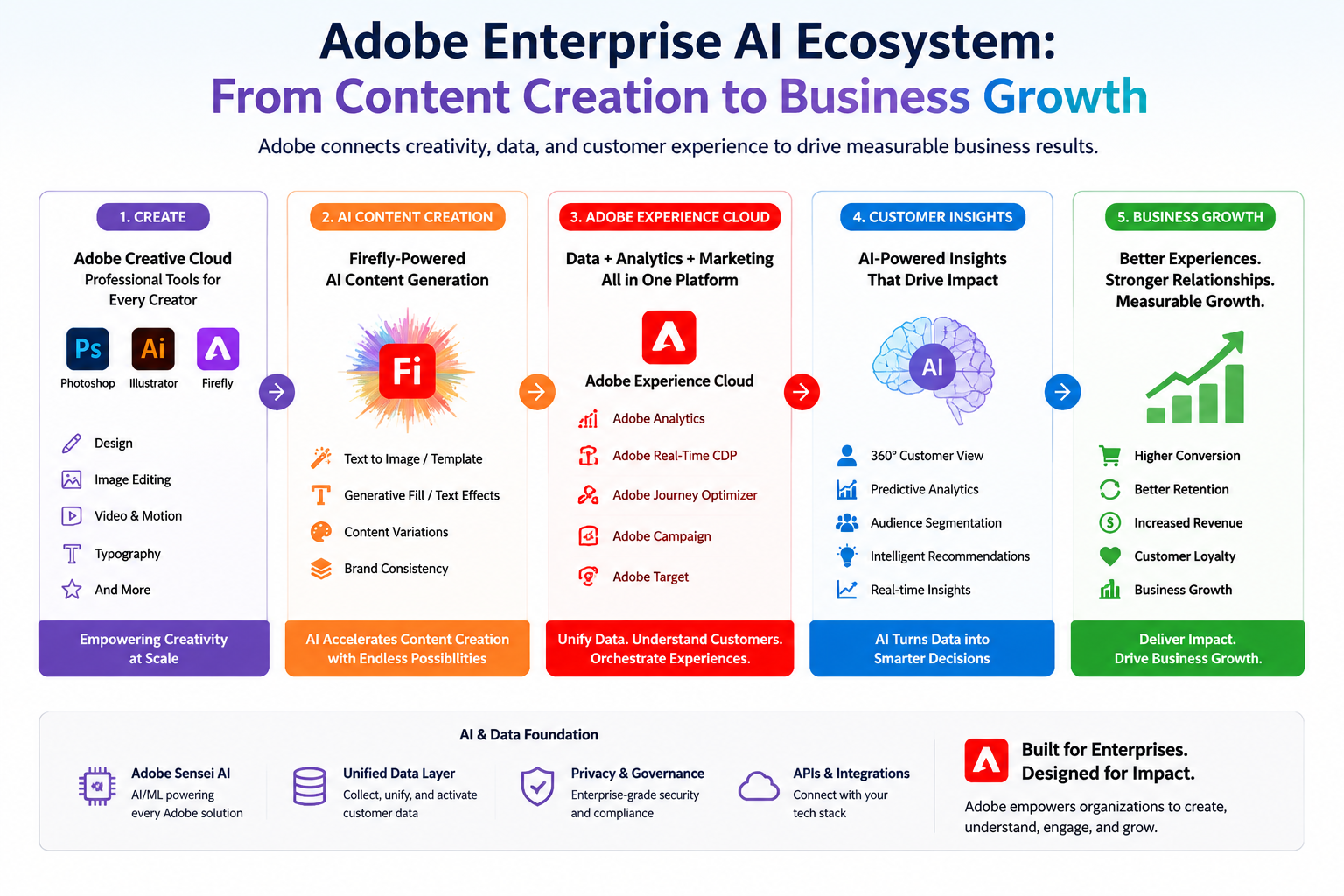
What Is Adobe Experience Cloud
Adobe Experience Cloud is a suite of digital experience management solutions designed for enterprise clients, with the primary goal of enhancing customer experience through data, content, and AI technologies.
Unlike Creative Cloud products such as Photoshop and Illustrator, which are tailored for designers and content creators, Experience Cloud targets large enterprises, brand marketing teams, and digital business units. Its focus is not on creating a single design, but on enabling organizations to better understand customers, reach users, and drive business growth.
Experience Cloud addresses multiple enterprise digital scenarios, including customer data analytics, content management, marketing automation, ad optimization, and user experience management. By consolidating data from diverse channels, businesses can build comprehensive user profiles and adjust marketing strategies based on consumer behavior.
For example, a retail company can leverage Experience Cloud to analyze browsing history, purchase behavior, and interaction data, track shifts in user interests, and—using AI—generate more targeted marketing content. Compared to traditional mass advertising, this data-driven approach enables greater marketing efficiency.
Within Adobe’s ecosystem, Experience Cloud serves as the bridge between content and commercial value. Creative Cloud powers content creation, Document Cloud manages information, and Experience Cloud transforms content into user engagement and business outcomes.
Historically, enterprise marketing relied on TV ads, offline channels, and conventional promotion. With the growth of the internet, e-commerce, and mobile apps, the consumer decision-making process has become more complex.
Users may encounter brand messaging on social media, search for products online, complete purchases on official websites, and provide feedback through support channels. User data is dispersed across platforms, making it difficult for businesses to gain a holistic view of consumers.
Digital experience management platforms address this challenge by integrating fragmented data.
A unified analytics system enables enterprises to track behavioral shifts throughout the consumer journey—from initial brand contact to purchase completion. Companies can pinpoint where users become interested, where attrition occurs, and which content most effectively drives purchase decisions.
For large organizations, digital experience management impacts not only marketing efficiency but also customer lifetime value. Accurately understanding user needs improves retention and fosters stable, long-term relationships.
With AI technology advancing, the importance of digital experience platforms is rising. Traditional analytics answer “what happened,” while AI predicts “what could happen.” Enterprises can use AI to anticipate changes in consumer demand and adjust products and marketing strategies proactively.
Digital experience management platforms are evolving from data tools into intelligent decision-making infrastructure for enterprises.
How AI Enhances Marketing Content Generation
Generative AI is a cornerstone of Adobe’s enterprise strategy, with content generation as a primary application.
Traditionally, producing marketing materials required multiple steps—market analysis, creative planning, design, review, and revision. When companies need to launch large volumes of content across countries and user segments, conventional workflows are often inefficient.
AI transforms this process. Using generative AI like Adobe Firefly, businesses can rapidly create images, visuals, and marketing content in diverse styles, adapting to market needs. A global brand, for example, can quickly produce multiple ad versions tailored to regional preferences, which professionals can further refine.
This approach doesn’t replace marketers or designers, but boosts creative efficiency. AI handles repetitive tasks, while human teams focus on brand strategy, creative direction, and final approval.
Adobe’s strength is its ability to connect AI content generation to a comprehensive software ecosystem. Marketing teams use AI for initial drafts, designers refine content via Creative Cloud, and enterprises analyze effectiveness through Experience Cloud.
This closed loop—from creation to feedback—gives Adobe a distinct competitive advantage in enterprise AI.
How Data Analytics Deepen User Insights
The true value of enterprise AI lies not just in content generation, but in understanding users.
Adobe Experience Cloud’s analytics integrate information from websites, mobile apps, ad channels, and consumer interactions. After AI processing, this data yields actionable user insights.
Businesses can identify which content attracts consumers, which marketing activities drive conversions, and what demand differences exist among customer segments.
AI’s greatest advantage over traditional analytics is its predictive power.
Historically, companies adjusted strategies based on past data; AI leverages vast datasets to forecast trends. Enterprises can proactively identify potential churn, uncover growth opportunities, and select optimal marketing approaches based on user behavior.
For industries like e-commerce, finance, retail, and media, user data is a strategic asset—and AI unlocks its value.
By combining analytics with its content ecosystem, Adobe enables businesses to not only understand who their users are, but also what content to deliver.
How Adobe Links Content Creation and Business Outcomes
Adobe’s unique strength is connecting creative production with commercial applications. Traditionally, businesses used separate systems for content creation, marketing distribution, and performance analysis—design teams with creative software, marketers with campaign tools, and data teams with analytics platforms.
This fragmentation leads to data silos. Adobe aims to build a seamless content lifecycle through Creative Cloud, Experience Cloud, and AI. Design teams create brand assets in Photoshop and Illustrator, marketing teams deploy content via Experience Cloud, and AI analyzes feedback to optimize future campaigns.
This model transforms content from a visual asset into a critical data node for business growth.
As enterprises prioritize personalized marketing, platforms that connect creativity, data, and business results will gain a competitive edge.
How Adobe Differs from Salesforce and Oracle in Marketing Cloud
The enterprise marketing cloud sector is highly competitive, with Adobe facing rivals like Salesforce and Oracle.
Salesforce leads in CRM, excelling in customer relationship management and sales automation. Its CRM systems help businesses manage customer data, sales opportunities, and service workflows.
Adobe, by contrast, focuses on digital experience and content management—connecting creative content, user data, and marketing experience—while Salesforce emphasizes customer relationships and business operations.
Oracle specializes in enterprise databases, cloud computing, and business software, with strengths in infrastructure and resource management for large organizations.
Adobe’s positioning centers on digital experience, aiming to optimize consumer interaction.
Going forward, the three companies will likely pursue distinct AI strategies: Salesforce with intelligent CRM, Oracle with enterprise infrastructure, and Adobe with AI-driven content and customer experience.
Challenges Enterprises Face in AI Adoption
Despite rapid AI adoption, enterprises face several challenges:
-
Data quality. AI’s effectiveness depends on robust data. Fragmented, incomplete, or poorly managed data limits AI’s value.
-
Security and privacy. Enterprises must ensure AI-driven customer data processing complies with regulatory standards, especially in sensitive sectors like finance and healthcare.
-
AI commercialization is still evolving. Businesses must assess whether AI delivers tangible value—such as higher sales efficiency, lower operational costs, or improved customer satisfaction.
For Adobe, demonstrating that AI capabilities create lasting business value is essential for future competitiveness.
The Future of Adobe’s Enterprise AI Strategy
Adobe’s enterprise AI strategy will continue to focus on content intelligence, data intelligence, and automation.
-
Adobe will expand generative AI in content production. As Firefly evolves, AI will cover more scenarios in image, video, and marketing asset generation.
-
Adobe will deepen AI integration with analytics. Enterprises need not just content tools, but intelligent platforms for consumer insight and decision optimization.
-
Adobe will advance AI in marketing automation—enabling automatic strategy adjustments, content distribution optimization, and improved operational efficiency based on user feedback.
Long-term, Adobe aims to build an enterprise AI ecosystem spanning content creation, customer analytics, and business transformation—not just offer standalone AI tools.
Summary
Adobe Experience Cloud is a cornerstone of Adobe’s enterprise AI strategy, linking analytics, content management, marketing automation, and generative AI to help businesses elevate digital experience management.
As consumer behavior grows more digital, enterprises increasingly demand personalized marketing and intelligent decision-making. AI is shifting marketing from manual operations to data-driven, intelligent models.
Adobe’s competitive advantage is its integrated software ecosystem, combining Creative Cloud’s content production with Experience Cloud’s business analytics. Unlike platforms focused solely on AI models or CRM tools, Adobe emphasizes the synergy between content, data, and business value.
Competition in enterprise AI will intensify. Adobe’s ability to expand its market share will depend on its pace of AI innovation, data capabilities, and its effectiveness in driving real business growth.