On July 6, 2026, data from the CME FedWatch Tool showed that the probability of the Federal Reserve maintaining interest rates unchanged at the July FOMC meeting is 77%, while the probability of a cumulative 25-basis-point rate hike is 23%. This probability distribution indicates that the market has largely ruled out a July rate hike from the base scenario. Meanwhile, Morgan Stanley's Chief Global Economist, after attending the ECB's Sintra conference, reiterated the firm's base forecast that the Fed will not raise rates at all during 2026.
In 2026, a year of dramatic swings in rate expectations, the crypto market faces a core question: When rate hikes are no longer an imminent threat, how will Bitcoin's macro narrative be rewritten?
77% vs. 23%: How the CME FedWatch Data Interprets Market Pricing for the July FOMC
The CME FedWatch tool uses 30-day federal funds futures prices to infer the market's probability distribution for FOMC meeting interest rate outcomes. As of July 6, the tool shows a 77% probability of maintaining rates unchanged in July, and a 23% probability of a 25-basis-point hike. This distribution has changed significantly from a week earlier — on July 3, the probability of holding rates steady was 82.4% and the probability of a hike was only 17.6%. The marginal shift reflects the market's continuous digestion of the latest economic data.
More notably, the probability matrix for September shows a 41.9% probability of rates unchanged, a 47.6% probability of a cumulative 25-basis-point hike, and a 10.5% probability of a cumulative 50-basis-point hike. This implies the market sees the September meeting as the key inflection point for the rate path in the second half of 2026 — the probabilities of a hike and a hold are almost equal, with divergence reaching an extreme.
From 82.4% to 77%: How Nonfarm Payrolls Rewrote July Rate Hike Probability
The June nonfarm payrolls report released on July 2 was the core catalyst for the recent shift in rate expectations. The report showed only 57,000 new jobs added, well below the market expectation of 110,000 to 114,000; April and May data were revised down by a combined 74,000. Before the data release, the market's implied probability of a July rate hike was about 30%; after the release, it plummeted to under 20%.
The deeper implication of this report lies in a triple signal: the trend slowdown in job growth, labor force participation falling to a multi-year low masking underlying weakness, and the collective confirmation from leading indicators such as ADP employment and initial jobless claims. The nonfarm payrolls data was essentially a "data correction" to the true state of the labor market — the previous narrative of "economic resilience" based on overestimated data was re-examined. It was this correction that drove the July rate hike probability from 30% down to 23%.
Why Morgan Stanley Insists on No Rate Hikes All Year: Warsh's Sintra Signals and Data Logic
Seth Carpenter, Chief Global Economist at Morgan Stanley, wrote after attending the ECB's Sintra conference that the Fed will not raise rates this year. The core basis for this judgment comes from direct observation of policy signals from new Fed Chair Kevin Warsh.
Carpenter noted two key changes: First, Warsh has become more balanced in his articulation of the dual mandate, moving from a near-singular focus on inflation to more explicit acknowledgment of the maximum employment goal; second, Warsh specifically emphasized that the most recent policy meeting (compounded by falling oil prices) has already lowered market inflation expectations and term premiums. This combination of wording was interpreted as a clear signal — the Fed is not in a hurry to act in July.
On the fundamental side, Morgan Stanley's inflation forecast is notably lower than the median FOMC member forecast, and there is a possibility of further substantial downward revision to PCE inflation readings due to methodological revisions. Carpenter said that these factors combined make him feel "comfortable" maintaining the forecast of no rate hikes all year.
Hike, Cut, or Hold: Extreme Divergence Among Wall Street Investment Banks on Rate Forecasts
Morgan Stanley's "no rate hike all year" forecast is not market consensus. In fact, the divergence among Wall Street investment banks on the 2026 rate path has reached an extreme.
Bank of America, in a June 22 report, forecasts that the Fed will hike by 25 basis points each in September, October, and December 2026, for a cumulative 75 basis points. Deutsche Bank forecasts two rate hikes this year. In contrast, Citigroup maintains its base forecast that the Fed will hold steady in July and September, then deliver a first 25-basis-point rate cut in October. UBS also believes the risk of Fed rate hikes is overestimated and expects rates to remain unchanged for the rest of 2026.
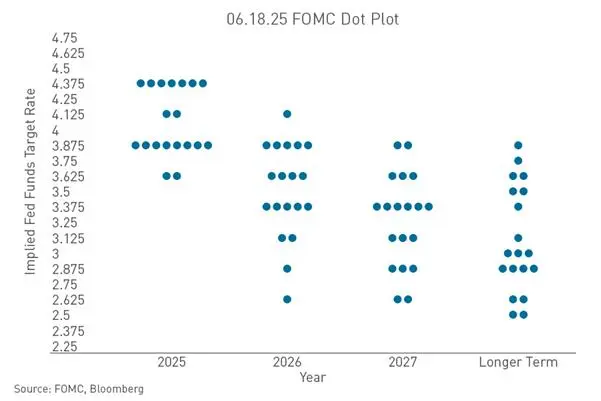
The root of this divergence lies in differing assessments among institutions of the inflation path and economic resilience. The June FOMC dot plot showed that of the 18 officials providing rate forecasts, as many as 9 expected at least one rate hike within 2026. The Fed also removed forward guidance language at its June 17 meeting, entering an "era without guidance." In a world without forward guidance, the market can only reprice the rate path with each new data release — this is the structural reason for the heightened volatility in current expectations.
How Rate Expectations Transmit to Bitcoin: The Pricing Chain from Risk-Free Rate to Risk Premium
Bitcoin, as a risk asset that generates no cash flows, is highly sensitive to the interest rate environment. Higher rates — or even a credible threat of rate increases — tighten liquidity across financial markets. When Treasury yields rise, the opportunity cost of holding non-yielding crypto assets increases.
Specifically, interest rate expectations affect Bitcoin prices through three channels:
- Risk-free rate channel. The federal funds rate sets the benchmark for the cost of funds across the financial market. Rate hike expectations push up short-end Treasury yields, increasing the opportunity cost of holding risk assets and driving capital from the crypto market to low-risk fixed-income assets.
- Liquidity expectations channel. Rate hike expectations are essentially expectations of liquidity tightening. The depth and breadth of the crypto market are highly dependent on the global liquidity environment; rate hike cycles are often accompanied by valuation compression of risk assets.
- U.S. dollar exchange rate channel. Rate hike expectations typically support a stronger U.S. dollar. Data shows that Bitcoin had a very high negative correlation with the U.S. Dollar Index (DXY) in the first half of 2026, approximately -0.85. A stronger dollar directly pressures Bitcoin.
From 58,000 to 63,000: How Bitcoin Reacted to Cooling Rate Hike Expectations
After the nonfarm payrolls data release, Bitcoin rebounded from a low of $59,776 to around $61,507. On July 6, Bitcoin further rose above $63,000, briefly touching $63,900 during the session.
The backdrop to this price recovery is a systematic cooling of rate hike expectations. On July 3, U.S. Bitcoin ETFs recorded $224 million in inflows, ending a 10-day streak of outflows. The market logic is clear: when rate hikes are no longer an imminent risk, risk appetite recovers, driving funds back into crypto assets.
The head of Grayscale Research previously noted that if the Fed keeps rates unchanged for the remainder of 2026, Bitcoin prices could match equity market gains. The core logic is that stable rates mean the liquidity environment will not deteriorate further, providing macro conditions for valuation recovery of risk assets.
As of the time of writing on the evening of July 6, BTC had fallen back to around $61,500 following news that Strategy sold BTC again.
Pricing Crypto Assets in an Era Without Guidance: When the Fed No Longer "Leads the Way"
Warsh stated clearly at the Global Central Bank Governors Forum on July 1 that the Fed will no longer provide forward guidance. This means the market can no longer obtain clues about the future rate path from the Fed's policy statements; each FOMC meeting becomes an independent policy decision event.
For the crypto market, the impact of this change is profound. In the past, forward guidance provided an "anchor" for the policy path, allowing investors to allocate assets over a longer time frame. In the "era without guidance," interest rate expectations will entirely fluctuate with the rhythm of economic data such as inflation and employment. This means crypto assets' macro sensitivity will further increase, and volatility on data release days may continue to rise.
FAQ
Q1: What does the 77% probability from the CME FedWatch mean?
The CME FedWatch tool uses federal funds futures prices to infer the market's probability distribution for interest rate outcomes. The 77% probability means the market sees maintaining rates unchanged in July as the base scenario, with only a 23% probability of a hike. This is not a Fed official commitment, but the collective market judgment expressed through real-money bets.
Q2: Why does Morgan Stanley believe the Fed will not raise rates in 2026?
Morgan Stanley Chief Economist Carpenter, after observing Warsh's comments at the Sintra conference, believes Warsh has shifted from a singular focus on inflation to a more balanced dual mandate, and actively noted that the policy meeting has already lowered market inflation expectations. Combined with the policy space provided by the nonfarm payrolls data, Morgan Stanley maintains its base forecast of no rate hikes all year.
Q3: What impact does the Fed's elimination of forward guidance have on the crypto market?
The elimination of forward guidance means the market can no longer get clues about the future rate path from the Fed's policy statements. The pricing of crypto assets will rely more on real-time interpretation of each economic data release, which may lead to persistently higher volatility.
Q4: What is the relationship between Bitcoin price and Fed rate expectations?
Bitcoin, as a risk asset with no cash flow, is highly sensitive to the interest rate environment. Rate hike expectations raise the risk-free rate, increasing the opportunity cost of holding crypto assets, while also supporting a stronger dollar. Bitcoin's negative correlation with the U.S. Dollar Index is approximately -0.85, further reinforcing this transmission mechanism.
Q5: After the July FOMC meeting, what macro risks could Bitcoin face?
If subsequent inflation data exceeds expectations, the market could reprice the rate hike path, and crypto assets would face dual pressure from liquidity tightening and a stronger dollar. Additionally, in the "era without guidance," any surprise change in economic data could trigger sharp swings in interest rate expectations, which would then transmit to Bitcoin prices.


