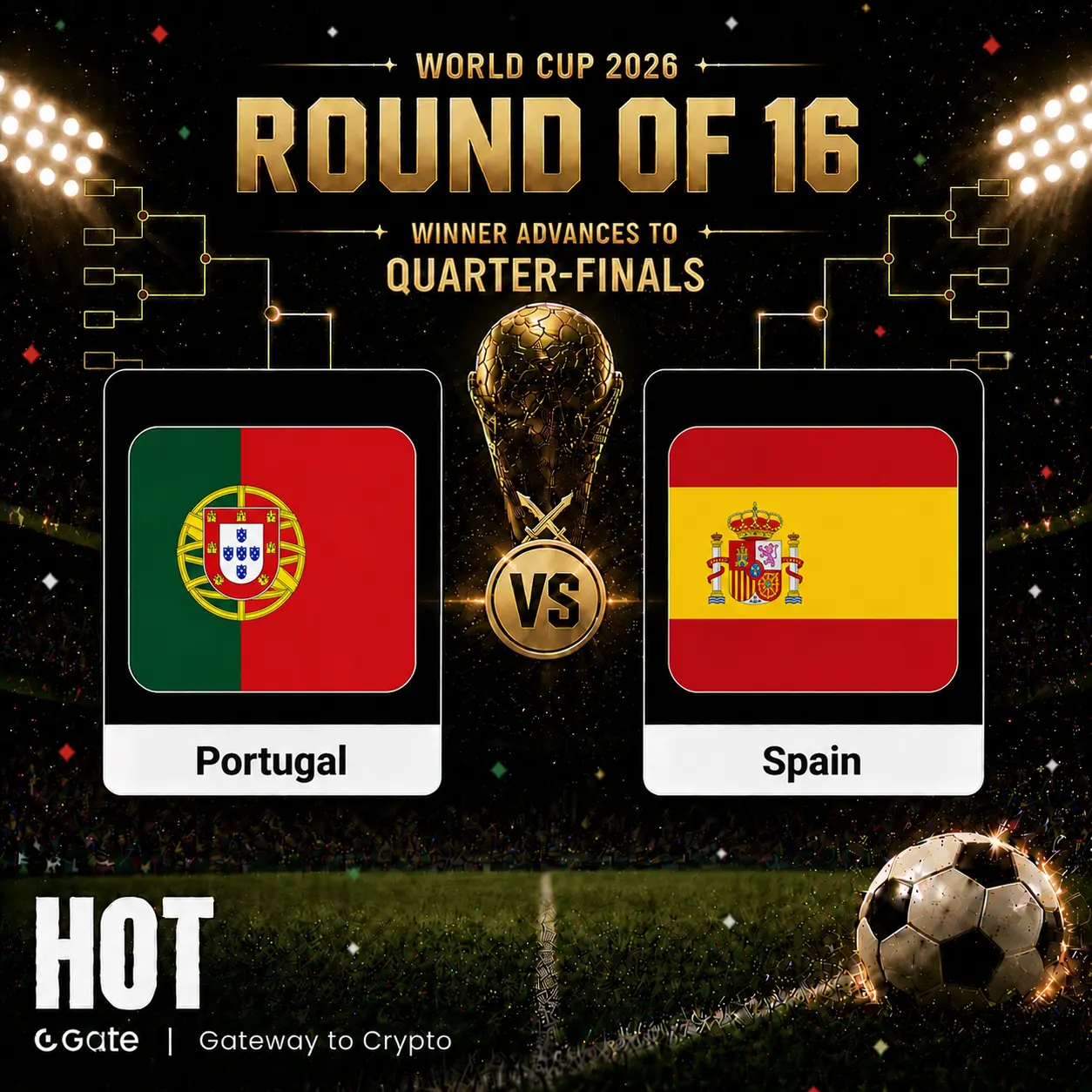
As the World Cup enters the knockout stage, prediction market activity continues to heat up. Gate's limited-time "Gate 世界杯预言王者赛" campaign allows users to participate in prediction trading on the Gate Polymarket World Cup zone, earning points based on the payout multiples of successful predictions. A total prize pool of 100,000 USDT across two leaderboards awaits distribution.
This is not a simple set of win-loss predictions. In the knockout stage, the core of prediction market trading is no longer group stage points or goal difference, but the probability pricing of 90-minute match outcomes. Understanding the logic behind this set of data is more valuable than simply judging who will advance.
Why Spain Is the Favorite — Underlying Basis for Market Pricing
The 51% win rate means the market considers Spain the favorite, but this advantage is not overwhelming. The main logic supporting this probability comes from three levels.
Defensive stability. Spain has kept clean sheets in all four matches of this World Cup so far. Goalkeeper Unai Simón averages only about 1 save per game, reflecting the overall suppression power of Spain's defense — opponents struggle to even produce effective shots. In the knockout stage, defensive stability is often the most valued variable in market pricing.
Possession and rhythm control. Spain averages 68% possession and a 91% pass accuracy. This data indicates that Spain has the ability to impose its familiar rhythm on the match, consuming the opponent and reducing their offensive opportunities through possession. Although Portugal also has possession ability (average 62%), there are questions about whether it can maintain passing efficiency against Spain's high press.
Recent form and psychological advantage. Spain has remained unbeaten in 34 matches, with the last loss dating back to 2025. In international competitions, Spain and Portugal have met 42 times, with Spain clearly leading 19 wins, 16 draws, and 7 losses. Although their most recent encounter — the 2025 UEFA Nations League final — ended 2-2 before Portugal won on penalties, Spain's overall performance in regular time is still regarded by the market as the more reliable side.
What 51% Means — Favorite, Not Guaranteed Win
In the context of traditional sports betting, a 51% win rate is often simplified as "favorite." But in the pricing logic of prediction markets, 51% conveys a much more complex message than "backing Spain."
The core mechanism of prediction markets is that price equals probability: users buy and sell contracts linked to outcomes of future events, with contract prices fluctuating between $0 and $1, directly read as implied probability. A price of 51 cents means the market believes Spain has a 51% chance of winning within 90 minutes — nothing more.
The flip side of this data is that the market believes Spain's non-win probability is as high as 49%. Portugal's 24% win rate plus the 27% draw probability together form an effective counterbalance to Spain's advantage. In other words, while the market lists Spain as the favorite, it still reserves nearly half the uncertainty space.
More importantly, 51% sits right around the critical threshold between "slight advantage" and "even odds." In financial market pricing logic, a probability above 50% only indicates directional preference, while the deviation from 50% is the key metric for measuring certainty. Spain leads Portugal by only 27 percentage points (51% vs. 24%), a gap that does not constitute an overwhelming signal in the knockout context.
The 27% Draw — Caution in Knockouts and a Signal of Close Strength
The 27% draw probability is the most noteworthy number in this set of data.
In the group stage, draws are often seen as the "default result" when two teams are closely matched. But in the knockout stage, draw probabilities tend to be systematically depressed — because market participants naturally lean toward pricing a decisive outcome. However, the draw probability for this match is as high as 27%, close to one-third, indicating that the market sees a real possibility that both sides will struggle to break the deadlock within 90 minutes.
This judgment has solid tactical basis. Both Spain and Portugal play possession-based football — Spain averages 68% possession, Portugal 62%. When two possession-oriented teams meet, the match often turns into a midfield battle with fewer shooting opportunities. Historical data also supports this: in the last five meetings between the two sides, four had total goals under 2.5.
Furthermore, the 2025 UEFA Nations League final ended in a 2-2 draw in regular time, further reinforcing the market's expectation that "it's hard to separate them in regular time." The 27% draw probability indicates that the market not only anticipates the match could go to extra time, but even considers extra time a non-negligible normal path.
Portugal's Attacking Path — Why the Market Still Retains 24% Weight
Portugal's 24% win rate, though lower than Spain's, is far from being "abandoned by the market" in a single knockout match. The underlying logic supporting this probability is equally clear.
Counter-attacking efficiency. Portugal's tactical core is not to vie for possession with Spain, but to create threats through quick transitions. The midfield trio of Bruno Fernandes, Vitinha, and Bernardo Silva possesses excellent ability to switch from defense to attack. If Spain makes mistakes during possession, Portugal can complete the transition from defense to offense within seconds.
Set-piece threat. In a match where possession is expected to be lopsided, set pieces are often the most important scoring method for the underdog. Portugal boasts set-piece specialists and penalty-area finishers like Cristiano Ronaldo, and while the Spanish defense is solid overall, it is not impervious in set-piece defense.
Unpredictability of individual brilliance. The nature of knockout matches dictates that "individual moments" often outweigh "overall performance." Portugal has several players capable of instantly changing the game — Ronaldo's finishing in the box, Rafael Leão's wing breakthroughs, Fernandes's long-range shots and passes. In market pricing, this "high variance" characteristic both brings uncertainty and prevents Portugal's win rate from being further depressed.
Market Signals Worth Watching Before Kickoff
As kickoff approaches, the price movements in prediction markets themselves will become important information carriers. The following dimensions are worth continuous monitoring.
Whether Spain's win rate rises further. If Spain's win rate breaks upward from 51% before the match, it indicates that the market is absorbing more information favorable to Spain (e.g., confirmed starting lineup, real-time form feedback, etc.). Conversely, if the win rate falls below 50%, it means market confidence in Spain's advantage is weakening.
Flow of funds into the draw. The 27% draw probability is already at a relatively high level for the knockout stage. If the draw probability rises further to above 30% before the match, it suggests the market expects an even tighter contest, increasing the likelihood of extra time.
Whether funds return to Portugal close to kickoff. In knockout matches, the market often reassesses the value of "underdogs" near game time. If Portugal's win rate moves from 24% into the 26%–28% range, this could be the market digesting some under-priced information — such as player injuries, tactical adjustments, or weather factors.
Knockout Stage Pricing Logic in Prediction Markets
The Portugal vs. Spain match provides a typical sample for observing the knockout stage pricing logic of prediction markets.
The core conclusion can be summarized into three points: First, Spain's 51% win rate represents the "favorite" rather than the "sure winner" — the market's preference for Spain is conditional and marginal; second, the 27% draw probability is an important signal in the knockout stage, indicating the market believes both sides are close enough in strength that regular time may not produce a winner; third, Portugal's 24% win rate, though lower than Spain's, constitutes a non-negligible tail risk in the context of a single-elimination match.
What sets prediction markets apart from traditional odds systems is that price is probability, and probability itself is the most honest information. 51%, 24%, 27% — these three numbers together form a market perception picture of this match. It is not a prophecy of victory or defeat, but a precise measure of uncertainty.
FAQ
Q1: Why is the draw probability as high as 27% in the knockout stage?
The draw probability in knockout matches is typically systematically depressed because markets tend to price for a decisive outcome. However, the 27% draw probability for this match reflects two factors: first, both sides are closely matched with similar styles (both possession-based); second, historical encounter data shows that four of the last five meetings had total goals under 2.5. The market believes that the possibility of a deadlock within 90 minutes is real.
Q2: Does Spain's 51% win rate mean the market thinks Spain will definitely win?
No. 51% only indicates that the market believes Spain has a slightly higher than half chance of winning within 90 minutes. Spain's "non-win" probability is as high as 49% (Portugal 24% + draw 27%), meaning the market still reserves a huge space of uncertainty for the outcome. 51% is merely a signal of "slight advantage," far from a "sure win."
Q3: How will prediction market prices change before the match?
Prediction market prices will continuously reflect the inflow of new information. Factors that may affect prices before the match include: confirmed starting lineups, player injury updates, real-time form feedback, weather conditions, and self-reinforcing market sentiment. If Spain's win rate rises further, it indicates the market is absorbing more favorable information for Spain; conversely, a decline means the advantage is weakening.
Q4: How to participate in the Gate World Cup Prediction King event?
After logging into Gate, users click 立即报名 on the event page, then go to the Gate Polymarket World Cup zone, select a World Cup-related prediction market, and complete a single transaction of ≥10 USDT. The system will calculate points based on the payout multiple after prediction settlement, with the formula: (payout multiple - 1) × 100. The event features two independent leaderboards — Match Predictions and Fun Quizzes — each with a 50,000 USDT prize pool. Users can participate in both leaderboards simultaneously to compete for a total of 100,000 USDT rewards. Note: A cumulative effective trading volume of ≥50 USDT per single leaderboard is required to qualify for ranking.