OpenAI’s official release of a GPT-5.6 prompt guideline: internal tests show that after significantly trimming a lengthy system prompt, scores not only don’t drop—they rise by 10% to 15%, while token usage is reduced by 41% to 66%. The core recommendation of the guideline is that developers only need to tell the model the expected results and red lines; they don’t need to specify how to take every step. The model will choose the efficiency path on its own.
Test data for simplifying the system prompt
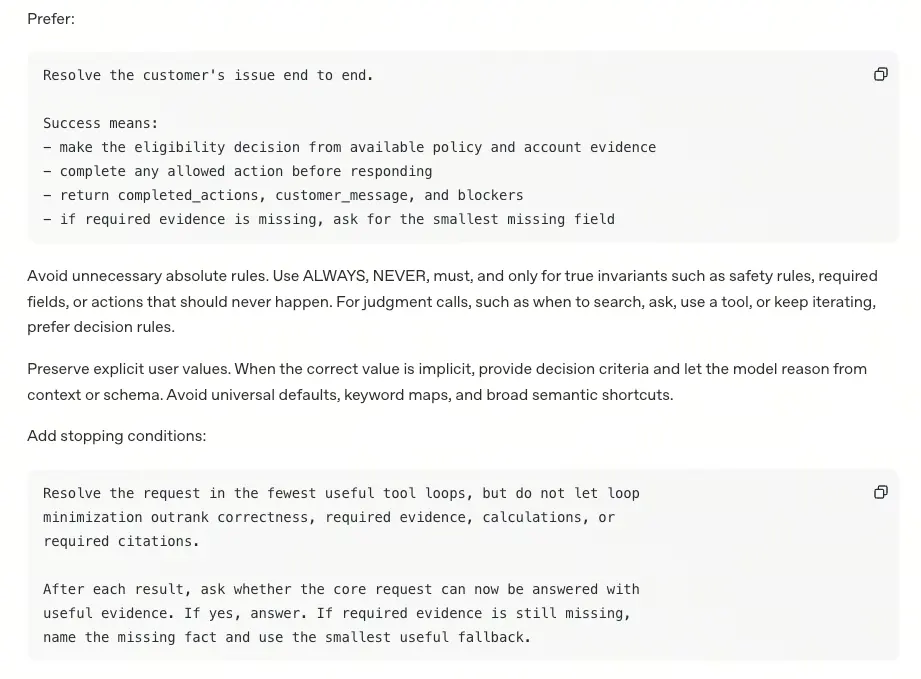 (Source: OpenAI official website)
According to the OpenAI GPT-5.6 guideline, engineering teams’ hands-on testing found that the following four categories of content in the system prompt can be removed, and after removing them the model’s performance is actually better:
Repeated rules: paragraphs that repeatedly emphasize the same restriction
Style instructions with no real behavioral impact: e.g., “Answer professionally,” “Answer briefly,” etc. (GPT-5.6’s defaults are already more concise)
Unnecessary examples: demonstrations that don’t add effective information
Process guidance the model can already do anyway: too much step-by-step instruction
The recommended simplification method is “start from a version that runs, then delete gradually”: keep the effective prompts first, remove questionable parts one by one, and track eval (quantified scores) at the same time; if the score doesn’t drop, deletion can be confirmed. The content that truly should be preserved includes: visible definitions of outcomes, success and stop criteria, safety and commercial constraints, and tool-selection rules and output formatting.
New writing core: only write results and red lines
Per the OpenAI GPT-5.6 guideline, the most core prompt principle is: “Define the result, important constraints, usable evidence, completion criteria, and then leave room for the model to choose an efficient path on its own.” The example policy OpenAI provides is: “Solve the request with the fewest useful tool loops, but you can’t sacrifice correctness, necessary evidence, or citations to reduce the number of loops”—this is a decision rule, not a hard command.
On parameter usage, text.verbosity (low/medium/high) is designed specifically to control the length of the response; tone and formality should be described separately. Reasoning effort (low/medium/high/xhigh/max) manages the model’s thinking strength, but before increasing it, OpenAI recommends first confirming whether the prompt itself has already clearly defined success criteria and the verification loop—“making the instructions clear often works better than adding more thinking.”
Tool descriptions are also part of the prompt: tools should be kept only if they’re relevant to the task. Each tool description should state what it does, when to use it, and how it should behave when it fails.
Frequently asked questions
Why does simplifying the system prompt increase GPT-5.6’s score instead?
According to the guideline from OpenAI, an overly detailed system prompt adds unnecessary parsing burden to the model, and duplicated or redundant instructions may interfere with the model’s assessment of the true priorities. GPT-5.6 itself has strong reasoning capabilities; after providing goals and constraints, it can choose an effective path on its own. Overly prescriptive step requirements instead constrain its performance.
How should the text.verbosity and reasoning effort parameters be set?
According to OpenAI’s guidance, text.verbosity has three tiers (low/medium/high) and controls the response length specifically; reasoning effort has five levels (low/medium/high/xhigh/max) and manages the model’s thinking strength. The two should be set separately and should not rely on stacking text in the system prompt. Before raising reasoning effort, you should first confirm that the prompt clearly defines success criteria, because in many cases “making the instructions clear works better than thinking more.”
What is the correct order for migrating a prompt workflow?
According to OpenAI’s guideline, the correct migration order is: first swap the model (keeping the original reasoning settings) → run eval as the baseline → remove outdated scaffolding and repeated instructions → make the smallest possible fixes only to the parts where eval shows real regressions → re-measure. The key principle is to change only one variable at a time; don’t modify the model, reasoning settings, prompt, and toolset at the same time, otherwise you can’t tell which one caused the behavioral change.


