# BernsteinSaysMemoryBullMarketToLastUntil2027

480.2K

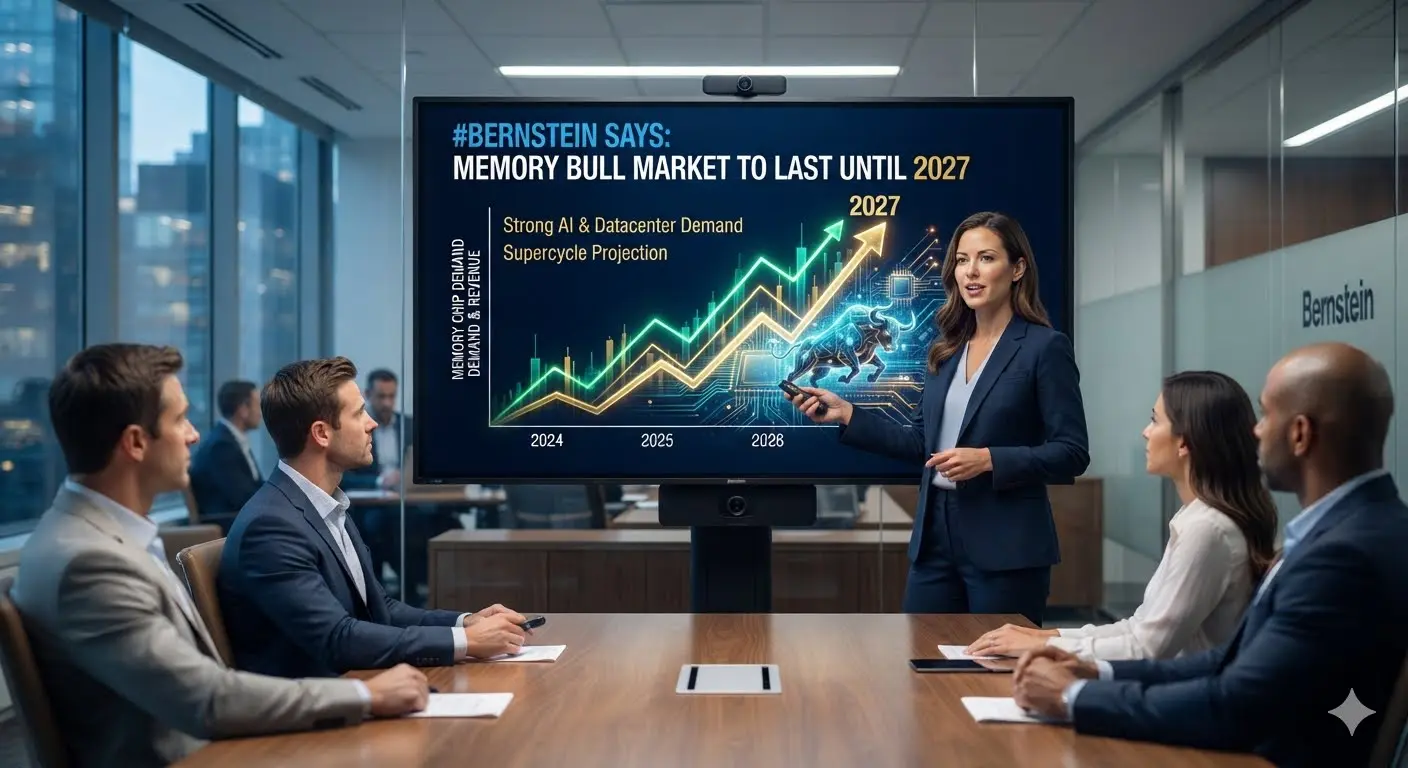
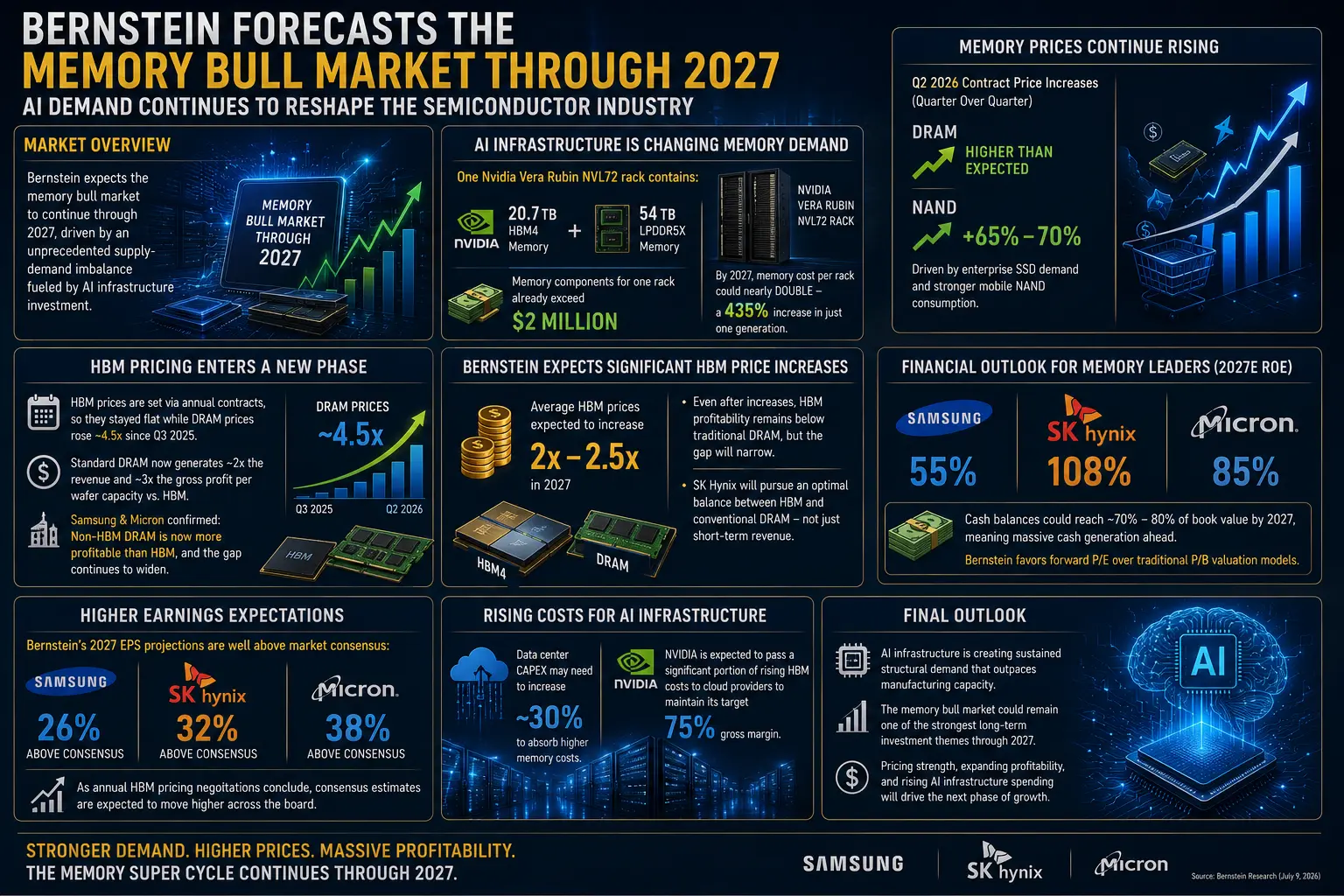
Bernstein's monthly storage report indicates the current memory bull market is expected to last until 2027, though the rapid price surge phase has passed. Q2 DRAM prices rose 74% quarter-over-quarter, with Server and Mobile DRAM up over 60% and nearly 80% respectively. Q3 DRAM growth is expected to slow to 13%-18% as consumer electronics demand weakens. NAND shows divergent trends — wafer prices softening but mobile and SSD contract prices up 60%. Long-term orders from AI cloud providers are the key cyclical driver. The bank maintains positive ratings on Samsung, SK Hynix, Micron, and SanDisk, while remaining cautious on Kioxia.

$NVDAX ‌NVIDIA Outlook: AI Demand Continues to Drive Long-Term Growth
NVIDIA remains one of the biggest beneficiaries of the AI boom. Demand for its Blackwell GPUs continues to exceed supply, while major cloud providers—including Microsoft, Amazon, Google, and Meta—are investing heavily in AI infrastructure. As long as AI spending remains strong, NVIDIA's long-term outlook stays positive.
From a technical perspective, NVDA has recovered from a roughly 25% pullback from its May all-time high and has reclaimed the daily 200-day moving average, signaling renewed bullish momentum.
Trade Plan
- Ac
NVDAX3.80%
  • Reward
  • 3
  • Repost
  • Share
Kartal1520:
nvdai long. go go mvdai
View More
Bernstein Forecasts the Memory Bull Market Through 2027: AI Demand Continues to Reshape the Semiconductor Industry
Market Overview
The global memory semiconductor cycle may be far from over.
According to a landmark research report from Bernstein, the current memory bull market is expected to continue through 2027, supported by an unprecedented supply-demand imbalance driven by accelerating artificial intelligence infrastructure investment.
Rather than viewing the current cycle as a temporary recovery, Bernstein argues that structural AI demand is creating a fundamentally different environment
NVDA4.06%
MSFT0.19%
AMZN-0.68%
MU-1.19%
SK Hynix-0.27%
post-image
post-image
  • Reward
  • 1
  • Repost
  • Share
HighAmbition:
good information 👍 good
#BernsteinSaysMemoryBullMarketToLastUntil2027
The AI boom is no longer driven by software alone. Behind every advanced AI model is an enormous demand for one critical resource—high-performance memory chips. According to Bernstein's latest outlook, this demand is expected to keep the memory industry in a bullish cycle through 2027, sending a strong message to both technology investors and the semiconductor market.
This isn't a traditional semiconductor rally.
It's an infrastructure expansion.
Every new AI model, cloud platform, and hyperscale data center requires faster memory, higher bandwidt
SoominStar
#BernsteinSaysMemoryBullMarketToLastUntil2027
The AI boom is no longer driven by software alone. Behind every advanced AI model is an enormous demand for one critical resource—high-performance memory chips. According to Bernstein's latest outlook, this demand is expected to keep the memory industry in a bullish cycle through 2027, sending a strong message to both technology investors and the semiconductor market.
This isn't a traditional semiconductor rally.
It's an infrastructure expansion.
Every new AI model, cloud platform, and hyperscale data center requires faster memory, higher bandwidth, and greater processing efficiency. That structural demand continues to outpace global supply, giving leading memory manufacturers significant pricing power.
At the center of this transformation is SK Hynix, which has established itself as one of the dominant players in the High-Bandwidth Memory (HBM) market. Micron continues to strengthen its long-term position through multi-year customer agreements, while Samsung remains a global heavyweight with massive manufacturing capabilities and expanding AI ambitions.
One of the strongest bullish signals is production visibility.
Much of the industry's advanced memory capacity has already been committed well into the future.
That means demand isn't based on short-term excitement.
It is supported by real customer orders and long-term infrastructure investment.
Another powerful catalyst is hyperscale spending.
The world's largest technology companies continue investing billions of dollars into AI infrastructure, creating sustained demand for advanced memory solutions. As AI workloads become larger and more complex, memory performance is becoming just as important as computing power itself.
Recent price corrections across semiconductor stocks have created uncertainty for some investors.
I see them differently.
Corrections are a normal part of every long-term bull market.
They don't automatically change the underlying fundamentals.
As long as AI investment continues accelerating, memory manufacturers remain positioned to benefit.
Why This Matters
• AI infrastructure demand continues expanding globally.
• High-performance memory remains in limited supply.
• Long-term customer contracts improve revenue visibility.
• Industry leaders maintain strong competitive advantages.
• AI investment supports future pricing power.
My View
The semiconductor industry has entered a new era where memory is no longer treated as a low-margin commodity.
It has become strategic infrastructure.
Companies leading this segment are likely to remain at the center of the AI revolution for years to come.
My Prediction
I believe the memory chip supercycle has not reached its peak.
If AI infrastructure spending remains on its current trajectory, leading memory manufacturers could continue delivering strong financial performance through 2027.
Short-term volatility may continue, but I expect it to create opportunities rather than signal the end of the trend.
The market is shifting from temporary AI enthusiasm to long-term infrastructure investment.
That transition changes everything.
The companies producing the memory powering tomorrow's AI systems are no longer simply semiconductor businesses—they are becoming essential pillars of the global digital economy.
My Prediction: The AI memory sector will remain one of the strongest-performing technology industries through 2027, with leading manufacturers continuing to benefit from structural demand, limited supply, and expanding global AI adoption.
@Gate_Square
repost-content-media
  • Reward
  • 12
  • Repost
  • Share
BlackBullion_Alpha:
Bull Run 🐂
View More
#BernsteinSaysMemoryBullMarketToLastUntil2027
Artificial intelligence is rapidly transforming the global semiconductor industry, and one segment continues to stand above the rest: advanced memory. As AI models become larger and more computationally intensive, the need for faster, higher-capacity memory is accelerating at an unprecedented pace. This structural shift has prompted Bernstein to maintain a bullish outlook on the memory sector, forecasting that the current upcycle could remain intact through 2027.
Unlike previous memory booms that were heavily dependent on smartphone, PC, and consu
SK Hynix-0.27%
SKHYV-0.98%
MU-1.19%
post-image
  • Reward
  • 7
  • Repost
  • Share
PrinceMagsi786:
To The Moon 🌕
View More
#BernsteinSaysMemoryBullMarketToLastUntil2027
We are moving away from the chaotic, sudden price spikes triggered by the panic following supply shortages; instead, we are entering a period of structurally sound, AI-driven expansion expected to last until 2027.
The dynamics driving this cycle explain why the market has remained resilient despite slowing consumer demand.
Q2 2026 Price Increases and Q3 Slowdown: The second quarter of 2026 was tremendous for memory manufacturers; however, the slowdown in the third quarter signals that consumers are reaching the limits of their purchasing power.
Tr
SK Hynix-0.27%
SKHYV-0.98%
MU-1.19%
DRAM-2.02%
ybaser
#BernsteinSaysMemoryBullMarketToLastUntil2027
We are moving away from the chaotic, sudden price spikes triggered by the panic following supply shortages; instead, we are entering a period of structurally sound, AI-driven expansion expected to last until 2027.
The dynamics driving this cycle explain why the market has remained resilient despite slowing consumer demand.
Q2 2026 Price Increases and Q3 Slowdown: The second quarter of 2026 was tremendous for memory manufacturers; however, the slowdown in the third quarter signals that consumers are reaching the limits of their purchasing power.
Traditional DRAM: Average increase of 74%; growth is expected to moderate to the 13%–18% range.
Server DRAM: +60% to +67%; bolstered by high-performance DDR5 modules; spot prices are trading at significant premiums compared to contract prices.
Mobile DRAM: ~80%; experienced a sharp peak, but smartphone manufacturers (OEMs) are now adjusting procurement schedules and scaling back configurations due to costs.
NAND Flash: ~60% (overall contract); significant divergences are evident. Wafer spot prices fell 3%–4% in June, yet the enterprise SSD and mobile storage segments (+70% to +80%) sustained the market.
AI-Driven Structural Shift: Why Is This Time Different? Historically, memory cycles have been characterized by "boom-and-bust" patterns: suppliers build up excess capacity, consumer demand for PCs and smartphones drops, and prices hit rock bottom.
This cycle is being fundamentally reshaped by two key forces:
Long-Term Agreements (LTAs): Hyperscale data center operators and Tier-1 US Cloud Service Providers (CSPs) are no longer relying solely on purchases from the open spot market. They are signing 3-to-5-year contracts that include strict price floors to protect against downturns. For instance, while suppliers like SK Hynix and Micron signed major LTAs early in the year to secure product allocations, Samsung adopted an aggressive stance aimed at achieving higher price ceilings.
Capacity Shifting (Cannibalization): Insatiable demand for High Bandwidth Memory (HBM) and advanced server DDR5 means manufacturers are shifting physical wafer capacity away from traditional PC and mobile DRAM production toward these sectors. Even as demand for consumer electronics weakens, overall supply remains constrained because production facilities (fabs) are focused on manufacturing high-margin AI chips.
Supplier Outlook
Bernstein’s view highlights the winners of this highly diversified, AI-centric production strategy:
Samsung, SK Hynix, and Micron (Outperform): These three companies are the primary beneficiaries of the HBM and DDR5 boom; they possess substantial, secured backlogs of Long-Term Agreement (LTA) orders that smooth out their revenue trajectories through 2027.
SanDisk (Outperform): Highly advantaged due to its exceptionally strong structural positioning in enterprise SSD contracts, offering a high price floor (~$0.29/GB) that shields it from minor fluctuations in NAND wafer prices.
Kioxia (Cautious/Underperform): Exposed to more volatile, non-LTA commodity flash markets and less insulated from the softening consumer wafer segment.
The "rocket ship" phase of monthly price surges is ending, but do not mistake this for the end of the bull market. The structural baseline for memory pricing remains at a high level. Normalization is not expected to fully take hold until late 2027 or 2028, as newly constructed production capacity finally comes online.
repost-content-media
  • Reward
  • 5
  • Repost
  • Share
PrinceMagsi786:
2026 GOGOGO 👊
View More
#BernsteinSaysMemoryBullMarketToLastUntil2027
𝗕𝗘𝗥𝗡𝗦𝗧𝗘𝗜𝗡 𝗘𝗫𝗣𝗘𝗖𝗧𝗦 𝗔𝗜 𝗠𝗘𝗠𝗢𝗥𝗬 𝗕𝗨𝗟𝗟 𝗠𝗔𝗥𝗞𝗘𝗧 𝗧𝗢 𝗖𝗢𝗡𝗧𝗜𝗡𝗨𝗘 𝗨𝗡𝗧𝗜𝗟 𝟮𝟬𝟮𝟳 • 𝗛𝗕𝗠 𝗗𝗘𝗠𝗔𝗡𝗗 𝗦𝗧𝗔𝗬𝗦 𝗦𝗧𝗥𝗢𝗡𝗚 • 𝗔𝗜 𝗜𝗦 𝗥𝗘𝗦𝗛𝗔𝗣𝗜𝗡𝗚 𝗧𝗛𝗘 𝗖𝗛𝗜𝗣 𝗜𝗡𝗗𝗨𝗦𝗧𝗥𝗬
𝗧𝗛𝗘 𝗔𝗜 𝗥𝗔𝗖𝗘 𝗜𝗦𝗡'𝗧 𝗦𝗟𝗢𝗪𝗜𝗡𝗚 𝗗𝗢𝗪𝗡—𝗔𝗡𝗗 𝗡𝗘𝗜𝗧𝗛𝗘𝗥 𝗜𝗦 𝗧𝗛𝗘 𝗗𝗘𝗠𝗔𝗡𝗗 𝗙𝗢𝗥 𝗠𝗘𝗠𝗢𝗥𝗬.
Artificial intelligence is changing the semiconductor industry faster than almost anyone expected. Every new AI model requires more computing power, and that demand cannot be met without high-performanc
SK Hynix-0.27%
SKHYV-0.98%
MU-1.19%
post-image
post-image
  • Reward
  • 5
  • Repost
  • Share
PrinceMagsi786:
2026 GOGOGO 👊
View More
#BernsteinSaysMemoryBullMarketToLastUntil2027
🚀 The global memory semiconductor industry is entering one of its most exciting growth phases, and recent market analysis suggests that this bullish cycle could remain strong through 2027. 📈
This optimistic outlook is being driven by a powerful combination of technological innovation, expanding AI infrastructure, cloud computing, high-performance data centers, and the growing demand for advanced memory solutions across multiple industries.
💡 Why is the memory market attracting so much attention?
Artificial Intelligence continues to reshape the
post-image
post-image
post-image
  • Reward
  • 5
  • Repost
  • Share
PrincessOfBitcoin:
To The Moon 🌕
View More
#BernsteinSaysMemoryBullMarketToLastUntil2027
The AI memory boom is far from over.
Bernstein believes the current memory supercycle could extend through 2027, driven by explosive demand for High-Bandwidth Memory (HBM), AI servers, and next-generation data centers.
📊 Key Highlights
🔹 Memory bull market expected to continue until 2027.
🔹 HBM demand is accelerating as AI models become larger and more compute-intensive.
🔹 DRAM pricing remains supported by tight supply and strong AI infrastructure spending.
🔹 Leading memory manufacturers are expanding production to meet growing demand.
🔹 AI
DRAM-2.02%
CLOUD3.09%
  • Reward
  • 10
  • Repost
  • Share
EagleEye:
2026 GOGOGO 👊
View More
#BernsteinSaysMemoryBullMarketToLastUntil2027
The AI Memory Boom Isn’t Ending - It’s Entering a More Mature Phase. Memory stocks, and they’ve been the AI trade’s biggest winners over the last year. Now, Bernstein analysts think the cycle could persist well into 2027, but there’s an important twist: the era of eye-watering growth might be giving way to more sustainable gains. It actually makes sense to me.
After all, it’s unlikely DRAM prices can keep surging more than 70% a quarter, forever.
Markets just don’t work that way. Instead, Bernstein says, what looks like slowing growth could just
DRAM-2.02%
post-image
post-image
  • Reward
  • 17
  • Repost
  • Share
ybaser:
2026 GOGOGO 👊
View More
#BernsteinSaysMemoryBullMarketToLastUntil2027
Bernstein, a leading global investment research and asset management firm, has issued a bold prediction that the memory chip bull market will extend through 2027, driven by unprecedented demand from artificial intelligence infrastructure, data centers, and high-performance computing applications. This forecast represents a significant bullish signal for major memory chip manufacturers including SK Hynix, Samsung Electronics, and Micron Technology, indicating that the current uptrend in the semiconductor sector has substantial runway ahead.
The mem
HighAmbition
#BernsteinSaysMemoryBullMarketToLastUntil2027
Bernstein, a leading global investment research and asset management firm, has issued a bold prediction that the memory chip bull market will extend through 2027, driven by unprecedented demand from artificial intelligence infrastructure, data centers, and high-performance computing applications. This forecast represents a significant bullish signal for major memory chip manufacturers including SK Hynix, Samsung Electronics, and Micron Technology, indicating that the current uptrend in the semiconductor sector has substantial runway ahead.
The memory chip industry has experienced a remarkable transformation over the past eighteen months, evolving from a cyclical commodity business into a critical enabler of the AI revolution. High-Bandwidth Memory (HBM) chips have emerged as the most sought-after components in the semiconductor supply chain, with demand significantly outpacing available manufacturing capacity. SK Hynix currently dominates the HBM market with approximately 58% global market share, substantially ahead of Micron's 21% market share. This leadership position has positioned SK Hynix as the primary beneficiary of the AI infrastructure buildout, with Bernstein projecting that the company will achieve gross margins of 91% by the second quarter of 2026, accompanied by operating margins between 70% and 80%. These figures compare favorably to Micron's projected operating margins of 50% to 55%, highlighting SK Hynix's superior competitive positioning in the high-margin HBM segment.
Micron Technology has also demonstrated exceptional performance, with the company reporting record quarterly revenue of $41.46 billion and adjusted gross margins reaching 84.6%. The company has secured approximately $100 billion in contracted multi-year revenue through non-cancelable, take-or-pay agreements, effectively insulating its business from the traditional boom-bust cycles that have historically characterized the DRAM industry. Micron has committed up to $3 billion toward domestic expansion initiatives, including $500 million in strategic financing to GlobalWafers to support its Sherman, Texas facility, alongside a ten-year silicon wafer supply agreement that locks in raw material capacity for the foreseeable future. The company's HBM supply has been completely sold out through 2028, underscoring the structural supply-demand imbalance that continues to drive pricing power across the memory chip sector.
Samsung Electronics, the world's largest memory chip manufacturer, has experienced an extraordinary financial turnaround, with operating profit surging approximately 18-fold year-over-year to reach record levels in the second quarter. The company's shares have appreciated 158% this year, while SK Hynix shares have gained 273% and Micron shares have risen 242%. All three companies have now achieved market capitalizations exceeding $1 trillion, reflecting investor confidence in the sustained growth trajectory of the AI memory market. Nomura Securities anticipates that commodity DRAM prices will increase 24% quarter-over-quarter and NAND prices will rise 25% in the July through September period, supported by robust demand from both consumer memory products and chips for traditional and AI data centers.
The pricing environment for memory chips has reached levels not seen in years, with Micron reporting that DRAM memory chip prices rose more than 60% in the quarter ended May 28 compared with the previous quarter, while NAND flash memory prices increased more than 80%. These dramatic price increases reflect the growing importance of semiconductor suppliers within the AI supply chain, as chip manufacturers benefit from one of the strongest pricing environments the industry has experienced in decades. The limited manufacturing capacity for HBM chips has kept supply tight as demand continues to grow exponentially, creating a favorable dynamic for memory chip makers who can command premium pricing for their products.
The hyperscaler capital expenditure cycle continues to provide fundamental support for memory chip demand. The world's four largest cloud computing providers are projected to spend more than $700 billion on AI infrastructure this year alone, ensuring that demand remains elevated for the components powering next-generation AI systems. Samsung Group and SK Group have announced plans to build two chipmaking plants each in southwest regions, representing a combined investment of 800 trillion won, as they race to expand manufacturing capacity to meet the insatiable demand for AI memory solutions. These massive capital commitments underscore the industry's confidence in the long-term growth prospects for memory chips, with Bernstein's 2027 timeline aligning with the expected duration of the current AI infrastructure buildout cycle.
The structural drivers behind the memory chip bull market extend beyond immediate AI demand to include broader technological trends. The proliferation of edge computing devices, the expansion of 5G networks, and the increasing sophistication of autonomous vehicles all contribute to growing demand for memory solutions. Data centers continue to expand globally, with each new facility requiring substantial memory capacity to support cloud computing services, artificial intelligence training and inference workloads, and big data analytics applications. The transition to higher-density memory technologies, including DDR5 DRAM and advanced NAND flash architectures, creates additional revenue opportunities for manufacturers as customers upgrade their infrastructure to support higher performance requirements.
However, the memory chip sector has recently experienced significant volatility, with the Roundhill Memory ETF declining 25% from its peak in late June, and individual stocks including SK Hynix and SanDisk falling approximately 28% from their June highs. This correction reflects broader market concerns about the sustainability of AI infrastructure spending and potential supply chain disruptions, rather than any fundamental deterioration in the underlying demand outlook. The sector remains up a median of nearly 60% since late March and has added approximately $5 trillion in market value over that period, indicating that the recent pullback represents a healthy consolidation rather than a trend reversal. Bernstein's prediction that the bull market will continue through 2027 suggests that these corrections should be viewed as buying opportunities rather than signals of a broader market top.
The competitive dynamics within the memory chip industry are also evolving in ways that support sustained profitability. The three dominant players, Samsung, SK Hynix, and Micron, have consolidated market share through years of intense competition that drove weaker competitors from the market. This oligopolistic structure enables disciplined capacity management and rational pricing behavior, reducing the risk of the destructive price wars that characterized earlier periods in the industry's history. The technical complexity of HBM manufacturing creates additional barriers to entry, as new competitors would require years of research and development investment to achieve competitive product yields and performance characteristics.
Investment implications of Bernstein's 2027 bull market prediction are substantial for both equity investors and industry participants. The forecast suggests that memory chip stocks may continue to outperform the broader technology sector, driven by earnings growth that exceeds market expectations. The visibility provided by multi-year contracts and sold-out production capacity reduces uncertainty around future revenue and profitability, supporting higher valuation multiples for memory chip companies. For technology companies dependent on memory components, the extended bull market implies continued cost pressures that may impact margins and necessitate strategic adjustments to procurement and product design strategies.
The geographic concentration of memory chip manufacturing in South Korea and the United States creates strategic considerations for policymakers and investors alike. Government initiatives to support domestic semiconductor production, including the CHIPS Act in the United States and similar programs in other countries, are likely to receive continued funding and political support given the critical importance of memory chips to AI competitiveness and national security. These policy tailwinds provide additional support for the investment case in memory chip companies with significant manufacturing presence in jurisdictions with favorable regulatory environments.
Looking ahead to 2027, the memory chip industry appears well-positioned to maintain its growth trajectory, supported by the continued expansion of AI applications, the proliferation of data-intensive technologies, and the structural supply constraints that limit competitive entry. Bernstein's prediction reflects a comprehensive analysis of demand drivers, competitive dynamics, and supply chain conditions that collectively support an optimistic outlook for the sector. While short-term volatility is inevitable in any cyclical industry, the fundamental underpinnings of the memory chip bull market appear robust enough to sustain the current uptrend for several more years, creating attractive investment opportunities for those with the patience to navigate periodic market fluctuations.
The transformation of memory chips from commodity components to strategic enablers of the AI economy represents a permanent shift in the industry's value proposition. As artificial intelligence continues to permeate every aspect of the global economy, from consumer applications to enterprise software to industrial automation, the demand for high-performance memory solutions will only intensify. Bernstein's prediction that this demand will sustain a bull market through 2027 provides a valuable framework for investors seeking to understand the long-term growth potential of the semiconductor sector and position their portfolios accordingly.@Gate_Square
repost-content-media
  • Reward
  • 14
  • Repost
  • Share
ybaser:
To The Moon 🌕
View More
Load More

Join 40 M users in our growing community

⚡️ Join 40 M users in the crypto craze discussion
💬 Engage with your favorite top creators
👍 See what interests you
  • Pinned