# PutinVisitsChina

11.28K

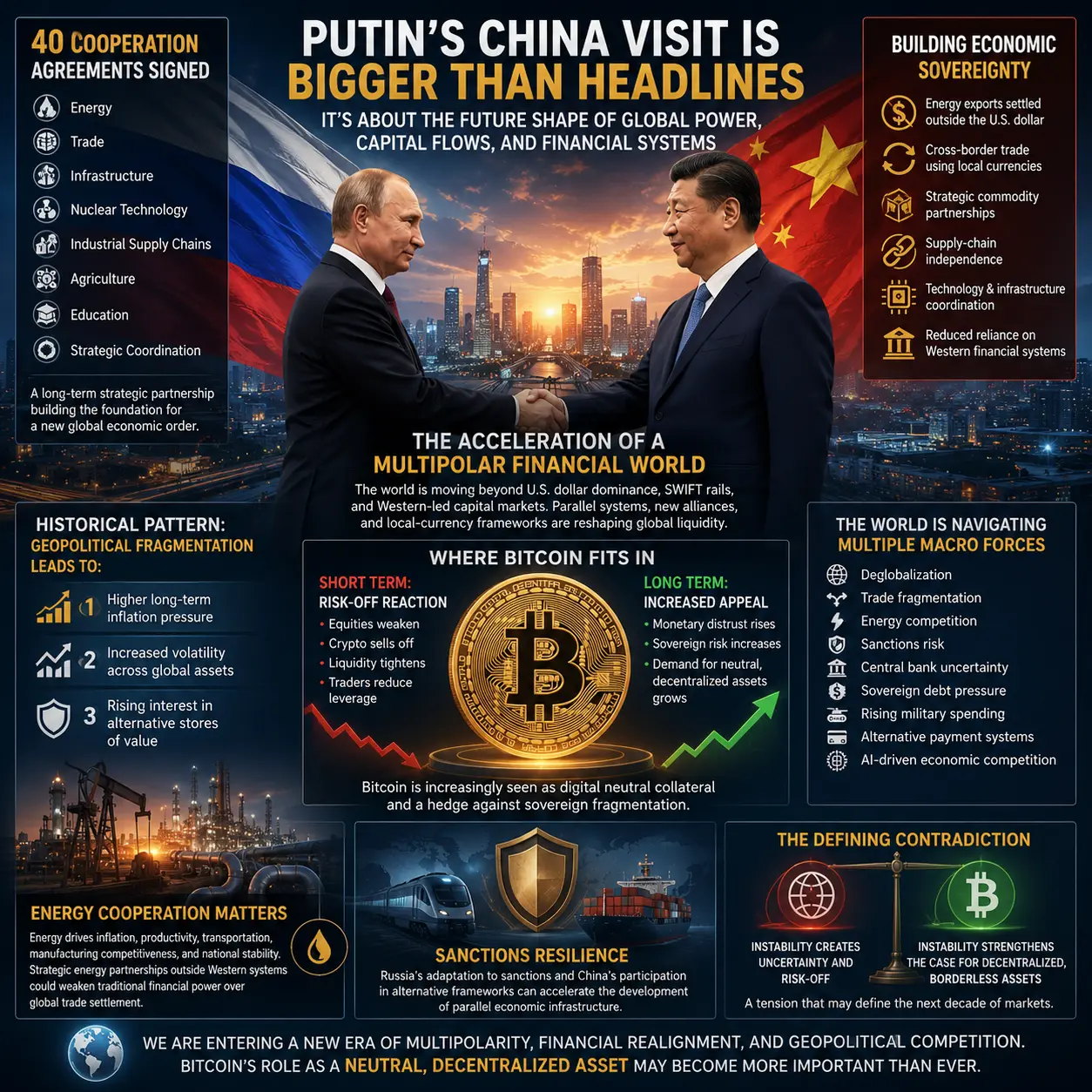
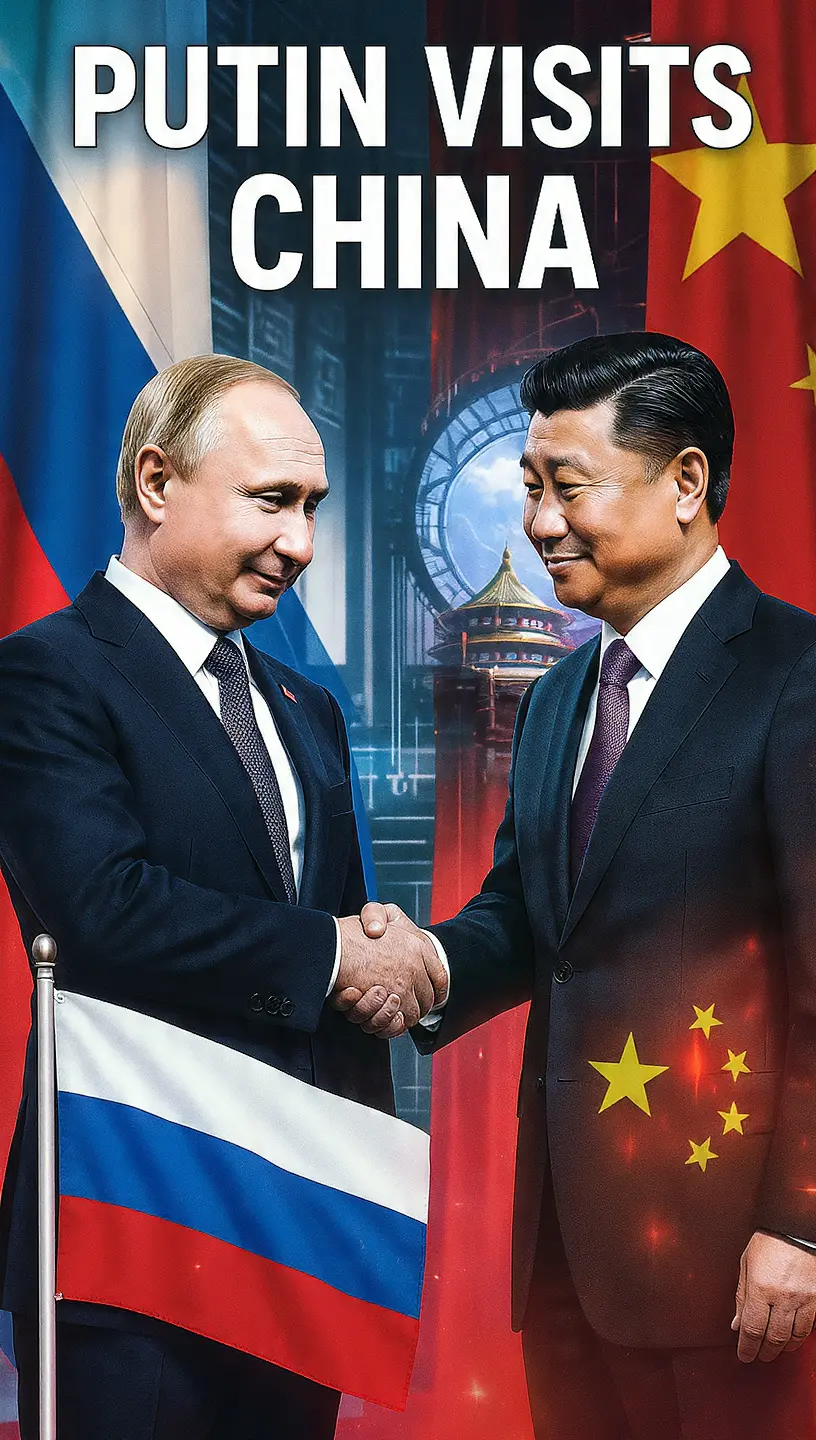
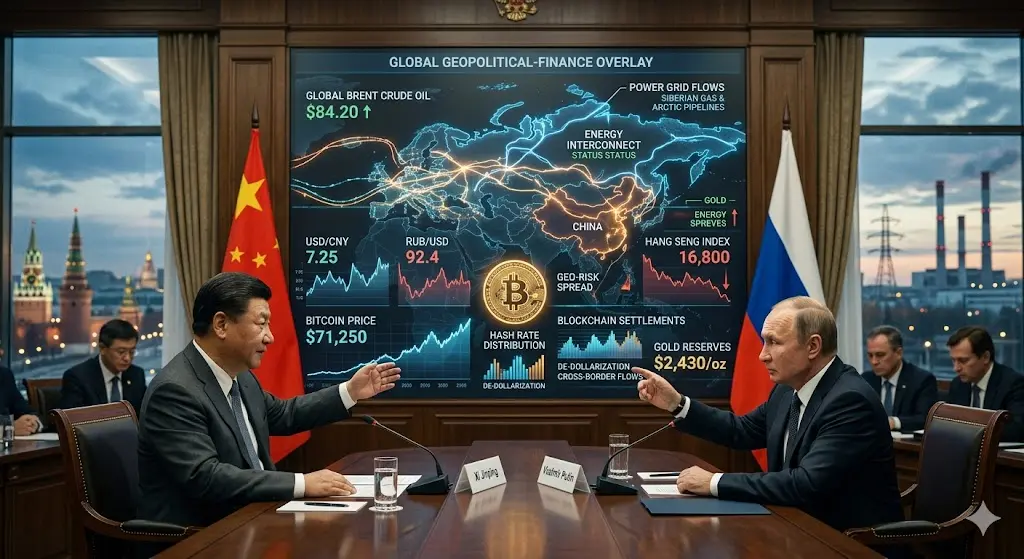
Russian President Putin paid a state visit to China on May 19-20. The two heads of state signed a joint declaration on deepening the comprehensive strategic partnership of coordination for a new era, along with approximately 40 cooperation documents spanning energy, trade, nuclear energy and education. The two sides also launched the China Russia Year of Education. The visit reinforces strategic coordination between the two countries amid continued pressure from the US and Europe.

#PutinVisitsChina
Global markets are entering a period where geopolitics is no longer operating quietly in the background of finance. Every strategic meeting between major world powers now directly influences liquidity conditions, commodity pricing, inflation expectations, capital allocation, and the long-term direction of global financial systems. Putin’s latest visit to China is not just another diplomatic headline designed for media coverage. It represents a much deeper shift taking place beneath the surface of the global economy as nations gradually reposition themselves inside an increas
Vortex_King
#PutinVisitsChina
Global markets are entering a period where geopolitics is no longer operating quietly in the background of finance. Every strategic meeting between major world powers now directly influences liquidity conditions, commodity pricing, inflation expectations, capital allocation, and the long-term direction of global financial systems. Putin’s latest visit to China is not just another diplomatic headline designed for media coverage. It represents a much deeper shift taking place beneath the surface of the global economy as nations gradually reposition themselves inside an increasingly fragmented and competitive financial environment.
What many market participants still underestimate is how deeply connected crypto has become to the broader macroeconomic machine. Bitcoin no longer trades as an isolated experimental asset moving independently from traditional finance. Today, digital assets react to the same macro forces influencing equities, bonds, currencies, commodities, and global capital markets. Interest rates, liquidity flows, energy prices, inflation pressure, and geopolitical instability now shape behavior across every major asset class simultaneously. This is why meetings between Russia and China now carry direct implications for market sentiment far beyond politics alone.
Russia and China are strengthening coordination during one of the most unstable economic periods of the modern era. Both nations are expanding discussions surrounding trade systems, payment infrastructure, commodity cooperation, manufacturing supply chains, local currency settlement mechanisms, and long-term strategic alignment. These developments may appear political on the surface, but underneath, they are deeply financial because they influence the future structure of global liquidity movement and international economic power.
The world is slowly transitioning away from a fully centralized economic order dominated by a single financial structure. More countries are exploring alternatives designed to reduce dependency on traditional settlement networks and external monetary influence. As this transition accelerates, blockchain technology quietly becomes more strategically important because decentralized systems offer alternative methods for cross-border settlement, value transfer, and digital liquidity infrastructure outside conventional frameworks.
But markets rarely move in a straight line.
Whenever geopolitical uncertainty increases, financial markets usually react defensively at first. Investors reduce exposure to high-risk assets, volatility expands rapidly, and liquidity conditions become increasingly cautious. This often creates temporary pressure across crypto markets because traders shift toward defensive positioning during unstable macro periods. Emotional participants panic during headlines while experienced investors focus on how liquidity itself is behaving underneath the surface.
Liquidity remains one of the most important forces controlling modern markets. Narratives alone cannot sustain long-term bullish momentum. Financial markets require expanding capital flows, institutional participation, improving macro conditions, and stable investor confidence to maintain aggressive growth cycles. Even when geopolitical fragmentation strengthens the long-term relevance of decentralized systems, short-term price action can still remain highly sensitive to tightening liquidity conditions and rising global uncertainty.
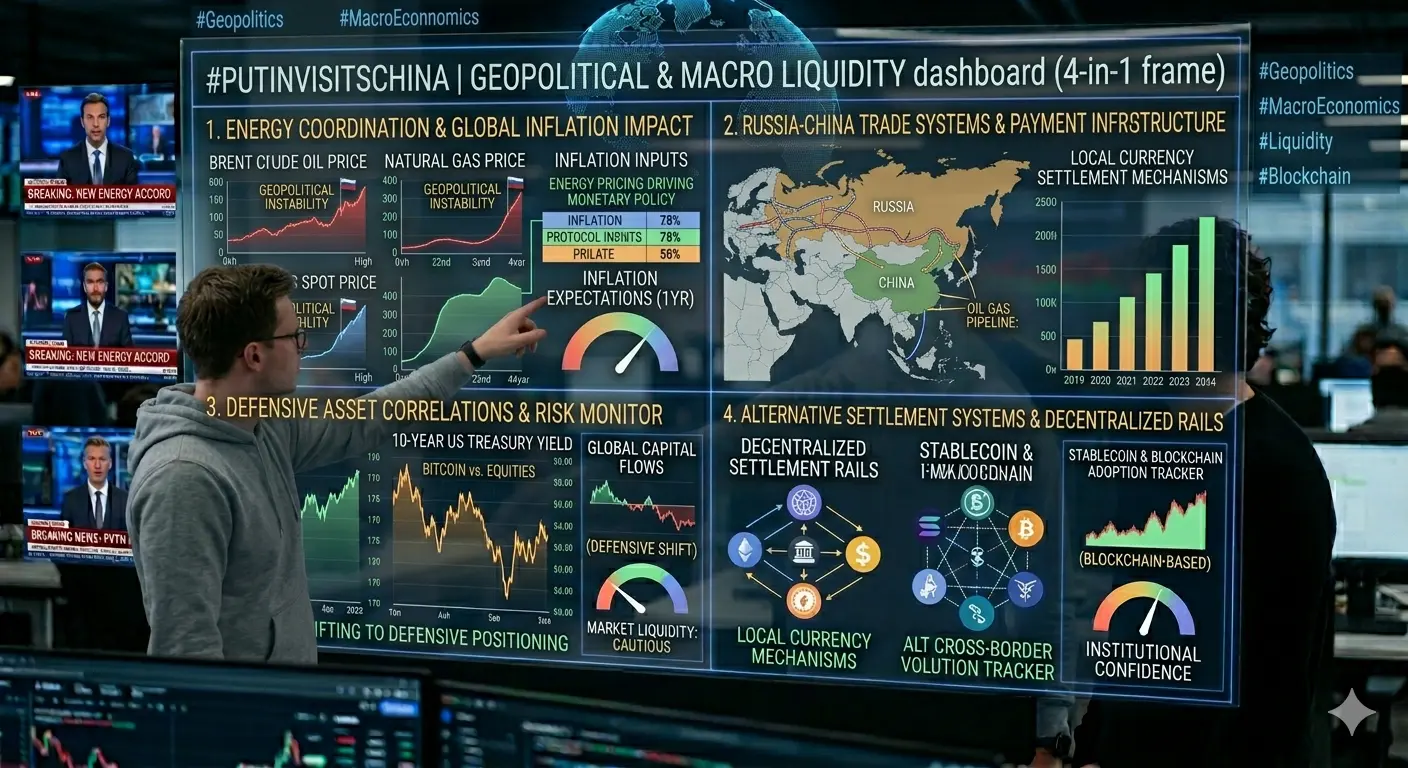
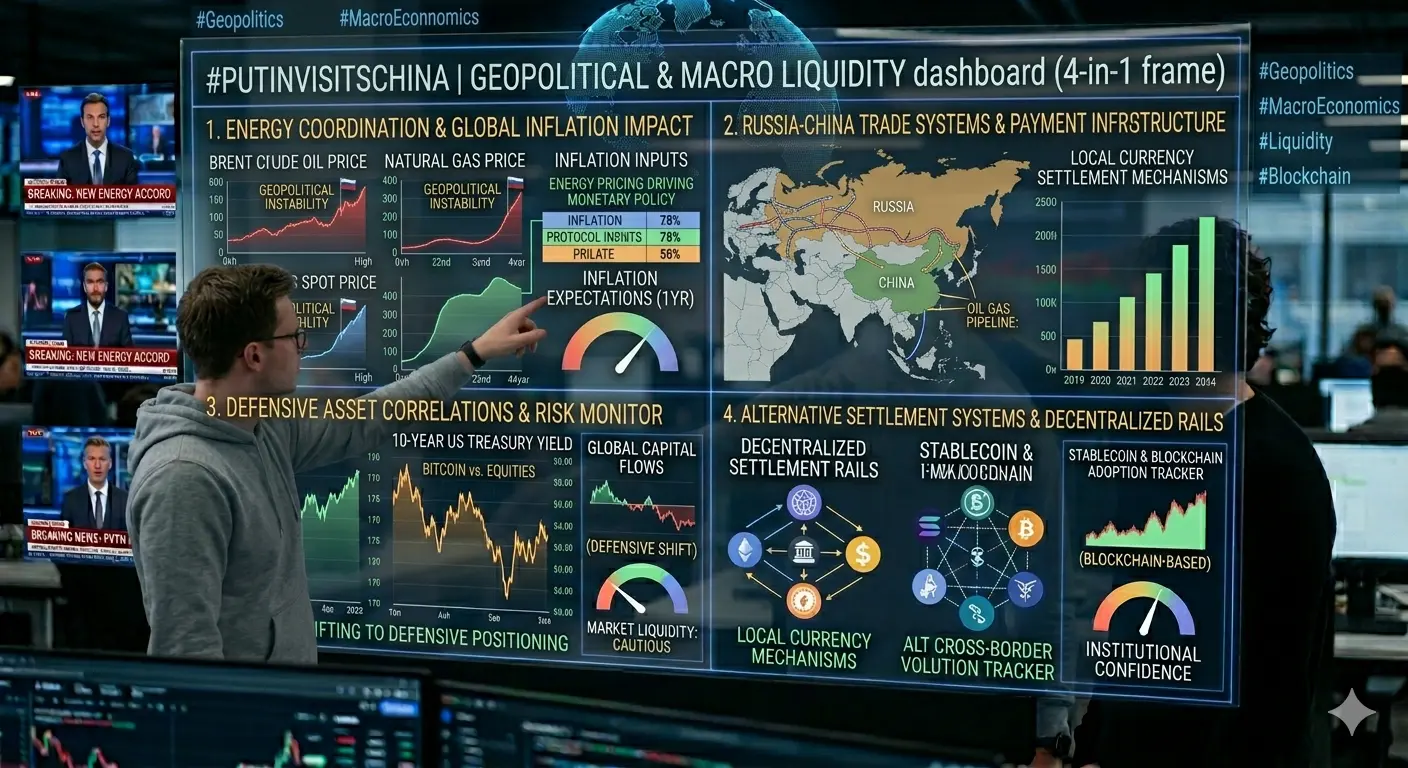
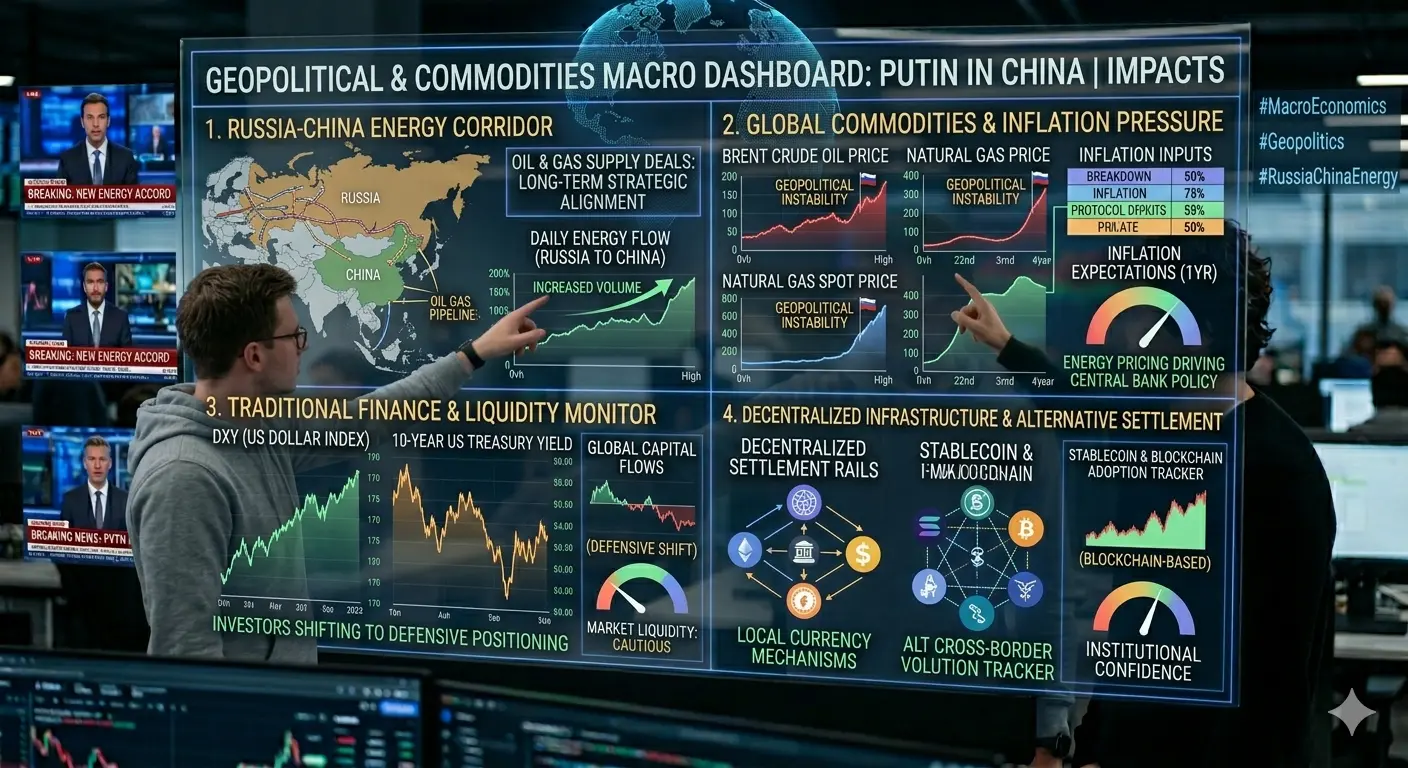
One of the most critical aspects of the Russia-China relationship is energy coordination. Russia remains one of the world’s largest energy exporters while China remains one of the largest energy consumers and industrial powers globally. Any deeper cooperation between these two nations can influence oil markets, natural gas flows, manufacturing costs, transportation systems, industrial production, and global inflation expectations. Energy pricing has become one of the central drivers of modern macroeconomic behavior because it directly impacts central bank policy and long-term liquidity conditions.
If energy prices continue rising aggressively due to geopolitical tensions or supply coordination, markets may begin pricing higher inflation expectations for longer periods. This creates fears surrounding delayed interest rate cuts, tighter monetary conditions, and prolonged pressure on risk assets. Historically, environments dominated by restrictive liquidity conditions have created major volatility across speculative sectors including crypto. This is why professional traders focus heavily on macro liquidity behavior instead of reacting emotionally to headlines alone.
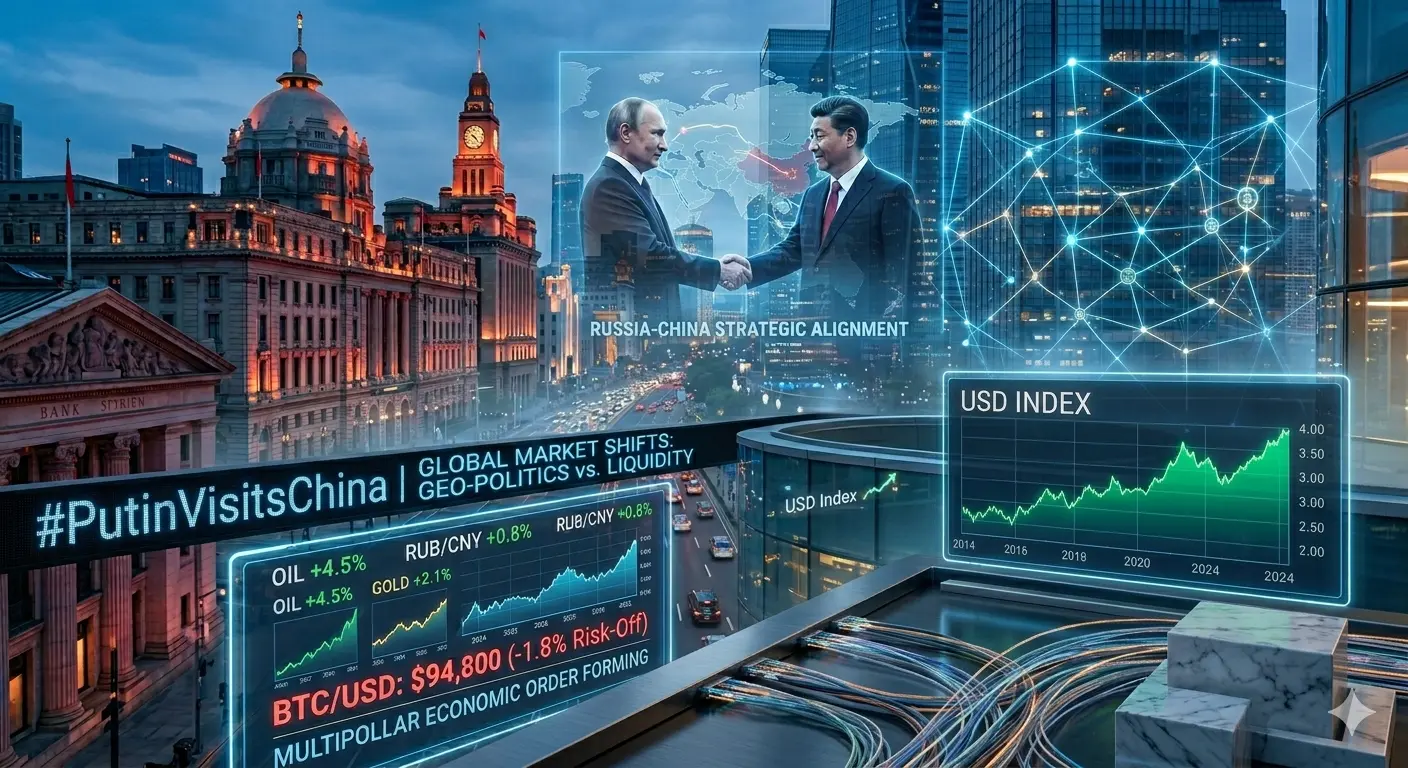
Institutional participants are currently monitoring several major indicators very closely. These include Bitcoin’s correlation with equities, movements in the US Dollar Index, Treasury yield volatility, commodity market reactions, oil pricing trends, stablecoin inflows, and broader institutional positioning behavior. These signals help determine whether markets are experiencing temporary geopolitical stress or beginning to price in a much larger structural transformation inside the global financial system.
The broader picture becoming visible right now is that politics and finance are becoming deeply interconnected. Trade systems are increasingly being used as strategic tools. Reserve currencies are becoming geopolitical leverage mechanisms. Payment infrastructure is evolving into part of national economic security strategy. Capital allocation itself is slowly becoming influenced by political alignment, supply chain control, and strategic resource positioning rather than pure economic efficiency alone.
And directly in the middle of this transition sits blockchain technology.
The long-term relevance of decentralized financial infrastructure may continue growing as nations search for alternative settlement systems and more flexible liquidity frameworks. Stablecoins, tokenized assets, decentralized liquidity rails, and blockchain-based payment infrastructure could eventually become increasingly important inside a fragmented multipolar economic environment. However, the transition toward that future will almost certainly remain highly volatile because every geopolitical escalation now immediately impacts inflation expectations, monetary policy assumptions, energy markets, and global investor confidence.
This creates a difficult environment for traders relying purely on emotion instead of macroeconomic understanding. Markets can reverse aggressively within hours during geopolitical cycles because headlines move rapidly while liquidity conditions adjust more slowly underneath. Disciplined positioning and risk management now matter far more than emotional reactions or short-term narratives driven by fear.
The next decade of crypto may ultimately be shaped less by speculation alone and more by macroeconomic restructuring, institutional capital behavior, geopolitical competition, and the evolution of financial infrastructure itself. The era where digital assets traded independently from global economic conditions is fading. Crypto is now deeply integrated into the broader global liquidity system.
Putin’s visit to China is another reminder that the international financial order itself is gradually evolving. Nations are repositioning strategically. Alternative settlement infrastructure is becoming increasingly valuable. Global alliances are shifting. And decentralized financial technology is quietly moving closer toward the center of the modern economic system.
This is no longer just politics.
This is financial restructuring unfolding in real time.
This is competition over liquidity, influence, energy, and economic power between emerging global blocs.
And markets across the world, including crypto, will continue reacting to every stage of this transformation.
Short-term volatility may continue dominating headlines.
But structurally, the global economy is moving toward an era where decentralized infrastructure, alternative settlement systems, and blockchain-based liquidity networks become increasingly relevant as geopolitical fragmentation accelerates across the world.
The traders who survive this environment will not be the loudest voices chasing headlines across social media.
They will be the participants who understand how liquidity, geopolitics, inflation, energy markets, institutional capital, and macroeconomic restructuring connect together beneath the surface while the majority remain distracted by short-term noise alone.
repost-content-media
  • Reward
  • Comment
  • Repost
  • Share
#PutinVisitsChina
Global markets are entering a period where geopolitics is no longer operating quietly in the background of finance. Every strategic meeting between major world powers now directly influences liquidity conditions, commodity pricing, inflation expectations, capital allocation, and the long-term direction of global financial systems. Putin’s latest visit to China is not just another diplomatic headline designed for media coverage. It represents a much deeper shift taking place beneath the surface of the global economy as nations gradually reposition themselves inside an increas
Vortex_King
#PutinVisitsChina
Global markets are entering a period where geopolitics is no longer operating quietly in the background of finance. Every strategic meeting between major world powers now directly influences liquidity conditions, commodity pricing, inflation expectations, capital allocation, and the long-term direction of global financial systems. Putin’s latest visit to China is not just another diplomatic headline designed for media coverage. It represents a much deeper shift taking place beneath the surface of the global economy as nations gradually reposition themselves inside an increasingly fragmented and competitive financial environment.
What many market participants still underestimate is how deeply connected crypto has become to the broader macroeconomic machine. Bitcoin no longer trades as an isolated experimental asset moving independently from traditional finance. Today, digital assets react to the same macro forces influencing equities, bonds, currencies, commodities, and global capital markets. Interest rates, liquidity flows, energy prices, inflation pressure, and geopolitical instability now shape behavior across every major asset class simultaneously. This is why meetings between Russia and China now carry direct implications for market sentiment far beyond politics alone.
Russia and China are strengthening coordination during one of the most unstable economic periods of the modern era. Both nations are expanding discussions surrounding trade systems, payment infrastructure, commodity cooperation, manufacturing supply chains, local currency settlement mechanisms, and long-term strategic alignment. These developments may appear political on the surface, but underneath, they are deeply financial because they influence the future structure of global liquidity movement and international economic power.
The world is slowly transitioning away from a fully centralized economic order dominated by a single financial structure. More countries are exploring alternatives designed to reduce dependency on traditional settlement networks and external monetary influence. As this transition accelerates, blockchain technology quietly becomes more strategically important because decentralized systems offer alternative methods for cross-border settlement, value transfer, and digital liquidity infrastructure outside conventional frameworks.
But markets rarely move in a straight line.
Whenever geopolitical uncertainty increases, financial markets usually react defensively at first. Investors reduce exposure to high-risk assets, volatility expands rapidly, and liquidity conditions become increasingly cautious. This often creates temporary pressure across crypto markets because traders shift toward defensive positioning during unstable macro periods. Emotional participants panic during headlines while experienced investors focus on how liquidity itself is behaving underneath the surface.
Liquidity remains one of the most important forces controlling modern markets. Narratives alone cannot sustain long-term bullish momentum. Financial markets require expanding capital flows, institutional participation, improving macro conditions, and stable investor confidence to maintain aggressive growth cycles. Even when geopolitical fragmentation strengthens the long-term relevance of decentralized systems, short-term price action can still remain highly sensitive to tightening liquidity conditions and rising global uncertainty.
One of the most critical aspects of the Russia-China relationship is energy coordination. Russia remains one of the world’s largest energy exporters while China remains one of the largest energy consumers and industrial powers globally. Any deeper cooperation between these two nations can influence oil markets, natural gas flows, manufacturing costs, transportation systems, industrial production, and global inflation expectations. Energy pricing has become one of the central drivers of modern macroeconomic behavior because it directly impacts central bank policy and long-term liquidity conditions.
If energy prices continue rising aggressively due to geopolitical tensions or supply coordination, markets may begin pricing higher inflation expectations for longer periods. This creates fears surrounding delayed interest rate cuts, tighter monetary conditions, and prolonged pressure on risk assets. Historically, environments dominated by restrictive liquidity conditions have created major volatility across speculative sectors including crypto. This is why professional traders focus heavily on macro liquidity behavior instead of reacting emotionally to headlines alone.
Institutional participants are currently monitoring several major indicators very closely. These include Bitcoin’s correlation with equities, movements in the US Dollar Index, Treasury yield volatility, commodity market reactions, oil pricing trends, stablecoin inflows, and broader institutional positioning behavior. These signals help determine whether markets are experiencing temporary geopolitical stress or beginning to price in a much larger structural transformation inside the global financial system.
The broader picture becoming visible right now is that politics and finance are becoming deeply interconnected. Trade systems are increasingly being used as strategic tools. Reserve currencies are becoming geopolitical leverage mechanisms. Payment infrastructure is evolving into part of national economic security strategy. Capital allocation itself is slowly becoming influenced by political alignment, supply chain control, and strategic resource positioning rather than pure economic efficiency alone.
And directly in the middle of this transition sits blockchain technology.
The long-term relevance of decentralized financial infrastructure may continue growing as nations search for alternative settlement systems and more flexible liquidity frameworks. Stablecoins, tokenized assets, decentralized liquidity rails, and blockchain-based payment infrastructure could eventually become increasingly important inside a fragmented multipolar economic environment. However, the transition toward that future will almost certainly remain highly volatile because every geopolitical escalation now immediately impacts inflation expectations, monetary policy assumptions, energy markets, and global investor confidence.
This creates a difficult environment for traders relying purely on emotion instead of macroeconomic understanding. Markets can reverse aggressively within hours during geopolitical cycles because headlines move rapidly while liquidity conditions adjust more slowly underneath. Disciplined positioning and risk management now matter far more than emotional reactions or short-term narratives driven by fear.
The next decade of crypto may ultimately be shaped less by speculation alone and more by macroeconomic restructuring, institutional capital behavior, geopolitical competition, and the evolution of financial infrastructure itself. The era where digital assets traded independently from global economic conditions is fading. Crypto is now deeply integrated into the broader global liquidity system.
Putin’s visit to China is another reminder that the international financial order itself is gradually evolving. Nations are repositioning strategically. Alternative settlement infrastructure is becoming increasingly valuable. Global alliances are shifting. And decentralized financial technology is quietly moving closer toward the center of the modern economic system.
This is no longer just politics.
This is financial restructuring unfolding in real time.
This is competition over liquidity, influence, energy, and economic power between emerging global blocs.
And markets across the world, including crypto, will continue reacting to every stage of this transformation.
Short-term volatility may continue dominating headlines.
But structurally, the global economy is moving toward an era where decentralized infrastructure, alternative settlement systems, and blockchain-based liquidity networks become increasingly relevant as geopolitical fragmentation accelerates across the world.
The traders who survive this environment will not be the loudest voices chasing headlines across social media.
They will be the participants who understand how liquidity, geopolitics, inflation, energy markets, institutional capital, and macroeconomic restructuring connect together beneath the surface while the majority remain distracted by short-term noise alone.
repost-content-media
  • Reward
  • Comment
  • Repost
  • Share
#PutinVisitsChina
Global markets are entering a phase where geopolitics is no longer just political news sitting in the background. Every high-level meeting between major powers now directly influences liquidity flows, inflation expectations, commodity pricing, capital movement, and the future direction of digital assets. Putin’s latest visit to China is not some routine diplomatic handshake designed for headlines. It is part of a much deeper global transition where nations are quietly restructuring trade alliances, payment systems, energy coordination, and long-term financial strategy while
BTC-0.74%
NG-1.32%
STABLE-6.52%
post-image
  • Reward
  • 5
  • Repost
  • Share
MasterChuTheOldDemonMasterChu:
DYOR 🤓
View More
#PutinVisitsChina
Global markets are entering a period where geopolitics is no longer operating quietly in the background of finance. Every strategic meeting between major world powers now directly influences liquidity conditions, commodity pricing, inflation expectations, capital allocation, and the long-term direction of global financial systems. Putin’s latest visit to China is not just another diplomatic headline designed for media coverage. It represents a much deeper shift taking place beneath the surface of the global economy as nations gradually reposition themselves inside an increas
post-image
post-image
  • Reward
  • 6
  • Repost
  • Share
shahJi786:
2026 GOGOGO 👊
View More
#PutinVisitsChina
The latest high-level meeting between Russia and China is far bigger than a symbolic diplomatic event. It represents a continuing shift in global power coordination that could reshape energy markets, international trade systems, capital flows, and long-term financial infrastructure.
For crypto traders and macro investors, this is not simply political theater.
It is a liquidity and risk-pricing event.
As digital assets become increasingly connected to macroeconomic conditions, geopolitical developments now influence Bitcoin and broader crypto markets through the same channels
CryptoChampion
#PutinVisitsChina
The latest high-level meeting between Russia and China is far bigger than a symbolic diplomatic event. It represents a continuing shift in global power coordination that could reshape energy markets, international trade systems, capital flows, and long-term financial infrastructure.
For crypto traders and macro investors, this is not simply political theater.
It is a liquidity and risk-pricing event.
As digital assets become increasingly connected to macroeconomic conditions, geopolitical developments now influence Bitcoin and broader crypto markets through the same channels that impact equities, commodities, foreign exchange, and bond markets.
The global market structure is evolving into a world where geopolitics, monetary policy, energy security, and digital finance are deeply interconnected.
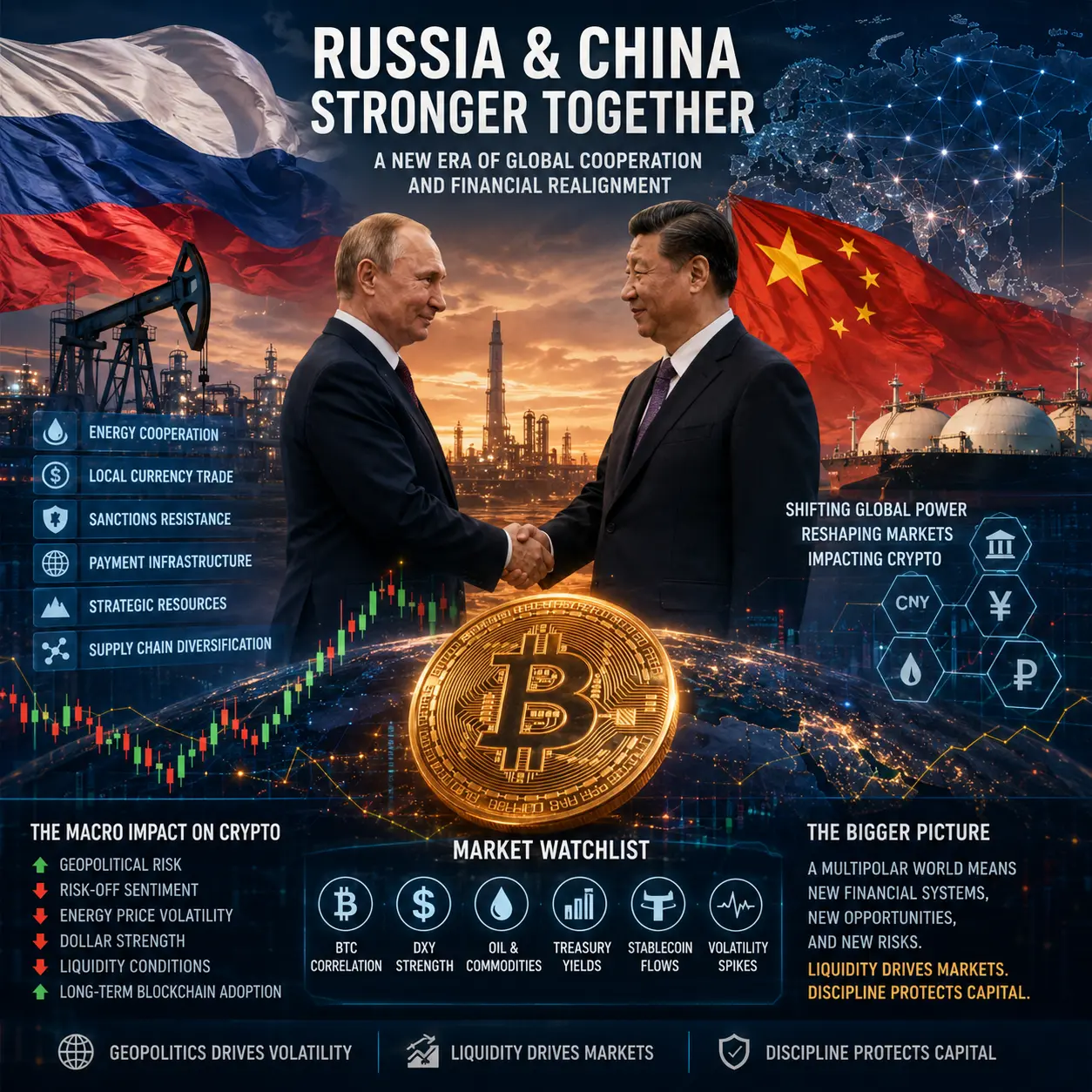
Why This Meeting Matters
Russia and China are strengthening economic and strategic cooperation during a period of growing fragmentation between major global powers.
Markets are closely watching several key areas:
• Energy trade agreements
• Commodity settlement systems
• Local currency trade expansion
• Sanctions resistance mechanisms
• Cross-border payment infrastructure
• Strategic resource coordination
• Global supply chain diversification
This matters because the international financial system is gradually moving toward a more multipolar structure where nations seek alternatives to traditional Western-dominated settlement networks.
That creates important implications for blockchain technology, stablecoins, and decentralized financial infrastructure.
The Macro Transmission Into Crypto
Crypto no longer trades as an isolated speculative industry.
Bitcoin now reacts heavily to:
• Global liquidity expectations
• US dollar strength
• Bond market volatility
• Central bank policy
• Energy price movements
• Geopolitical risk sentiment
When geopolitical tensions rise, markets typically experience a temporary “risk-off” reaction where investors reduce exposure to higher-volatility assets.
That can pressure crypto prices in the short term.
However, there is also a second layer developing beneath the surface.
As geopolitical fragmentation increases, institutional interest in alternative settlement systems and decentralized financial rails may continue expanding over the long run.
This creates a powerful dual narrative for digital assets:
Short-term volatility.
Long-term structural relevance.
Energy Markets Remain the Core Variable
One of the most important aspects of Russia-China coordination is energy.
Russia remains one of the world’s largest energy exporters, while China is one of the world’s largest energy consumers.
Any deeper coordination between both nations can influence:
• Oil pricing expectations
• Natural gas trade flows
• Commodity supply stability
• Inflation expectations globally
• Industrial production forecasts
• Transportation and manufacturing costs
Energy prices directly affect inflation, and inflation heavily influences central bank policy.
That means geopolitical developments can indirectly shape interest rate expectations, liquidity conditions, and ultimately crypto market direction.
If energy prices spike sharply, markets may fear tighter monetary conditions for longer.
That environment usually pressures speculative assets temporarily.
Liquidity Still Controls Everything
Narratives alone rarely sustain major crypto rallies.
Liquidity remains the most important driver.
Even if geopolitical fragmentation strengthens blockchain adoption narratives, markets still require:
• Expanding liquidity
• Stable macro conditions
• Institutional participation
• Capital inflows
• Risk appetite recovery
Without those factors, bullish narratives often fail to generate sustainable momentum.
This is why experienced traders focus less on emotional headlines and more on liquidity behavior after geopolitical events unfold.
What Traders Should Watch Closely
Professional traders are monitoring several key indicators right now:
→ Bitcoin correlation with equities and macro risk sentiment
→ US Dollar Index (DXY) strength
→ Oil and commodity market reactions
→ Treasury yield movements
→ Stablecoin inflow and outflow trends
→ Institutional positioning behavior
→ Volatility spikes during geopolitical headlines
→ Capital rotation between risk assets and safe havens
These signals reveal whether markets are pricing temporary uncertainty or a deeper structural macro shift.
The Bigger Picture
The global economy is entering an era where geopolitical fragmentation increasingly shapes financial markets.
Trade systems, reserve currencies, payment infrastructure, and capital allocation are all becoming more politically sensitive.
For crypto, this creates both opportunity and instability.
Blockchain infrastructure may benefit from growing demand for alternative settlement systems and decentralized financial rails.
But in the short term, markets remain vulnerable to volatility whenever geopolitical uncertainty threatens liquidity confidence.
That is why disciplined positioning matters more than emotional reactions.
The traders who survive geopolitical cycles are usually the ones who understand one simple principle:
Markets react first to liquidity conditions — and only later to narratives.
repost-content-media
  • Reward
  • Comment
  • Repost
  • Share
#PutinVisitsChina
🌏 Putin’s China Visit Is Bigger Than Headlines It’s About the Future Shape of Global Power, Capital Flows, and Financial Systems
The May 19–20 meeting between Russian President and Chinese President may look like another diplomatic summit on the surface, but the deeper market implications are far more important than most traders realize.
This was not simply a symbolic state visit.
China and Russia reportedly signed around 40 cooperation agreements covering energy, trade, infrastructure, nuclear technology, industrial supply chains, agriculture, education, and long-term s
BTC-0.74%
post-image
post-image
  • Reward
  • 10
  • Repost
  • Share
MrFlower_XingChen:
I impressed your explanation of crypto Market
View More
#PutinVisitsChina Global markets are entering a phase where geopolitics is no longer just political news sitting in the background. Every high-level meeting between major powers now directly influences liquidity flows, inflation expectations, commodity pricing, capital movement, and the future direction of digital assets. Putin’s latest visit to China is not some routine diplomatic handshake designed for headlines. It is part of a much deeper global transition where nations are quietly restructuring trade alliances, payment systems, energy coordination, and long-term financial strategy while
BTC-0.74%
STABLE-6.52%
USIDX0.08%
post-image
post-image
  • Reward
  • 9
  • Repost
  • Share
AYATTAC:
LFG 🔥
View More
#PutinVisitsChina
🌏 Putin Visiting China Isn’t Just Diplomacy — It’s Macro Market Fuel
This China–Russia meeting on May 19–20 feels like more than a routine state visit. When two major powers sign ~40 cooperation agreements across energy, trade, nuclear, and education, the market implication isn’t immediate price action — it’s longer-term geopolitical alignment that slowly reshapes global risk perception.
From a trader’s lens, the most important part isn’t the headlines themselves, but what they signal for global capital flows. Energy cooperation plus deeper trade coordination usually streng
BTC-0.74%
post-image
  • Reward
  • 14
  • Repost
  • Share
AYATTAC:
LFG 🔥
View More
#PutinVisitsChina
The latest high-level meeting between Russia and China is far bigger than a symbolic diplomatic event. It represents a continuing shift in global power coordination that could reshape energy markets, international trade systems, capital flows, and long-term financial infrastructure.
For crypto traders and macro investors, this is not simply political theater.
It is a liquidity and risk-pricing event.
As digital assets become increasingly connected to macroeconomic conditions, geopolitical developments now influence Bitcoin and broader crypto markets through the same channels
BTC-0.74%
  • Reward
  • 1
  • Repost
  • Share
Yusfirah:
To The Moon 🌕
#PutinVisitsChina Putin Visits China — A Geopolitical Signal Accelerating the Shift Toward a Fragmented Global Order
The state visit of Russian President Vladimir Putin to China on May 19–20, 2026 is not being interpreted as a routine diplomatic exchange. Instead, it represents a deliberate geopolitical signal reinforcing a deeper structural realignment already underway across global trade, energy flows, and financial systems.
In a world already under pressure from inflation uncertainty, volatile energy markets, rising sovereign debt, and shifting monetary dominance, this summit adds further
  • Reward
  • 4
  • Repost
  • Share
Yusfirah:
LFG 🔥
View More
Load More