# RWAMarketCapExceeds65Billion

19.26K

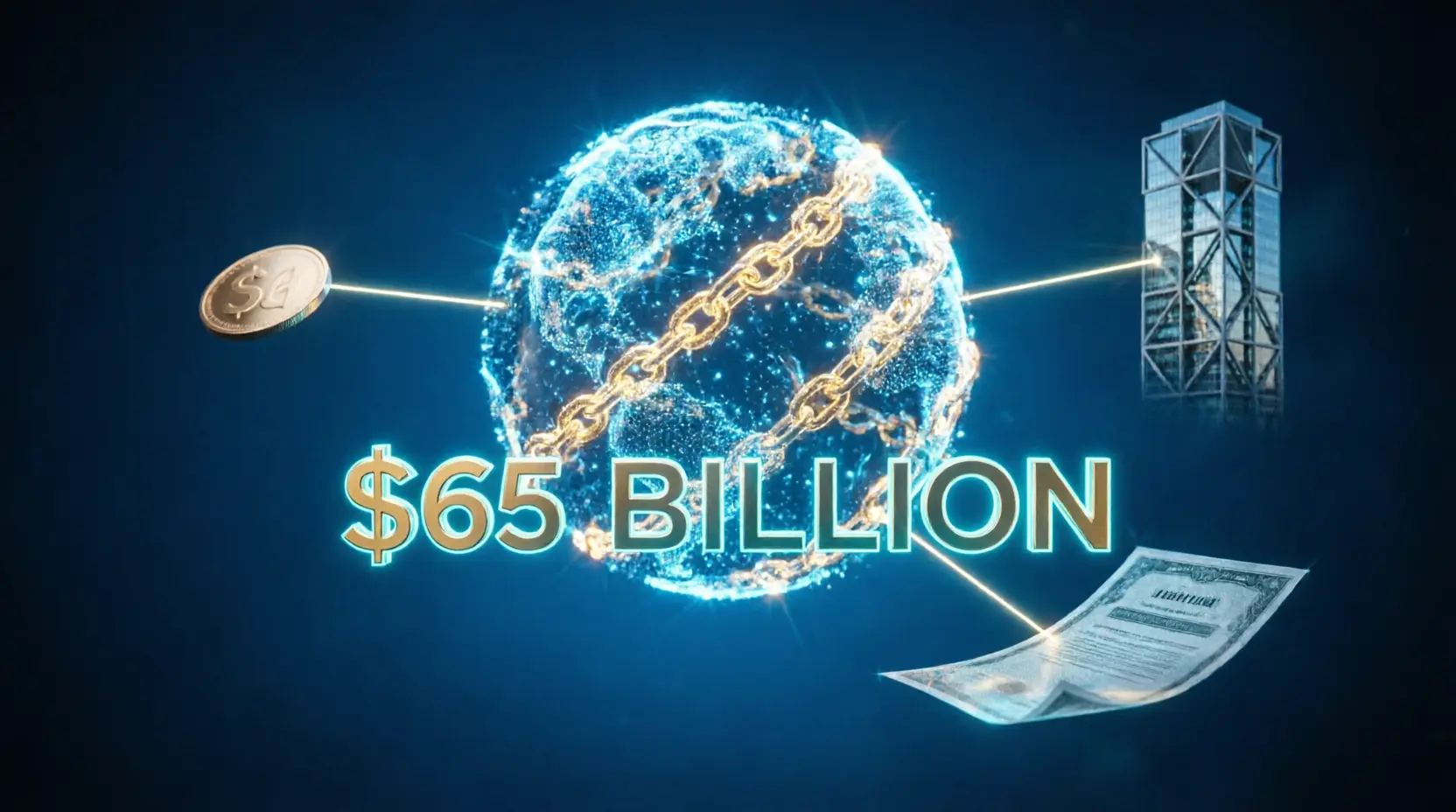
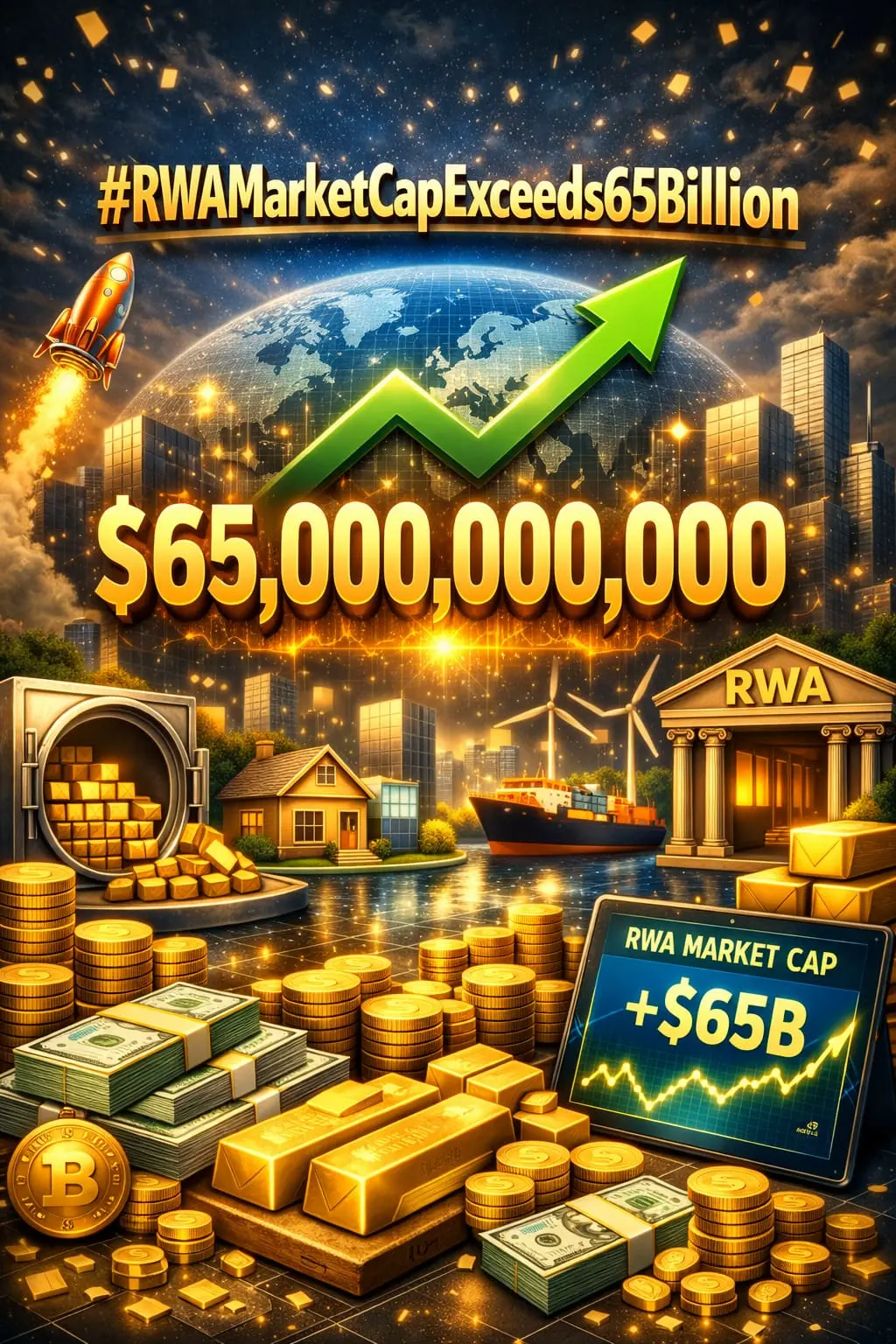
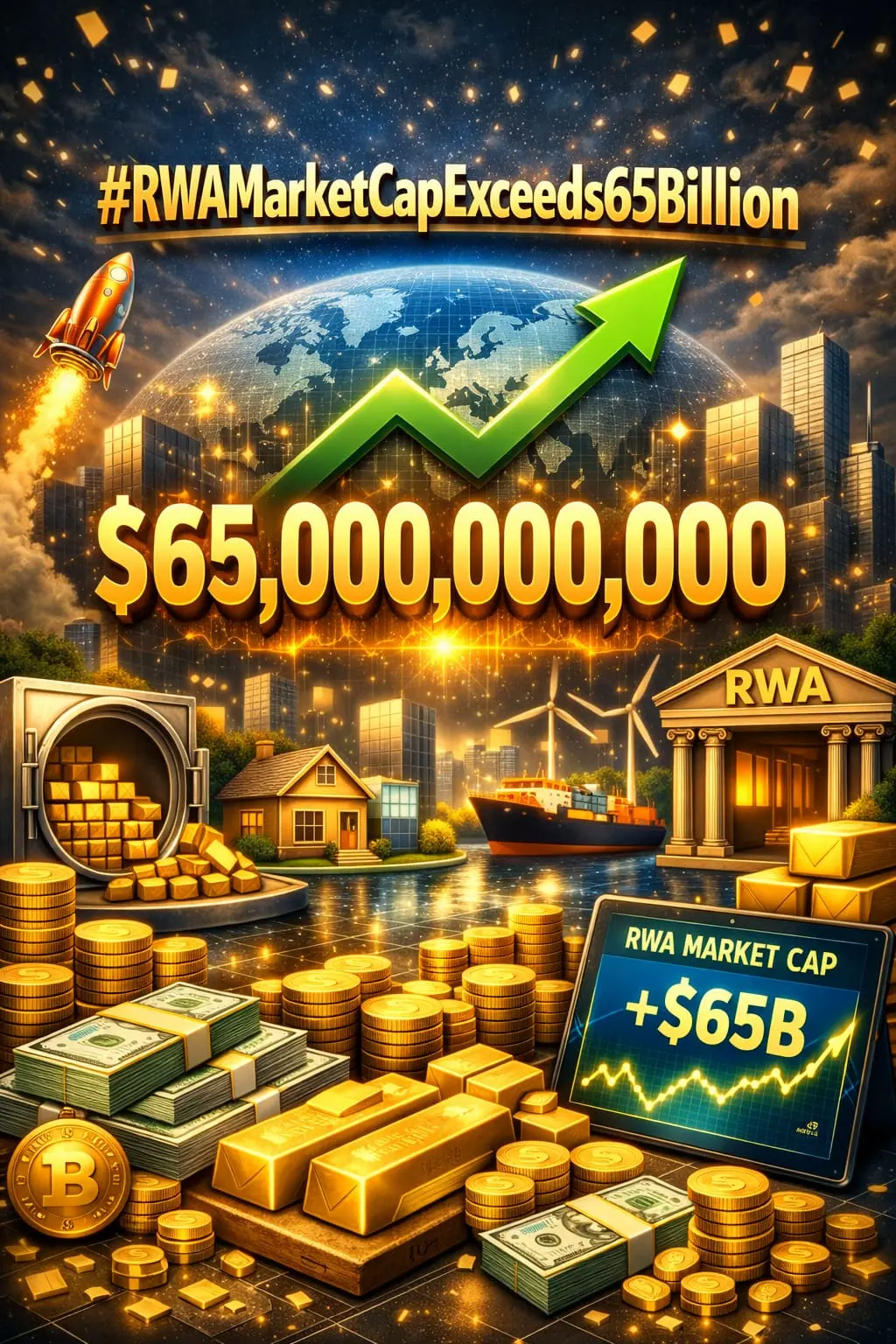
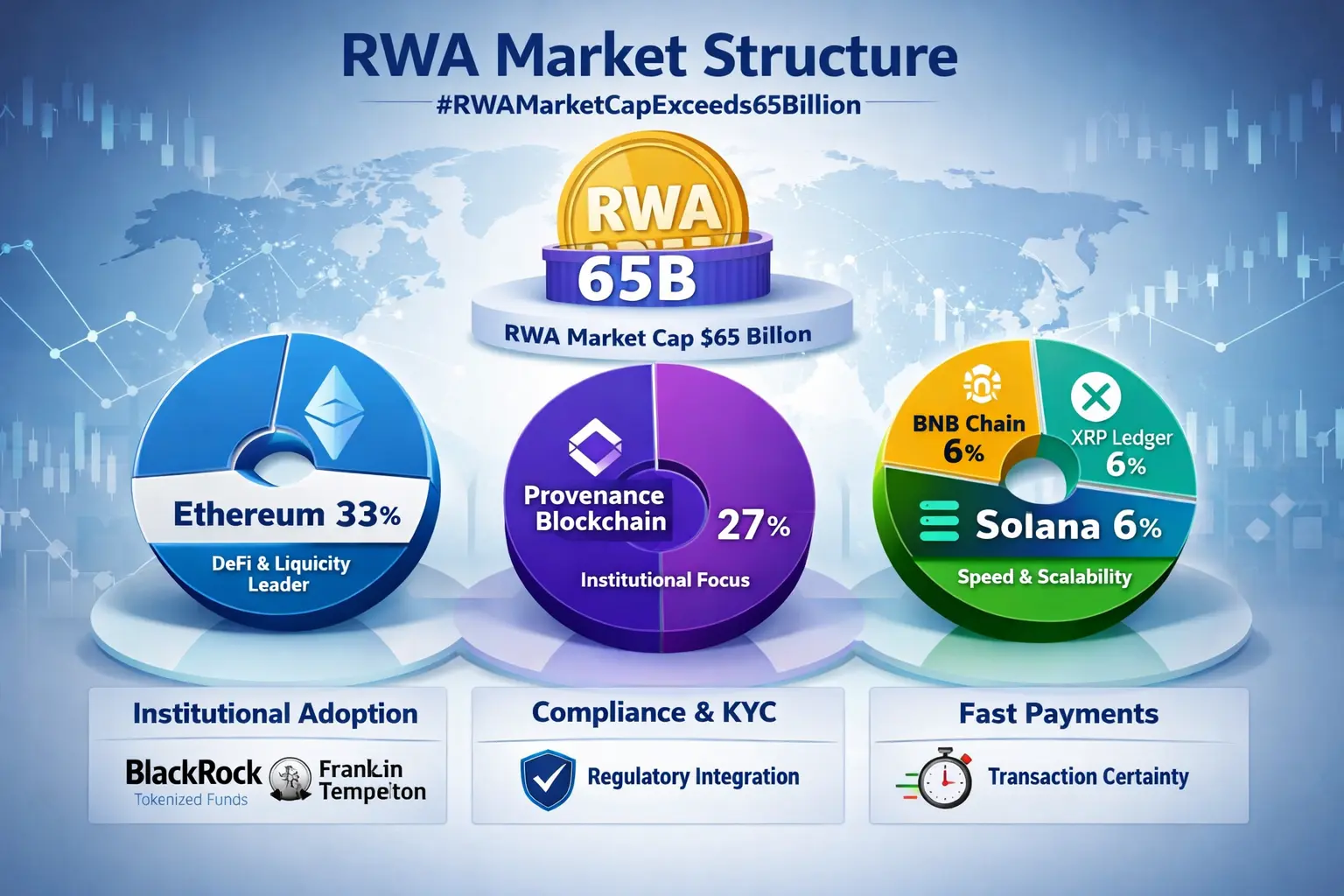
The total market capitalization of real world assets has surpassed 65 billion US dollars, up 44 percent since the start of the year. Ethereum leads with approximately 33 percent market share, followed by Provenance Blockchain at 27 percent, while BNB Chain, XRP Ledger and Solana each account for roughly 6 percent. The tokenization of traditional assets is accelerating, with institutions like BlackRock and Franklin Templeton continuing to expand their presence. The market remains in an early competitive stage, with blockchains differentiating themselves through compliance tools and settlement finality.

#RWAMarketCapExceeds65Billion
The global financial system is entering a structural transition phase where traditional markets and blockchain infrastructure are increasingly converging into a unified liquidity ecosystem. The milestone of Real-World Assets (RWA) surpassing a $65 billion market capitalization is not just another statistical update. It represents a deeper transformation in how value is created, transferred, and represented across global financial rails. This shift reflects a gradual but powerful integration between traditional finance systems and decentralized blockchain infrastr
Vortex_King
#RWAMarketCapExceeds65Billion
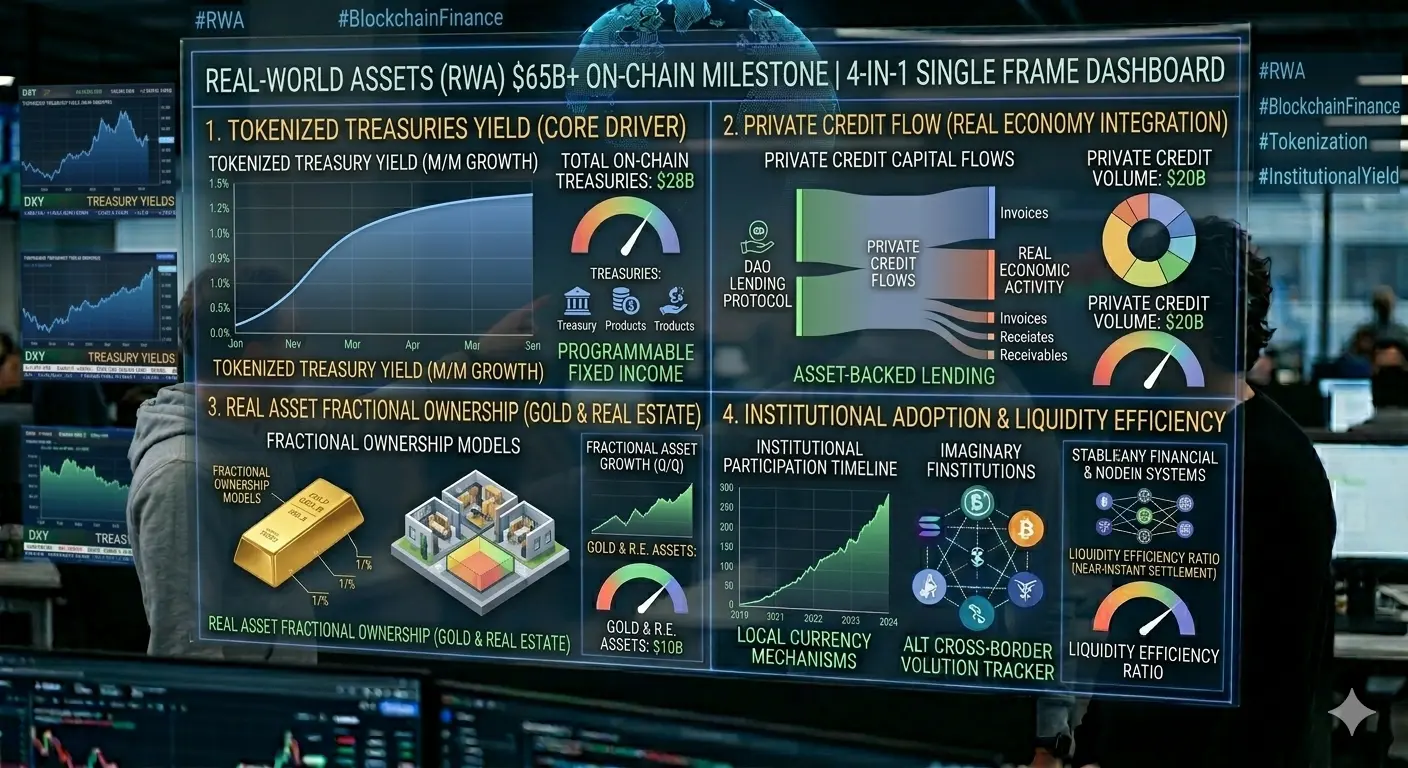
The global financial system is entering a structural transition phase where traditional markets and blockchain infrastructure are increasingly converging into a unified liquidity ecosystem. The milestone of Real-World Assets (RWA) surpassing a $65 billion market capitalization is not just another statistical update. It represents a deeper transformation in how value is created, transferred, and represented across global financial rails. This shift reflects a gradual but powerful integration between traditional finance systems and decentralized blockchain infrastructure, where real economic assets are being digitized and brought on-chain for improved efficiency, accessibility, and composability.
What makes this development significant is not the number itself, but what it represents in terms of institutional behavior, capital migration, and long-term financial restructuring. RWAs are effectively bridging the gap between legacy financial systems and the emerging digital economy, enabling assets like government bonds, private credit, real estate, commodities, and alternative yield instruments to exist in tokenized form on blockchain networks. This allows previously illiquid or restricted assets to become more accessible, transparent, and programmable within modern financial ecosystems.
The Structural Shift Behind RWA Growth
The rise of RWAs is being driven by a fundamental shift in investor demand. Market participants are no longer focused purely on speculative digital assets. Instead, there is a growing preference for yield-generating, real-backed financial instruments that exist within blockchain infrastructure. This transition reflects a broader maturity phase in the crypto market, where capital is increasingly flowing toward assets backed by real economic activity rather than purely narrative-driven speculation.
Institutional participation has played a key role in this evolution. Traditional financial institutions, asset managers, and regulated funds are actively exploring tokenization frameworks to improve settlement efficiency, reduce operational friction, and expand access to global liquidity pools. This has led to the emergence of tokenized Treasury products, on-chain money market funds, and blockchain-based credit systems that mirror traditional financial instruments while leveraging decentralized infrastructure for execution and settlement.
Tokenized Treasuries as the Core Driver
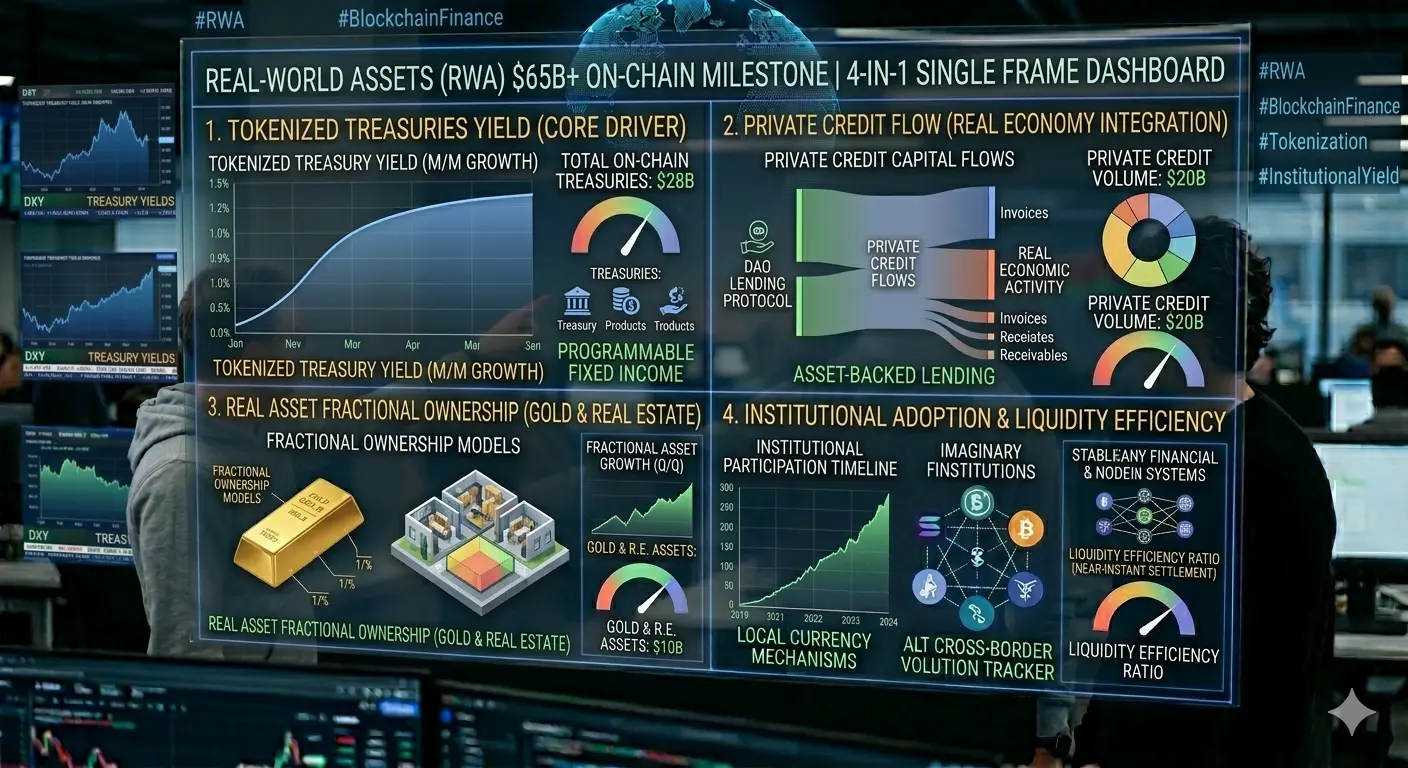
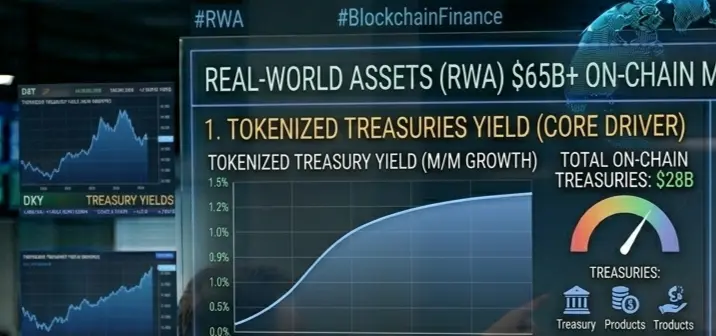
One of the most important components of the RWA ecosystem is tokenized U.S. Treasury exposure. These instruments have become a cornerstone of on-chain yield generation, especially in environments where interest rates remain elevated. Investors are increasingly allocating capital toward tokenized government debt instruments as a low-risk alternative within the digital asset ecosystem.
This segment has attracted significant attention because it provides stable yield while maintaining blockchain accessibility. Unlike traditional fixed-income products, tokenized Treasuries operate within programmable environments, allowing them to interact directly with decentralized finance protocols, collateral systems, and automated liquidity strategies. This composability creates an entirely new financial layer where traditional yield-bearing instruments become active components of on-chain capital markets.
Private Credit and Real Economy Integration
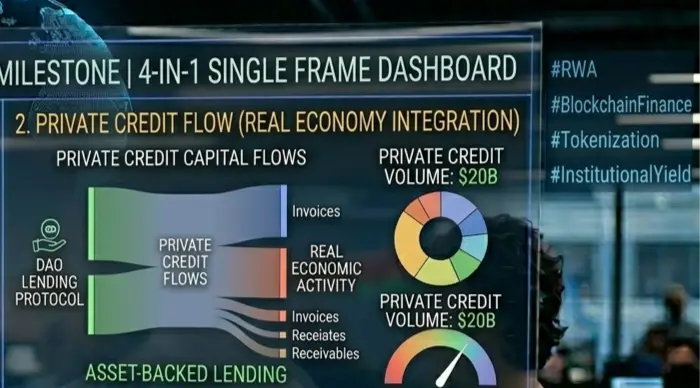
Another rapidly expanding segment within RWAs is private credit. This category connects real-world borrowing demand with decentralized lending infrastructure. Businesses seeking capital can access funding through blockchain-based platforms, while lenders earn yield backed by real economic activity such as invoices, receivables, or asset-backed lending structures.
This integration of real-world cash flows into blockchain systems represents a major step toward financial system digitization. It reduces dependency on traditional banking intermediaries and introduces more direct capital allocation mechanisms. However, it also introduces structural complexities related to risk assessment, credit underwriting, and off-chain legal enforcement, which remain key considerations for long-term scalability.
Commodities and Real Asset Tokenization
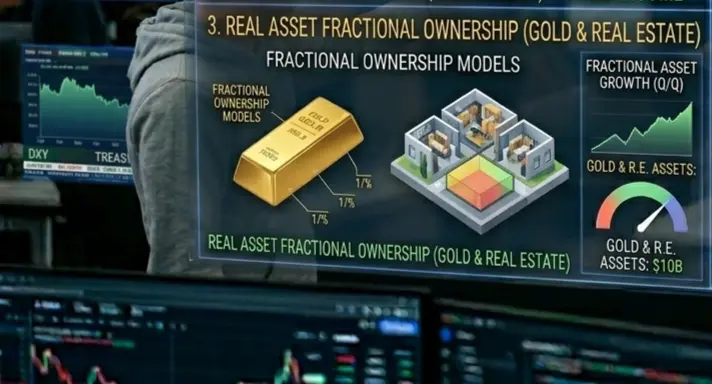
Commodities such as gold and real estate continue to play a significant role in the RWA ecosystem. Tokenized gold products allow fractional ownership of physical assets, making them more accessible to retail and institutional investors alike. Real estate tokenization, although slower due to regulatory and jurisdictional constraints, is gradually expanding in select regions where legal frameworks support digital asset ownership structures.
These developments are important because they introduce liquidity into historically illiquid asset classes. By converting physical assets into blockchain-based representations, markets can enable fractional ownership, 24/7 transferability, and improved transparency in ownership structures. This fundamentally changes how real-world value is accessed and traded.
Institutional Adoption and Market Validation
The involvement of major financial institutions has significantly strengthened the credibility of the RWA sector. Large asset managers and traditional finance entities are no longer observing from the sidelines. Instead, they are actively launching tokenized financial products and exploring blockchain-based settlement systems.
This institutional participation acts as a validation signal for the entire sector. It indicates that tokenization is not a temporary experiment but a long-term structural evolution of global financial infrastructure. As more regulated entities enter the space, the boundary between traditional capital markets and blockchain-based systems continues to blur.
Liquidity Efficiency and Capital Mobility
One of the key advantages of RWA tokenization is improved liquidity efficiency. Traditional financial systems often suffer from settlement delays, operational friction, and limited accessibility. Blockchain-based asset representation reduces these inefficiencies by enabling near-instant settlement, global accessibility, and programmable liquidity movement.
This improved capital mobility allows assets to move more freely across financial ecosystems, increasing overall market efficiency. It also enables new forms of financial engineering where tokenized assets can be used as collateral, integrated into yield strategies, or composed into multi-layered financial products.
Risk Considerations and Structural Limitations
Despite its rapid growth, the RWA ecosystem is not without challenges. Legal uncertainty surrounding asset ownership, custodial risk, regulatory fragmentation, and oracle dependency remain key structural limitations. The enforceability of off-chain assets represented on-chain varies across jurisdictions, creating potential legal and operational complexities.
Additionally, liquidity fragmentation across multiple blockchains and platforms remains a concern. Without standardized interoperability frameworks, capital efficiency may be constrained, limiting the full potential of tokenized financial systems.
The Macro Perspective Behind RWAs
From a macroeconomic perspective, the rise of RWAs reflects a broader shift toward yield-driven capital allocation in a higher interest rate environment. Investors are increasingly prioritizing stable returns over speculative appreciation, leading to capital rotation toward real yield instruments.
This trend also aligns with global financial fragmentation, where cross-border capital flows are becoming more complex due to geopolitical tensions and shifting monetary policies. Tokenized assets offer a potential solution by enabling more flexible, programmable, and borderless financial infrastructure.
The Future of Tokenized Financial Systems
Looking forward, the RWA sector is likely to expand beyond its current $65 billion valuation as institutional adoption deepens and regulatory clarity improves. Future developments may include tokenized equities, integrated central bank digital currency settlement systems, and fully programmable global capital markets operating on blockchain rails.
This evolution suggests a future where financial infrastructure is no longer divided between traditional and decentralized systems, but instead operates as a hybrid ecosystem where both coexist and interact seamlessly.
Final Perspective
The $65 billion milestone in Real-World Asset tokenization is not an endpoint but an early stage marker in a much larger transformation. It signals the beginning of a structural shift where blockchain technology transitions from speculative infrastructure to core financial plumbing for global markets.
As this transition continues, the distinction between traditional finance and decentralized finance will gradually fade. In its place, a unified digital financial system will emerge—one defined by programmability, transparency, and global accessibility.
The real story of RWAs is not just about growth in market capitalization. It is about the redesign of global financial architecture itself.
repost-content-media
  • Reward
  • Comment
  • Repost
  • Share
#RWAMarketCapExceeds65Billion
The global financial system is entering a structural transition phase where traditional markets and blockchain infrastructure are increasingly converging into a unified liquidity ecosystem. The milestone of Real-World Assets (RWA) surpassing a $65 billion market capitalization is not just another statistical update. It represents a deeper transformation in how value is created, transferred, and represented across global financial rails. This shift reflects a gradual but powerful integration between traditional finance systems and decentralized blockchain infrastr
Vortex_King
#RWAMarketCapExceeds65Billion
The global financial system is entering a structural transition phase where traditional markets and blockchain infrastructure are increasingly converging into a unified liquidity ecosystem. The milestone of Real-World Assets (RWA) surpassing a $65 billion market capitalization is not just another statistical update. It represents a deeper transformation in how value is created, transferred, and represented across global financial rails. This shift reflects a gradual but powerful integration between traditional finance systems and decentralized blockchain infrastructure, where real economic assets are being digitized and brought on-chain for improved efficiency, accessibility, and composability.
What makes this development significant is not the number itself, but what it represents in terms of institutional behavior, capital migration, and long-term financial restructuring. RWAs are effectively bridging the gap between legacy financial systems and the emerging digital economy, enabling assets like government bonds, private credit, real estate, commodities, and alternative yield instruments to exist in tokenized form on blockchain networks. This allows previously illiquid or restricted assets to become more accessible, transparent, and programmable within modern financial ecosystems.
The Structural Shift Behind RWA Growth
The rise of RWAs is being driven by a fundamental shift in investor demand. Market participants are no longer focused purely on speculative digital assets. Instead, there is a growing preference for yield-generating, real-backed financial instruments that exist within blockchain infrastructure. This transition reflects a broader maturity phase in the crypto market, where capital is increasingly flowing toward assets backed by real economic activity rather than purely narrative-driven speculation.
Institutional participation has played a key role in this evolution. Traditional financial institutions, asset managers, and regulated funds are actively exploring tokenization frameworks to improve settlement efficiency, reduce operational friction, and expand access to global liquidity pools. This has led to the emergence of tokenized Treasury products, on-chain money market funds, and blockchain-based credit systems that mirror traditional financial instruments while leveraging decentralized infrastructure for execution and settlement.
Tokenized Treasuries as the Core Driver
One of the most important components of the RWA ecosystem is tokenized U.S. Treasury exposure. These instruments have become a cornerstone of on-chain yield generation, especially in environments where interest rates remain elevated. Investors are increasingly allocating capital toward tokenized government debt instruments as a low-risk alternative within the digital asset ecosystem.
This segment has attracted significant attention because it provides stable yield while maintaining blockchain accessibility. Unlike traditional fixed-income products, tokenized Treasuries operate within programmable environments, allowing them to interact directly with decentralized finance protocols, collateral systems, and automated liquidity strategies. This composability creates an entirely new financial layer where traditional yield-bearing instruments become active components of on-chain capital markets.
Private Credit and Real Economy Integration
Another rapidly expanding segment within RWAs is private credit. This category connects real-world borrowing demand with decentralized lending infrastructure. Businesses seeking capital can access funding through blockchain-based platforms, while lenders earn yield backed by real economic activity such as invoices, receivables, or asset-backed lending structures.
This integration of real-world cash flows into blockchain systems represents a major step toward financial system digitization. It reduces dependency on traditional banking intermediaries and introduces more direct capital allocation mechanisms. However, it also introduces structural complexities related to risk assessment, credit underwriting, and off-chain legal enforcement, which remain key considerations for long-term scalability.
Commodities and Real Asset Tokenization
Commodities such as gold and real estate continue to play a significant role in the RWA ecosystem. Tokenized gold products allow fractional ownership of physical assets, making them more accessible to retail and institutional investors alike. Real estate tokenization, although slower due to regulatory and jurisdictional constraints, is gradually expanding in select regions where legal frameworks support digital asset ownership structures.
These developments are important because they introduce liquidity into historically illiquid asset classes. By converting physical assets into blockchain-based representations, markets can enable fractional ownership, 24/7 transferability, and improved transparency in ownership structures. This fundamentally changes how real-world value is accessed and traded.
Institutional Adoption and Market Validation
The involvement of major financial institutions has significantly strengthened the credibility of the RWA sector. Large asset managers and traditional finance entities are no longer observing from the sidelines. Instead, they are actively launching tokenized financial products and exploring blockchain-based settlement systems.
This institutional participation acts as a validation signal for the entire sector. It indicates that tokenization is not a temporary experiment but a long-term structural evolution of global financial infrastructure. As more regulated entities enter the space, the boundary between traditional capital markets and blockchain-based systems continues to blur.
Liquidity Efficiency and Capital Mobility
One of the key advantages of RWA tokenization is improved liquidity efficiency. Traditional financial systems often suffer from settlement delays, operational friction, and limited accessibility. Blockchain-based asset representation reduces these inefficiencies by enabling near-instant settlement, global accessibility, and programmable liquidity movement.
This improved capital mobility allows assets to move more freely across financial ecosystems, increasing overall market efficiency. It also enables new forms of financial engineering where tokenized assets can be used as collateral, integrated into yield strategies, or composed into multi-layered financial products.
Risk Considerations and Structural Limitations
Despite its rapid growth, the RWA ecosystem is not without challenges. Legal uncertainty surrounding asset ownership, custodial risk, regulatory fragmentation, and oracle dependency remain key structural limitations. The enforceability of off-chain assets represented on-chain varies across jurisdictions, creating potential legal and operational complexities.
Additionally, liquidity fragmentation across multiple blockchains and platforms remains a concern. Without standardized interoperability frameworks, capital efficiency may be constrained, limiting the full potential of tokenized financial systems.
The Macro Perspective Behind RWAs
From a macroeconomic perspective, the rise of RWAs reflects a broader shift toward yield-driven capital allocation in a higher interest rate environment. Investors are increasingly prioritizing stable returns over speculative appreciation, leading to capital rotation toward real yield instruments.
This trend also aligns with global financial fragmentation, where cross-border capital flows are becoming more complex due to geopolitical tensions and shifting monetary policies. Tokenized assets offer a potential solution by enabling more flexible, programmable, and borderless financial infrastructure.
The Future of Tokenized Financial Systems
Looking forward, the RWA sector is likely to expand beyond its current $65 billion valuation as institutional adoption deepens and regulatory clarity improves. Future developments may include tokenized equities, integrated central bank digital currency settlement systems, and fully programmable global capital markets operating on blockchain rails.
This evolution suggests a future where financial infrastructure is no longer divided between traditional and decentralized systems, but instead operates as a hybrid ecosystem where both coexist and interact seamlessly.
Final Perspective
The $65 billion milestone in Real-World Asset tokenization is not an endpoint but an early stage marker in a much larger transformation. It signals the beginning of a structural shift where blockchain technology transitions from speculative infrastructure to core financial plumbing for global markets.
As this transition continues, the distinction between traditional finance and decentralized finance will gradually fade. In its place, a unified digital financial system will emerge—one defined by programmability, transparency, and global accessibility.
The real story of RWAs is not just about growth in market capitalization. It is about the redesign of global financial architecture itself.
repost-content-media
  • Reward
  • Comment
  • Repost
  • Share
#RWAMarketCapExceeds65Billion
Real-World Assets (RWA) Tokenization: A New Milestone as Market Cap Breaches $65 Billion
The digital asset landscape is witnessing a paradigm shift. While speculative cryptocurrencies continue to experience their characteristic volatility, a quieter, more substantial revolution is taking place: the tokenization of real-world assets (RWAs). For the first time in history, the total market capitalization of tokenized RWAs on public blockchains has officially exceeded $65 billion. This milestone, excluding the stablecoin sector, signals a maturation of the crypto eco
post-image
  • Reward
  • Comment
  • Repost
  • Share
#RWAMarketCapExceeds65Billion
RWA's market capitalization exceeding $65 billion is a milestone, demonstrating how quickly tokenization has progressed from the concept stage to institutional adoption. Let's examine the dynamics:
**Market Structure**
Ethereum: ~33% share, benefiting from its established DeFi ecosystem and liquidity depth.
**Provenance Blockchain: ~27%, carving out a niche for itself with compliance-focused frameworks specifically designed for financial institutions.**
**BNB Chain, XRP Ledger, and Solana: With ~6% shares, they compete in terms of payment speed, scalability, and
RWA-0.32%
ETH-0.43%
BNB0.76%
ybaser
#RWAMarketCapExceeds65Billion
RWA's market capitalization exceeding $65 billion is a milestone, demonstrating how quickly tokenization has progressed from the concept stage to institutional adoption. Let's examine the dynamics:
**Market Structure**
Ethereum: ~33% share, benefiting from its established DeFi ecosystem and liquidity depth.
**Provenance Blockchain: ~27%, carving out a niche for itself with compliance-focused frameworks specifically designed for financial institutions.**
**BNB Chain, XRP Ledger, and Solana: With ~6% shares, they compete in terms of payment speed, scalability, and integration with existing crypto communities.**
**Growth Drivers**
**Institutional Adoption:** BlackRock and Franklin Templeton are validating this space for traditional finance by expanding their tokenized funds.
**Compliance Tools:** Blockchains differentiate themselves by offering KYC/AML integration, which is critical for institutional engagement.
**Payment Certainty:** Competing chains are emphasizing the speed and certainty of transactions, a crucial requirement for large-scale asset transfers. Strategic Implications
44% growth since the beginning of the year shows that tokenization is moving from being just a niche experiment to becoming a macro theme.
In the short term, fragmentation is expected as chains specialize, but ultimately, convergence will occur around platforms that balance liquidity, compatibility, and interoperability.
Institutions are likely to push for standardization in reporting, custody, and payments; this could support Ethereum's network impact but also leave room for niche players like Provenance.
This is still an early stage of competition, meaning the winners are not yet decided. The next milestone will come when tokenized assets move beyond funds and enter real estate, private lending, and trade finance on a large scale.
$BNB $XRP
repost-content-media
  • Reward
  • 5
  • Repost
  • Share
Yunna:
LFG 🔥
View More
#RWAMarketCapExceeds65Billion
The global financial system is entering a structural transition phase where traditional markets and blockchain infrastructure are increasingly converging into a unified liquidity ecosystem. The milestone of Real-World Assets (RWA) surpassing a $65 billion market capitalization is not just another statistical update. It represents a deeper transformation in how value is created, transferred, and represented across global financial rails. This shift reflects a gradual but powerful integration between traditional finance systems and decentralized blockchain infrastr
post-image
post-image
post-image
post-image
  • Reward
  • 6
  • Repost
  • Share
shahJi786:
To The Moon 🌕
View More
#RWAMarketCapExceeds65Billion
RWA Tokenization Is Quietly Reshaping Global Finance
The tokenized real-world asset market has now crossed $65 billion in total value, marking one of the most important structural shifts happening across both traditional finance and crypto markets. At the beginning of the year, the sector stood near $45 billion. In only a few months, it has expanded by roughly 44%, showing that institutional adoption is no longer theoretical. Capital is moving on-chain at a pace the market can no longer ignore.
The largest segment remains tokenized US Treasuries, currently valued
RWA-0.32%
ETH-0.43%
BNB0.76%
XRP-1.08%
post-image
  • Reward
  • 4
  • Repost
  • Share
MasterChuTheOldDemonMasterChu:
DYOR 🤓
View More
#RWAMarketCapExceeds65Billion
RWA Tokenization Is Quietly Reshaping Global Finance
The tokenized real-world asset market has now crossed $65 billion in total value, marking one of the most important structural shifts happening across both traditional finance and crypto markets. At the beginning of the year, the sector stood near $45 billion. In only a few months, it has expanded by roughly 44%, showing that institutional adoption is no longer theoretical. Capital is moving on-chain at a pace the market can no longer ignore.
The largest segment remains tokenized US Treasuries, currently valued
RWA-0.32%
ETH-0.43%
BNB0.76%
XRP-1.08%
CryptoChampion
#RWAMarketCapExceeds65Billion
RWA Tokenization Is Quietly Reshaping Global Finance
The tokenized real-world asset market has now crossed $65 billion in total value, marking one of the most important structural shifts happening across both traditional finance and crypto markets. At the beginning of the year, the sector stood near $45 billion. In only a few months, it has expanded by roughly 44%, showing that institutional adoption is no longer theoretical. Capital is moving on-chain at a pace the market can no longer ignore.
The largest segment remains tokenized US Treasuries, currently valued at approximately $12.78 billion. This category has become the institutional gateway into blockchain-based finance because it combines traditional low-risk yield products with blockchain settlement efficiency. Funds, banks, and asset managers are increasingly treating tokenization as infrastructure rather than experimentation.
BlackRock’s BUIDL fund alone has surpassed $2.5 billion, becoming one of the clearest signals that major financial institutions are now actively building inside blockchain ecosystems. At the same time, tokenized equities are gaining momentum rapidly. Daily trading volume recently climbed to nearly $3.57 billion, while transfer activity surged more than 85% over the past month.
The competitive landscape between blockchains is becoming increasingly important.
Ethereum currently controls roughly 33% of the tokenized asset market, supported by institutional liquidity, stable infrastructure, and major products such as BUIDL. Provenance Blockchain follows with approximately 27%, driven heavily by Figure Lending and mortgage-related asset issuance. Meanwhile, BNB Chain, XRP Ledger, and Solana each hold close to 6% market share and continue competing aggressively for institutional onboarding.
What makes this race especially important is that RWA liquidity tends to be extremely sticky. Once institutions build compliance systems, settlement frameworks, custody integrations, and issuance infrastructure on a specific chain, migrating to another network becomes expensive and operationally difficult. Early adoption advantages may therefore compound for years.
Beyond Treasuries, the market is beginning to diversify quickly.
Tokenized equities are approaching the $1 billion milestone in total market size. Ondo Finance currently dominates this segment with more than 70% market share, controlling over $557 million across hundreds of tokenized assets and multiple financial categories. Commodities represent another rapidly growing segment, now exceeding $5.4 billion, led primarily by gold-backed digital assets. Asset-backed private credit has also expanded beyond $3 billion.
The bigger story, however, is the scale of the opportunity ahead.
Even after reaching $65 billion, tokenized assets still represent only around 0.02% penetration of the estimated $300 trillion global addressable market spanning equities, bonds, commodities, real estate, credit, and cash products. In other words, the industry is still operating in the earliest phase of adoption.
Major financial institutions believe the expansion could accelerate dramatically over the next decade. Standard Chartered and Boston Consulting Group estimate the tokenized asset market could eventually reach $16 trillion by 2030, while McKinsey projects a more conservative but still massive $2 trillion outcome.
Another key catalyst may arrive in October 2026, when the DTCC plans broader production activity for tokenized securities infrastructure following limited rollout phases earlier in the year. If successful, this could become the moment tokenization moves from a parallel financial experiment into a standard option embedded directly within existing capital-market systems.
The significance of this transition cannot be overstated.
This is no longer just a crypto narrative. It is the digitization of ownership, settlement, collateral, and liquidity itself. The infrastructure is scaling, institutional participation is accelerating, and blockchain networks are now competing for a financial market potentially worth trillions.
The tokenization era is no longer approaching.
It has already begun.
#GateSquare
repost-content-media
  • Reward
  • 1
  • Repost
  • Share
TradingSkills:
Great information thank you so much ☺️
#RWAMarketCapExceeds65Billion
The RWA Rocket Just Punched Through $65 Billion
Tokenized real-world assets just crossed $65 billion in total market value, up 44% from $45 billion at the start of the year. The pace is accelerating, and the chains are fighting for the spoils.
🔹 The Growth Is Relentless
The market has climbed roughly 44% since January alone, as traditional asset managers bring bonds, cash products, and equities on-chain at an accelerating pace. Tokenized US Treasuries now represent approximately $12.78 billion of the total, remaining the largest and most liquid segment.
This is
RWA-0.32%
ETH-0.43%
BNB0.76%
XRP-1.08%
SinCity
#RWAMarketCapExceeds65Billion
The RWA Rocket Just Punched Through $65 Billion
Tokenized real-world assets just crossed $65 billion in total market value, up 44% from $45 billion at the start of the year. The pace is accelerating, and the chains are fighting for the spoils.
🔹 The Growth Is Relentless
The market has climbed roughly 44% since January alone, as traditional asset managers bring bonds, cash products, and equities on-chain at an accelerating pace. Tokenized US Treasuries now represent approximately $12.78 billion of the total, remaining the largest and most liquid segment.
This is not a pilot phase anymore. BlackRock's BUIDL fund has surpassed the $2.5 billion mark. Tokenized equities hit a record $3.57 billion in single-day trading volume. The DTCC plans limited production tokenized securities activity in July 2026 with a broader launch in October. The infrastructure is moving from experiment to production.
🔹 Five Chains Are Splitting The Market
Ethereum holds roughly 33% of the market, anchored by BlackRock's BUIDL and deep institutional liquidity. Provenance Blockchain commands about 27%, driven by Figure Lending and mortgage-related issuance. BNB Chain, XRP Ledger, and Solana each sit near 6%.
The structure is not yet consolidated. RWA liquidity is among the stickiest in crypto. Once asset managers build tokenization infrastructure on a given chain, switching networks is costly. Early institutional wins compound over time. The race for issuance is a structurally significant phase for long-term chain positioning.
🔹 Equities Are Surging
Tokenized equities are approaching the $1 billion mark, with daily transfer volume jumping 85.78% over 30 days to $2.94 billion. Ondo Finance controls over 70% of the tokenized equity market with $557 million across 230 assets in eight categories.
Commodities follow with $5.4 billion, led by gold-backed tokens. Asset-backed credit sits at $3.19 billion. The diversification beyond Treasuries is real and accelerating.
🔹 **The $300 Trillion Addressable Market**
The current $65 billion represents roughly 0.02% penetration of the total $300 trillion addressable market across major asset classes. Standard Chartered and Boston Consulting Group project the market could reach $16 trillion by 2030. McKinsey forecasts $2 trillion.
The DTCC launch in October 2026 could be the catalyst that shifts tokenization from a parallel system to an optional setting within existing capital-market infrastructure. That is the moment the pilot phase truly ends.
Bottom Line
Tokenized RWAs hit $65 billion, up 44% year-to-date. Ethereum leads with 33%. Equities hit record daily volume. Treasuries anchor the market at $12.78 billion. DTCC production launches in October. The infrastructure is scaling. The chains are competing. The runway stretches toward $16 trillion. Tokenization is no longer a concept. It is a live market with real liquidity and accelerating institutional adoption.
Friends, does the $65 billion milestone change your view on which chain ultimately dominates tokenized assets, or is the race still too early to call?
  • Reward
  • Comment
  • Repost
  • Share
Surpassed Solana?
The XRP Ledger just rewired the RWA conversation. Tokenized real-world assets on the network smashed through $3.53 billion, a fresh all-time high that lifts XRPL past Solana's $2.8 billion milestone. Five months ago, this number sat below $1 billion.
🔹 Treasuries exploding, transfers multiplying
Tokenized U.S. Treasuries on XRPL ballooned from roughly $50 million to $418 million in twelve months, an eightfold surge. Transfer volume tells the sharper story. Full-year 2025 saw about $70 million in Treasury movement. The first four months of 2026 alone clocked roughly $352 mill
SOL0.26%
XRP-1.08%
RWA-0.32%
ETH-0.43%
User_any
Surpassed Solana?
The XRP Ledger just rewired the RWA conversation. Tokenized real-world assets on the network smashed through $3.53 billion, a fresh all-time high that lifts XRPL past Solana's $2.8 billion milestone. Five months ago, this number sat below $1 billion.
🔹 Treasuries exploding, transfers multiplying
Tokenized U.S. Treasuries on XRPL ballooned from roughly $50 million to $418 million in twelve months, an eightfold surge. Transfer volume tells the sharper story. Full-year 2025 saw about $70 million in Treasury movement. The first four months of 2026 alone clocked roughly $352 million, over five times that figure. Capital is not just arriving. It is moving, settling, and rebalancing.
🔹 Commodities and energy dominate the ledger
Tokenized commodities crossed $1.14 billion, representing 52% of XRPL's RWA market and placing the network second globally behind Ethereum. Justoken's JMWH energy token added another dimension, with over $2.2 billion in tokenized electricity now hosted on the ledger. Each token represents one megawatt-hour of real power, backed by Latin American energy producers. When electricity is consumed, the corresponding token burns. Physical infrastructure, recorded and settled onchain.
🔹 Institutional rails clicking into place
Archax launched the first tokenized money market fund on XRPL, giving digital access to abrdn's £3.8 billion liquidity fund. Ondo Finance deployed OUSG, unlocking tokenized Treasury exposure. Ripple's RLUSD stablecoin provided the settlement lubricant. XRPL now processes transactions in three to five seconds for fractions of a cent, with native compliance tools like Credentials, Deep Freeze, and the Permissioned DEX giving issuers institutional-grade control.
🔹 Market share rising inside a $65 billion arena
The global RWA market sits at $65 billion. Ethereum leads with 33%. Provenance holds 27%. XRP Ledger, alongside BNB Chain and Solana, each claims roughly 6%. The gap between third place and first remains wide, but the velocity is unmistakable. XRPL climbed from below $1 billion to $3.53 billion in under five months. At that pace, market share math starts shifting fast.
The network once known for cross-border payments now hosts tokenized Treasuries, electricity, commodities, and money market funds. Issuance signals confidence. Transfer volume signals usage. Both are accelerating.
Friends, does XRPL have the infrastructure to keep climbing the RWA leaderboard, or is this a momentum spike?
#RWAMarketCapExceeds65Billion
$XRP
repost-content-media
  • Reward
  • 24
  • Repost
  • Share
AYATTAC:
Ape In 🚀
View More
#RWAMarketCapExceeds65Billion
The RWA Rocket Just Punched Through $65 Billion
Tokenized real-world assets just crossed $65 billion in total market value, up 44% from $45 billion at the start of the year. The pace is accelerating, and the chains are fighting for the spoils.
🔹 The Growth Is Relentless
The market has climbed roughly 44% since January alone, as traditional asset managers bring bonds, cash products, and equities on-chain at an accelerating pace. Tokenized US Treasuries now represent approximately $12.78 billion of the total, remaining the largest and most liquid segment.
This is
RWA-0.32%
ETH-0.43%
BNB0.76%
XRP-1.08%
User_any
#RWAMarketCapExceeds65Billion
The RWA Rocket Just Punched Through $65 Billion
Tokenized real-world assets just crossed $65 billion in total market value, up 44% from $45 billion at the start of the year. The pace is accelerating, and the chains are fighting for the spoils.
🔹 The Growth Is Relentless
The market has climbed roughly 44% since January alone, as traditional asset managers bring bonds, cash products, and equities on-chain at an accelerating pace. Tokenized US Treasuries now represent approximately $12.78 billion of the total, remaining the largest and most liquid segment.
This is not a pilot phase anymore. BlackRock's BUIDL fund has surpassed the $2.5 billion mark. Tokenized equities hit a record $3.57 billion in single-day trading volume. The DTCC plans limited production tokenized securities activity in July 2026 with a broader launch in October. The infrastructure is moving from experiment to production.
🔹 Five Chains Are Splitting The Market
Ethereum holds roughly 33% of the market, anchored by BlackRock's BUIDL and deep institutional liquidity. Provenance Blockchain commands about 27%, driven by Figure Lending and mortgage-related issuance. BNB Chain, XRP Ledger, and Solana each sit near 6%.
The structure is not yet consolidated. RWA liquidity is among the stickiest in crypto. Once asset managers build tokenization infrastructure on a given chain, switching networks is costly. Early institutional wins compound over time. The race for issuance is a structurally significant phase for long-term chain positioning.
🔹 Equities Are Surging
Tokenized equities are approaching the $1 billion mark, with daily transfer volume jumping 85.78% over 30 days to $2.94 billion. Ondo Finance controls over 70% of the tokenized equity market with $557 million across 230 assets in eight categories.
Commodities follow with $5.4 billion, led by gold-backed tokens. Asset-backed credit sits at $3.19 billion. The diversification beyond Treasuries is real and accelerating.
🔹 **The $300 Trillion Addressable Market**
The current $65 billion represents roughly 0.02% penetration of the total $300 trillion addressable market across major asset classes. Standard Chartered and Boston Consulting Group project the market could reach $16 trillion by 2030. McKinsey forecasts $2 trillion.
The DTCC launch in October 2026 could be the catalyst that shifts tokenization from a parallel system to an optional setting within existing capital-market infrastructure. That is the moment the pilot phase truly ends.
Bottom Line
Tokenized RWAs hit $65 billion, up 44% year-to-date. Ethereum leads with 33%. Equities hit record daily volume. Treasuries anchor the market at $12.78 billion. DTCC production launches in October. The infrastructure is scaling. The chains are competing. The runway stretches toward $16 trillion. Tokenization is no longer a concept. It is a live market with real liquidity and accelerating institutional adoption.
Friends, does the $65 billion milestone change your view on which chain ultimately dominates tokenized assets, or is the race still too early to call?
repost-content-media
  • Reward
  • Comment
  • Repost
  • Share
Load More