# Web3SecurityGuide

90.79K
#Web3SecurityGuide
Web3 has transformed the financial world by giving users direct ownership of digital assets without relying on traditional banks or centralized institutions. Blockchain technology allows people to control their own wealth, interact with decentralized applications, trade globally, and participate in the digital economy with full financial freedom.
However, this freedom comes with major responsibility.
In traditional finance, banks manage security systems, fraud protection, and account recovery processes. In Web3, users are fully responsible for protecting their wallets, priv
HighAmbition
#Web3SecurityGuide
Web3 has transformed the financial world by giving users direct ownership of digital assets without relying on traditional banks or centralized institutions. Blockchain technology allows people to control their own wealth, interact with decentralized applications, trade globally, and participate in the digital economy with full financial freedom.
However, this freedom comes with major responsibility.
In traditional finance, banks manage security systems, fraud protection, and account recovery processes. In Web3, users are fully responsible for protecting their wallets, private keys, and assets. If a wallet is compromised or a seed phrase is exposed, transactions cannot usually be reversed.
As cryptocurrency adoption continues expanding in 2026, cyber threats inside the blockchain ecosystem are also increasing rapidly. Phishing attacks, wallet drainers, fake applications, malicious smart contracts, social engineering campaigns, and exchange impersonation scams are now more advanced than ever before.
Understanding Web3 security is now one of the most important skills for every crypto user.
The Foundation of Crypto Ownership
The most important principle in blockchain security is:
“Not Your Keys, Not Your Coins.”
This means ownership of crypto assets depends entirely on who controls the private keys.
Important components of every wallet include:
🔑 Private Key — The secret code controlling access to funds
🔑 Public Address — The wallet address used to receive assets
🔑 Seed Phrase — Backup recovery phrase used to restore wallets
🔑 Smart Contract Permissions — Approvals allowing applications to access tokens
Anyone with access to the seed phrase or private key can fully control the wallet.
This is why crypto security begins with protecting recovery information properly.
Modern Web3 Threat Landscape
The Web3 ecosystem now faces multiple categories of cyber threats, including:
• Phishing websites
• Fake exchange login pages
• Wallet drainers
• Malicious browser extensions
• Address poisoning attacks
• Fake customer support accounts
• AI-generated scam campaigns
• Fake airdrops and giveaways
• Social engineering attacks
• Smart contract exploits
• SIM swap attacks
• Malware targeting wallet files
Many attacks no longer rely on technical hacking alone. Instead, attackers often manipulate users emotionally through urgency, fear, excitement, or fake investment opportunities.
Seed Phrase Protection — The Highest Priority
Your seed phrase is the master backup for your wallet.
If someone gains access to it: • They can restore your wallet anywhere • They can transfer all assets instantly • They can bypass passwords and device security
Because of this, proper seed phrase storage is critical.
Best practices include:
✅ Write seed phrases on physical materials
✅ Store backups in secure offline locations
✅ Use fireproof or metal backup solutions
✅ Keep multiple copies in separate locations
✅ Protect backups from water and physical damage
Never: ❌ Save seed phrases in screenshots
❌ Store phrases in cloud drives
❌ Share phrases through messaging apps
❌ Enter phrases into websites
❌ Give phrases to support agents
Legitimate exchanges and wallet providers will never ask for your recovery phrase.
Hardware Wallet Security
Hardware wallets remain one of the strongest security solutions for long-term crypto storage.
Popular hardware wallet providers include: • Ledger
• Trezor
• SafePal
• Keystone
These devices store private keys offline, reducing exposure to online attacks.
Benefits of hardware wallets: ✅ Offline key storage
✅ Protection from malware
✅ Secure transaction signing
✅ Physical verification screens
✅ Better long-term storage security
Most experienced investors use cold wallets for large holdings and hot wallets for daily activity.
The 80/20 Security Strategy
Professional crypto users often follow the 80/20 protection strategy:
• 80–90% of holdings stay in cold storage
• 10–20% remain in hot wallets or exchanges for active use
This reduces overall risk exposure significantly.
Even if a hot wallet is compromised, most funds remain protected offline.
Exchange Security — Safe Trading Practices
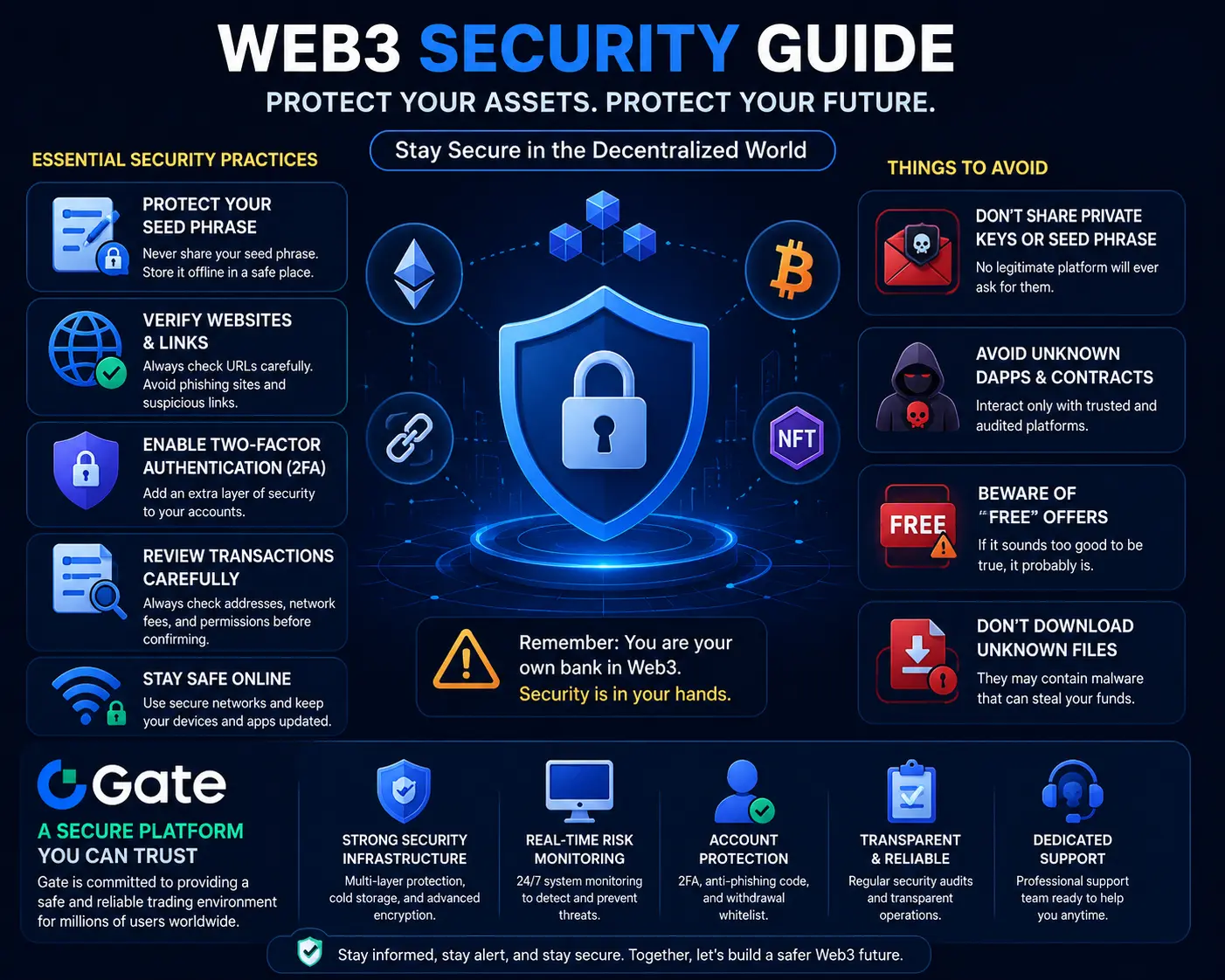
When using centralized exchanges such as gate.io, account protection becomes extremely important.
Recommended security settings include:
✅ Enable Google Authenticator 2FA
✅ Use strong unique passwords
✅ Activate anti-phishing codes
✅ Enable withdrawal whitelist protection
✅ Monitor login history regularly
✅ Avoid logging in through public WiFi
✅ Use separate emails for trading accounts
Gate.io also provides advanced security infrastructure, including risk monitoring systems, cold wallet storage solutions, and multi-layer account protection features.
However, personal account security still depends heavily on the user’s own habits and awareness.
Smart Contract Risks in DeFi
Every time users connect wallets to decentralized applications, they approve permissions that may access tokens or NFTs.
Malicious contracts may: • Drain wallets automatically
• Steal NFTs
• Abuse unlimited approvals
• Transfer assets without clear warnings
Before interacting with DeFi platforms:
✅ Research projects carefully
✅ Verify security audits
✅ Review community reputation
✅ Start with small amounts
✅ Check wallet transaction previews
✅ Revoke unnecessary approvals regularly
Security awareness is essential when exploring new protocols.
Address Poisoning Attacks
Address poisoning is becoming increasingly common across blockchain networks.
Attackers send small transactions from wallet addresses visually similar to legitimate ones. Users accidentally copy the fake address from transaction history and send funds to attackers.
Protection methods:
✅ Verify entire wallet addresses carefully
✅ Save trusted addresses in wallet books
✅ Avoid copying addresses from transaction history
✅ Double-check recipient information before confirming
Even experienced traders have lost significant funds through address poisoning mistakes.
Social Engineering Threats
Many attackers focus on manipulating human behavior instead of attacking blockchain technology directly.
Common tactics include: • Fake support messages
• Emergency account warnings
• Fake investment opportunities
• Giveaway scams
• Impersonation on Telegram or Discord
• Pressure to act immediately
Important reminder: No legitimate platform will ask for your seed phrase or private keys.
Always verify information through official channels before taking action.
Two-Factor Authentication (2FA)
Two-factor authentication adds another security layer beyond passwords.
Security ranking:
Hardware Security Keys
Authenticator Apps
SMS Verification
Authenticator apps such as Google Authenticator are generally stronger than SMS-based protection because SMS systems may face SIM swap attacks.
Browser & Device Security
Crypto security also depends heavily on device protection.
Recommended practices: ✅ Keep operating systems updated
✅ Remove suspicious browser extensions
✅ Avoid cracked software
✅ Use antivirus protection
✅ Lock devices securely
✅ Separate crypto activity from general browsing
Many modern wallet drainers are hidden inside fake browser extensions or malicious software downloads.
DeFi & Yield Farming Risks
Decentralized finance offers high opportunities but also carries serious risks.
Before depositing funds into protocols: • Understand token utility
• Study liquidity conditions
• Review audit reports
• Analyze platform reputation
• Understand smart contract exposure
High rewards often come with elevated risks.
Careful research remains one of the strongest protections in DeFi.
NFT & Web3 Gaming Security
NFT ecosystems continue facing phishing attacks and fake mint scams.
Common risks include: • Fake NFT collections
• Malicious mint pages
• Wallet connection scams
• Fake marketplace listings
Users should: ✅ Verify official collection pages
✅ Avoid random mint links
✅ Review transaction approvals carefully
✅ Use separate wallets for testing new platforms
AI-Powered Crypto Scams
Artificial intelligence is making scams more convincing.
Modern threats now include: • AI-generated phishing emails
• Deepfake influencer videos
• Fake voice calls
• Automated social engineering campaigns
Scammers increasingly use realistic branding and professional-looking interfaces.
Always verify information through official websites and trusted channels.
Security Checklist
Daily: ✅ Verify wallet transactions
✅ Review URLs carefully
✅ Monitor account activity
Weekly: ✅ Check wallet permissions
✅ Update software
✅ Review browser extensions
Monthly: ✅ Audit wallets and accounts
✅ Update passwords
✅ Verify backup systems
Yearly: ✅ Test recovery procedures
✅ Update hardware wallet firmware
✅ Review complete security strategy
Web3 is creating a new era of digital ownership, decentralized finance, and blockchain innovation. However, the ability to control assets directly also means users must prioritize personal security at every level.
The strongest protection in crypto is not only technology — it is awareness, discipline, education, and responsible behavior.
Remember:
Protect your seed phrase carefully
Verify everything before signing
Security should become a daily habit
Responsible users survive long-term in Web3
Stay informed. Stay careful. Stay secure.
repost-content-media
  • Reward
  • 3
  • Repost
  • Share
Miss_1903:
To The Moon 🌕
View More
#Web3SecurityGuide
As Web3 adoption continues growing across exchanges, DeFi, NFTs, and payment systems, security is becoming one of the most important survival skills in crypto. In 2026, making profits is no longer enough — protecting access to your funds, wallets, and accounts has become equally important. Modern exchanges and compliance systems now monitor transaction behavior, wallet exposure, device activity, IP consistency, and source of funds in real time. A single suspicious transfer, risky wallet interaction, or inconsistent activity pattern can sometimes trigger freezes, withdrawal
  • Reward
  • 13
  • Repost
  • Share
CryptoDiscovery:
To The Moon 🌕
View More
#Web3SecurityGuide
In Crypto, Security Is the Real Bull Market Strategy
Most people enter Web3 focused on one thing: making money.
Very few enter focused on protecting it.
That’s why every cycle creates the same outcome. New users rush into trending ecosystems, chase fast profits, connect wallets to random platforms, click suspicious links, ignore permissions, and underestimate how aggressive attackers have become. Then one mistake wipes out years of gains in minutes.
In traditional finance, banks usually absorb security failures.
In Web3, you are the bank.
That changes everything.
The growt
CROSS-1.63%
  • Reward
  • 5
  • Repost
  • Share
BeautifulDay:
To The Moon 🌕
View More
#Web3SecurityGuide
🚨 The Ultimate Web3 Security Guide 🚨
The Web3 ecosystem is growing at an incredible speed. Every day, millions of users interact with decentralized applications, crypto wallets, NFT marketplaces, DeFi protocols, staking platforms, gaming ecosystems, and blockchain networks. With innovation expanding rapidly, digital security has become one of the most important skills every crypto participant must develop.
In traditional finance, banks and institutions are responsible for protecting user accounts. In Web3, the responsibility shifts directly to the individual. This creates
cryptoStylish
#Web3SecurityGuide
🚨 The Ultimate Web3 Security Guide 🚨
The Web3 ecosystem is growing at an incredible speed. Every day, millions of users interact with decentralized applications, crypto wallets, NFT marketplaces, DeFi protocols, staking platforms, gaming ecosystems, and blockchain networks. With innovation expanding rapidly, digital security has become one of the most important skills every crypto participant must develop.
In traditional finance, banks and institutions are responsible for protecting user accounts. In Web3, the responsibility shifts directly to the individual. This creates freedom, ownership, and financial independence — but it also creates risk for those who are careless.
A single mistake can lead to irreversible losses.
One fake website.
One malicious smart contract.
One leaked seed phrase.
One phishing link.
One unsafe wallet connection.
That is often all it takes.
The strongest investors are not only the ones who find opportunities early. They are the ones who survive market cycles by protecting their assets properly.
━━━━━━━━━━━━━━━
🔐 Protect Your Seed Phrase
━━━━━━━━━━━━━━━
Your seed phrase is the master key to your wallet. Anyone who gains access to it can control every asset stored inside.
Never:
• Share your seed phrase
• Save it in screenshots
• Store it in cloud storage
• Send it through messaging apps
• Enter it into random websites
Best practices include:
• Writing it on paper
• Using metal backup storage
• Keeping backups in secure locations
• Creating redundancy with multiple safe copies
No legitimate platform or support team will ever ask for your seed phrase.
━━━━━━━━━━━━━━━
🛡️ Use Hardware Wallets
━━━━━━━━━━━━━━━
Hardware wallets provide one of the safest ways to secure digital assets. Unlike browser wallets connected directly to the internet, hardware wallets isolate private keys from online exposure.
Benefits include:
• Better protection against malware
• Safer transaction signing
• Reduced phishing risks
• Long-term cold storage security
Serious Web3 participants often separate wallets into categories:
• Trading wallet
• DeFi wallet
• Long-term storage wallet
• Experimental wallet
This layered approach reduces overall risk exposure.
━━━━━━━━━━━━━━━
⚠️ Beware of Phishing Attacks
━━━━━━━━━━━━━━━
Phishing scams are becoming increasingly advanced. Attackers now create fake:
• Wallet interfaces
• Exchange websites
• Social media accounts
• Airdrop pages
• Telegram groups
• Discord verification bots
Some scam websites look almost identical to legitimate platforms.
Always verify:
• URLs
• Official announcements
• Smart contract addresses
• Social media handles
Bookmark official sites instead of searching them repeatedly.
━━━━━━━━━━━━━━━
🔎 Smart Contract Approvals Matter
━━━━━━━━━━━━━━━
Every time users connect wallets to decentralized applications, permissions are granted to smart contracts.
Many users unknowingly approve unlimited access to their assets.
Best practices:
• Read approval requests carefully
• Avoid unnecessary permissions
• Revoke unused approvals regularly
• Use trusted applications only
Wallet security is not only about protecting keys — it is also about managing permissions wisely.
━━━━━━━━━━━━━━━
💻 Secure Your Devices
━━━━━━━━━━━━━━━
Your device is your gateway to Web3.
Keep it secure by:
• Updating software regularly
• Avoiding suspicious downloads
• Removing unnecessary browser extensions
• Using strong passwords
• Enabling biometric authentication
• Installing apps only from trusted sources
Some advanced users maintain separate devices exclusively for crypto activity.
━━━━━━━━━━━━━━━
🧠 Emotional Discipline Is Security
━━━━━━━━━━━━━━━
Many scams succeed because users panic or rush decisions.
Scammers create urgency with messages like:
• “Claim rewards immediately”
• “Limited-time mint”
• “Wallet verification required”
• “Exclusive airdrop access”
Fear and greed are powerful tools used against inexperienced users.
The safest strategy is simple:
Pause.
Verify.
Research.
Then proceed.
━━━━━━━━━━━━━━━
📉 Avoid Unrealistic Promises
━━━━━━━━━━━━━━━
Projects promising guaranteed profits, massive APYs, or instant wealth should always be approached carefully.
Warning signs include:
• Anonymous teams
• Lack of audits
• Hidden tokenomics
• Fake partnerships
• Excessive influencer promotion
• No real utility
Strong projects welcome transparency and community questions.
━━━━━━━━━━━━━━━
🌐 Web3 Security Is an Ongoing Process
━━━━━━━━━━━━━━━
Cybersecurity evolves constantly. New threats appear every market cycle.
Good habits include:
• Monitoring wallet activity
• Reviewing permissions regularly
• Staying informed about new exploits
• Following trusted security researchers
• Diversifying storage methods
The safest users are usually the most disciplined and informed participants.
━━━━━━━━━━━━━━━
🚀 Final Thoughts
━━━━━━━━━━━━━━━
Web3 represents a massive shift toward decentralized ownership, financial freedom, and digital innovation. But freedom comes with responsibility.
Security is not optional.
It is the foundation of long-term success in crypto.
Protect your keys.
Protect your devices.
Verify everything.
Think carefully before signing transactions.
The users who survive and thrive in Web3 are not always the fastest movers — they are the ones who stay secure while everyone else takes unnecessary risks.
repost-content-media
  • Reward
  • 14
  • Repost
  • Share
Ryakpanda:
Just charge forward 👊
View More
#Web3SecurityGuide
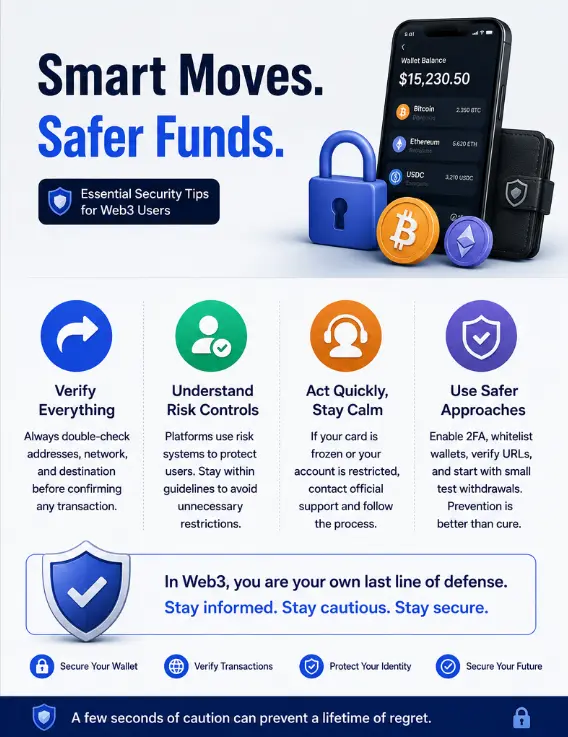
Security remains one of the most important responsibilities in the Web3 ecosystem. As blockchain adoption grows, users must prioritize wallet protection, secure password management, and careful verification of transactions.
The strongest defense against scams is education. Always verify website URLs, avoid sharing private keys, enable two-factor authentication where available, and remain cautious of offers that appear too good to be true.
Innovation creates opportunities, but maintaining strong security practices ensures those opportunities can be pursued safely and confiden
post-image
  • Reward
  • 5
  • Repost
  • Share
AYATTAC:
LFG 🔥
View More
#Web3SecurityGuide
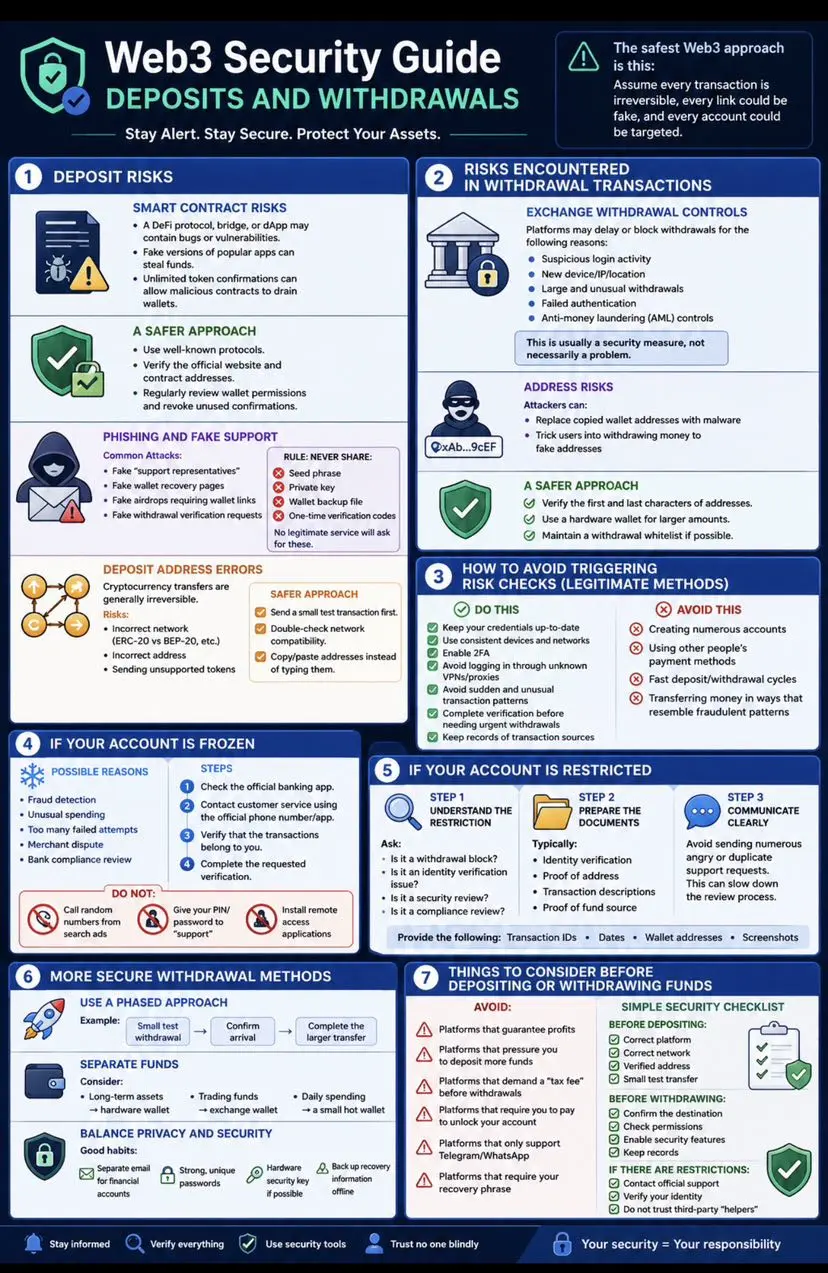
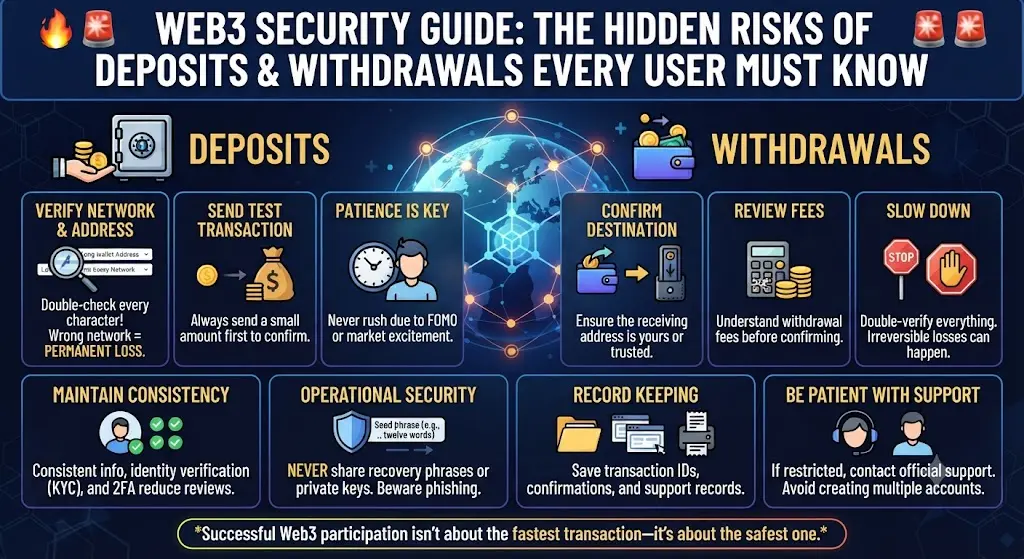
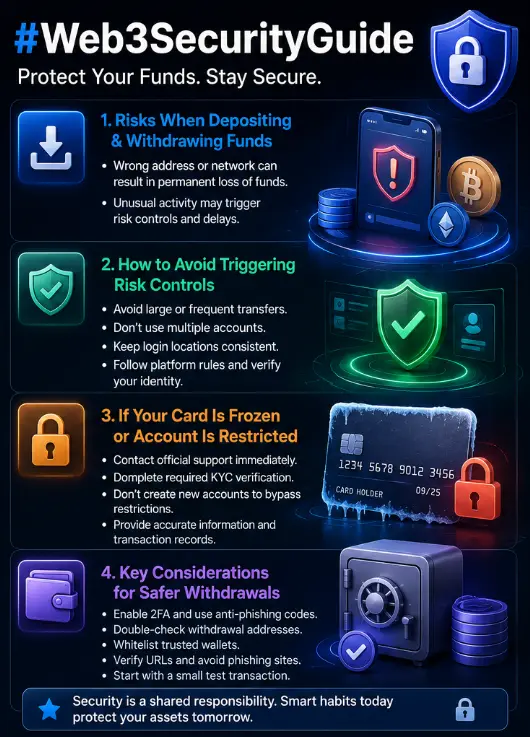
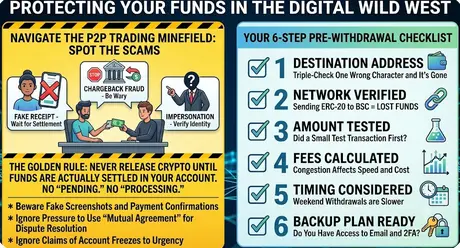
🔐 Web3 Security Isn’t About Hacks Only — It’s About How You Move Money
Most people think risks in crypto only come from smart contract hacks or phishing links, but in reality, a big chunk of user losses and stress comes from something much simpler: deposit/withdrawal friction, compliance flags, and account restrictions that catch people off guard.
When you deposit or withdraw funds, especially across exchanges or fiat ramps, the system isn’t just “moving crypto.” It’s running automated risk models in the background — looking at transaction patterns, wallet history, jurisdi
Crypto_Buzz_with_Alex
#Web3SecurityGuide
🔐 Web3 Security Isn’t About Hacks Only — It’s About How You Move Money
Most people think risks in crypto only come from smart contract hacks or phishing links, but in reality, a big chunk of user losses and stress comes from something much simpler: deposit/withdrawal friction, compliance flags, and account restrictions that catch people off guard.
When you deposit or withdraw funds, especially across exchanges or fiat ramps, the system isn’t just “moving crypto.” It’s running automated risk models in the background — looking at transaction patterns, wallet history, jurisdiction signals, and even behavior consistency. If something looks unusual, it can trigger temporary holds or additional verification checks.
A lot of traders panic at that point, but most of the time it’s not a “you did something wrong” situation — it’s just systems doing what they’re designed to do in a high-risk financial environment.
The key mindset shift is this: treat your account like a long-term financial identity, not a disposable trading tool. Consistency matters. Sudden large behavioral changes, repeated rapid in-and-out flows, or mixing unrelated funding sources can increase friction. Not because you’re being targeted, but because risk engines are built to protect both users and platforms from abuse patterns.
If a card gets frozen or an account is restricted, the worst thing you can do is try to “force” activity or keep retrying transactions blindly. The smarter move is usually simple: check verification requirements, review notifications carefully, and complete any requested compliance steps. In most cases, access is restored once the system can revalidate your profile.
For withdrawals, the safest approach is planning ahead. Keep records clean, avoid unnecessary complexity in transaction paths, and give time for settlement when moving larger amounts. Speed is convenient, but stability matters more when real capital is involved.
In Web3, control is not just about holding your keys — it’s also about understanding how centralized and decentralized systems interact when money crosses between them.
The traders who survive long term aren’t just profitable… they’re operationally disciplined.
How do you personally balance speed vs security when moving funds between exchanges and wallets?
#Web3 #CryptoSecurity #DeFi
repost-content-media
  • Reward
  • 16
  • Repost
  • Share
BlackBullion_Alpha:
Ape In 🚀
View More
#Web3SecurityGuide The Web3 ecosystem is expanding at a rapid pace, but with this growth comes a parallel rise in security threats that are becoming more sophisticated, more automated, and far more damaging than earlier crypto cycles. In a decentralized environment where users directly control their assets, there is no central authority to reverse transactions, recover funds, or resolve disputes, which means every action carries final and irreversible consequences. This makes security not just a technical requirement but the foundation of survival in Web3.
Unlike traditional finance, where ba
  • Reward
  • 5
  • Repost
  • Share
discovery:
To The Moon 🌕
View More
#Web3SecurityGuide
Web3 has transformed the financial world by giving users direct ownership of digital assets without relying on traditional banks or centralized institutions. Blockchain technology allows people to control their own wealth, interact with decentralized applications, trade globally, and participate in the digital economy with full financial freedom.
However, this freedom comes with major responsibility.
In traditional finance, banks manage security systems, fraud protection, and account recovery processes. In Web3, users are fully responsible for protecting their wallets, priv
M谋ngYueZen
#Web3SecurityGuide
Web3 has transformed the financial world by giving users direct ownership of digital assets without relying on traditional banks or centralized institutions. Blockchain technology allows people to control their own wealth, interact with decentralized applications, trade globally, and participate in the digital economy with full financial freedom.
However, this freedom comes with major responsibility.
In traditional finance, banks manage security systems, fraud protection, and account recovery processes. In Web3, users are fully responsible for protecting their wallets, private keys, and assets. If a wallet is compromised or a seed phrase is exposed, transactions cannot usually be reversed.
As cryptocurrency adoption continues expanding in 2026, cyber threats inside the blockchain ecosystem are also increasing rapidly. Phishing attacks, wallet drainers, fake applications, malicious smart contracts, social engineering campaigns, and exchange impersonation scams are now more advanced than ever before.
Understanding Web3 security is now one of the most important skills for every crypto user.
The Foundation of Crypto Ownership
The most important principle in blockchain security is:
“Not Your Keys, Not Your Coins.”
This means ownership of crypto assets depends entirely on who controls the private keys.
Important components of every wallet include:
🔑 Private Key — The secret code controlling access to funds
🔑 Public Address — The wallet address used to receive assets
🔑 Seed Phrase — Backup recovery phrase used to restore wallets
🔑 Smart Contract Permissions — Approvals allowing applications to access tokens
Anyone with access to the seed phrase or private key can fully control the wallet.
This is why crypto security begins with protecting recovery information properly.
Modern Web3 Threat Landscape
The Web3 ecosystem now faces multiple categories of cyber threats, including:
• Phishing websites
• Fake exchange login pages
• Wallet drainers
• Malicious browser extensions
• Address poisoning attacks
• Fake customer support accounts
• AI-generated scam campaigns
• Fake airdrops and giveaways
• Social engineering attacks
• Smart contract exploits
• SIM swap attacks
• Malware targeting wallet files
Many attacks no longer rely on technical hacking alone. Instead, attackers often manipulate users emotionally through urgency, fear, excitement, or fake investment opportunities.
Seed Phrase Protection — The Highest Priority
Your seed phrase is the master backup for your wallet.
If someone gains access to it: • They can restore your wallet anywhere • They can transfer all assets instantly • They can bypass passwords and device security
Because of this, proper seed phrase storage is critical.
Best practices include:
✅ Write seed phrases on physical materials
✅ Store backups in secure offline locations
✅ Use fireproof or metal backup solutions
✅ Keep multiple copies in separate locations
✅ Protect backups from water and physical damage
Never: ❌ Save seed phrases in screenshots
❌ Store phrases in cloud drives
❌ Share phrases through messaging apps
❌ Enter phrases into websites
❌ Give phrases to support agents
Legitimate exchanges and wallet providers will never ask for your recovery phrase.
Hardware Wallet Security
Hardware wallets remain one of the strongest security solutions for long-term crypto storage.
Popular hardware wallet providers include: • Ledger
• Trezor
• SafePal
• Keystone
These devices store private keys offline, reducing exposure to online attacks.
Benefits of hardware wallets: ✅ Offline key storage
✅ Protection from malware
✅ Secure transaction signing
✅ Physical verification screens
✅ Better long-term storage security
Most experienced investors use cold wallets for large holdings and hot wallets for daily activity.
The 80/20 Security Strategy
Professional crypto users often follow the 80/20 protection strategy:
• 80–90% of holdings stay in cold storage
• 10–20% remain in hot wallets or exchanges for active use
This reduces overall risk exposure significantly.
Even if a hot wallet is compromised, most funds remain protected offline.
Exchange Security — Safe Trading Practices
When using centralized exchanges such as gate.io, account protection becomes extremely important.
Recommended security settings include:
✅ Enable Google Authenticator 2FA
✅ Use strong unique passwords
✅ Activate anti-phishing codes
✅ Enable withdrawal whitelist protection
✅ Monitor login history regularly
✅ Avoid logging in through public WiFi
✅ Use separate emails for trading accounts
Gate.io also provides advanced security infrastructure, including risk monitoring systems, cold wallet storage solutions, and multi-layer account protection features.
However, personal account security still depends heavily on the user’s own habits and awareness.
Smart Contract Risks in DeFi
Every time users connect wallets to decentralized applications, they approve permissions that may access tokens or NFTs.
Malicious contracts may: • Drain wallets automatically
• Steal NFTs
• Abuse unlimited approvals
• Transfer assets without clear warnings
Before interacting with DeFi platforms:
✅ Research projects carefully
✅ Verify security audits
✅ Review community reputation
✅ Start with small amounts
✅ Check wallet transaction previews
✅ Revoke unnecessary approvals regularly
Security awareness is essential when exploring new protocols.
Address Poisoning Attacks
Address poisoning is becoming increasingly common across blockchain networks.
Attackers send small transactions from wallet addresses visually similar to legitimate ones. Users accidentally copy the fake address from transaction history and send funds to attackers.
Protection methods:
✅ Verify entire wallet addresses carefully
✅ Save trusted addresses in wallet books
✅ Avoid copying addresses from transaction history
✅ Double-check recipient information before confirming
Even experienced traders have lost significant funds through address poisoning mistakes.
Social Engineering Threats
Many attackers focus on manipulating human behavior instead of attacking blockchain technology directly.
Common tactics include: • Fake support messages
• Emergency account warnings
• Fake investment opportunities
• Giveaway scams
• Impersonation on Telegram or Discord
• Pressure to act immediately
Important reminder: No legitimate platform will ask for your seed phrase or private keys.
Always verify information through official channels before taking action.
Two-Factor Authentication (2FA)
Two-factor authentication adds another security layer beyond passwords.
Security ranking:
Hardware Security Keys
Authenticator Apps
SMS Verification
Authenticator apps such as Google Authenticator are generally stronger than SMS-based protection because SMS systems may face SIM swap attacks.
Browser & Device Security
Crypto security also depends heavily on device protection.
Recommended practices: ✅ Keep operating systems updated
✅ Remove suspicious browser extensions
✅ Avoid cracked software
✅ Use antivirus protection
✅ Lock devices securely
✅ Separate crypto activity from general browsing
Many modern wallet drainers are hidden inside fake browser extensions or malicious software downloads.
DeFi & Yield Farming Risks
Decentralized finance offers high opportunities but also carries serious risks.
Before depositing funds into protocols: • Understand token utility
• Study liquidity conditions
• Review audit reports
• Analyze platform reputation
• Understand smart contract exposure
High rewards often come with elevated risks.
Careful research remains one of the strongest protections in DeFi.
NFT & Web3 Gaming Security
NFT ecosystems continue facing phishing attacks and fake mint scams.
Common risks include: • Fake NFT collections
• Malicious mint pages
• Wallet connection scams
• Fake marketplace listings
Users should: ✅ Verify official collection pages
✅ Avoid random mint links
✅ Review transaction approvals carefully
✅ Use separate wallets for testing new platforms
AI-Powered Crypto Scams
Artificial intelligence is making scams more convincing.
Modern threats now include: • AI-generated phishing emails
• Deepfake influencer videos
• Fake voice calls
• Automated social engineering campaigns
Scammers increasingly use realistic branding and professional-looking interfaces.
Always verify information through official websites and trusted channels.
Security Checklist
Daily: ✅ Verify wallet transactions
✅ Review URLs carefully
✅ Monitor account activity
Weekly: ✅ Check wallet permissions
✅ Update software
✅ Review browser extensions
Monthly: ✅ Audit wallets and accounts
✅ Update passwords
✅ Verify backup systems
Yearly: ✅ Test recovery procedures
✅ Update hardware wallet firmware
✅ Review complete security strategy
Web3 is creating a new era of digital ownership, decentralized finance, and blockchain innovation. However, the ability to control assets directly also means users must prioritize personal security at every level.
The strongest protection in crypto is not only technology — it is awareness, discipline, education, and responsible behavior.
Remember:
Protect your seed phrase carefully
Verify everything before signing
Security should become a daily habit
Responsible users survive long-term in Web3
Stay informed. Stay careful. Stay secure.
  • Reward
  • 1
  • Repost
  • Share
HighAmbition:
2026 GOGOGO 👊
#Web3SecurityGuide
Web3 has transformed the financial world by giving users direct ownership of digital assets without relying on traditional banks or centralized institutions. Blockchain technology allows people to control their own wealth, interact with decentralized applications, trade globally, and participate in the digital economy with full financial freedom.
However, this freedom comes with major responsibility.
In traditional finance, banks manage security systems, fraud protection, and account recovery processes. In Web3, users are fully responsible for protecting their wallets, priv
HighAmbition
#Web3SecurityGuide
Web3 has transformed the financial world by giving users direct ownership of digital assets without relying on traditional banks or centralized institutions. Blockchain technology allows people to control their own wealth, interact with decentralized applications, trade globally, and participate in the digital economy with full financial freedom.
However, this freedom comes with major responsibility.
In traditional finance, banks manage security systems, fraud protection, and account recovery processes. In Web3, users are fully responsible for protecting their wallets, private keys, and assets. If a wallet is compromised or a seed phrase is exposed, transactions cannot usually be reversed.
As cryptocurrency adoption continues expanding in 2026, cyber threats inside the blockchain ecosystem are also increasing rapidly. Phishing attacks, wallet drainers, fake applications, malicious smart contracts, social engineering campaigns, and exchange impersonation scams are now more advanced than ever before.
Understanding Web3 security is now one of the most important skills for every crypto user.
The Foundation of Crypto Ownership
The most important principle in blockchain security is:
“Not Your Keys, Not Your Coins.”
This means ownership of crypto assets depends entirely on who controls the private keys.
Important components of every wallet include:
🔑 Private Key — The secret code controlling access to funds
🔑 Public Address — The wallet address used to receive assets
🔑 Seed Phrase — Backup recovery phrase used to restore wallets
🔑 Smart Contract Permissions — Approvals allowing applications to access tokens
Anyone with access to the seed phrase or private key can fully control the wallet.
This is why crypto security begins with protecting recovery information properly.
Modern Web3 Threat Landscape
The Web3 ecosystem now faces multiple categories of cyber threats, including:
• Phishing websites
• Fake exchange login pages
• Wallet drainers
• Malicious browser extensions
• Address poisoning attacks
• Fake customer support accounts
• AI-generated scam campaigns
• Fake airdrops and giveaways
• Social engineering attacks
• Smart contract exploits
• SIM swap attacks
• Malware targeting wallet files
Many attacks no longer rely on technical hacking alone. Instead, attackers often manipulate users emotionally through urgency, fear, excitement, or fake investment opportunities.
Seed Phrase Protection — The Highest Priority
Your seed phrase is the master backup for your wallet.
If someone gains access to it: • They can restore your wallet anywhere • They can transfer all assets instantly • They can bypass passwords and device security
Because of this, proper seed phrase storage is critical.
Best practices include:
✅ Write seed phrases on physical materials
✅ Store backups in secure offline locations
✅ Use fireproof or metal backup solutions
✅ Keep multiple copies in separate locations
✅ Protect backups from water and physical damage
Never: ❌ Save seed phrases in screenshots
❌ Store phrases in cloud drives
❌ Share phrases through messaging apps
❌ Enter phrases into websites
❌ Give phrases to support agents
Legitimate exchanges and wallet providers will never ask for your recovery phrase.
Hardware Wallet Security
Hardware wallets remain one of the strongest security solutions for long-term crypto storage.
Popular hardware wallet providers include: • Ledger
• Trezor
• SafePal
• Keystone
These devices store private keys offline, reducing exposure to online attacks.
Benefits of hardware wallets: ✅ Offline key storage
✅ Protection from malware
✅ Secure transaction signing
✅ Physical verification screens
✅ Better long-term storage security
Most experienced investors use cold wallets for large holdings and hot wallets for daily activity.
The 80/20 Security Strategy
Professional crypto users often follow the 80/20 protection strategy:
• 80–90% of holdings stay in cold storage
• 10–20% remain in hot wallets or exchanges for active use
This reduces overall risk exposure significantly.
Even if a hot wallet is compromised, most funds remain protected offline.
Exchange Security — Safe Trading Practices
When using centralized exchanges such as gate.io, account protection becomes extremely important.
Recommended security settings include:
✅ Enable Google Authenticator 2FA
✅ Use strong unique passwords
✅ Activate anti-phishing codes
✅ Enable withdrawal whitelist protection
✅ Monitor login history regularly
✅ Avoid logging in through public WiFi
✅ Use separate emails for trading accounts
Gate.io also provides advanced security infrastructure, including risk monitoring systems, cold wallet storage solutions, and multi-layer account protection features.
However, personal account security still depends heavily on the user’s own habits and awareness.
Smart Contract Risks in DeFi
Every time users connect wallets to decentralized applications, they approve permissions that may access tokens or NFTs.
Malicious contracts may: • Drain wallets automatically
• Steal NFTs
• Abuse unlimited approvals
• Transfer assets without clear warnings
Before interacting with DeFi platforms:
✅ Research projects carefully
✅ Verify security audits
✅ Review community reputation
✅ Start with small amounts
✅ Check wallet transaction previews
✅ Revoke unnecessary approvals regularly
Security awareness is essential when exploring new protocols.
Address Poisoning Attacks
Address poisoning is becoming increasingly common across blockchain networks.
Attackers send small transactions from wallet addresses visually similar to legitimate ones. Users accidentally copy the fake address from transaction history and send funds to attackers.
Protection methods:
✅ Verify entire wallet addresses carefully
✅ Save trusted addresses in wallet books
✅ Avoid copying addresses from transaction history
✅ Double-check recipient information before confirming
Even experienced traders have lost significant funds through address poisoning mistakes.
Social Engineering Threats
Many attackers focus on manipulating human behavior instead of attacking blockchain technology directly.
Common tactics include: • Fake support messages
• Emergency account warnings
• Fake investment opportunities
• Giveaway scams
• Impersonation on Telegram or Discord
• Pressure to act immediately
Important reminder: No legitimate platform will ask for your seed phrase or private keys.
Always verify information through official channels before taking action.
Two-Factor Authentication (2FA)
Two-factor authentication adds another security layer beyond passwords.
Security ranking:
Hardware Security Keys
Authenticator Apps
SMS Verification
Authenticator apps such as Google Authenticator are generally stronger than SMS-based protection because SMS systems may face SIM swap attacks.
Browser & Device Security
Crypto security also depends heavily on device protection.
Recommended practices: ✅ Keep operating systems updated
✅ Remove suspicious browser extensions
✅ Avoid cracked software
✅ Use antivirus protection
✅ Lock devices securely
✅ Separate crypto activity from general browsing
Many modern wallet drainers are hidden inside fake browser extensions or malicious software downloads.
DeFi & Yield Farming Risks
Decentralized finance offers high opportunities but also carries serious risks.
Before depositing funds into protocols: • Understand token utility
• Study liquidity conditions
• Review audit reports
• Analyze platform reputation
• Understand smart contract exposure
High rewards often come with elevated risks.
Careful research remains one of the strongest protections in DeFi.
NFT & Web3 Gaming Security
NFT ecosystems continue facing phishing attacks and fake mint scams.
Common risks include: • Fake NFT collections
• Malicious mint pages
• Wallet connection scams
• Fake marketplace listings
Users should: ✅ Verify official collection pages
✅ Avoid random mint links
✅ Review transaction approvals carefully
✅ Use separate wallets for testing new platforms
AI-Powered Crypto Scams
Artificial intelligence is making scams more convincing.
Modern threats now include: • AI-generated phishing emails
• Deepfake influencer videos
• Fake voice calls
• Automated social engineering campaigns
Scammers increasingly use realistic branding and professional-looking interfaces.
Always verify information through official websites and trusted channels.
Security Checklist
Daily: ✅ Verify wallet transactions
✅ Review URLs carefully
✅ Monitor account activity
Weekly: ✅ Check wallet permissions
✅ Update software
✅ Review browser extensions
Monthly: ✅ Audit wallets and accounts
✅ Update passwords
✅ Verify backup systems
Yearly: ✅ Test recovery procedures
✅ Update hardware wallet firmware
✅ Review complete security strategy
Web3 is creating a new era of digital ownership, decentralized finance, and blockchain innovation. However, the ability to control assets directly also means users must prioritize personal security at every level.
The strongest protection in crypto is not only technology — it is awareness, discipline, education, and responsible behavior.
Remember:
Protect your seed phrase carefully
Verify everything before signing
Security should become a daily habit
Responsible users survive long-term in Web3
Stay informed. Stay careful. Stay secure.
repost-content-media
  • Reward
  • 1
  • Repost
  • Share
HighAmbition:
2026 GOGOGO 👊
#Web3SecurityGuide The Web3 era is expanding at full speed, but beneath the surface of innovation lies a growing battlefield that most retail users still underestimate security is no longer optional in decentralized systems, it is survival.
As Web3 adoption accelerates across DeFi, NFTs, on-chain identity, gaming ecosystems, and cross-chain infrastructure, the attack surface is expanding faster than the security framework designed to protect it. Every new wallet created, every smart contract deployed, and every bridge interaction adds another potential entry point for exploitation.
The uncom
TOKEN-4.76%
  • Reward
  • 4
  • Repost
  • Share
Luna_Star:
LFG 🔥
View More
Load More