PrinceMagsi786

vip
Age 0.2 Year
Peak Tier 0
No content yet
#AnthropicSecondaryValuationHits1.2Trillion
🤖💎 𝗔𝗡𝗧𝗛𝗥𝗢𝗣𝗜𝗖 𝗛𝗜𝗧𝗦 𝗔 $𝟭.𝟮 𝗧𝗥𝗜𝗟𝗟𝗜𝗢𝗡 𝗦𝗘𝗖𝗢𝗡𝗗𝗔𝗥𝗬 𝗩𝗔𝗟𝗨𝗔𝗧𝗜𝗢𝗡 • 𝗔𝗜 𝗜𝗡𝗩𝗘𝗦𝗧𝗢𝗥 𝗙𝗥𝗘𝗡𝗭𝗬 𝗜𝗡𝗧𝗘𝗡𝗦𝗜𝗙𝗜𝗘𝗦 • 𝗦𝗛𝗔𝗥𝗘𝗦 𝗥𝗘𝗠𝗔𝗜𝗡 𝗘𝗫𝗧𝗥𝗘𝗠𝗘𝗟𝗬 𝗦𝗖𝗔𝗥𝗖𝗘 🚀
𝗧𝗛𝗘 𝗔𝗜 𝗥𝗔𝗖𝗘 𝗜𝗦 𝗡𝗢 𝗟𝗢𝗡𝗚𝗘𝗥 𝗝𝗨𝗦𝗧 𝗔𝗕𝗢𝗨𝗧 𝗧𝗘𝗖𝗛𝗡𝗢𝗟𝗢𝗚𝗬—𝗜𝗧'𝗦 𝗔𝗟𝗦𝗢 𝗔 𝗥𝗔𝗖𝗘 𝗙𝗢𝗥 𝗢𝗪𝗡𝗘𝗥𝗦𝗛𝗜𝗣.
As artificial intelligence continues to transform industries around the world, investors are competing aggressively for exposure to the companies building the future. Few names have attracted a
EagleEye
#AnthropicSecondaryValuationHits1.2Trillion
🤖💎 𝗔𝗡𝗧𝗛𝗥𝗢𝗣𝗜𝗖 𝗛𝗜𝗧𝗦 𝗔 $𝟭.𝟮 𝗧𝗥𝗜𝗟𝗟𝗜𝗢𝗡 𝗦𝗘𝗖𝗢𝗡𝗗𝗔𝗥𝗬 𝗩𝗔𝗟𝗨𝗔𝗧𝗜𝗢𝗡 • 𝗔𝗜 𝗜𝗡𝗩𝗘𝗦𝗧𝗢𝗥 𝗙𝗥𝗘𝗡𝗭𝗬 𝗜𝗡𝗧𝗘𝗡𝗦𝗜𝗙𝗜𝗘𝗦 • 𝗦𝗛𝗔𝗥𝗘𝗦 𝗥𝗘𝗠𝗔𝗜𝗡 𝗘𝗫𝗧𝗥𝗘𝗠𝗘𝗟𝗬 𝗦𝗖𝗔𝗥𝗖𝗘 🚀
𝗧𝗛𝗘 𝗔𝗜 𝗥𝗔𝗖𝗘 𝗜𝗦 𝗡𝗢 𝗟𝗢𝗡𝗚𝗘𝗥 𝗝𝗨𝗦𝗧 𝗔𝗕𝗢𝗨𝗧 𝗧𝗘𝗖𝗛𝗡𝗢𝗟𝗢𝗚𝗬—𝗜𝗧'𝗦 𝗔𝗟𝗦𝗢 𝗔 𝗥𝗔𝗖𝗘 𝗙𝗢𝗥 𝗢𝗪𝗡𝗘𝗥𝗦𝗛𝗜𝗣.
As artificial intelligence continues to transform industries around the world, investors are competing aggressively for exposure to the companies building the future. Few names have attracted as much attention as Anthropic, whose private shares have become some of the most sought-after assets in technology.
The latest secondary market pricing shows just how strong that demand has become.
𝗔 $𝟭.𝟮 𝗧𝗥𝗜𝗟𝗟𝗜𝗢𝗡 𝗜𝗠𝗣𝗟𝗜𝗘𝗗 𝗩𝗔𝗟𝗨𝗔𝗧𝗜𝗢𝗡.
Anthropic's implied valuation in the secondary market has climbed to approximately $1.2 trillion, placing it among the most valuable private AI companies in the world.
It's important to note that this figure comes from secondary-market trading, where existing shareholders sell privately held shares. It is not the company's latest official funding valuation, which was $965 billion in its most recent financing round.

𝗪𝗛𝗬 𝗜𝗦 𝗗𝗘𝗠𝗔𝗡𝗗 𝗦𝗢 𝗛𝗜𝗚𝗛?
Investor enthusiasm is being driven by Anthropic's rapid revenue growth, expanding enterprise adoption, and its increasingly important position in the global AI ecosystem.
At the same time, very few shareholders are willing to sell their stakes. That limited supply has pushed secondary-market prices sharply higher as buyers compete for a small number of available shares.

𝗦𝗖𝗔𝗥𝗖𝗜𝗧𝗬 𝗜𝗦 𝗕𝗘𝗖𝗢𝗠𝗜𝗡𝗚 𝗣𝗔𝗥𝗧 𝗢𝗙 𝗧𝗛𝗘 𝗩𝗔𝗟𝗨𝗔𝗧𝗜𝗢𝗡.
Unlike publicly traded companies, private AI firms have a limited number of shares available for purchase.
With strong demand and very little supply, secondary-market prices can trade well above the company's most recent official valuation. That doesn't necessarily represent the company's intrinsic value, but it does reflect how eager investors are to gain exposure before a potential public listing.

𝗪𝗛𝗬 𝗧𝗛𝗜𝗦 𝗠𝗔𝗧𝗧𝗘𝗥𝗦.
The surge in Anthropic's secondary valuation highlights how AI has become one of the most competitive investment themes in global markets.
Companies building foundation models, AI infrastructure, and enterprise AI solutions continue attracting enormous amounts of capital as investors bet on decades of future growth rather than today's earnings.
𝗠𝗬 𝗣𝗘𝗥𝗦𝗣𝗘𝗖𝗧𝗜𝗩𝗘.
The excitement surrounding Anthropic shows how strongly investors believe AI will reshape the global economy. However, secondary-market valuations should be viewed carefully because they are influenced by limited liquidity and scarce share availability.
Long-term success will ultimately depend on innovation, execution, customer adoption, and sustainable financial performance—not just rising private-market prices.
𝗙𝗜𝗡𝗔𝗟 𝗧𝗛𝗢𝗨𝗚𝗛𝗧𝗦.
Anthropic's implied $1.2 trillion secondary-market valuation reflects extraordinary investor demand and growing confidence in the future of artificial intelligence. Whether those expectations are fully justified will depend on the company's ability to continue delivering technological leadership and business growth. For now, one thing is clear: AI remains one of the hottest investment stories in the world.
@Gate_Square

repost-content-media
  • Reward
  • Comment
  • Repost
  • Share
#SKHynixADRIndicativePrice149
🚀💾 𝗦𝗞 𝗛𝗬𝗡𝗜𝗫 𝗔𝗗𝗥 𝗜𝗡𝗗𝗜𝗖𝗔𝗧𝗜𝗩𝗘 𝗣𝗥𝗜𝗖𝗘 𝗦𝗘𝗧 𝗔𝗧 $𝟭𝟰𝟵 • 𝗔𝗜 𝗠𝗘𝗠𝗢𝗥𝗬 𝗗𝗘𝗠𝗔𝗡𝗗 𝗜𝗚𝗡𝗜𝗧𝗘𝗦 𝗚𝗟𝗢𝗕𝗔𝗟 𝗜𝗡𝗩𝗘𝗦𝗧𝗢𝗥 𝗘𝗫𝗖𝗜𝗧𝗘𝗠𝗘𝗡𝗧 • 𝗔 𝗛𝗜𝗦𝗧𝗢𝗥𝗜𝗖 𝗠𝗢𝗠𝗘𝗡𝗧 𝗙𝗢𝗥 𝗧𝗛𝗘 𝗦𝗘𝗠𝗜𝗖𝗢𝗡𝗗𝗨𝗖𝗧𝗢𝗥 𝗜𝗡𝗗𝗨𝗦𝗧𝗥𝗬 📈
𝗧𝗛𝗘 𝗔𝗜 𝗥𝗘𝗩𝗢𝗟𝗨𝗧𝗜𝗢𝗡 𝗜𝗦 𝗡𝗢𝗧 𝗝𝗨𝗦𝗧 𝗖𝗛𝗔𝗡𝗚𝗜𝗡𝗚 𝗧𝗘𝗖𝗛𝗡𝗢𝗟𝗢𝗚𝗬—𝗜𝗧 𝗜𝗦 𝗔𝗟𝗦𝗢 𝗥𝗘𝗗𝗘𝗙𝗜𝗡𝗜𝗡𝗚 𝗚𝗟𝗢𝗕𝗔𝗟 𝗜𝗡𝗩𝗘𝗦𝗧𝗠𝗘𝗡𝗧.
Artificial intelligence has created one of the strongest technology cycles in decades. Every breakthrough in AI requires more p
SKHYV-0.98%
EagleEye
#SKHynixADRIndicativePrice149
🚀💾 𝗦𝗞 𝗛𝗬𝗡𝗜𝗫 𝗔𝗗𝗥 𝗜𝗡𝗗𝗜𝗖𝗔𝗧𝗜𝗩𝗘 𝗣𝗥𝗜𝗖𝗘 𝗦𝗘𝗧 𝗔𝗧 $𝟭𝟰𝟵 • 𝗔𝗜 𝗠𝗘𝗠𝗢𝗥𝗬 𝗗𝗘𝗠𝗔𝗡𝗗 𝗜𝗚𝗡𝗜𝗧𝗘𝗦 𝗚𝗟𝗢𝗕𝗔𝗟 𝗜𝗡𝗩𝗘𝗦𝗧𝗢𝗥 𝗘𝗫𝗖𝗜𝗧𝗘𝗠𝗘𝗡𝗧 • 𝗔 𝗛𝗜𝗦𝗧𝗢𝗥𝗜𝗖 𝗠𝗢𝗠𝗘𝗡𝗧 𝗙𝗢𝗥 𝗧𝗛𝗘 𝗦𝗘𝗠𝗜𝗖𝗢𝗡𝗗𝗨𝗖𝗧𝗢𝗥 𝗜𝗡𝗗𝗨𝗦𝗧𝗥𝗬 📈
𝗧𝗛𝗘 𝗔𝗜 𝗥𝗘𝗩𝗢𝗟𝗨𝗧𝗜𝗢𝗡 𝗜𝗦 𝗡𝗢𝗧 𝗝𝗨𝗦𝗧 𝗖𝗛𝗔𝗡𝗚𝗜𝗡𝗚 𝗧𝗘𝗖𝗛𝗡𝗢𝗟𝗢𝗚𝗬—𝗜𝗧 𝗜𝗦 𝗔𝗟𝗦𝗢 𝗥𝗘𝗗𝗘𝗙𝗜𝗡𝗜𝗡𝗚 𝗚𝗟𝗢𝗕𝗔𝗟 𝗜𝗡𝗩𝗘𝗦𝗧𝗠𝗘𝗡𝗧.
Artificial intelligence has created one of the strongest technology cycles in decades. Every breakthrough in AI requires more powerful chips, faster processors, and most importantly, advanced memory solutions capable of handling enormous amounts of data.
As this demand accelerates, companies leading the memory industry are becoming some of the most valuable businesses in the global technology sector.
𝗦𝗞 𝗛𝗬𝗡𝗜𝗫 𝗘𝗡𝗧𝗘𝗥𝗦 𝗧𝗛𝗘 𝗦𝗣𝗢𝗧𝗟𝗜𝗚𝗛𝗧.
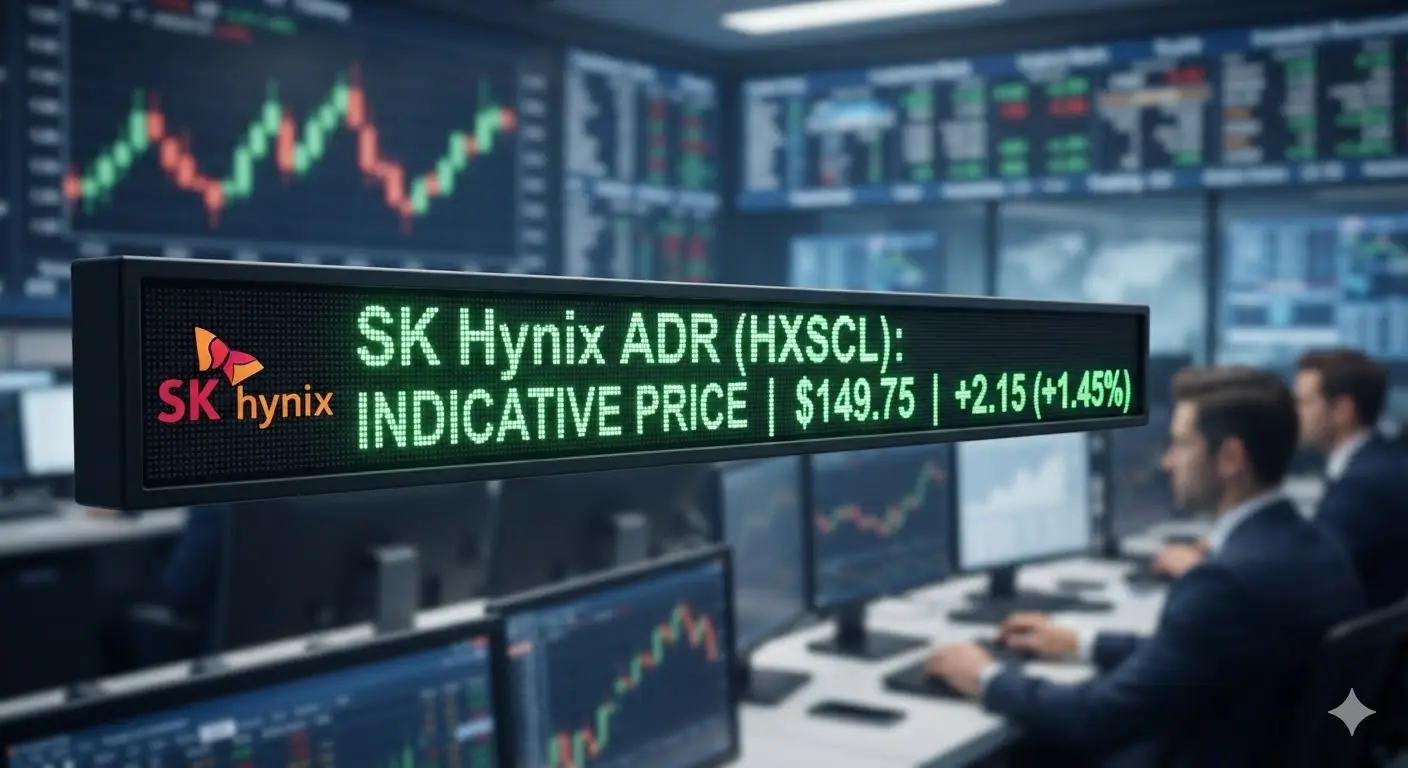
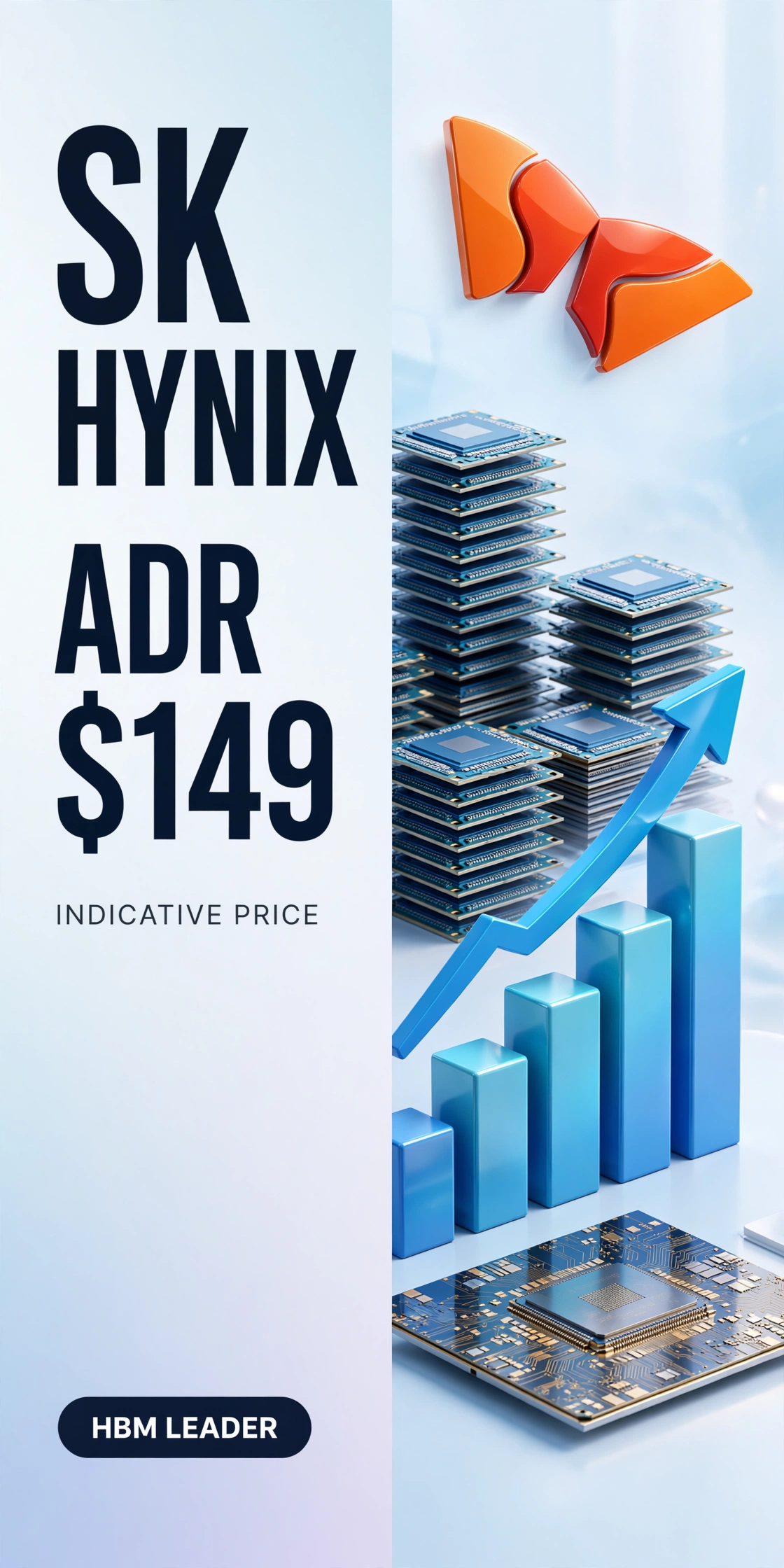
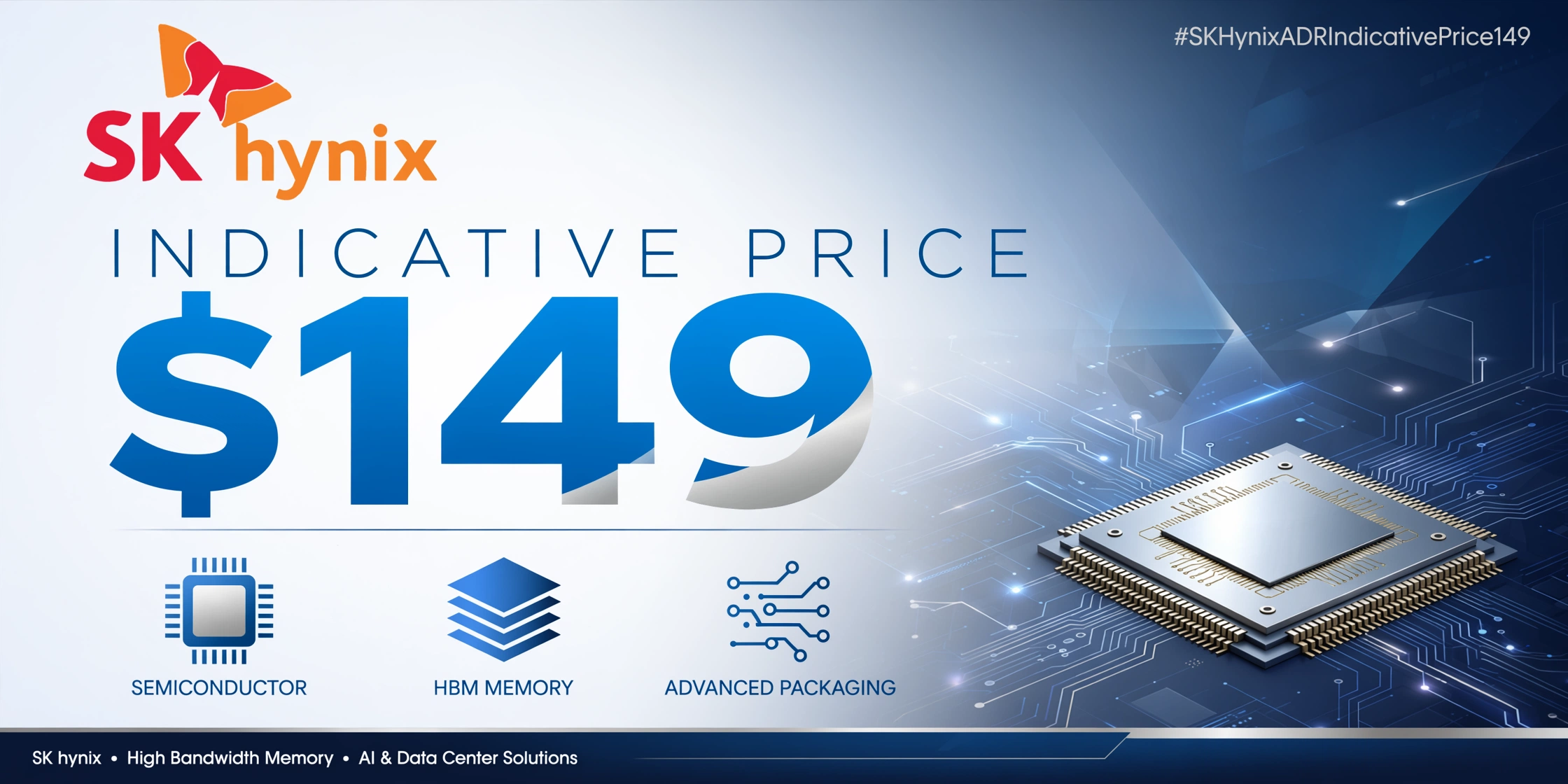
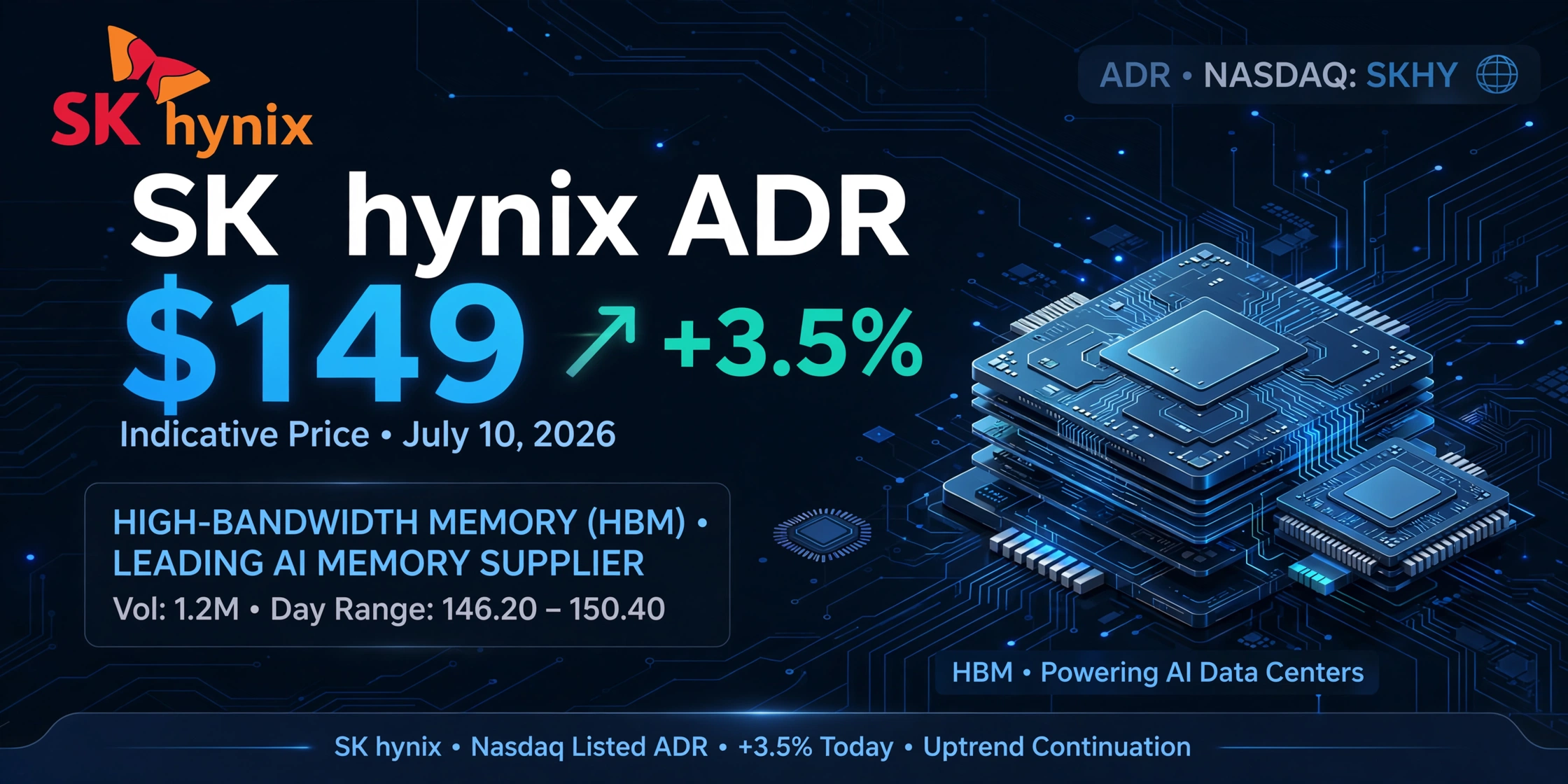
SK Hynix has announced an indicative ADR price of **$149**, marking a major milestone as the company prepares for its highly anticipated U.S. market debut.
The pricing reflects exceptionally strong institutional demand and demonstrates the confidence global investors have in the future of AI infrastructure. Interest from major investment funds has remained strong throughout the offering process, making it one of the most closely watched semiconductor listings in recent years.
𝗪𝗛𝗬 𝗜𝗦 𝗦𝗢 𝗠𝗨𝗖𝗛 𝗔𝗧𝗧𝗘𝗡𝗧𝗜𝗢𝗡 𝗙𝗢𝗖𝗨𝗦𝗘𝗗 𝗢𝗡 𝗦𝗞 𝗛𝗬𝗡𝗜𝗫?
The answer is simple—AI.
SK Hynix is one of the world's leading producers of High-Bandwidth Memory (HBM), a technology that has become essential for training and running modern artificial intelligence models.
Without advanced memory, even the most powerful AI processors cannot deliver their full performance. As AI models continue becoming larger and more sophisticated, demand for HBM continues to rise at an extraordinary pace.
𝗧𝗛𝗘 𝗔𝗜 𝗕𝗢𝗢𝗠 𝗜𝗦 𝗖𝗥𝗘𝗔𝗧𝗜𝗡𝗚 𝗔 𝗡𝗘𝗪 𝗠𝗘𝗠𝗢𝗥𝗬 𝗦𝗨𝗣𝗘𝗥𝗖𝗬𝗖𝗟𝗘.
Cloud providers, AI startups, enterprise software companies, and global technology giants are investing billions of dollars into AI infrastructure.
Every new data center requires thousands of AI accelerators, and every accelerator depends on high-performance memory chips.
This structural demand is transforming memory from a cyclical business into one of the most strategic industries supporting artificial intelligence.
𝗧𝗛𝗘 𝗡𝗔𝗦𝗗𝗔𝗤 𝗟𝗜𝗦𝗧𝗜𝗡𝗚 𝗢𝗣𝗘𝗡𝗦 𝗡𝗘𝗪 𝗗𝗢𝗢𝗥𝗦.
A U.S. listing gives SK Hynix greater visibility among global institutional investors and provides easier access for American funds seeking exposure to one of the world's most important AI hardware companies.
At the same time, the capital raised will help expand semiconductor manufacturing capacity, strengthen research and development, and accelerate investment in next-generation memory technologies.
𝗜𝗡𝗩𝗘𝗦𝗧𝗢𝗥𝗦 𝗔𝗥𝗘 𝗟𝗢𝗢𝗞𝗜𝗡𝗚 𝗕𝗘𝗬𝗢𝗡𝗗 𝗧𝗢𝗗𝗔𝗬.
The excitement surrounding this offering is not simply about today's earnings.
It reflects expectations that artificial intelligence will continue expanding across industries including healthcare, finance, robotics, manufacturing, autonomous vehicles, cybersecurity, and cloud computing.
If AI adoption continues at its current pace, advanced memory will remain one of the most critical components powering this transformation.
𝗪𝗛𝗬 𝗧𝗛𝗜𝗦 𝗠𝗔𝗧𝗧𝗘𝗥𝗦.
The semiconductor industry is becoming the backbone of the digital economy.
Companies producing advanced memory are no longer supporting players—they are becoming essential infrastructure providers for the next generation of computing.
That shift explains why investors are paying such close attention to every development involving SK Hynix.
𝗠𝗬 𝗣𝗘𝗥𝗦𝗣𝗘𝗖𝗧𝗜𝗩𝗘.
The AI race is still in its early stages, and memory demand continues to grow faster than supply in several advanced categories.
SK Hynix has positioned itself as one of the companies most likely to benefit from this long-term trend. While no investment is without risk, the company's leadership in HBM technology gives it a strong competitive advantage as AI infrastructure continues expanding around the world.
𝗙𝗜𝗡𝗔𝗟 𝗧𝗛𝗢𝗨𝗚𝗛𝗧𝗦.
The $149 indicative ADR price represents far more than a listing milestone—it reflects growing confidence in the future of artificial intelligence and the companies building its foundation. As AI investment accelerates worldwide, SK Hynix stands at the center of one of the fastest-growing sectors in technology. The coming years will depend on execution, innovation, and continued demand, but one thing is becoming increasingly clear: advanced memory is no longer just a component—it has become one of the engines powering the global AI revolution.
@Gate_Square
repost-content-media
  • Reward
  • Comment
  • Repost
  • Share
#GUSDYieldRisesto3.8%
𝗚𝗨𝗦𝗗 𝗬𝗜𝗘𝗟𝗗 𝗥𝗜𝗦𝗘𝗦 𝗧𝗢 𝟯.𝟴% • 𝟭:𝟭 𝗨𝗦𝗗𝟭 𝗠𝗜𝗡𝗧𝗜𝗡𝗚 • 𝗗𝗔𝗜𝗟𝗬 𝗥𝗘𝗪𝗔𝗥𝗗𝗦 • 𝗠𝗨𝗟𝗧𝗜𝗣𝗟𝗘 𝗪𝗘𝗔𝗟𝗧𝗛 𝗢𝗣𝗣𝗢𝗥𝗧𝗨𝗡𝗜𝗧𝗜𝗘𝗦 • 𝗣𝗨𝗧 𝗬𝗢𝗨𝗥 𝗦𝗧𝗔𝗕𝗟𝗘𝗖𝗢𝗜𝗡𝗦 𝗧𝗢 𝗪𝗢𝗥𝗞
𝗦𝗧𝗔𝗕𝗟𝗘𝗖𝗢𝗜𝗡𝗦 𝗔𝗥𝗘 𝗡𝗢 𝗟𝗢𝗡𝗚𝗘𝗥 𝗝𝗨𝗦𝗧 𝗙𝗢𝗥 𝗦𝗧𝗢𝗥𝗜𝗡𝗚 𝗩𝗔𝗟𝗨𝗘.
The digital asset market continues to evolve, and investors are looking for more than simply holding stablecoins. Today, users want security, flexibility, and the ability to generate passive income without making their portfolios more complicated.
That is why yield-ge
USD10.02%
RWA0.16%
EagleEye
#GUSDYieldRisesto3.8%
𝗚𝗨𝗦𝗗 𝗬𝗜𝗘𝗟𝗗 𝗥𝗜𝗦𝗘𝗦 𝗧𝗢 𝟯.𝟴% • 𝟭:𝟭 𝗨𝗦𝗗𝟭 𝗠𝗜𝗡𝗧𝗜𝗡𝗚 • 𝗗𝗔𝗜𝗟𝗬 𝗥𝗘𝗪𝗔𝗥𝗗𝗦 • 𝗠𝗨𝗟𝗧𝗜𝗣𝗟𝗘 𝗪𝗘𝗔𝗟𝗧𝗛 𝗢𝗣𝗣𝗢𝗥𝗧𝗨𝗡𝗜𝗧𝗜𝗘𝗦 • 𝗣𝗨𝗧 𝗬𝗢𝗨𝗥 𝗦𝗧𝗔𝗕𝗟𝗘𝗖𝗢𝗜𝗡𝗦 𝗧𝗢 𝗪𝗢𝗥𝗞
𝗦𝗧𝗔𝗕𝗟𝗘𝗖𝗢𝗜𝗡𝗦 𝗔𝗥𝗘 𝗡𝗢 𝗟𝗢𝗡𝗚𝗘𝗥 𝗝𝗨𝗦𝗧 𝗙𝗢𝗥 𝗦𝗧𝗢𝗥𝗜𝗡𝗚 𝗩𝗔𝗟𝗨𝗘.
The digital asset market continues to evolve, and investors are looking for more than simply holding stablecoins. Today, users want security, flexibility, and the ability to generate passive income without making their portfolios more complicated.
That is why yield-generating stablecoin products are becoming an increasingly important part of modern digital finance.
𝗚𝗨𝗦𝗗 𝗡𝗢𝗪 𝗢𝗙𝗙𝗘𝗥𝗦 𝗠𝗢𝗥𝗘 𝗩𝗔𝗟𝗨𝗘.
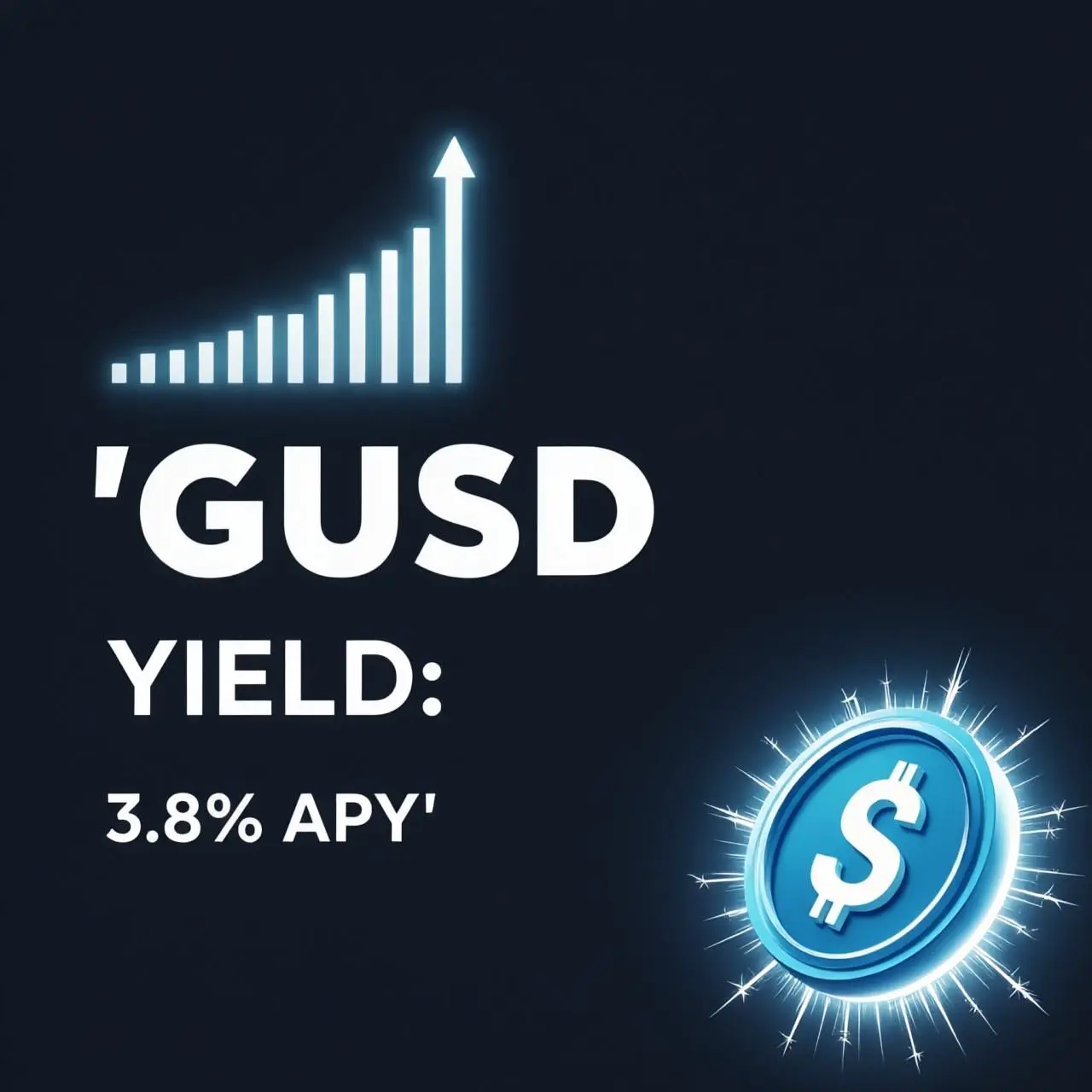
GUSD minting has been upgraded, allowing users to mint GUSD at a 1:1 ratio using USD1 while earning a 3.8% annual yield.
Instead of letting stable assets remain idle, users can now hold GUSD and allow their balances to generate returns automatically, creating a more productive way to manage digital assets.
𝗗𝗔𝗜𝗟𝗬 𝗥𝗘𝗪𝗔𝗥𝗗𝗦 𝗪𝗜𝗧𝗛 𝗔𝗨𝗧𝗢𝗠𝗔𝗧𝗜𝗖 𝗗𝗜𝗦𝗧𝗥𝗜𝗕𝗨𝗧𝗜𝗢𝗡.
One of the biggest advantages of the upgraded system is its simplicity.
Interest is distributed automatically every day, meaning users do not need to manually claim rewards or perform extra steps. Your assets continue working in the background while your balance keeps growing over time.
𝗦𝗨𝗣𝗣𝗢𝗥𝗧𝗘𝗗 𝗕𝗬 𝗥𝗘𝗔𝗟 𝗬𝗜𝗘𝗟𝗗 𝗦𝗢𝗨𝗥𝗖𝗘𝗦.
The yield is supported through multiple sources, including the Gate ecosystem, Treasury real-world assets (RWA), and high-quality stablecoin-backed assets.
Using diversified sources helps create a more sustainable reward model while connecting blockchain finance with real-world financial opportunities.
𝗢𝗡𝗘 𝗔𝗦𝗦𝗘𝗧, 𝗠𝗨𝗟𝗧𝗜𝗣𝗟𝗘 𝗢𝗣𝗣𝗢𝗥𝗧𝗨𝗡𝗜𝗧𝗜𝗘𝗦.
Holding GUSD does not mean giving up other opportunities.
Users can also participate in products such as Launchpool, Pre-IPOs, and additional wealth products while continuing to benefit from their GUSD holdings. This creates the potential for multiple sources of returns from the same capital.
𝗪𝗛𝗬 𝗧𝗛𝗜𝗦 𝗠𝗔𝗧𝗧𝗘𝗥𝗦.
Digital finance is moving toward capital efficiency, where every asset has the potential to generate value.
Products that combine stability, passive income, and access to multiple earning opportunities are becoming increasingly attractive for both new and experienced investors looking to optimize their portfolios.
𝗠𝗬 𝗣𝗘𝗥𝗦𝗣𝗘𝗖𝗧𝗜𝗩𝗘.
The future of stablecoins is not only about preserving value but also about creating smarter ways to earn from idle assets.
Features such as 1:1 USD1 minting, a 3.8% annual yield, automatic daily rewards, and access to multiple investment products show how digital finance continues to evolve toward greater flexibility and efficiency.
As always, users should understand how any yield product works and evaluate whether it aligns with their own financial objectives and risk tolerance.
𝗙𝗜𝗡𝗔𝗟 𝗧𝗛𝗢𝗨𝗚𝗛𝗧𝗦.
The latest GUSD upgrade transforms a traditional stablecoin into a more productive financial tool. With 1:1 USD1 minting, a 3.8% annual yield, daily automatic reward distribution, and access to additional earning opportunities, GUSD offers a practical solution for users who want their digital assets to do more than simply sit in a wallet.
@Gate_Square
repost-content-media
  • Reward
  • Comment
  • Repost
  • Share
#USIranWarCloudsGather
⚠️🌍 𝗨.𝗦.–𝗜𝗥𝗔𝗡 𝗪𝗔𝗥 𝗖𝗟𝗢𝗨𝗗𝗦 𝗚𝗔𝗧𝗛𝗘𝗥 • 𝗧𝗘𝗡𝗦𝗜𝗢𝗡𝗦 𝗥𝗜𝗦𝗘 • 𝗢𝗜𝗟 𝗠𝗔𝗥𝗞𝗘𝗧𝗦 𝗢𝗡 𝗘𝗗𝗚𝗘 • 𝗧𝗛𝗘 𝗪𝗢𝗥𝗟𝗗 𝗪𝗔𝗧𝗖𝗛𝗘𝗦 𝗧𝗛𝗘 𝗡𝗘𝗫𝗧 𝗠𝗢𝗩𝗘 🌍📈
𝗔 𝗙𝗥𝗔𝗚𝗜𝗟𝗘 𝗖𝗘𝗔𝗦𝗘𝗙𝗜𝗥𝗘 𝗜𝗦 𝗙𝗔𝗖𝗜𝗡𝗚 𝗜𝗧𝗦 𝗕𝗜𝗚𝗚𝗘𝗦𝗧 𝗧𝗘𝗦𝗧.
The latest developments between the United States and Iran have once again pushed the Middle East to the center of global attention. Military operations have intensified, diplomatic progress has slowed, and uncertainty is growing across financial and energy markets.
Every new headline is being closely w
EagleEye
#USIranWarCloudsGather
⚠️🌍 𝗨.𝗦.–𝗜𝗥𝗔𝗡 𝗪𝗔𝗥 𝗖𝗟𝗢𝗨𝗗𝗦 𝗚𝗔𝗧𝗛𝗘𝗥 • 𝗧𝗘𝗡𝗦𝗜𝗢𝗡𝗦 𝗥𝗜𝗦𝗘 • 𝗢𝗜𝗟 𝗠𝗔𝗥𝗞𝗘𝗧𝗦 𝗢𝗡 𝗘𝗗𝗚𝗘 • 𝗧𝗛𝗘 𝗪𝗢𝗥𝗟𝗗 𝗪𝗔𝗧𝗖𝗛𝗘𝗦 𝗧𝗛𝗘 𝗡𝗘𝗫𝗧 𝗠𝗢𝗩𝗘 🌍📈
𝗔 𝗙𝗥𝗔𝗚𝗜𝗟𝗘 𝗖𝗘𝗔𝗦𝗘𝗙𝗜𝗥𝗘 𝗜𝗦 𝗙𝗔𝗖𝗜𝗡𝗚 𝗜𝗧𝗦 𝗕𝗜𝗚𝗚𝗘𝗦𝗧 𝗧𝗘𝗦𝗧.
The latest developments between the United States and Iran have once again pushed the Middle East to the center of global attention. Military operations have intensified, diplomatic progress has slowed, and uncertainty is growing across financial and energy markets.
Every new headline is being closely watched because the consequences extend far beyond the region itself.
𝗧𝗘𝗡𝗦𝗜𝗢𝗡𝗦 𝗛𝗔𝗩𝗘 𝗘𝗦𝗖𝗔𝗟𝗔𝗧𝗘𝗗 𝗥𝗔𝗣𝗜𝗗𝗟𝗬.
Recent U.S. military strikes and renewed sanctions have been followed by sharp responses from Iran, with both sides exchanging strong warnings. At the same time, the Strait of Hormuz remains a major point of concern because it is one of the world's most important energy shipping routes.
As diplomatic efforts struggle, investors are preparing for the possibility of further volatility.
𝗢𝗜𝗟 𝗠𝗔𝗥𝗞𝗘𝗧𝗦 𝗔𝗥𝗘 𝗥𝗘𝗔𝗖𝗧𝗜𝗡𝗚 𝗜𝗠𝗠𝗘𝗗𝗜𝗔𝗧𝗘𝗟𝗬.
Whenever geopolitical risks increase in the Gulf region, energy markets respond quickly.
Concerns about supply disruptions have already pushed crude oil prices higher as traders assess the potential impact on global shipping and energy exports. Even without a prolonged conflict, uncertainty alone can create significant price swings across commodities and financial markets.
𝗚𝗟𝗢𝗕𝗔𝗟 𝗠𝗔𝗥𝗞𝗘𝗧𝗦 𝗔𝗥𝗘 𝗪𝗔𝗧𝗖𝗛𝗜𝗡𝗚 𝗘𝗩𝗘𝗥𝗬 𝗛𝗘𝗔𝗗𝗟𝗜𝗡𝗘.
Higher oil prices can influence inflation, transportation costs, manufacturing expenses, and central bank expectations around the world.
That is why geopolitical developments between the United States and Iran are not only regional issues—they have the potential to affect businesses, investors, and consumers across the global economy.
𝗪𝗛𝗬 𝗧𝗛𝗜𝗦 𝗠𝗔𝗧𝗧𝗘𝗥𝗦.
Markets dislike uncertainty more than almost anything else.
When military tensions rise, investors often move toward safer assets while risk-sensitive markets become more volatile. Energy prices, defense stocks, currencies, and commodities can all react within minutes as new information emerges.
𝗠𝗬 𝗣𝗘𝗥𝗦𝗣𝗘𝗖𝗧𝗜𝗩𝗘.
The current situation remains highly fluid, and events can change quickly. While military actions have increased concerns, diplomacy could still influence the direction of the crisis.
For investors, this is a reminder that geopolitical developments can move markets just as powerfully as economic data or corporate earnings. Staying informed and avoiding emotional decisions becomes especially important during periods like these.
𝗙𝗜𝗡𝗔𝗟 𝗧𝗛𝗢𝗨𝗚𝗛𝗧𝗦.
The renewed tensions between the United States and Iran have once again raised concerns about regional stability and global energy security. Whether the coming days bring further escalation or renewed diplomatic efforts, the outcome will likely have a significant impact on oil prices, investor sentiment, and financial markets worldwide. For now, the world is watching every development with caution.
repost-content-media
  • Reward
  • Comment
  • Repost
  • Share
EigenLayer Restaking Caps Lift as Liquid AVS Yields Test New Guardrails
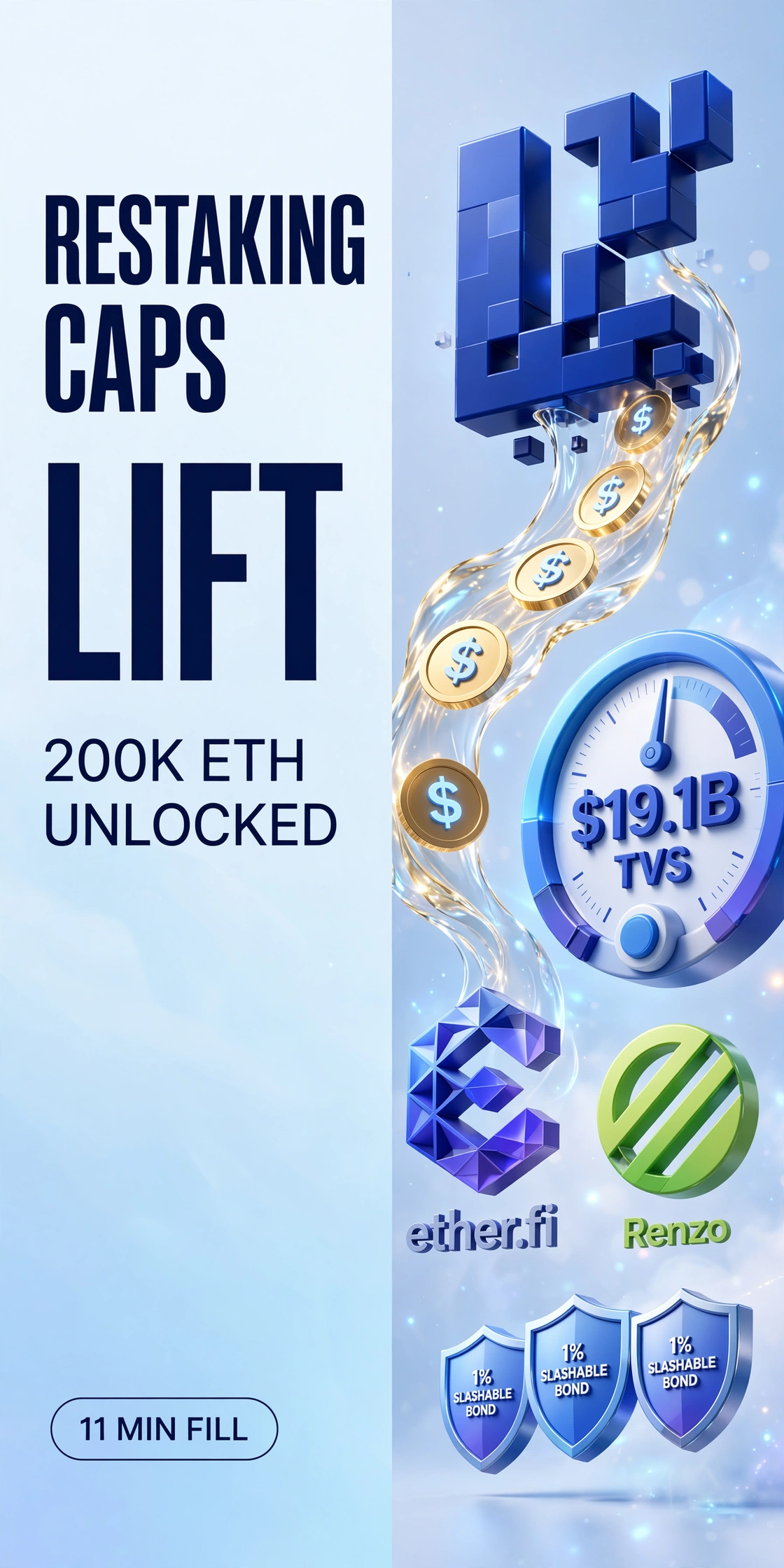
Restaking moved from a niche strategy to a balance-sheet consideration this week. EigenLayer raised its pool caps, unlocking another 200,000 ETH for delegation, and deposits filled within 11 minutes. Total value secured crossed $19.1 billion, with 68% routed through liquid restaking protocols such as EtherFi and Renzo. The driver is straightforward: native ETH staking pays around 3.1%, while curated AVS bundles are generating 6–9% real yield, paid in ETH, reward points, or protocol fees.
The mechanics also became more robu
EIGEN-2.59%
ETH1.28%
REZ-0.58%
AAVE2.29%
Venüs_
EigenLayer Restaking Caps Lift as Liquid AVS Yields Test New Guardrails
Restaking moved from a niche strategy to a balance-sheet consideration this week. EigenLayer raised its pool caps, unlocking another 200,000 ETH for delegation, and deposits filled within 11 minutes. Total value secured crossed $19.1 billion, with 68% routed through liquid restaking protocols such as EtherFi and Renzo. The driver is straightforward: native ETH staking pays around 3.1%, while curated AVS bundles are generating 6–9% real yield, paid in ETH, reward points, or protocol fees.
The mechanics also became more robust. Operators must now post a 1% slashable bond for each AVS, and slashing conditions are now active across three data availability layers. That introduces additional risk while strengthening security. Aave governance has discussed using restaked ETH as collateral with a 5% haircut, potentially bringing restaking yield into DeFi money markets for the first time. If approved, it could create a reinforcing cycle of higher collateral demand, stronger AVS fee generation, improved yields, and more ETH being locked.
Flow data indicates capital rotation rather than fresh inflows. Staking outflows from Lido declined by 14,000 ETH, while EtherFi recorded inflows of 22,000 ETH, suggesting participants are pursuing roughly 300 basis points of additional yield instead of unstaking. Derivatives markets reflected the same trend. ETH futures basis on the Chicago Mercantile Exchange remained near a 10% annualized premium despite weakness in the spot market, indicating that basis traders are using staked ETH to finance carry strategies rather than selling their holdings.
The primary risk remains slashing correlation. If a major AVS experiences a failure, the shared security model could result in multiple operators being slashed simultaneously, increasing the possibility of liquid restaking token depegs. Audits and bonded security measures reduce that risk, although the ecosystem has yet to experience a significant live slashing event. Until such an event occurs, the market continues to value restaking as an enhanced form of ETH staking supported by an additional security layer. For long-term allocators, it remains one of the most efficient approaches to generating ETH-denominated yield without relying on token inflation.
#Ethereum #EigenLayer #Restaking #DeFi #Staking
repost-content-media
  • Reward
  • 7
  • Repost
  • Share
ThisIsTranslateContent::
Just push through 👊
View More
#USIranWarCloudsGather
US-Iran War Clouds Gather: Why Global Investors Are Preparing for a New Wave of Market Volatility
A single geopolitical headline can change the direction of global markets within minutes—and the latest developments in the Middle East are proving exactly that. Renewed military operations, escalating rhetoric from Washington and Tehran, and rising tensions around the Strait of Hormuz are fueling concerns that the conflict could deepen further. What began as a fragile ceasefire has rapidly evolved into one of the biggest macroeconomic risks facing investors this week.
The
USO-0.28%
XOM1.05%
CVX1.32%
BTC0.51%
ETH1.28%
Venüs_
#USIranWarCloudsGather
US-Iran War Clouds Gather: Why Global Investors Are Preparing for a New Wave of Market Volatility
A single geopolitical headline can change the direction of global markets within minutes—and the latest developments in the Middle East are proving exactly that. Renewed military operations, escalating rhetoric from Washington and Tehran, and rising tensions around the Strait of Hormuz are fueling concerns that the conflict could deepen further. What began as a fragile ceasefire has rapidly evolved into one of the biggest macroeconomic risks facing investors this week.
The situation intensified after the United States carried out another round of airstrikes against Iranian targets, while President Donald Trump declared that the previous ceasefire was effectively over during his visit to Türkiye for the NATO Summit in Ankara. The summit, originally focused on alliance security and defense spending, quickly became a platform for urgent discussions on the growing regional crisis. Trump also met with Turkish President Recep Tayyip Erdoğan, with Middle East security dominating the agenda.
At the center of global attention is the Strait of Hormuz, one of the world's most important energy corridors. Roughly one-fifth of global seaborne oil trade passes through this narrow waterway. Any disruption immediately raises concerns about energy supplies, inflation, and global economic growth. Following the latest attacks and military exchanges, shipping companies have increased security measures while energy traders closely monitor every new development.
Markets reacted almost immediately. Oil prices strengthened as traders priced in higher geopolitical risk, while demand for traditional safe-haven assets such as gold increased. Equity markets turned more cautious, and cryptocurrencies experienced higher intraday volatility as investors reduced exposure to risk-sensitive assets. Currency markets also reflected the uncertainty, with investors reassessing expectations for inflation and future central bank decisions.
History shows why investors should pay attention. During previous Middle East crises, spikes in oil prices often translated into higher transportation costs, stronger inflationary pressure, and greater volatility across equities and digital assets. Similar patterns were seen during the Gulf conflicts and other major disruptions affecting global energy supply chains. Today's market is even more interconnected, meaning geopolitical shocks can spread across asset classes within hours.
What Should Investors Watch Next?
The coming days could prove decisive. Key developments include:
- Any renewed diplomatic efforts involving the United States, Iran, and regional partners.
- Security conditions in the Strait of Hormuz.
- Additional military operations or retaliatory actions.
- Oil price movements and their impact on inflation expectations.
- The reaction of global equity markets, gold, and cryptocurrencies.
For investors, this is no longer just a regional political story—it is a global macroeconomic event. The direction of oil prices, inflation, interest rate expectations, and overall market sentiment could all be influenced by how the situation unfolds. In an environment where headlines can reshape markets overnight, disciplined risk management and close attention to geopolitical developments are becoming just as important as earnings reports or technical analysis.
$USO
$XOM
$CVX
$BTC
$ETH
$GOLD
repost-content-media
  • Reward
  • 8
  • Repost
  • Share
ThisIsTranslateContent::
Just go for it 👊
View More
#GUSDYieldRisesto3.8%
Gate’s GUSD Edges Up to 3.8% as On-Exchange Cash Starts Paying Like Treasuries
Traders watching Gate this week noticed something subtle but important: GUSD yields have nudged higher to 3.8% APY in Wealth Management. For a stablecoin that already pays you just for holding it, that move turns idle capital into a working asset.
GUSD isn’t built like USDT or USDC. It’s an investment certificate pegged 1:1 to the dollar and backed by real-world assets such as short-term U.S. Treasury bonds. The yield comes from those bonds, not from risky lending loops. You don’t stake it or
GT-0.44%
BTC0.51%
Venüs_
#GUSDYieldRisesto3.8%
Gate’s GUSD Edges Up to 3.8% as On-Exchange Cash Starts Paying Like Treasuries
Traders watching Gate this week noticed something subtle but important: GUSD yields have nudged higher to 3.8% APY in Wealth Management. For a stablecoin that already pays you just for holding it, that move turns idle capital into a working asset.
GUSD isn’t built like USDT or USDC. It’s an investment certificate pegged 1:1 to the dollar and backed by real-world assets such as short-term U.S. Treasury bonds. The yield comes from those bonds, not from risky lending loops. You don’t stake it or claim rewards daily. The value accrues inside the token, and you receive principal plus return when you redeem. That structure is why Gate positioned GUSD as a “defensive anchor” back in March at 3.4%, and why the bump to 3.8% matters now. Underlying rates have improved, and Gate’s September 2025 upgrade means GUSD in Spot or Earn automatically earns minting yield without extra clicks.
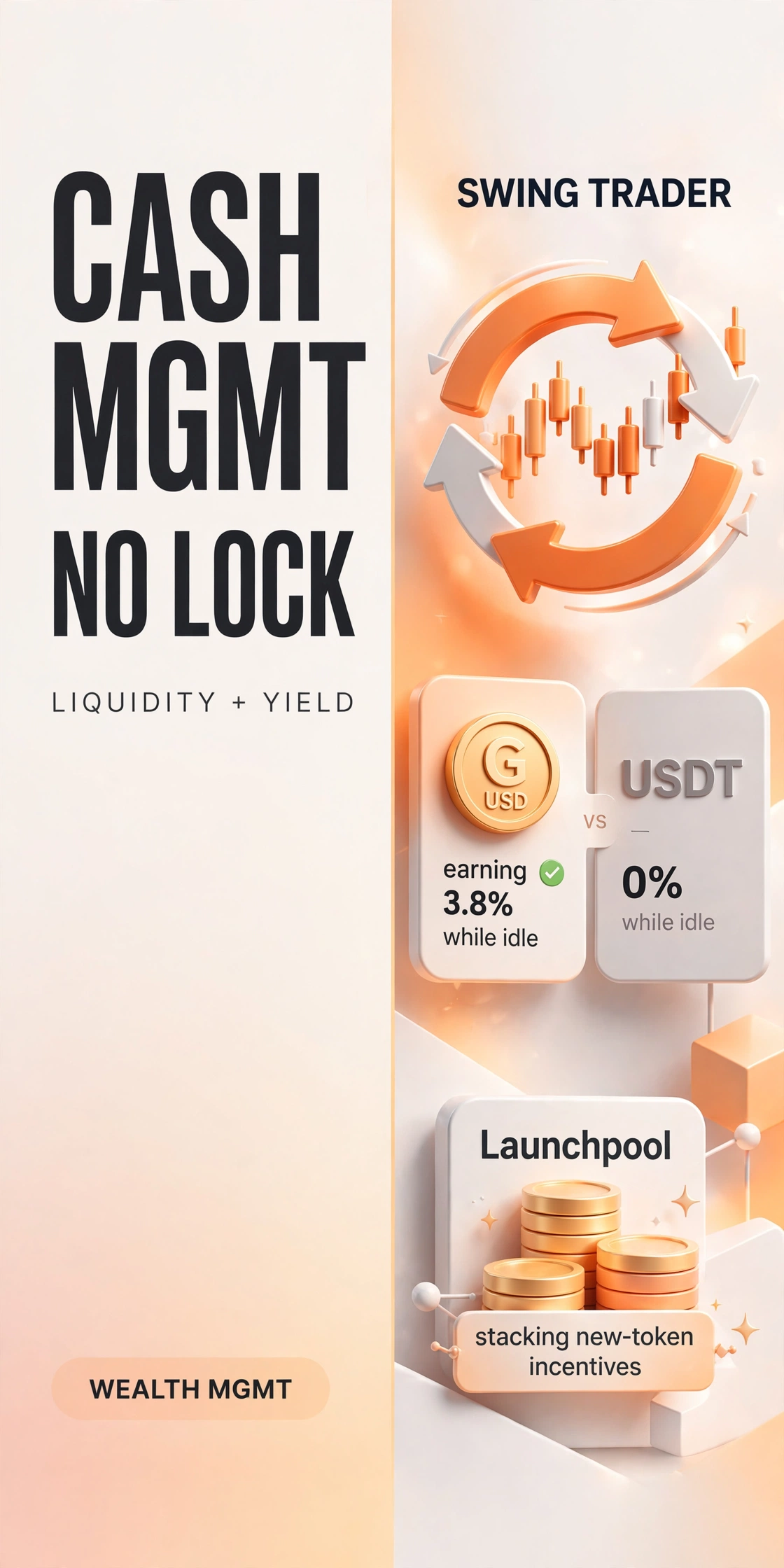
The practical impact shows up in three places. First, cash management. Swing traders rotating out of positions no longer choose between liquidity and yield. Parking in GUSD means 3.8% APY while you wait for the next setup, versus 0% in idle USDT. Second, yield stacking. Hold GUSD and drop it into Launchpool. You collect new-token incentives on top of the base 3.8% from RWAs. Third, portfolio construction. With BTC consolidating and alts choppy, many Gate users are running barbell strategies: GT or sector tokens for upside, GUSD for steady cash flow that compounds daily.
Compared to flexible USDT products, which move with lending demand, GUSD is steadier because it tracks Treasuries. Compared to DeFi stablecoins promising 10%+, it carries less smart-contract and depeg risk, and there’s no lock-up. Gate’s transparency push and monthly audits on GUSD reserves give it the compliance angle that institutions want, while retail traders get a one-tap savings layer.
Risks are straightforward. If Treasury yields drop, GUSD’s APY will follow. Returns are realized at redemption, so flipping in and out intraday won’t capture much accrual. And as with any exchange product, you’re trusting Gate’s custody and RWA framework.
Still, the signal is clear. When the cash sitting between trades earns 3.8% with no lock and no staking, the opportunity cost of staying flat just rose. For active users on Gate, GUSD is quietly becoming the default “do something” position when you’re doing nothing.
This is market commentary for educational purposes only and not financial advice. Always check Gate’s current GUSD terms and live APY before allocating.
repost-content-media
  • Reward
  • 9
  • Repost
  • Share
ThisIsTranslateContent::
Just do it—👊
View More
#SKHynixADRIndicativePrice149
SK Hynix Sets ADR Price at $149 Ahead of Friday Nasdaq Debut
SK Hynix just locked in a key number for US investors. The South Korean memory giant priced its American Depositary Receipts at $149 each, raising roughly $26.5 billion in what’s now the second-largest share sale globally after SpaceX’s record IPO last month. Trading starts Friday on Nasdaq under ticker SKHY, giving US. portfolios direct access to the world’s dominant supplier of high-bandwidth memory for AI.
The pricing came in slightly below earlier chatter of $166, but it still represents a ∼3% premi
Venüs_
#SKHynixADRIndicativePrice149
SK Hynix Sets ADR Price at $149 Ahead of Friday Nasdaq Debut
SK Hynix just locked in a key number for US investors. The South Korean memory giant priced its American Depositary Receipts at $149 each, raising roughly $26.5 billion in what’s now the second-largest share sale globally after SpaceX’s record IPO last month. Trading starts Friday on Nasdaq under ticker SKHY, giving US. portfolios direct access to the world’s dominant supplier of high-bandwidth memory for AI.
The pricing came in slightly below earlier chatter of $166, but it still represents a ∼3% premium to SK Hynix’s Seoul closing price of 2,186,000 won. Ten ADRs equal one common share, so the $149 level implies strong conviction from the buy side. Books were covered more than seven times over, with chunky $200 million-plus tickets from US institutions and commitments up to $7 billion combined from Baillie Gifford, Coatue, and Situational Awareness Partners. That kind of oversubscription is rare, and bankers are flagging it as evidence of how scarce pure-play AI memory exposure is for American funds.
Why the demand? SK Hynix owns 57% of the HBM market and is Nvidia’s key partner for HBM3E in the Vera Rubin platform. While Samsung leads total DRAM volume, SK Hynix captured the AI upside early and now commands higher margins and faster growth. Q1 revenue nearly tripled year over year to 52.58 trillion won, with operating margins hitting 72%. Management says HBM supply will stay tight through 2030, and it’s building new fabs in Yongin and advanced packaging in Cheongju to keep up.
For US investors, the ADR solves a long-standing access problem. Buying Korean shares meant currency friction, custody headaches, and limited ETF inclusion. The ADR structure uses one-tenth units, brings liquidity to Nasdaq hours, and opens the door to index and ETF flows. Analysts at Mirae and Hanwha estimate potential demand of $340 million to $450 million from semiconductor and Nasdaq-tracking ETFs alone if included. That’s before active funds benchmark themselves to the new listing.
The $149 price also sets up an arbitrage watch. Converting ADRs to Korean shares is allowed, but the reverse requires a reporting procedure. A similar friction has let TSMC’s ADR trade at a persistent premium for years. If SKHY opens above the Seoul equivalent, it signals US investors are paying up for AI memory scarcity, and that premium could pull the Korean listing higher next session. If it trades at a discount, it suggests the AI euphoria is already in the price.
Valuation context helps. Micron trades at a 12-month forward P/E of 6.66x. SK Hynix, even after an 800% rally over the past year, sits around 5.5x. The ADR doesn’t go into the S&P 500, but eligibility is possible, and that alone changes the passive bid. Proceeds from the deal fund EUV lithography buys and wafer capacity, directly targeting Nvidia, Google, and Amazon’s AI chip pipelines.
Bottom line for Gate traders: $149 isn’t just a number. It’s the market’s vote on how much scarcity premium belongs on the company building the memory that makes AI run. Watch Friday’s open, watch the Seoul arb, and watch ETF flows next week. The memory cycle just got a US ticker.
repost-content-media
  • Reward
  • 8
  • Repost
  • Share
ThisIsTranslateContent::
Just do it—👊
View More
#AnthropicSecondaryValuationHits1.2Trillion
Anthropic’s Secondary Valuation Touches $1.2 Trillion as Private Shares Become Silicon Valley’s Hottest Ticket
Anthropic just crossed a line that seemed impossible six months ago. Secondary-market trades for the Claude-maker’s shares are now pricing the company at $1.2 trillion, a 20% jump in a single week and nearly triple the $380 billion Series G round it closed in February. The surge puts Anthropic ahead of OpenAI on private marketplace Forge Global, where OpenAI sits around $880 billion despite a higher $852 billion primary raise earlier this y
AMZN-0.68%
AVGO-0.27%
NVDA4.06%
JUP-4.72%
Venüs_
#AnthropicSecondaryValuationHits1.2Trillion
Anthropic’s Secondary Valuation Touches $1.2 Trillion as Private Shares Become Silicon Valley’s Hottest Ticket
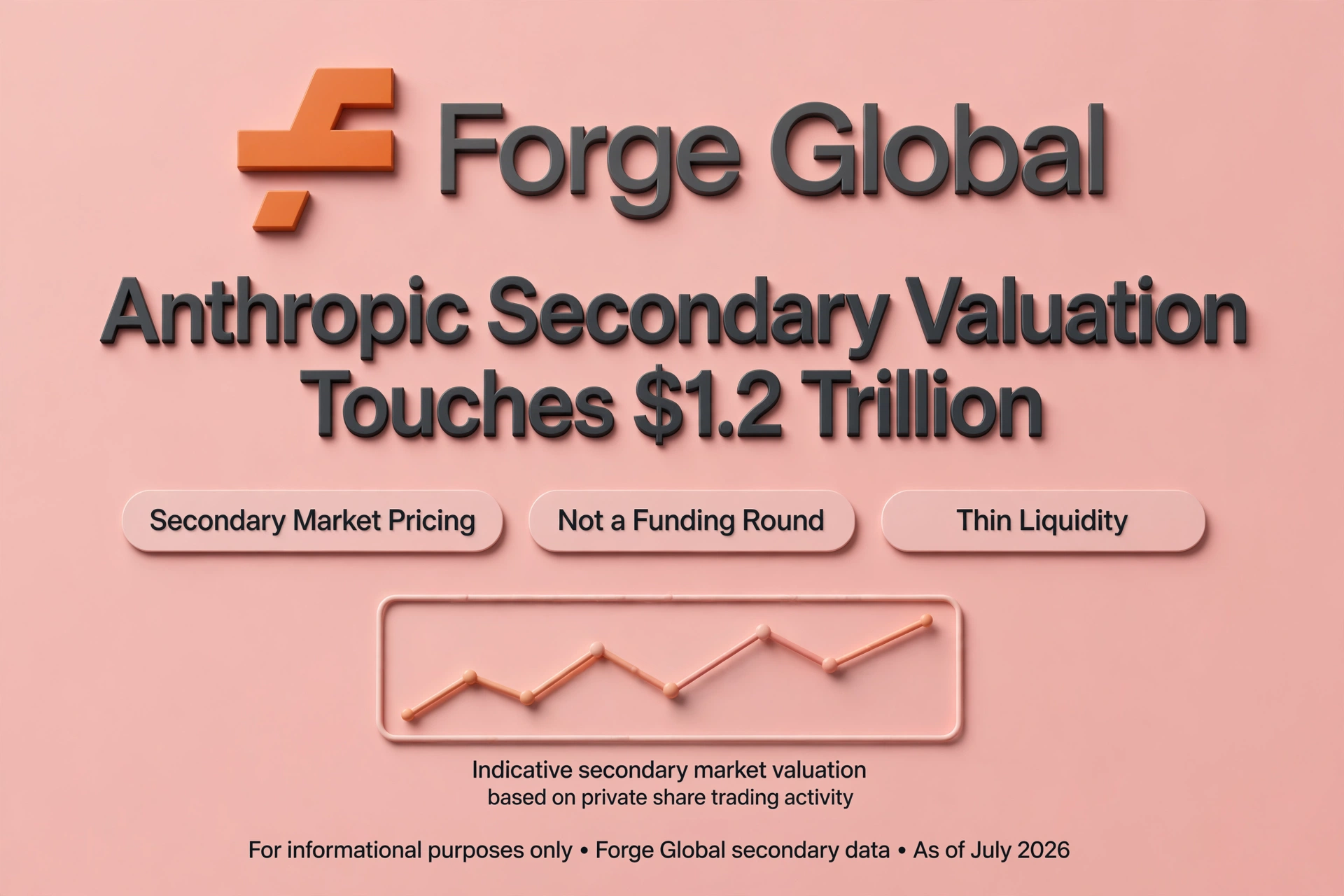
Anthropic just crossed a line that seemed impossible six months ago. Secondary-market trades for the Claude-maker’s shares are now pricing the company at $1.2 trillion, a 20% jump in a single week and nearly triple the $380 billion Series G round it closed in February. The surge puts Anthropic ahead of OpenAI on private marketplace Forge Global, where OpenAI sits around $880 billion despite a higher $852 billion primary raise earlier this year.
What’s fueling the run
The headline driver is revenue. Anthropic’s annualized run rate exploded from $9 billion in late 2025 to $30 billion by March 2026, a 233% quarter-over-quarter jump. Enterprise adoption of Claude Code and the new Mythos model under Project Glasswing pushed demand for inference capacity past available supply. Amazon’s pledge of up to $25 billion for 5 gigawatts of Trainium compute, plus deals with Google, Broadcom, and Nvidia for tens of gigawatts, convinced buyers that Anthropic can actually deliver on its pipeline.
Supply is the other half. Employees and early backers have had almost no windows to sell, while inbound interest spiked 650% year-over-year, according to Caplight. With buyers lined up and almost no sellers, a $960 billion bid that looked “unthinkable” a month ago was cleared in hours. One shareholder even tested the market at $1.15 trillion and found takers.
The OpenAI comparison
Just months ago, OpenAI’s $852 billion primary round set the bar. Today, its secondary shares trade at a discount to Anthropic. Some investors now call Anthropic the “relative bargain” at $380 billion primary versus OpenAI’s $852 billion, arguing that justifying OpenAI’s last round requires an IPO at $1.2 trillion or more. Others, like Sapphire Ventures’ Jai Das, frame OpenAI as the “Netscape of AI” — first to scale, but vulnerable to a faster-moving rival.
Why $1.2 trillion isn’t official
Two caveats matter. First, this is secondary market pricing, not a funding round. Trades happen between employees and accredited buyers on platforms like Forge Global and Rainmaker Securities. Liquidity is thin, and prices move on sentiment. Second, tokenized pre-IPO instruments on platforms like Jupiter have shown implied caps above $1.5 trillion with only ∼$23 million of assets behind them. Those figures reflect speculation, not audited financials.
Still, the trend is real. Venture bids are now coming in at $800 billion, which Anthropic has rejected. Bankers are discussing a late-2026 IPO that could value the company north of $900 billion, with Goldman, JPMorgan, and Morgan Stanley already advising. If public markets accept even half the secondary premium, Anthropic becomes the first pure-play AI startup to debut near a trillion.
Market impact
For investors, the message is scarcity. Owning Anthropic shares is now a status signal as much as a financial bet. For enterprises, the valuation raises the stakes on model lock-in: companies are signing multi-year Claude deals because they expect the ecosystem to outlast competitors. For regulators, a $1.2 trillion private valuation amplifies questions about compute concentration, safety governance, and antitrust.
The AI race no longer has a clear leader. Three months ago, OpenAI was the default answer. Today, secondary markets are saying Anthropic is worth more. Whether public investors agree will define the next chapter of the AI economy.
repost-content-media
  • Reward
  • 7
  • Repost
  • Share
ThisIsTranslateContent::
Go for it, 👊
View More
Ether ETFs Absorb Billions as Yield Narrative Flips
The quiet rotation is no longer quiet. Ether-linked exchange-traded products pulled in $5.6 billion of net inflows across three weeks, pushing cumulative ETF exposure toward $22.8 billion and closing the gap with Bitcoin’s early lead. What changed is the pitch. Issuers are now framing ETH as a productive reserve asset: staking rewards, burn dynamics, and Layer-2 fee dividends form a composite “on-chain yield” that traditional allocators can model like a dividend-paying equity. Desk chatter confirms the shift. One London-based family office th
BTC1.10%
ETH2.58%
COIN0.39%
CRV0.53%
Venüs_
Ether ETFs Absorb Billions as Yield Narrative Flips
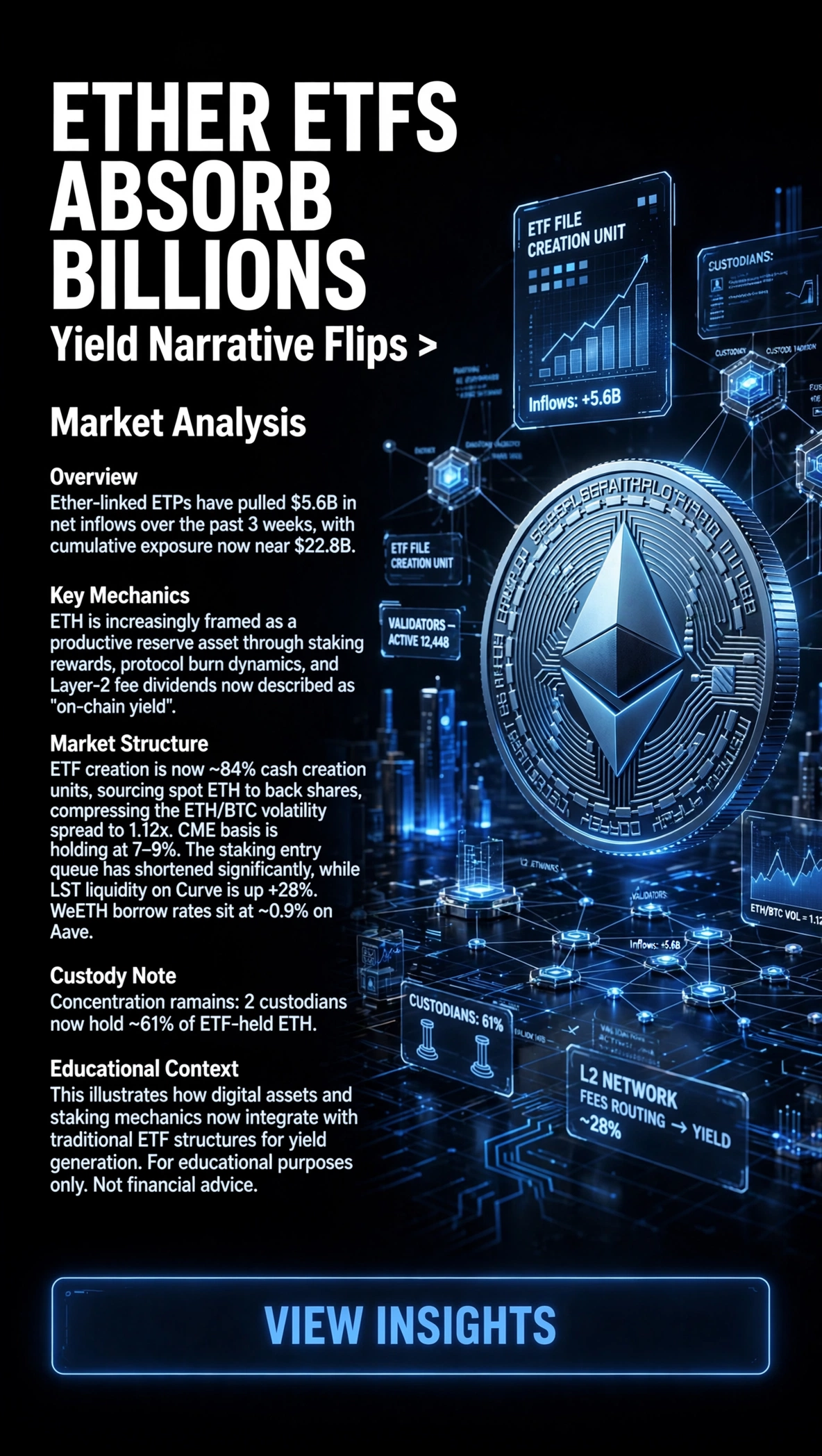
The quiet rotation is no longer quiet. Ether-linked exchange-traded products pulled in $5.6 billion of net inflows across three weeks, pushing cumulative ETF exposure toward $22.8 billion and closing the gap with Bitcoin’s early lead. What changed is the pitch. Issuers are now framing ETH as a productive reserve asset: staking rewards, burn dynamics, and Layer-2 fee dividends form a composite “on-chain yield” that traditional allocators can model like a dividend-paying equity. Desk chatter confirms the shift. One London-based family office that sat out 2021’s run cited the clarity of post-Merge supply mechanics as the reason for a 2.4% portfolio sleeve initiated last month.
Under the hood, the flows are reshaping structure. Coinbase Prime data shows ETF creation units are 84% cash, forcing authorized participants to source spot ETH in size. That bid is steady, not spiky, and it lands during U.S. hours. The result is a compression in ETH/BTC volatility spreads; realized 30-day vol for ETH is only 1.12x Bitcoin’s, the lowest ratio since 2020. Meanwhile, CME Ether futures basis annualized 7-9% over spot, a level that keeps carry trades engaged but not euphoric.
On-chain, the staking queue shortened to five days as validators exit to reallocate into liquid staking derivatives that plug directly into ETF collateral desks. LST liquidity on Curve deepened 28%, and borrow rates for weETH on Aave dropped to 0.9%, a sign that leverage demand is being met without strain. Critics still flag concentration: two custodians hold 61% of ETF ETH, and any operational hiccup would ripple fast. Yet the broader message is institutional comfort. When the risk team can underwrite a yield-bearing, supply-capped commodity that settles on its own ledger, mandates change.
The second-order effect is altcoin capital formation. As ETH stabilizes, market makers recycle hedges into Layer-2 tokens and restaking plays, looking for torque. Expect that pattern to persist as long as ETF inflows stay above $300 million per day. If they stall, the same dealers will unwind exposure, and the “yield asset” story gets tested by drawdown. For now, the bid is real, methodical, and far less meme-driven than prior cycles.
#EthereumETF #Staking #CryptoInvesting #DigitalAssets #InstitutionalCrypto
repost-content-media
  • Reward
  • 8
  • Repost
  • Share
ThisIsTranslateContent::
Just go for it 👊
View More
From Mining Rigs to Treasury Stacks: Cango’s Bitcoin Bet Deepens
Cango didn’t wait for permission. The firm added 450 BTC to its balance sheet in a single week, lifting total holdings to 4,387 BTC and cementing its shift from auto-financing to hard-asset accumulation. The purchase, disclosed in a July production update, was funded by cash from operations and a partial draw on an existing credit line — a signal that management views Bitcoin as working capital, not a speculative side pocket.
The pivot traces back nine months. Cango began liquidating legacy loan portfolios and redirecting procee
BTC0.51%
Venüs_
From Mining Rigs to Treasury Stacks: Cango’s Bitcoin Bet Deepens
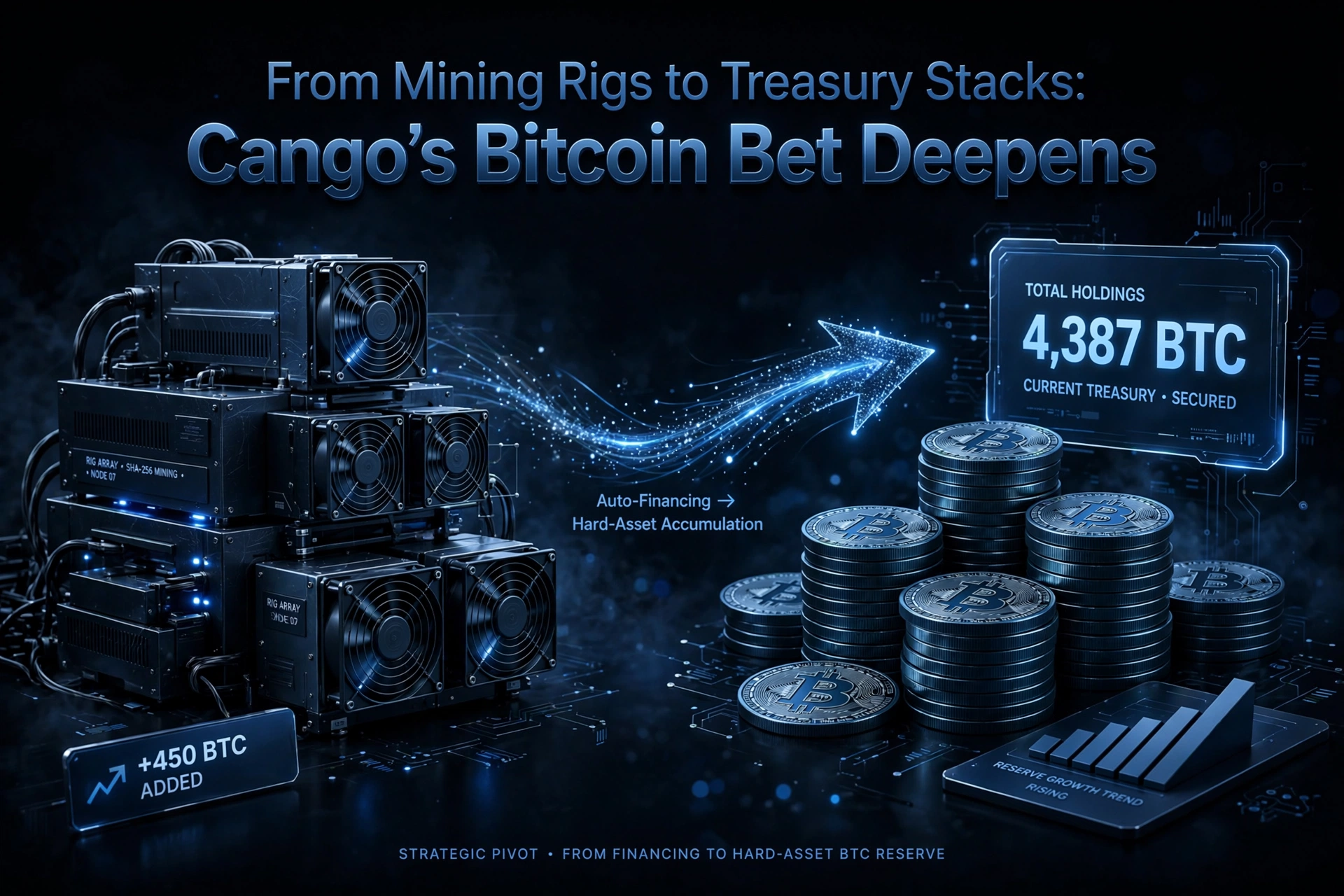
Cango didn’t wait for permission. The firm added 450 BTC to its balance sheet in a single week, lifting total holdings to 4,387 BTC and cementing its shift from auto-financing to hard-asset accumulation. The purchase, disclosed in a July production update, was funded by cash from operations and a partial draw on an existing credit line — a signal that management views Bitcoin as working capital, not a speculative side pocket.
The pivot traces back nine months. Cango began liquidating legacy loan portfolios and redirecting proceeds into ASIC fleets, then quickly realized that hashing at industrial scale meant competing with power contracts it didn’t control. The answer was to mine what it could, then buy the rest. This hybrid model is now explicit. Hashrate supplies a steady drip of coins at cost, while opportunistic treasury buys compress the average entry price when network difficulty spikes or energy markets tighten.
What makes the move stand out is scale. Among public non-crypto firms, only a handful carry more than 4,000 BTC. Cango’s stack now exceeds its trailing twelve-month revenue, turning the equity into a de facto Bitcoin proxy with an operating business attached. That changes the holder base. ETF arbitrage desks that can’t hold spot due to mandate now use Cango shares to mirror exposure, and options flow shows a clear skew: dealers are short upside calls from $18 to $24 as funds sell premium against core positions.
Risk cuts both ways. A 20% drawdown in BTC would erase roughly $118 million in mark-to-market value, nearly half of Cango’s cash buffer. Yet the firm argues that downside is cushioned by its mining segment, which throws off coin at sub-market cost and provides a natural dollar-cost average. The market seems to agree, for now. The stock’s 30-day correlation to BTC sits at 0.83, up from 0.41 in January, while short interest fell to 6.1% of float, a twelve-month low.
Zoom out and the playbook is spreading. Energy firms, data-center operators, and even logistics companies are testing the same thesis: if your core asset is cheap power, a Bitcoin treasury is the highest-margin way to monetize it. Cango is simply the loudest proof-of-concept. Whether that earns it a premium or a warning label depends on the next halving cycle and how credit markets treat digital collateral.
#BTC #Cango #BitcoinTreasury #CryptoMining #PublicCompanies
repost-content-media
  • Reward
  • 8
  • Repost
  • Share
ThisIsTranslateContent::
DYOR 🤓
View More
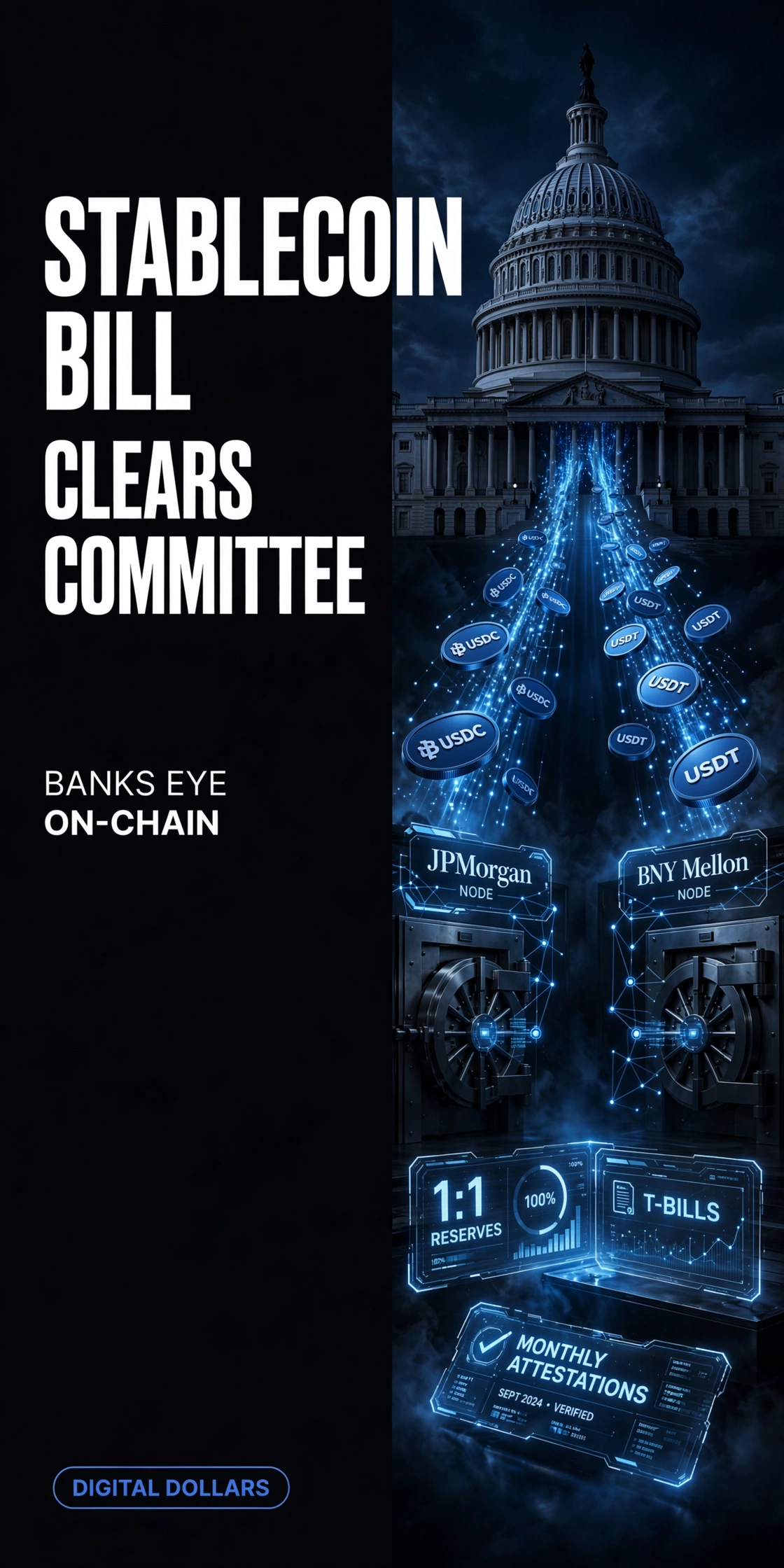
Stablecoin Bill Clears Committee as Banks Eye On-Chain Dollars
The quietest room in Washington produced the loudest signal for digital dollars. A key House committee advanced the Payment Stablecoin Act with bipartisan support, sending the first federal framework for dollar tokens to a full floor vote. The draft forces 1:1 reserves in cash and T-bills, monthly attestations, and a ban on algorithmic variants without collateral. That last clause matters. Issuers like Circle and Paxos gain clarity, while offshore players face a choice: comply or lose U.S. payment rails.
Markets moved before the ga
CRCLG4.50%
USDP0.01%
TRX-0.56%
Venüs_
Stablecoin Bill Clears Committee as Banks Eye On-Chain Dollars
The quietest room in Washington produced the loudest signal for digital dollars. A key House committee advanced the Payment Stablecoin Act with bipartisan support, sending the first federal framework for dollar tokens to a full floor vote. The draft forces 1:1 reserves in cash and T-bills, monthly attestations, and a ban on algorithmic variants without collateral. That last clause matters. Issuers like Circle and Paxos gain clarity, while offshore players face a choice: comply or lose U.S. payment rails.
Markets moved before the gavel. USDC supply grew $640 million in 48 hours as prime brokers shifted collateral from regional banks to on-chain venues ahead of potential approval. Tether printed $1 billion on Tron, but its dominance slipped to 61% as regulated options gained share. The real tell came from repo desks. Overnight rates for USDC-backed loans dropped 37 bps, a sign that treasurers now view the token as near-cash, not crypto exposure.
Banks are reading the same draft. JPMorgan’s deposit token pilot expanded to five corporate clients, and BNY Mellon confirmed it is building custody for “permitted payment stablecoins” under the bill’s definition. If passed, the law would let insured depositories issue tokens directly, collapsing the spread between fintech issuers and traditional lenders.
Edge risk sits with state charters. The bill preserves dual licensing, so New York and Wyoming can still set stricter terms, creating arbitrage until federal preemption is tested. Traders are positioning early: options on COIN and SQ saw call skew rise as the vote neared, while DeFi rates on Aave and Compound dipped, reflecting expectations of cheaper on-chain dollars.
Should the Act become law, stablecoins graduate from crypto plumbing to regulated money. That rewrites settlement, payroll, and treasury playbooks in one stroke.
#USDC #USDT #CryptoRegulation #DigitalDollar #Blockchain
repost-content-media
  • Reward
  • 8
  • Repost
  • Share
ThisIsTranslateContent::
DYOR 🤓
View More
Tokenization Pilots Move From Proof to Production as Real-World Rails Go Live
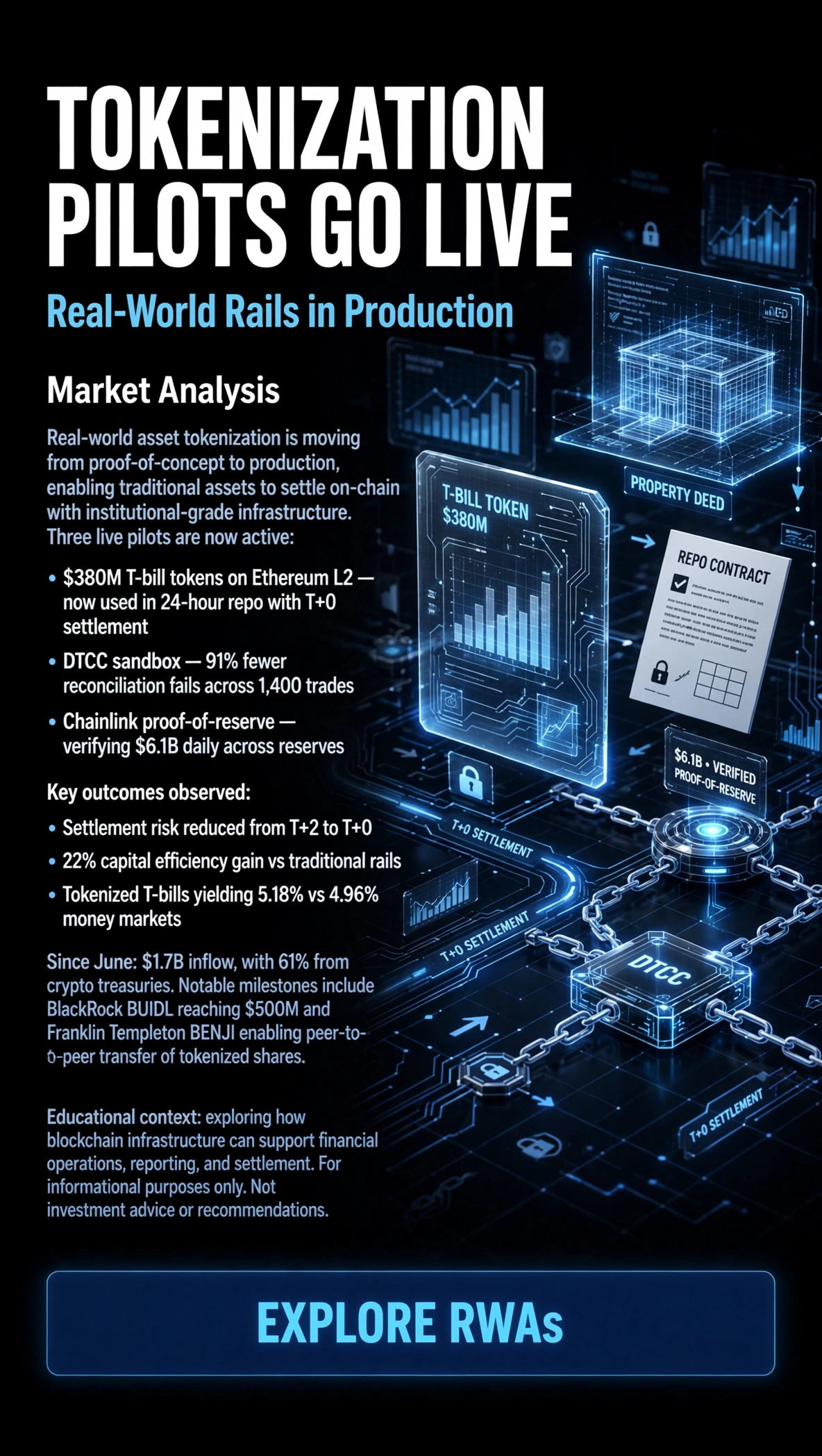
Paperwork met protocol this week. Three separate trials settled tokenized U.S. Treasuries, commercial property deeds, and repo contracts on public chains, each with same-day finality and on-chain audit logs. The largest came from a consortium of asset managers who minted $380 million in T-bill tokens on Ethereum Layer-2 rails, then used them as collateral in a 24-hour repo that cleared without a clearinghouse. Settlement risk dropped from T+2 to T+0, and capital efficiency improved 22% compared with the legacy route.
ETH1.28%
LINK1.07%
BENJI-4.57%
Venüs_
Tokenization Pilots Move From Proof to Production as Real-World Rails Go Live
Paperwork met protocol this week. Three separate trials settled tokenized U.S. Treasuries, commercial property deeds, and repo contracts on public chains, each with same-day finality and on-chain audit logs. The largest came from a consortium of asset managers who minted $380 million in T-bill tokens on Ethereum Layer-2 rails, then used them as collateral in a 24-hour repo that cleared without a clearinghouse. Settlement risk dropped from T+2 to T+0, and capital efficiency improved 22% compared with the legacy route.
The shift is no longer theory. DTCC’s sandbox report showed tokenized securities reduced reconciliation fails by 91% across 1,400 test trades. Chainlink’s proof-of-reserve feeds now verify $6.1 billion in off-chain assets daily, giving auditors a real-time pane of glass instead of monthly PDF packs. Banks notice because it trims balance sheet drag. A single desk can now recycle collateral multiple times intraday, something impossible when assets sit in siloed custodians.
Yield is the magnet. Tokenized T-bills pay 5.18% on-chain versus 4.96% in money markets, because they skip two intermediaries. That 22 bps spread pulled $1.7 billion into the sector since June, with 61% coming from crypto-native treasuries rotating out of idle stablecoins. Risks are plumbing and policy. Smart contract upgrades need governance that courts accept, and bankruptcy remoteness of tokenized funds remains untested in Chapter 11.
Still, the direction is clear. When BlackRock’s BUIDL fund crossed $500 million and Franklin Templeton enabled peer-to-peer transfer of its BENJI token, the moat around old custodians cracked. Tokenization stopped being a pitch deck and became a P&L line. The next phase is scale: routing SWIFT messages to smart contracts, not just demos.
#Tokenization #RWAs #Blockchain #DigitalAssets #Finance
repost-content-media
  • Reward
  • 8
  • Repost
  • Share
ThisIsTranslateContent::
DYOR 🤓
View More
L2 Fee Revenue Flips Mainnet as Rollups Become the Default Highway
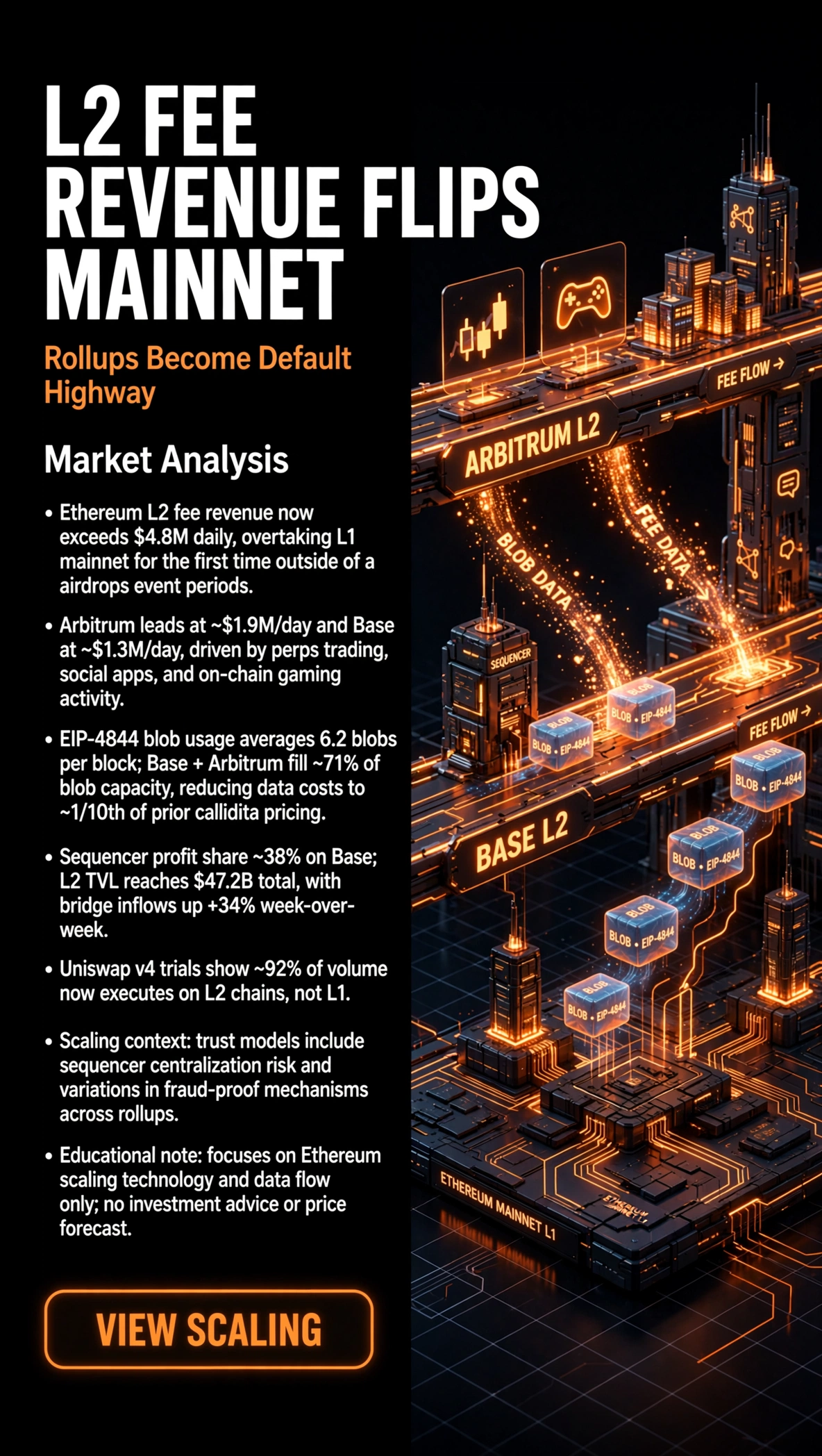
The ledger finally tilted. Aggregate fees paid to Ethereum Layer-2 networks crossed $4.8 million daily this week, overtaking Layer-1 mainnet revenue for the first time outside of airdrop events. Arbitrum and Base led with $1.9 million and $1.3 million respectively, driven by a surge in perpetuals, social apps, and gaming ticks that now settle in sub-cent batches. The flip matters because it proves users choose speed and cost over brand when the security guarantee is inherited.
Blob usage tells the backstory. After EIP-4844, rol
ETH1.28%
ARB1.73%
OP0.95%
UNI-0.59%
Venüs_
L2 Fee Revenue Flips Mainnet as Rollups Become the Default Highway
The ledger finally tilted. Aggregate fees paid to Ethereum Layer-2 networks crossed $4.8 million daily this week, overtaking Layer-1 mainnet revenue for the first time outside of airdrop events. Arbitrum and Base led with $1.9 million and $1.3 million respectively, driven by a surge in perpetuals, social apps, and gaming ticks that now settle in sub-cent batches. The flip matters because it proves users choose speed and cost over brand when the security guarantee is inherited.
Blob usage tells the backstory. After EIP-4844, rollups post data to Ethereum as blobs at 1/10th the prior cost, yet throughput keeps climbing. Average blob count hit 6.2 per block, with Base and Arbitrum alone filling 71% of capacity. That pushes L2 margins up: sequencer profit on Base ran 38% last month, and the chain now funds its own grants program without token sales.
Capital followed. L2 TVL rose to $47.2 billion, while bridging volume from mainnet jumped 34% week-over-week. More telling is app migration. Uniswap v4 trials on Optimism show 92% of swap volume staying on L2 even when gas on mainnet drops, suggesting user habit formation is complete.
Risk shifts from tech to alignment. Sequencer centralization remains the attack vector, and fraud-proof systems on Arbitrum and fraud-proof-less designs on Base create different trust models. Yet the market voted with fees. As long as users pay rollups, not mainnet, the economic center of Ethereum has moved up one layer. The base chain becomes a settlement court, while execution happens elsewhere.
#Ethereum #Layer2 #Arbitrum #Base #Rollups
repost-content-media
  • Reward
  • 5
  • Repost
  • Share
EagleEye:
To The Moon 🌕
View More
Court Ruling Reshapes Exchange Listings as Securities Label Narrows
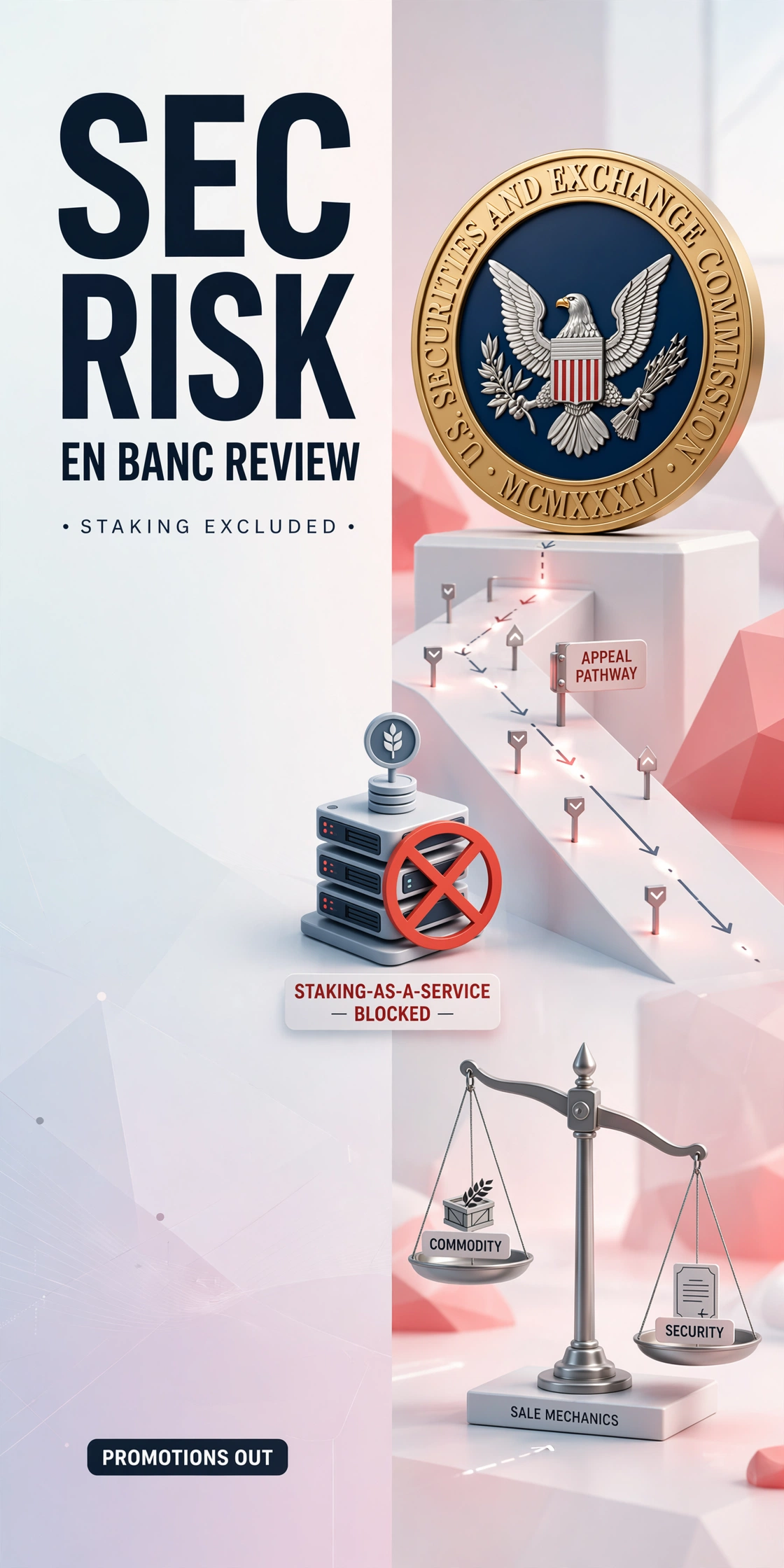
A gavel cracked, and listing desks exhaled. The appellate panel ruled that secondary-market token sales on a compliant exchange do not, by default, meet the test for investment contracts. The decision vacates a key portion of last year’s district order and sends the case back with guidance: context beats label. Within hours, Coinbase re-enabled order books for three assets paused in 2023, and liquidity providers widened quotes by 40% as legal overhang eased.
The opinion drills into “efforts of others.” Judges said buyers on an
TOKEN-1.99%
COIN0.39%
CME0.24%
BTC0.49%
ETH1.23%
Venüs_
Court Ruling Reshapes Exchange Listings as Securities Label Narrows
A gavel cracked, and listing desks exhaled. The appellate panel ruled that secondary-market token sales on a compliant exchange do not, by default, meet the test for investment contracts. The decision vacates a key portion of last year’s district order and sends the case back with guidance: context beats label. Within hours, Coinbase re-enabled order books for three assets paused in 2023, and liquidity providers widened quotes by 40% as legal overhang eased.
The opinion drills into “efforts of others.” Judges said buyers on an open book rely on price, not issuer promises, distinguishing it from ICOs or SAFT rounds. That carves a path for U.S. venues to list older tokens without a bespoke registration for each one. Compliance teams still run Howey checks, but the bar for blanket bans just rose.
Market impact was immediate and measured. Spot volumes for the relisted tokens jumped 3.1x, yet spreads tightened, not widened, signaling market makers trust the ruling enough to deploy capital. Derivatives followed: CME signaled it will review margin rules for altcoin futures if CFTC clarity aligns, potentially unlocking institutional basis trades beyond BTC and ETH.
Risks did not vanish. The SEC can seek en banc review, and the ruling does not shield staking-as-a-service or token promotions. But the direction is set: trading venues get breathing room, and the line between commodity and security now hinges on sale mechanics, not ticker symbols. For portfolio builders, that reduces regulatory beta and lets fundamentals re-price assets that were discounted for legal risk alone.
#CryptoRegulation #SEC #Coinbase #CryptoLaw #DigitalAssets
repost-content-media
  • Reward
  • 5
  • Repost
  • Share
EagleEye:
2026 GOGOGO 👊
View More
#WorldCupChampionPrediction
2026 World Cup Quarterfinals are LIVE and the tournament has reached its most decisive stage. Only 8 matches remain before a new champion is crowned on July 19 in New Jersey. Based on latest results, market data, and performance throughout the tournament, the top 4 teams standing are:
1. France
2. Argentina
3. Spain
4. England
Here is the detailed breakdown of each team and why they are the four strongest contenders left in the competition.
France is the undisputed tournament leader right now. They hold a 39 percent championship probability on Polymarket, more than
HighAmbition
#WorldCupChampionPrediction
2026 World Cup Quarterfinals are LIVE and the tournament has reached its most decisive stage. Only 8 matches remain before a new champion is crowned on July 19 in New Jersey. Based on latest results, market data, and performance throughout the tournament, the top 4 teams standing are:
1. France
2. Argentina
3. Spain
4. England
Here is the detailed breakdown of each team and why they are the four strongest contenders left in the competition.
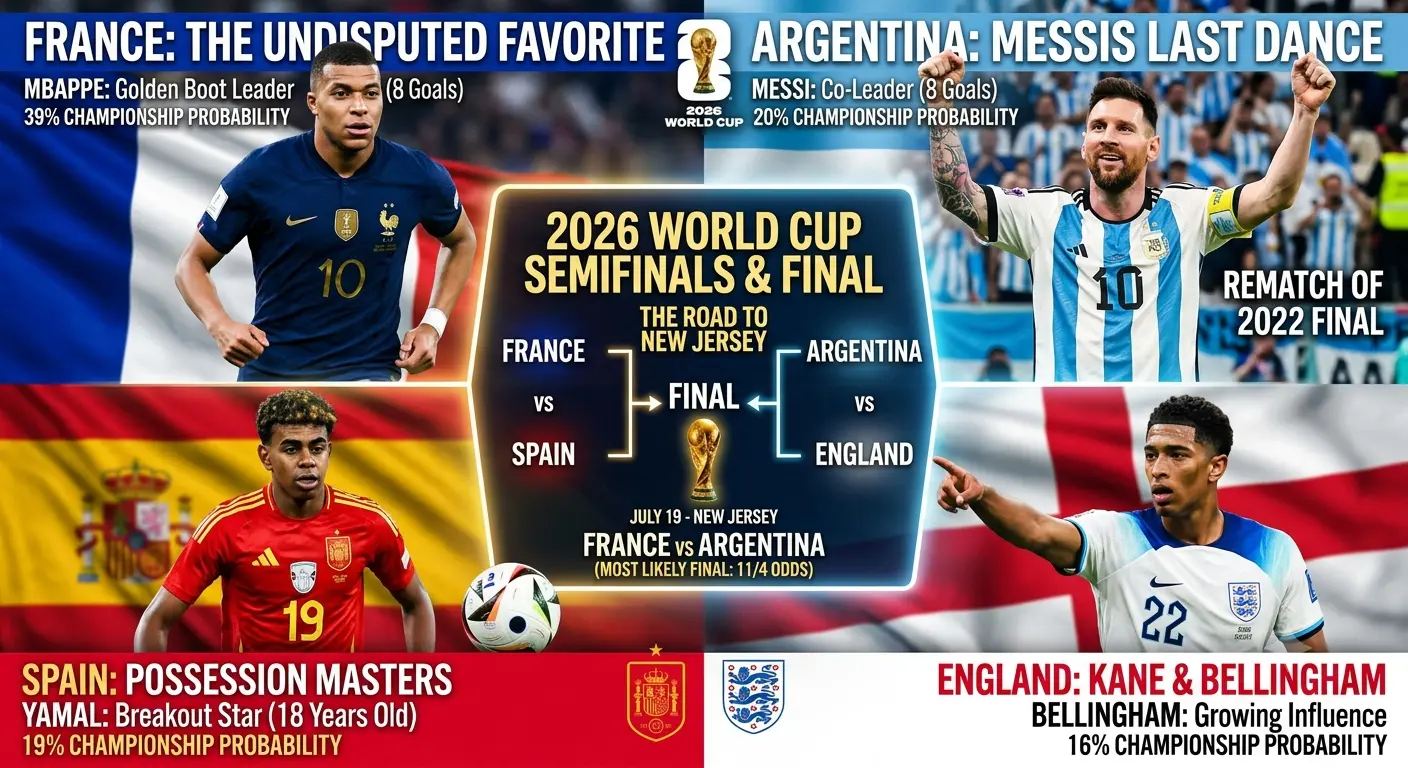
France is the undisputed tournament leader right now. They hold a 39 percent championship probability on Polymarket, more than double any other team. They swept their group with a perfect 9 points, scoring 10 goals while conceding only 2, and just dismantled Morocco 2-0 in the quarterfinals to reach the semifinals. Kylian Mbappe leads the Golden Boot race with 8 goals in 6 matches, only 4 away from Klose's all-time World Cup scoring record of 16. He has been the tournament's single most dangerous player, combining blistering pace, clinical finishing, and penalty-taking duties into an almost unstoppable attacking package. Ousmane Dembele has added 5 goals and 2 assists, giving France arguably the deepest and most lethal forward pairing in the competition. Defensively, France has been rock-solid, conceding just 2 goals across their entire group campaign and keeping Morocco at zero in the quarterfinals. The bookmakers have installed France as the 11/8 favorite to win the title, and the France vs Argentina rematch of the 2022 final is the most likely championship matchup at 11/4 odds. France's path to the title now runs through Spain in the semifinal, a match where their pace and individual brilliance should test Spain's possession-based system to its limits. If France reaches the final, whether facing Argentina or England, they will be favored in either scenario based on current market pricing and tournament form.
Argentina arrives as the defending champions and the second-strongest team in the field. They also won their group with a perfect 9 points, scoring 8 and conceding just 1, then dispatched Switzerland in the quarterfinals. Lionel Messi, at 39 years old, is having what could be his final World Cup and has scored 8 goals alongside Mbappe, making him a co-leader in the Golden Boot standings. This tournament is the last dance for one of football's greatest ever players, and every Argentina match carries the weight of his farewell narrative. The team around Messi has been well-drilled and disciplined, allowing just 1 goal in the group stage which was the best defensive record of any group winner alongside Mexico. Argentina's semifinal opponent will be England, and the market gives Argentina a slight edge in that matchup. The prospect of a France vs Argentina final is the storyline that has captured the entire tournament, a direct rematch of the 2022 Qatar final where Argentina prevailed on penalties after one of the greatest World Cup finals ever played. Bookmakers price Argentina at 20 percent on Polymarket for the title, and 8/11 to reach the final. The emotional pull of Messi's last stand combined with the team's proven tournament pedigree makes Argentina a formidable force. However, there are concerns, including a controversial moment involving defender Cristian Romero in the match against Egypt, and the simple fact that no team has successfully defended the World Cup since Brazil in 1962, and no player has won back-to-back titles at age 39. Argentina's ceiling is championship-level, but history is not on their side.
Spain has been the tournament's most aesthetically impressive team and the third member of the top-tier contenders. They topped Group H with 7 points, conceding zero goals across 3 matches, and then crushed Austria 3-0 in the Round of 32 before advancing through the knockout rounds. Their semifinal opponent is France, which sets up a clash of contrasting football philosophies: Spain's possession dominance and positional play against France's explosive pace and direct attacking transitions. Rodri has been the midfield fulcrum, controlling tempo and dictating play with surgical precision, while 18-year-old Lamine Yamal has emerged as the tournament's breakout star. Yamal's dribbling, creativity, and fearless attacking instincts have drawn comparisons to a young Messi, and Spanish analyst Guillem Balague noted that Yamal's impact is still underrated by the broader public. Spain's defense has been exceptional, allowing zero goals in the group stage, making them the only group winner besides Argentina and Mexico with a perfect defensive record. On Polymarket, Spain holds 19 percent championship probability, slightly behind Argentina. The France vs Spain semifinal will be the defining test of this tournament. If Spain's possession game can neuter France's counter-attacking speed, they could reach the final. But France's individual brilliance in open play and Mbappe's relentless goal-scoring makes this a genuine 50-50 contest. Spain's path to the title requires them to solve the Mbappe problem first, and then potentially face either Argentina or England in a final where their tactical sophistication would give them a fighting chance regardless of opponent.
England is the fourth pillar of this tournament's elite tier, and they carry a unique mix of quality and vulnerability. They topped Group L with 7 points from 2 wins and 1 draw, scoring 6 and conceding 2, then advanced through the knockout rounds to reach the quarterfinal where they face Norway and Erling Haaland. Jude Bellingham has been growing into the tournament, described as gradually taking control of matches with a maturity that surprised critics who questioned his national team role. Harry Kane stands as the English scoring threat with 6 goals including 2 penalties, making him the third-leading Golden Boot contender. However, England enters the semifinal stage with significant defensive concerns. Manager Thomas Tuchel faces a genuine backline crisis: Marc Guehi is suspended for two matches, and both Guehi and Declan Rice carry injury doubts. Sean Dyche publicly expressed concern over how these absences are being handled. England's semifinal opponent is Argentina, and on Polymarket they hold 16 percent championship probability, the lowest of the four semifinalists. They will need to contain Messi while managing their own defensive shortages, which is a daunting task. Bellingham and Kane give England attacking quality that can trouble any opponent, but the defensive fragility could be their undoing against Argentina's methodical attacking patterns. England's realistic ceiling is reaching the final if they can navigate past Argentina, but the probability markets suggest they are the least likely of the four to lift the trophy.
The tournament bracket now sets up for what could be the most dramatic semifinal pairings in recent World Cup history. France vs Spain is a battle between the tournament's most explosive attacking force and its most controlled possession system. Argentina vs England pits Messi's farewell crusade against an English side desperate to overcome its defensive injuries and reach a first World Cup final since 1966. The consensus across media, analysts, and prediction markets points to a France vs Argentina final as the most likely outcome, priced at 11/4 odds, which would be a direct replay of the unforgettable 2022 Qatar final. The broader narrative is compelling: Mbappe chasing Klose's scoring record, Messi writing the final chapter of his legendary career, Yamal announcing himself as football's next superstar, and Bellingham emerging as England's new talisman. Only 8 matches remain, and the next 9 days will determine who takes the throne.
Predict the champion with Gate AI and share your prediction on Gate Square to win rewards including a World Cup Crawfish Gift Box. First daily check-in post earns 20U, up to 300U total. Top 5 posts win the exclusive gift box. Join the Gate Square TG channel for daily token giveaways.
Join World Cup Predictions Now
@Gate_Square
repost-content-media
  • Reward
  • 6
  • Repost
  • Share
EagleEye:
2026 GOGOGO 👊
View More
#SKHynixADRIndicativePrice149
🚀 #SKHynixADRIndicativePrice149
The global semiconductor industry is witnessing another defining moment as SK Hynix prices its U.S. ADR at $149, marking one of the largest foreign stock offerings ever seen in the U.S. market. The landmark listing reflects extraordinary investor confidence in the company and its leadership in AI memory technology. The offering reportedly raised around $26.5 billion and attracted demand that exceeded available shares by several times, underscoring the market's strong appetite for companies powering the artificial intelligence revo
SK Hynix-0.27%
post-image
post-image
  • Reward
  • 4
  • 1
  • Share
EagleEye:
To The Moon 🌕
View More
#BernsteinSaysMemoryBullMarketToLastUntil2027 :
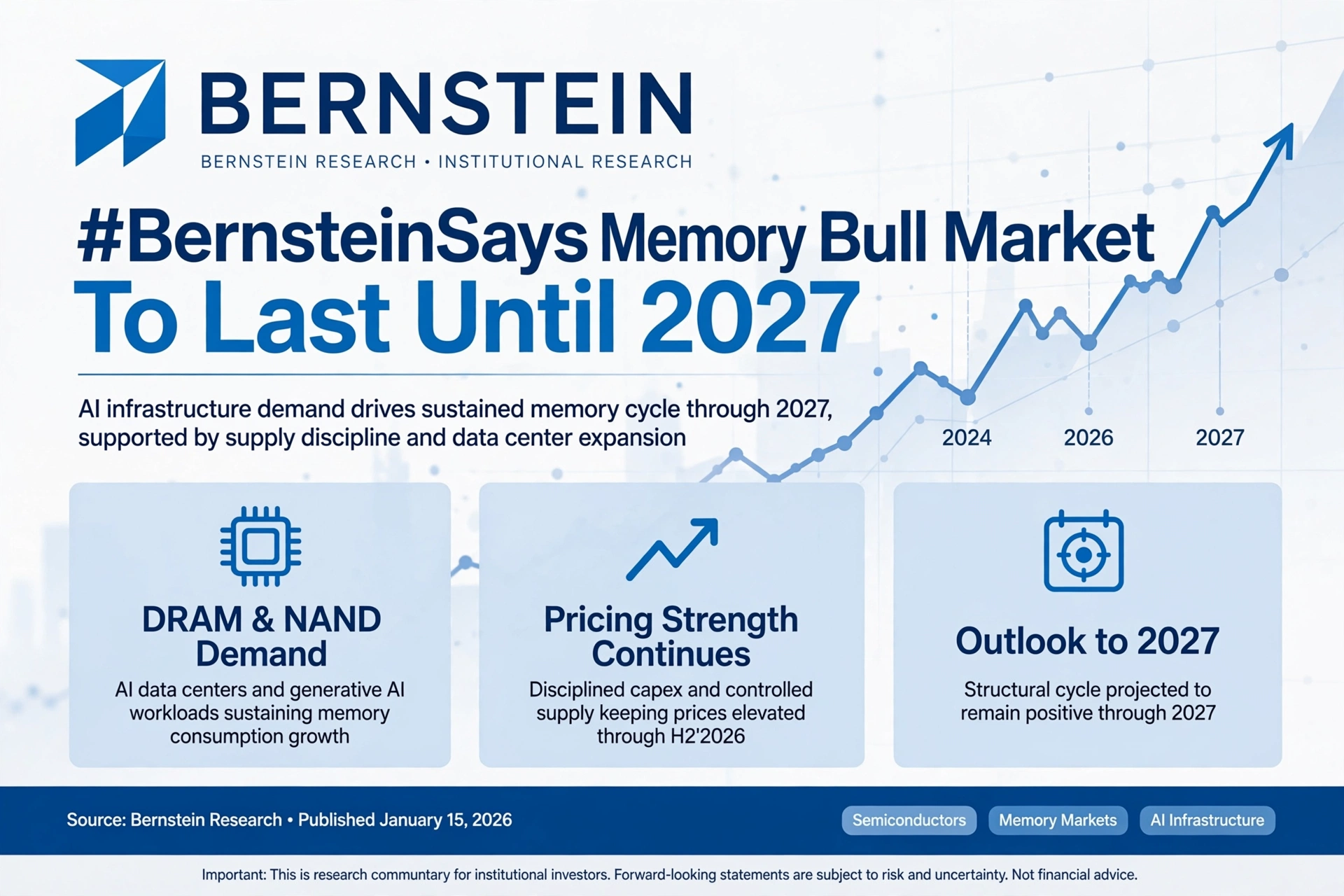
The global semiconductor industry continues to build momentum as analysts at Bernstein project that the current memory chip bull market could extend through 2027. Driven by explosive demand for artificial intelligence, cloud computing, advanced data centers, and high-performance computing, the outlook suggests that memory manufacturers may continue benefiting from strong pricing, improving profitability, and sustained investment over the coming years. Reports indicate that AI infrastructure spending remains one of the strongest growth drivers for
post-image
  • Reward
  • 5
  • 1
  • Share
EagleEye:
To The Moon 🌕
View More
#AnthropicSecondaryValuationHits1.2Trillion
🤖 #AnthropicSecondaryValuationHits1.2Trillion
The AI race has reached another remarkable milestone as Anthropic's implied secondary-market valuation reportedly climbs to an astonishing $1.2 trillion. While this valuation comes from private secondary share trading rather than a new funding round, it highlights the extraordinary demand from investors eager to gain exposure to one of the world's fastest-growing AI companies. At these levels, Anthropic has become one of the most sought-after private technology companies, with available shares remaining
post-image
post-image
  • Reward
  • 5
  • 1
  • Share
EagleEye:
To The Moon 🌕
View More
#StakeUSD1Earn8.88%APR
💰 #StakeUSD1Earn8.88%APR
Looking for a smarter way to make your digital assets work for you? An opportunity to stake USD1 and earn up to 8.88% APR offers users the potential to generate passive income while holding a U.S. dollar–denominated digital asset. As the crypto industry continues to evolve, yield-generating products are becoming an increasingly popular choice for investors seeking consistent returns without actively trading every market move.
Instead of leaving idle funds unused, staking allows eligible users to earn rewards over time while maintaining exposure
USD10.02%
post-image
post-image
  • Reward
  • 5
  • 1
  • Share
EagleEye:
2026 GOGOGO 👊
View More
  • Pinned