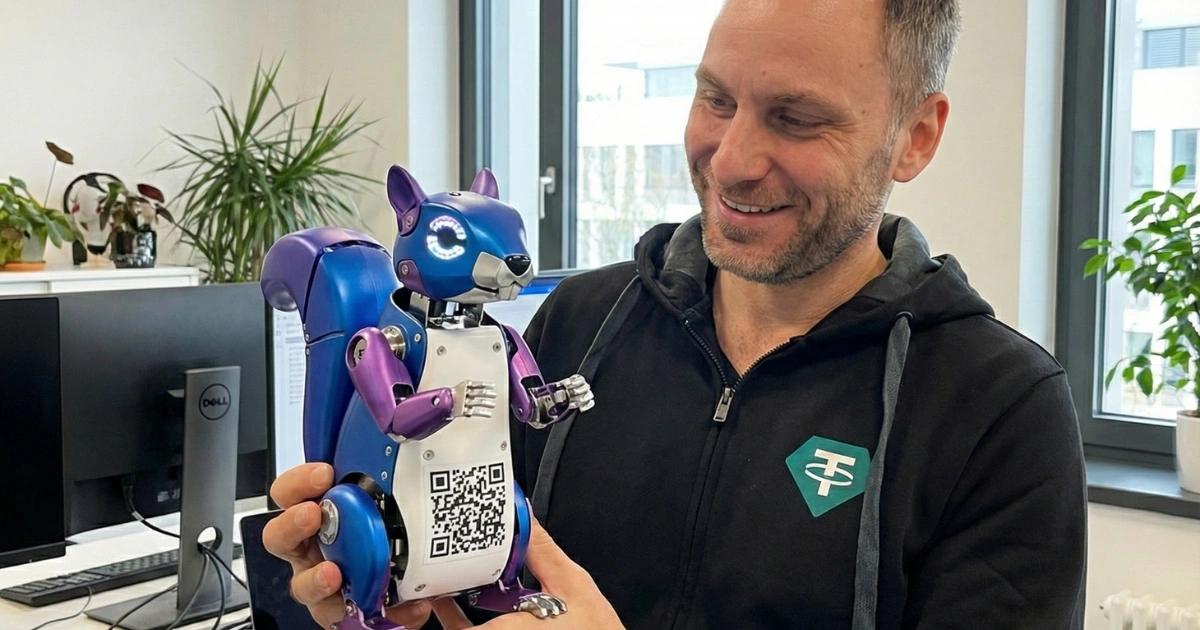
Tether invests in SQRIL, betting on the underlying infrastructure of cross-border QR payments, without pushing USDT, focusing on long-term strategies and regulatory considerations in building banking infrastructure.
Not developing consumer-end products, Tether invests in the “underlying infrastructure” of payments
Stablecoin issuer Tether recently invested in Southeast Asia’s cross-border payment startup SQRIL, drawing market attention. However, contrary to external expectations, this investment is not accompanied by any wallet products, $USDT traffic diversion, or consumer applications. Instead, Tether is choosing to bet on a set of “almost invisible” payment infrastructure.
Image source: SQRIL Stablecoin issuer Tether recently invested in Southeast Asia’s cross-border payment startup SQRIL
SQRIL focuses on creating an API-based payment exchange layer that allows banks’ apps, e-wallets, or fintech platforms in different countries to directly scan and pay for QR codes from other nations. Users pay in their local currency, and merchants receive local currency instantly, with currency exchange and clearing processes handled entirely by SQRIL in the backend. The entire process does not involve crypto assets and does not require end-users to change their payment tools. Its positioning clearly leans toward financial institutions and platform providers rather than retail markets.
Why QR Code, and focusing on Asia, Latin America, and Africa
In most Asian countries, QR code payments have long penetrated daily life. From the Philippines, Vietnam, Indonesia to Thailand, scanning codes for payments is mainstream, often based on national standards supported by central banks or regulatory agencies.
Similar real-time payment systems are also rapidly expanding in Latin America and Africa, even growing faster than credit card infrastructure. However, these systems almost all operate smoothly only within “domestic” borders. Once cross-border consumption or travel scenarios are involved, the payment experience immediately breaks down. SQRIL’s role is to fill this gap, quietly connecting incompatible national QR systems in the backend.
Currently, SQRIL supports QR payments in the Philippines, Vietnam, and Indonesia, and provides bank transfer services in Malaysia and Thailand. Future plans include expanding functionalities to more Asian, African, and Latin American markets, but actual success heavily depends on whether banks and wallet providers are willing to integrate its API.
Not pushing stablecoins, but more in line with Tether’s usual style
Notably, SQRIL’s payment process currently shows no sign of $USDT or any stablecoins. Tether’s investment appears not to be aimed at short-term promotion of crypto payments but rather betting on the strategic value of “payment infrastructure itself.”
This aligns with Tether’s recent movements. Besides stablecoin operations, Tether has invested resources into AI, data sets, and foundational technology industries, such as expanding and open-sourcing its QVAC Genesis II language model database for large language model research. At the same time, Tether has also revealed that it is exploring a mobile wallet centered on Bitcoin and $USDT , designed to operate AI models on-device with a non-custodial architecture.
The commonality of these layouts is that they do not directly compete for user attention but are positioned at the “core” of products, providing foundational capabilities for future application ecosystems. SQRIL clearly fits this investment logic.
Further reading
Tether ventures into AI health tech! How does QVAC Health integrate biological data while safeguarding your privacy?
Tether to launch a crypto wallet app! Integrating local AI assistants, supporting only Bitcoin and 3 stablecoins
A neutral connector role, but still cannot escape regulatory realities
Unlike large payment networks, SQRIL does not issue accounts, manage user relationships, or attempt to build a brand-based checkout experience. Instead, it positions itself as a “neutral connector.” This low-profile positioning makes it easier to be accepted by banks and regulators in various countries, especially in emerging markets that are highly cautious about foreign payment systems.
However, technology is not the only barrier. Payment regulation is inherently highly localized; each country has different rules regarding settlement, foreign exchange, compliance, and transaction monitoring. SQRIL can connect systems but cannot unify regulatory regimes. As it expands into Africa and Latin America, this complexity will only increase.
Overall, Tether’s investment in SQRIL seems more like a long-term infrastructure bet rather than an immediate crypto payment revolution. If successful, it will operate quietly within the global payment system; if it fails, it will leave no obvious consumer traces. For Tether, this might be the most ideal risk profile.
Disclaimer: The information on this page may come from third parties and does not represent the views or opinions of Gate. The content displayed on this page is for reference only and does not constitute any financial, investment, or legal advice. Gate does not guarantee the accuracy or completeness of the information and shall not be liable for any losses arising from the use of this information. Virtual asset investments carry high risks and are subject to significant price volatility. You may lose all of your invested principal. Please fully understand the relevant risks and make prudent decisions based on your own financial situation and risk tolerance. For details, please refer to
Disclaimer.
Related Articles
AI is no longer the exclusive domain of tech giants! Tether launches QVAC—has the moment arrived for everyone to have their own LLM?
Tether announced that its AI infrastructure, QVAC Fabric, has launched the world's first cross-platform BitNet LoRA fine-tuning framework, enabling large language models to be trained on consumer-grade hardware. This technology allows devices like smartphones to complete model fine-tuning, significantly reducing AI development costs, enabling AI decentralization, and making it possible to use AI anytime and anywhere in the future.
ChainNewsAbmedia1h ago
Tether Launches World's First Billion-Level AI Training Framework for Mobile, Compatible with iPhone and Samsung LoRA
Tether's QVAC division launched the world's first LoRA fine-tuning framework supporting Microsoft's BitNet architecture on March 17, significantly reducing AI model memory and computational requirements and enabling localized training on mobile phones. The technology allows users to perform personalized learning without uploading data, safeguarding privacy. Testing shows that modern smartphones can effectively fine-tune billion-parameter models, advancing the application potential of edge computing.
動區BlockTempo3h ago
Tether introduces the BitNet LoRA framework, supporting large model training on mobile devices
Gate News report: On March 17, Tether's QVAC Fabric launched the world's first cross-platform LoRA fine-tuning framework for Microsoft BitNet (1-bit LLM), significantly lowering the VRAM and computational thresholds for large model training. The framework supports LoRA fine-tuning and inference acceleration on Intel, AMD, Apple Silicon M series, and mobile GPUs (including Adreno, Mali, and Apple Bionic).
GateNews3h ago
Tether CEO Paolo Ardoino will attend the Mar-a-Lago Trump luncheon and deliver a speech
Gate News reported that on March 17, according to official sources, Tether CEO Paolo Ardoino will attend and speak at a Trump luncheon held at Mar-a-Lago.
GateNews4h ago
Tether CEO Paolo Ardoino to Attend Trump TRUMP Token Luncheon and Deliver Speech
TrumpMeme official announcement: Tether CEO Paolo Ardoino will attend and speak at the Trump TRUMP token luncheon. Trump will have lunch with 18 "superstars" and the top 297 holders on April 25 at Mar-a-Lago. The top 29 holders can also attend a special VIP reception.
GateNews4h ago
Delphi Digital: Sufficient collateral backing for stablecoins does not mean immunity from bank runs; the risk has shifted to the issuer level
Delphi Digital analysis points out that although Tether and Circle's stablecoins are backed by short-term Treasury bills and cash equivalents, they are not completely safe and still face bank run risks. The USDC depegging event in early 2023 demonstrated that stablecoin risks have shifted to issuers, highlighting the dangers posed by their centralization.
GateNews03-16 04:21


