Bitcoin drops to $72,096, hitting a 16-month low, down 42% from the high of $126,000. Four major bearish factors: Trump-Greenland dispute and US-Europe tensions, government shutdown delays, Warsh nomination sparking hawkish expectations, slow regulatory legislation. Bitcoin ETF saw a net outflow of $12 billion in March. MicroStrategy fell 5%, Riot and MARA dropped 11%.
Four Major Bearish Factors Trigger a Perfect Storm
Why did Bitcoin plummet today? The answer lies in four mutually reinforcing negative factors acting simultaneously. First is escalating geopolitical tensions. Trump’s actions regarding Greenland have strained US-Europe relations, with EU officials expressing strong dissatisfaction with Trump’s expansionist rhetoric. This transatlantic rift has triggered a global risk-off sentiment, prompting investors to sell risk assets and flock to US Treasuries and gold.
Second is the delayed effect of the government shutdown. Recent partial government closures have delayed key economic data releases, including non-farm payrolls and GDP revisions. This data vacuum prevents investors from accurately assessing economic conditions, leading to reduced holdings and risk aversion. As a highly volatile asset, Bitcoin is most affected in this environment.
Third is the hawkish shift in Federal Reserve policy expectations. Trump’s late-month nomination of Kevin Warsh as Fed Chair has led markets to anticipate a policy shift. Warsh is considered hawkish, favoring higher interest rates to combat inflation. This expectation has dashed hopes for rate cuts, and the high-rate environment is unfavorable for interest-free assets like Bitcoin, as investors can earn attractive yields from safe assets like US Treasuries, reducing the appeal of holding Bitcoin.
Fourth is slow progress on crypto regulation. Although the Trump administration has sent friendly signals toward the crypto industry, progress in establishing more favorable regulatory and legislative protections has been sluggish. The Senate’s Market Structure Bill remains stalled, and stablecoin legislation faces deadlock between banking and crypto sectors. This regulatory uncertainty keeps institutional investors on the sidelines, with insufficient new buying to support prices.
Four Core Reasons for Bitcoin’s Crash
Geopolitics: Trump-Greenland dispute sparks US-Europe tensions, global risk-off
Government Shutdown: Economic data delayed, market uncertainty increases
Hawkish Expectations: Warsh nomination triggers high interest rate expectations, pressuring interest-free assets
Regulatory Stagnation: Slow crypto legislation, institutional investors remain cautious
Spot ETF Outflows Reach $12 Billion
Deutsche Bank’s recent analysis indicates that due to expectations of a larger Bitcoin correction, massive institutional outflows have led to decreased liquidity, damaging its price. Analysts note that since a series of leveraged digital asset liquidations last October, spot Bitcoin ETFs have experienced significant fund outflows.
These funds saw over $3 billion in outflows in January, about $2 billion in December, and roughly $700 million in November. Total outflows over three months exceed $12 billion, a rare scale in the short history of Bitcoin ETFs. When ETFs launched in early 2024, they attracted continuous inflows totaling over $30 billion for months. The current reversal indicates a fundamental change in institutional Bitcoin allocation strategies.
ETF outflows are structural. Unlike retail investors’ emotional trading, institutions typically allocate via ETFs based on long-term portfolio strategies. When institutions begin systematic withdrawals, it signals a shift in their risk-reward assessment of Bitcoin. Possible reasons include: better risk-adjusted returns elsewhere (like AI stocks or US bonds), rising concerns over crypto regulation, or simple portfolio rebalancing needs.
The correction in Bitcoin has impacted many crypto stocks. MicroStrategy fell 5% today, while digital asset miners like Riot Platforms and MARA Holdings declined nearly 11%. This chain reaction shows that Bitcoin’s price decline not only affects the token itself but also impacts the entire crypto industry chain. MicroStrategy holds over 713,502 Bitcoins, with its stock price highly correlated to Bitcoin. Mining companies’ profitability is directly tied to Bitcoin’s price, so falling prices significantly worsen their earnings.
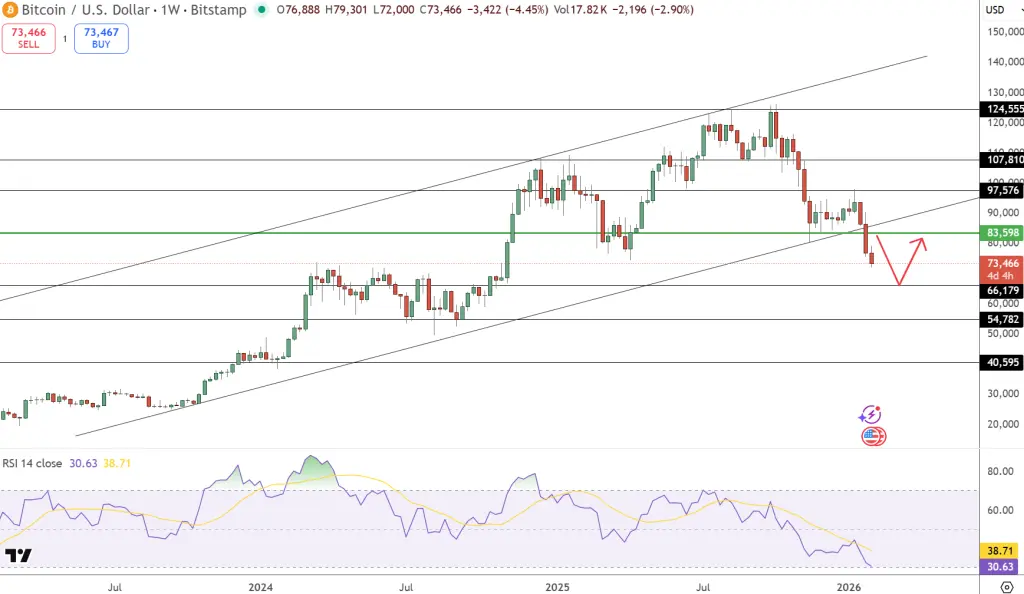
Technical Outlook: Three Black Crows Test the $68,400 Support
(Source: TradingView)
Bitcoin’s price outlook appears bearish as technical indicators show the market undergoing a necessary correction. The weekly chart displays a “Three Black Crows” candlestick pattern, indicating persistent selling pressure. The Three Black Crows is a classic bearish reversal pattern, consisting of three consecutive large bearish candles, each opening within the previous candle’s real body and closing progressively lower. This pattern typically appears at the top of an uptrend or mid-downtrend, signaling dominant bearish forces.
Key technical levels to watch include the 200-week exponential moving average (EMA) near $68,400, which remains a critical support level. This moving average has historically served as a “last line of defense” for Bitcoin; breaking below often signals a deep bear market. On the resistance side, regaining the $83,598 level (previous support turned resistance) is necessary to negate the current bearish bias.
The Relative Strength Index (RSI) is around 30, indicating the market is oversold. This could suggest a rebound is imminent, but experienced traders will look for RSI divergence before confirming a bottom. If RSI drops below 25 and then rebounds with increased volume, it would form a more reliable buy signal.
RWA and DeFi Infrastructure Quietly Bottoming
Despite short-term weakness in Bitcoin’s price, its use cases are rapidly expanding. Latin America’s leading digital asset company Mercado Bitcoin has issued over $20 million in tokenized private credit on the Rootstock Bitcoin sidechain, aiming to reach $100 million by April. This helps connect traditional private debt with Bitcoin-backed liquidity.
Meanwhile, Fireblocks announced plans to expand the Stacks layer, bringing institutional-grade DeFi to Bitcoin. This upgrade will reduce transaction times to about 29 seconds, far faster than Bitcoin’s usual 10-minute block time, and enable institutions to lend and earn yields using Bitcoin. Currently, around $5.5 billion is locked in Bitcoin DeFi, laying a solid foundation for the next growth phase.
The chart’s “Path Tool” indicates that in the remaining first quarter, Bitcoin’s price will re-accumulate between $68,000 and $72,000. If Bitcoin can stay above the 200-week moving average, the double bottom pattern could serve as a springboard for a rebound to $83,000, ultimately challenging the psychological resistance at $100,000. For long-term investors, the current dip is a transitional phase, and with RWA tokenization and faster DeFi integration, the next bull market is quietly taking shape.
Disclaimer: The information on this page may come from third parties and does not represent the views or opinions of Gate. The content displayed on this page is for reference only and does not constitute any financial, investment, or legal advice. Gate does not guarantee the accuracy or completeness of the information and shall not be liable for any losses arising from the use of this information. Virtual asset investments carry high risks and are subject to significant price volatility. You may lose all of your invested principal. Please fully understand the relevant risks and make prudent decisions based on your own financial situation and risk tolerance. For details, please refer to
Disclaimer.


