Why did Bitcoin rise today? BTC/USD broke through $71,000 on Sunday, temporarily halting last week’s downtrend. The Financial Times published a bearish article claiming that Bitcoin is “destined to hit rock bottom,” but this has become a contrarian indicator for bottom fishing. The 200-week moving average cloud provides support between $58,000 and $68,000, but analysts warn that a repeat of the 2022 bear market could occur.
Financial Times’ Pessimistic Article Becomes a Contrarian Indicator
The answer to why Bitcoin is up today may lie in those voices that have never stopped bearishness. The Financial Times has undoubtedly led all traditional media in opposing Bitcoin. The reporter Jamie Ma Kelly’s article published on Sunday succinctly summarizes their overall stance over the past decade: “Since its inception, Bitcoin has been on a path destined to hit rock bottom. This week’s situation indicates that the number of ‘big fools’ relying on Bitcoin is dwindling.”
Kelly continued: “The fairy tales supporting cryptocurrencies are ultimately just fairy tales. People are beginning to realize that anything based on intangible concepts has no bottom.” However, after Bitcoin surged overnight, the Financial Times changed its headline to “Above $70,000,” and this immediate correction highlights the rapid price rebound.
Perhaps the ultimate sign of a bottom is that those who have been consistently bearish on Bitcoin still cheer when the price rises from zero to over $100,000 in its 16-year history. Experience shows that when mainstream media’s bearish sentiment peaks, the market is often in the final stages of panic selling. This contrarian indicator has repeatedly proven effective in the crypto market and is a key clue to why Bitcoin is up today.
MicroStrategy Breaks Below Cost Basis Triggering Capitulation Selling
Earlier this week, as Bitcoin’s price fell below MicroStrategy (MSTR)‘s average cost basis of $76,000, the UK Financial Times’ Craig Coben published an article titled “MicroStrategy’s Long Desperate Road.” The stock has fallen about 80% from its all-time high at the end of 2024. Coben stated in February 2026: “Management has no safe options—only different ways to destroy shareholder value. It’s hard to see a reason to buy a company that has only broken even on its investments over the past five years.”
“Like a giant mammoth trapped in a La Brea tar pit,” Coben summarized, “MicroStrategy is desperately looking for a way out.” This extreme pessimism reflects that market sentiment has reached a freezing point. When institutional investors’ cost basis is broken, the market often experiences a final capitulation sell-off before a true bottoming process begins.
Longtime gold advocates and Bitcoin critics like Peter Schiff also joined the criticism. “According to Michael Saylor, Bitcoin is the best-performing asset in the world,” he wrote on Tuesday. “However, MicroStrategy has invested over $54 billion in Bitcoin over the past five years, and so far, the company is about 3% in the red on this investment. I am confident that the losses will be even greater over the next five years!” Schiff continued: “Bitcoin has fallen below $76,000, now worth about 15 ounces of gold, down 59% from its peak in November 2021. Bitcoin is in a long-term bear market measured in gold.”
Tether Funding Valuation Shrinks, Reflecting Market Confidence
Another important piece of news this week, though it may not make headlines, is that investor interest in Tether appears to be waning. Last year, when the crypto market was still active, reports indicated that the stablecoin giant was in talks to raise $15-20 billion at a valuation of $500 billion. However, according to a Tuesday report from the Financial Times, investors seem opposed to this valuation, and the funding round may only reach around $5 billion.
Tether CEO Paolo Ardoino told the Financial Times that the initial reports of raising $15-20 billion were a “misunderstanding,” and that Tether’s $500 billion valuation had already attracted widespread attention. However, the report notes that investors privately expressed concerns about such a high valuation. It also points out that the situation is constantly changing, and the bullish momentum in crypto markets could quickly shift market sentiment.
This significant reduction in funding valuation from another perspective explains why Bitcoin is up today. When the market becomes more conservative about valuations of crypto infrastructure companies, it often indicates that panic has been over-released, and conditions for a rebound are forming.
200-Week Moving Average Cloud Support as a Key Defensive Line
(Source: Trading View)
Technical analysis offers another perspective on why Bitcoin is up today. Bitcoin’s price rose 3% on Sunday, but some traders remain skeptical that the decline has truly ended. Data from TradingView shows BTC/USD broke above $71,000, up 20% from last Friday’s 15-month low.
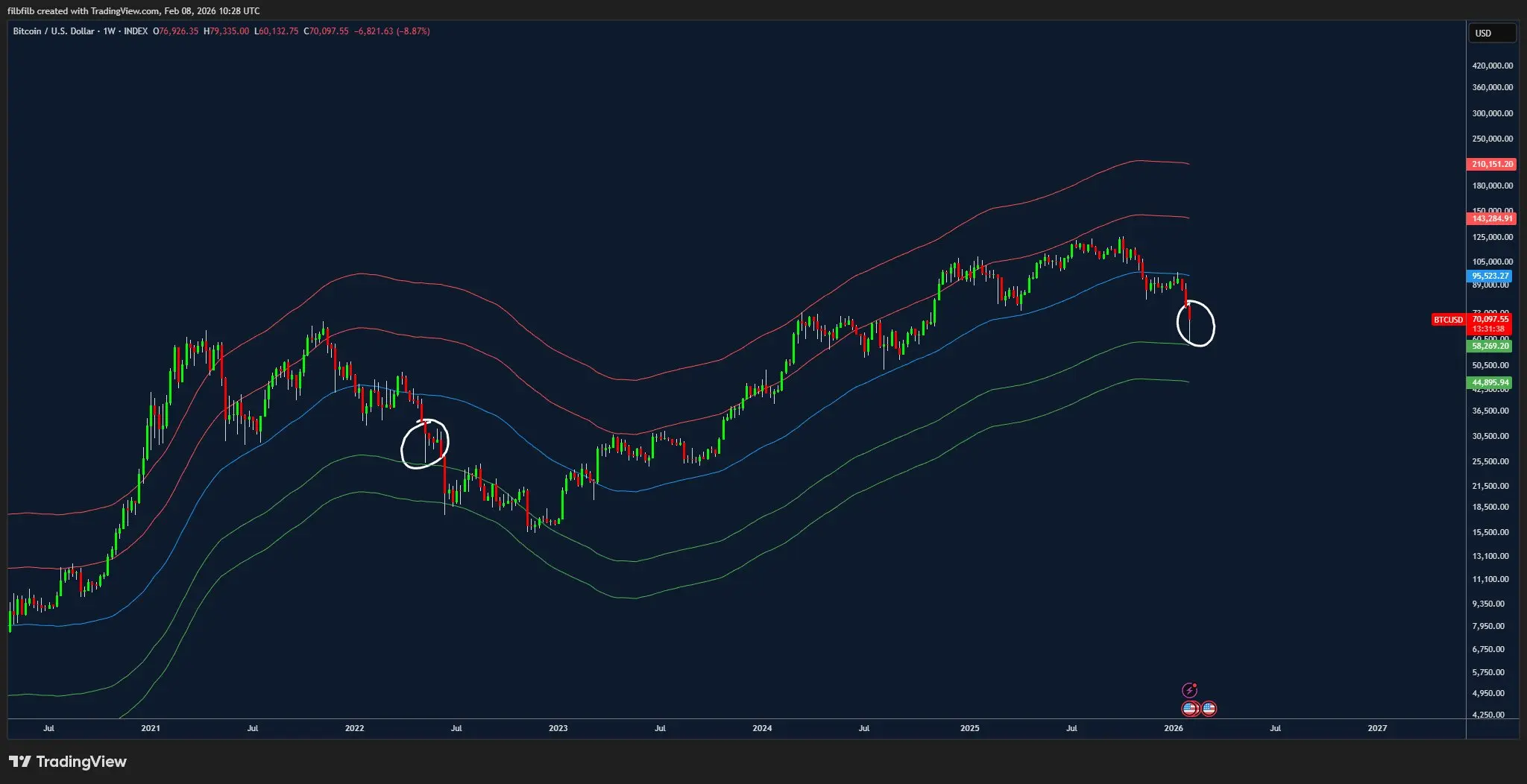
Independent analyst Filbfilb uploaded a chart comparing the current BTC price action with the 2022 bear market. “I won’t try to sugarcoat it in any way; it looks like this,” he commented beside a chart showing spot price versus the 50-week exponential moving average (EMA) at $95,300. Analyst Tony Sevilirino also shares a similar view, citing multiple price indicators and concluding that a new low is almost inevitable.
Trader BitBull agrees: “Bitcoin’s ultimate crash hasn’t happened yet, just like in 2022, as Filbfilb mentioned. The real bottom will form below $50,000, at which point most ETF buyers will be in the red.” According to data from Checkonchain, the current average purchase cost for US spot Bitcoin ETFs is $82,000.
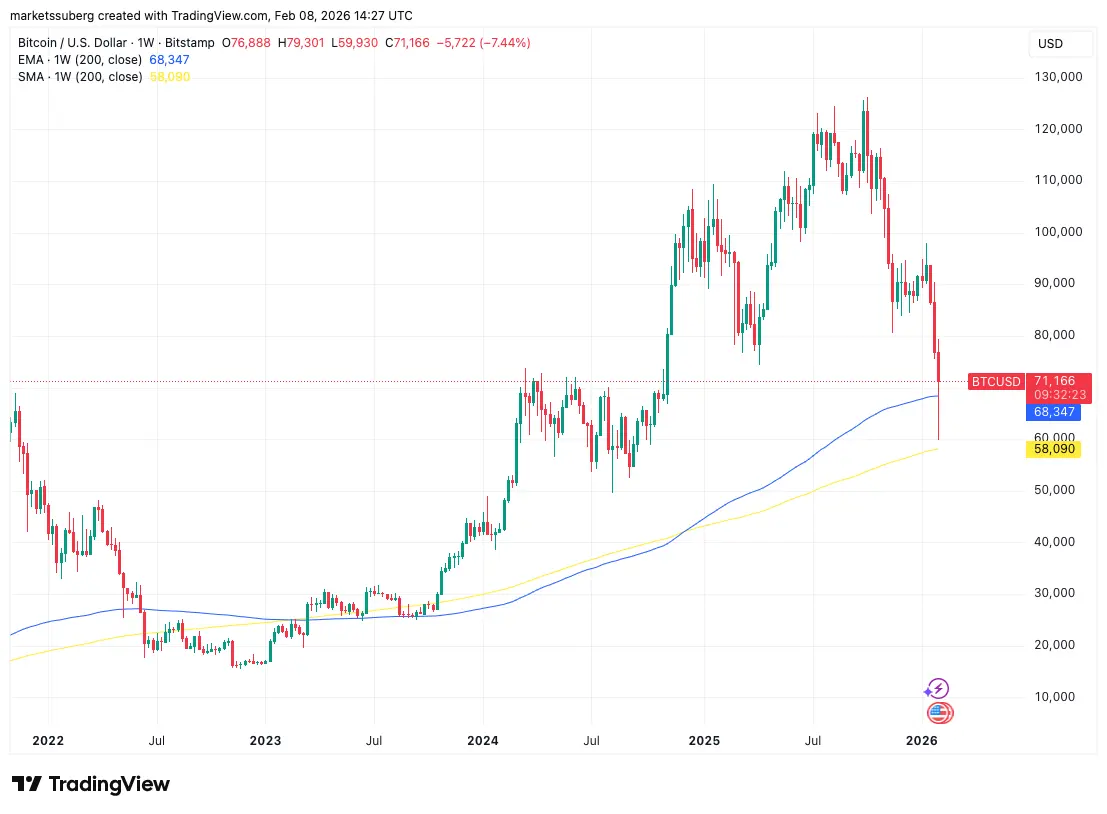
However, a key feature of the Bitcoin bear market is the support cloud formed by the 200-week simple moving average (SMA) and exponential moving average (EMA). Together, they create a support zone between $58,000 and $68,000.
Is the 2022 Bear Market Pattern Repeating?
(Source: Trading View)
Cubic Analytics founder Caleb Franzen believes that the shadow of 2022 is looming over the current market. “In May 2022, Bitcoin retested its 200-week moving average cloud. The bulls said, ‘That’s it, we’ve retested the long-term moving average, now we can continue higher.’” He summarized: “The price immediately rebounded in that zone, forming a long wick, and closed above the weekly midpoint.”
“But then this rally faded. Weeks later, the price fell back into the 200-week moving average cloud, failed to rebound, and in June 2022, broke through the cloud. What are we seeing now? This is the first retest of the 200-week cloud with a long wick,” Franzen explained. He noted that the market might not “perfectly” replicate the previous bear market. “The reality is, nobody knows what will happen next,” he admitted.
Key Technical Indicators Summary
50-week EMA: $95,300 (mid-term trend threshold)
200-week moving average cloud: $58,000 to $68,000 (long-term support zone)
US ETF average cost: $82,000 (institutional reference)
MicroStrategy cost basis: $76,000 (already broken, triggering capitulation)
Is It a Bottom Signal or a Trap for FOMO?
Former hedge fund manager Hugh Hendry once said, “I refuse to bottom fish; monkeys are always bottom fishing.” As Hendry pointed out, it’s best not to take excessive risks and try to time buying based on headlines like the Financial Times this week. However, one thing is certain: some form of bottoming process is underway.
The ultimate reason why Bitcoin is up today may be a combination of multiple factors: the extreme bearishness of traditional media serving as a contrarian indicator, the capitulation sell-off after breaking below MicroStrategy’s cost basis, technical support from the 200-week moving average cloud, and a natural rebound after market sentiment hits rock bottom. As the weekly close approaches, market participants remain highly skeptical about the sustainability of the rebound, but history shows that the most pessimistic moments often harbor the greatest opportunities.


