The world’s largest corporate Bitcoin holder, MicroStrategy (Strategy), CEO announced plans to issue more perpetual preferred shares to provide investors with a tool that offers “existing digital capital positions while avoiding volatility.” But how long can this financial magic last?
(Background recap: Bitcoin rebounds to $65,000, sleeping whales buy the dip, Japan’s MicroStrategy Metaplanet: embracing BTC with unchanged goals)
(Additional context: MicroStrategy’s BTC floating unrealized losses surpass $10 billion! The worst financial report in Strategy’s history with stock plunging 17% overnight)
Table of Contents
- The bet of 714,644 Bitcoins
- The limits of financial engineering
- Innovation or risk shifting?
MicroStrategy CEO Phong Le recently told Bloomberg that the company will issue more perpetual preferred shares to ease investor concerns over sharp stock price fluctuations.
We know Strategy is the publicly traded company holding the most Bitcoin globally, with its stock price highly correlated to Bitcoin. Its issued perpetual preferred share product is called “Stretch” (ticker STRC). Its mechanism: the dividend rate resets monthly, currently at 11.25%, designed to keep the stock price stable near a face value of $100.
This is a hybrid security: it has stock-like features (perpetual, no maturity date) and bond-like features (fixed dividends, price anchoring). For investors wanting Bitcoin exposure but unable to tolerate MSTR’s stock dropping from $200 to $100, STRC offers a “buffer zone.”
Data shows that since its launch last July, STRC has contributed over 27,000 BTC worth of funding to Strategy’s Bitcoin purchases. This makes it Michael Saylor’s primary fundraising tool.
The bet of 714,644 Bitcoins
According to the latest data, Strategy holds 714,644 Bitcoins, valued at approximately $48.4 billion, with an average cost basis of about $76,506 per BTC. Amid a significant Bitcoin correction, the current unrealized loss is nearly $6.2 billion.
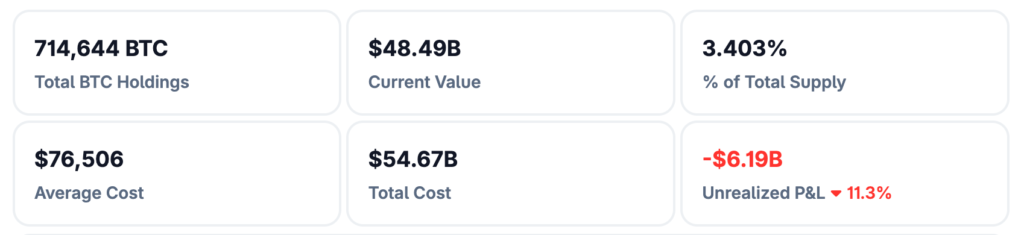
To reassure the market, Executive Chairman Saylor repeatedly emphasized that concerns about “Bitcoin declines forcing the company to sell holdings” are “groundless.” He pointed out that the company’s debt is unsecured and long-term, with most obligations not due until 2027-2028, so there’s no risk of margin calls.
This logic is technically sound, but he did not delve into a potential issue: if Bitcoin remains below cost basis long-term, how will the company continue issuing new shares or preferred stock to buy more Bitcoin?
The limits of financial engineering
Strategy’s business model is essentially an arbitrage: using the valuation premium in the stock market to buy spot Bitcoin. As long as investors are willing to pay above net asset value for “Bitcoin positions,” this machine can keep running.
Perpetual preferred shares are a new component of this machine. They attract a different set of investors—those seeking fixed income rather than unlimited upside potential. This broadens Strategy’s funding sources and reduces dilution pressure on common shares.
But this model carries clear risks. When Bitcoin’s price drops sharply (for example, below $70,000 currently), STRC’s attractiveness depends on whether investors believe that an 11.25% dividend yield sufficiently compensates for the risk. If confidence wanes, Strategy loses an important fundraising channel.
Innovation or risk shifting?
From one perspective, Strategy is doing what traditional financial institutions have done for decades: creating products with different risk levels to meet diverse investor preferences. There’s nothing new there.
But from another angle, it’s using financial engineering to mask a fundamental issue: Bitcoin’s volatility doesn’t disappear just because you package it as preferred shares. The risk is merely shifted—from those who can tolerate volatility to those who think they’re buying a “stable” product.
Saylor’s vision is to make Strategy an “on-ramp” to Bitcoin, but in times of panic, everyone will want to exit simultaneously. MicroStrategy has already demonstrated the long-term gains of holding through the last cycle; with the current bear market’s end still unclear, investors need to exercise stricter risk controls.

Disclaimer: The information on this page may come from third parties and does not represent the views or opinions of Gate. The content displayed on this page is for reference only and does not constitute any financial, investment, or legal advice. Gate does not guarantee the accuracy or completeness of the information and shall not be liable for any losses arising from the use of this information. Virtual asset investments carry high risks and are subject to significant price volatility. You may lose all of your invested principal. Please fully understand the relevant risks and make prudent decisions based on your own financial situation and risk tolerance. For details, please refer to
Disclaimer.
Related Articles
BTC 15-minute rise of 0.60%: ETF capital inflows and technical breakout resonance drive short-term momentum
2026-03-13 12:45 to 2026-03-13 13:00 (UTC), BTC achieved a +0.60% return within 15 minutes, with a price range of 72341.6-72888.0 USDT and a volatility amplitude of 0.76%. Short-term price oscillations noticeably intensified. Due to abundant trading volume, market attention rose rapidly, reflecting a phase of strengthened buying power.
The primary drivers of this movement are continuous net inflows into ETFs and a technical breakout of key structures. In March 2026, BTC spot ETFs attracted capital inflows as high as 1.6 billion dollars in a single week.
GateNews37m ago
DeFi enters a "winter of yields": liquidity stagnation, leverage contraction, and the disappearance of arbitrage opportunities
The DeFi market entered an "interest rate winter" since September 2025, with deposit rates for major stablecoins declining sharply and supply-demand imbalances causing liquidity congestion. The rate decline reflects reduced capital demand and a lack of high-return opportunities. Stablecoin lending demand has dropped significantly, with market risk appetite shifting toward more stable investment channels. In response to this situation, the Sky protocol demonstrates competitiveness and adaptability by introducing real-world assets to enhance yields. The low interest rates during this phase can be viewed as an opportunity for DeFi market transformation.
区块客41m ago
"Seeking a Sword by Marking a Boat" - Style Coin Price Predictions Go Viral: The Practical Logic and Flaws of Mystical Prophecies
Author: Frank, PANews
Whenever the market enters a confusing phase of going nowhere, people try to use a "cutting the boat to seek the sword" method of historical retrospection to predict the next market movement. In such cases, people often see from these theories and charts that history always repeats itself, and seem to automatically overlay and verify future price movements with a certain period in the past.
This coincidence seems to have a magical effect and is often verified. Some bloggers claim this prediction method has an accuracy rate of 75%~80%.
Does this "cutting the boat to seek the sword" style price prediction that repeatedly goes viral on social media help the market identify stages, or is it just packaging noise as prophecy?
From "Tick Fractals" to "History Rhyming"
The peak operation regarding predictions of October 2025 market tops is an analyst named CryptoBullet, who created a method called "ti
区块客45m ago
Surviving Oscillating Markets: How Retail Investors Can Minimize Losses? Capital Flow Trends and Practical Guide
Author: MyToken
In the crypto market, sentiment often emerges more easily than logic. When "volatility" becomes the norm for the broader market and "anxiety" becomes the prevailing mindset among retail investors, a discussion on how to "lose less money" carries more practical significance than any macro narrative presentation.
Recently, the renowned data aggregation platform MyToken hosted an AMA event themed "In the Current Market, How Can Retail Investors Lose Less Money? Capital Flow and Practical Guide." The event invited independent trader BTC Bull Demon King and KTX Exchange CMO Christine, who provided puzzled investors with a practical "survival guide" from the perspectives of independent traders and trading platforms respectively.
Below is a highlight recap of this AMA.
---
Market Phase Consensus: Stop Fantasizing About a Bull Run, This is a "Consolidation Phase"
Market positioning is a relatively important issue, as it directly determines the next
PANews2h ago
NAV Price Surges 44.25%: Is a New Trend Emerging?
NAV coin recently surged by 44.25%, reaching $0.032715, amid increased trading activity and fluctuating market conditions. Analysts attribute this rally to rising on-chain activity and shifting sentiment toward altcoins, while traders monitor key price levels for future movements.
Coinfomania3h ago
Why TARA Just Skyrocketed 24.47% in 60 Minutes
TARA's price surged 24.47% to $0.000047 amid mixed signals in the crypto market and increased trading activity. Market conditions and macroeconomic factors are influencing investor sentiment, with traders closely monitoring key resistance and support levels.
Coinfomania3h ago


