Monetary Policy

Explore crypto news and in-depth articles related to Monetary Policy, covering market updates, data-driven analysis, trend insights, and key developments to help you fully grasp key information about Monetary Policy in the crypto market.
ALLMacroeconomicsMonetary PolicyGlobal MarketsGeopolitics

Not like the Mega Bank experiment! The U.S. Federal Reserve: Stablecoins can significantly reduce cross-border payment costs, but there’s also a concern

The U.S. Federal Reserve’s first systematic assessment of payment stablecoins finds that they could improve cross-border payment efficiency, but may also change the flow of reserves and monetary policy. Stablecoin regulation is governed by the GENIUS Act and may affect the Fed’s asset management policies; as the scale grows, regulation will become more stringent.
CryptoCity·1h ago
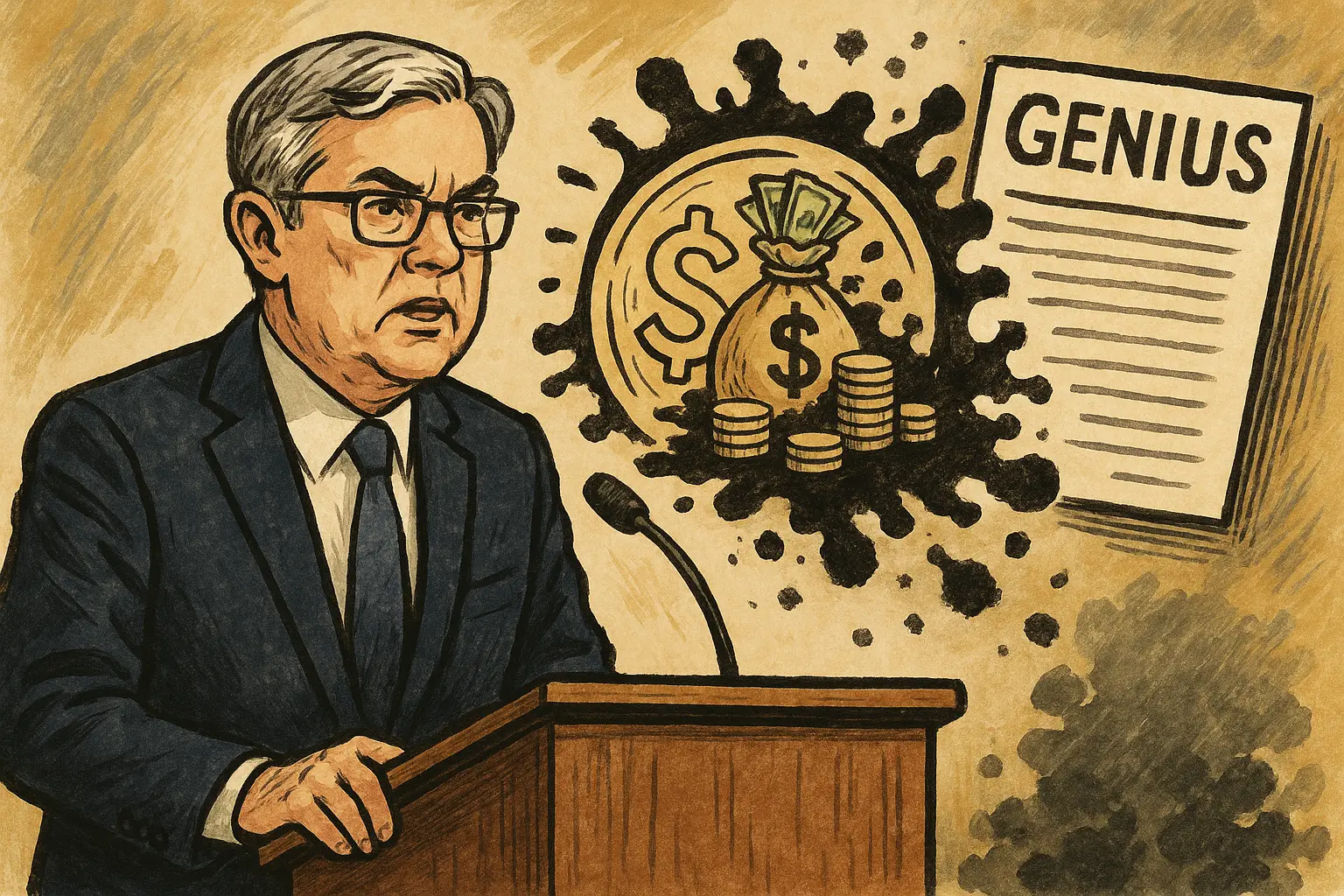
Federal Reserve Board Governor Barr: Stablecoins carry money-laundering risk, the GENIUS Act framework is taking shape soon

The Federal Reserve Board member Michael Barr warned that stablecoin reserve assets face money laundering and financial stability risks, emphasizing that reserve quality is crucial. Stablecoins have advantages in areas such as real-time cross-border payments, but they could pose dangers due to insufficient regulation. Pushing the “Lummis Act” will require issuers to formally register and hold equivalent reserves to strengthen market stability. The implementation of regulatory details will directly affect the development of the U.S. stablecoin market.
MarketWhisper·2h ago
news-image

$10 trillion in fresh funding! The U.S. Department of Labor proposes: Allow “401(k) retirement funds” to invest in cryptocurrencies

The U.S. Department of Labor has proposed loosening investment restrictions for 401(k) retirement accounts, allowing investments in alternative assets such as cryptocurrencies, real estate, and private equity. It could open up a $10.1 trillion retirement savings market. The move is intended to carry out President Trump’s executive order, but it has also sparked questions about the safety of people’s retirement funds.
区块客·16h ago

Pan Sen Macro: The European Central Bank may raise rates by 25 basis points in both June and July, with inflation expected to hold steady at 2.5%-3.0%

Panther Macro’s Claus Vistesen report says the European Central Bank is expected to raise rates in the coming months, with inflation rising to 2.5% in March and potentially stabilizing in a range of 2.5% to 3.0%. It is expected to raise rates by 25 basis points in June and July, but weak economic conditions could make rate cuts a policy option. The central bank will seek to strike a balance between inflation and recession risks.
GateNews·16h ago

**Vietnamese Title:**

New regulations in the U.S. aim to open the $8 trillion retirement market to cryptocurrency, allowing 401(k) fund managers to offer crypto-linked funds with enhanced legal protections.
TapChiBitcoin·18h ago

People’s Bank of China: Continue to implement a moderately loose monetary policy and increase the strength of counter-cyclical and cross-cycle adjustments

The People’s Bank of China convened a meeting of the Monetary Policy Committee to analyze the current global economic situation. The meeting emphasized the need to continue implementing a moderately accommodative monetary policy to respond to external shocks and promote steady economic growth and a reasonable rebound in prices.
GateNews·19h ago

BTC 15-minute decline of 0.71%: ETF outflows and leveraged short positions intensify sell pressure

2026-03-31 08:30 to 08:45 (UTC), BTC’s return over 15 minutes fell by 0.71%, with the price fluctuating in the 66,820.0 to 67,318.9 USDT range, an amplitude of 0.74%. During this period, market sentiment was cautious; volatility increased, with significant trading volume on major exchanges and rising market attention. The primary drivers of this anomalous move were sustained outflows of large-scale ETF funds and a drop in liquidity caused by institutional investors reducing positions. In March 2026, the total ETF outflow exceeded $3 billion, and combined with this, large holders’ position share fell to 9 percent.
BTC0,88%
GateNews·20h ago

Gold Plunges by the Largest Drop in 17 Years! Under the Impact of the Iran War, the Logic Behind Safe-Haven Assets Reverses

Due to the impact of the Middle East situation, the gold market has been extremely volatile, with this month’s expected decline reaching 14.6%. Even though Trump has signaled a more conciliatory stance, geopolitical conflicts have pushed up oil and gas prices, putting pressure on gold’s performance. Analysts believe that the outlook remains optimistic in the long and medium term, but in the short term, gold prices may face pullback pressure.
GateNews·20h ago

SEC eases collateral rules: S&P 500 and Russell 1000 stocks can be used for securities lending

The U.S. Securities and Exchange Commission (SEC) has recently approved new rules allowing brokers to use S&P 500 and Russell 1000 constituent stocks as collateral in securities lending. This change gives institutional investors greater flexibility in capital deployment and is expected to improve market liquidity, potentially affecting the logic behind risk-asset pricing. How institutions adopt it in the future will be a key point to watch.
BTC0,88%
GateNews·21h ago

A legislator brings up the Bitcoin and stablecoin reserve strategy again! Yang Chin-lung: My current position remains unchanged, but time and circumstances will change

Legislator Ko Ju-jun suggested adding Bitcoin and stablecoins to Taiwan’s foreign exchange reserves, emphasizing their potential advantages in a special geopolitical environment. The central bank governor, Yang Chin-lung, remains cautious on this, saying that the volatility risk makes Bitcoin unsuitable as a reserve asset, but acknowledging the possibility that “times and space will change.” Overall, in the short term, the plan to include these digital assets in foreign exchange reserves is difficult to implement.
BTC0,88%
CryptoCity·21h ago

Rising real interest rates are suppressing Bitcoin’s upside potential, and cooling ETF demand and weakening demand are the key variables.

By the end of March 2026, the Bitcoin price is about $67,400. Institutional funding has cooled and high macro interest rates have had an impact, limiting short-term upside momentum. The supply-and-demand structure has loosened, demand has weakened, the market’s ability to absorb has declined, and institutional demand has fallen significantly. Rising real interest rates are increasing liquidity pressure. The market needs to watch for improvements in liquidity and changes in interest rates.
BTC0,88%
GateNews·21h ago

CLARITY Act enters deliberation countdown: stablecoin yields are cut, DeFi regulation is clearer

The U.S. Senate is accelerating the推进《Digital Asset Market Clarity Act》, and it is expected to enter the review stage in April 2026. The bill has adjusted stablecoin yield, and the DeFi sector will receive clearer protection. Regulatory responsibilities are clearly divided, with the CFTC and SEC each overseeing the regulation of digital commodities and investment contracts. The bill’s progress is tied to crypto market regulation and the direction of global policy.
ETH2,42%
BTC0,88%
GateNews·22h ago

Powell Speaks! With the Fed’s outlook unclear, why is Bitcoin trading sideways without falling?

Federal Reserve Chair Jerome Powell spoke at Harvard University, emphasizing economic uncertainty and unclear policy direction, causing markets to hold off. Bitcoin has been trading sideways around $67,400, showing some resilience. Powell mentioned inflation and the state of the job market, suggesting that policy room is limited. Market expectations for future policy changes have been muted, and both traditional markets and crypto assets are waiting for key catalysts.
BTC0,88%
GateNews·22h ago

Goldman Sachs maintains its bullish outlook for gold, predicting that the gold price will reach $5,400 per ounce by the end of 2026

Goldman Sachs’ report maintains a bullish outlook for gold, expecting the gold price to reach $5,400 per ounce by the end of 2026, driven by central bank gold purchases and Federal Reserve rate cuts. Despite near-term downside risks, in the long run, the upside potential for gold remains substantial, as geopolitical factors or moves to diversify into more assets could prompt additional allocation.
GateNews·22h ago