December 16, TON dropped to $1.4953, significantly underperforming the overall cryptocurrency market which declined by 1.8%, indicating a clear relative weakness. Even more noteworthy is that trading volume exceeded 640,000 tokens, with both selling and rebound periods showing higher-than-average activity. The trend suggests that even if conditions in other markets improve, sellers remain active.
Independent Weakness: Why Is TON Underperforming the Market?
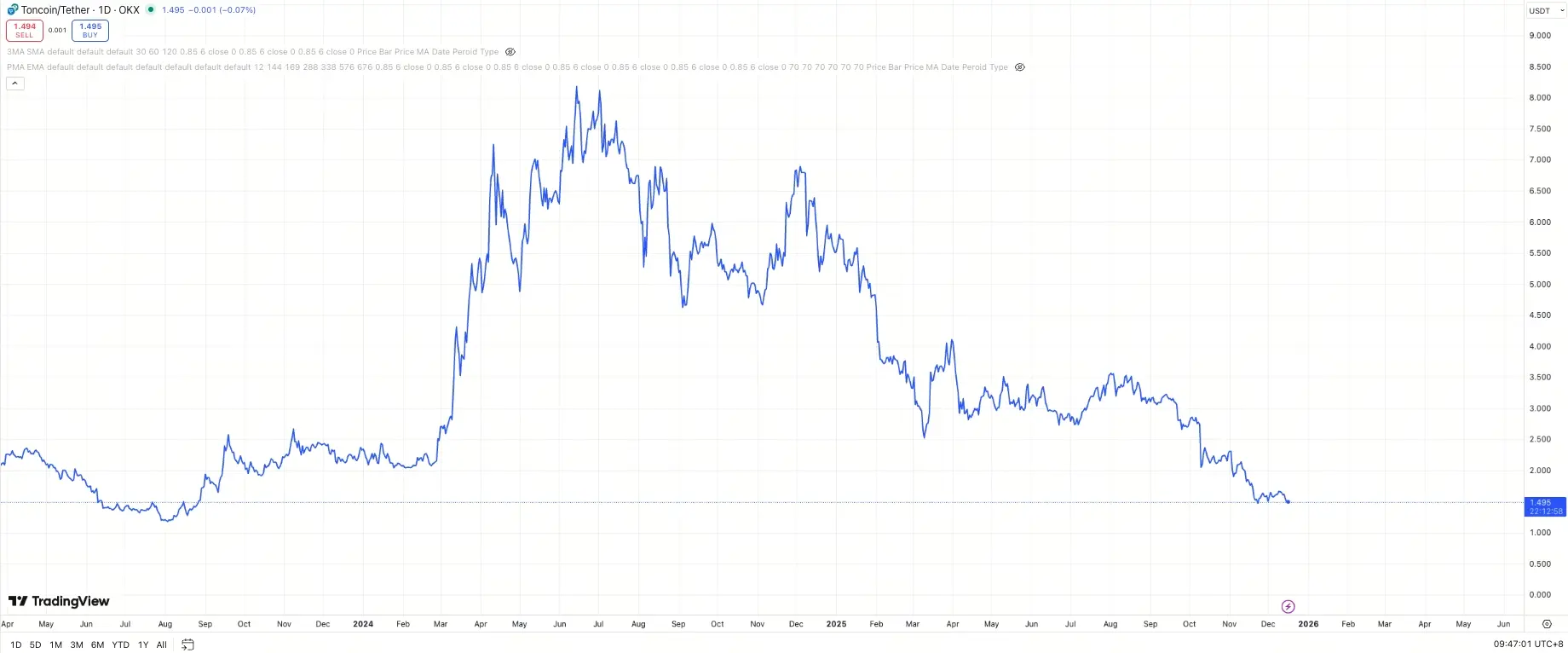
(Source: Trading View)
The performance gap between TON and the broader cryptocurrency market has further widened, making this relative weakness worth in-depth analysis. When the overall market falls by 1.8%, TON drops by 3.4%, meaning its decline is nearly twice that of the market. This “independent weakness” often stems from fundamental issues with the token or a loss of market confidence.
The token has experienced several brief rebounds but ultimately continued its downward trend. This pattern of failed rebounds is typical of a downtrend: each price recovery attracts new selling pressure, causing subsequent rebounds to diminish. From a technical analysis perspective, this movement is called a “descending channel” or “bear flag,” which usually indicates that the downtrend has not yet ended.
The relative underperformance compared to the market may reflect several factors. First, as a token closely linked to the Telegram ecosystem, its performance is influenced by Telegram’s platform development and regulatory environment. If Telegram faces regulatory pressure in certain regions or user growth slows, it will directly impact TON’s demand. Second, TON’s liquidity is relatively small, making it more susceptible to overselling during market panic. Third, there may be large holders or project team selling behaviors, as evidenced by high trading volume.
From a market psychology perspective, when a token consistently underperforms the market, it can create negative market expectations. Investors may start questioning the reasons for holding the token, and funds might flow into stronger-performing assets. This psychological effect can reinforce itself, further widening the relative weakness. Currently, TON seems to be caught in this vicious cycle.
The Game Behind the Surge in Trading Volume
Trading volume exceeding 640,000 tokens, far above the daily average, is a key indicator for understanding current market dynamics. High trading volume combined with falling prices typically has two interpretations: either panic selling has peaked, or large investors are accumulating but have not yet completed their positions. Based on price behavior, TON leans more toward the former.
According to CoinDesk Research’s technical analysis data model, the fluctuation range within the trading interval is close to 4.3%, a level of intraday volatility not common among mainstream tokens outside stablecoins. High volatility coupled with high trading volume indicates market participants are readjusting their positions, but not necessarily in a clear direction. This reflects market uncertainty, with active but cautious participants.
Three Possible Explanations for Abnormal Trading Volume
Peak Panic Selling: Long-term holders sell off in bulk due to loss of confidence, with the surge in trading volume representing a liquidation wave. If this is the case, the price may bottom out and rebound after the selling exhausts.
Institutional or Large Holder Distributions: Institutions or major holders sell in batches, taking advantage of each rebound to offload, causing repeated failed attempts at recovery. Under this scenario, prices may remain under pressure until the large holders complete their selling.
Active Short Selling Suppression: Derivatives market short sellers profit by dumping in the spot market, with high trading volume partly driven by hedging related to short positions. In this case, the price could experience more severe declines.
Can the Key Support at $1.5449 Hold?
Technical indicators remain mixed. The token found support near $1.5449, which is the day’s lowest point and a focal point of short-term bulls and bears. Based on order book data and historical transactions, there may be large buy orders or psychological support around this level, leading to a brief rebound to approximately $1.58 after touching it.
However, the rebound failed again, indicating that buyers’ short-term entry was met with renewed selling pressure. These movements suggest that major market participants may be interested, but without sustained follow-through, TON will continue to weaken. The failed rebound is an important technical signal, often indicating an imminent further decline.
If support at $1.5449 breaks, the next support levels could be at the psychological $1.50 mark or even lower near $1.45. Breaking below $1.50 could trigger a cascade of stop-loss orders, accelerating the decline. Conversely, if TON can stabilize above $1.5449 and regain above $1.60, it may temporarily ease selling pressure.
This decline has intensified the overall poor performance trend of the asset. Currently, traders are closely watching for signs of market stabilization or further selling. From a risk management perspective, investors should set clear stop-loss levels to avoid blindly bottom-fishing in a downtrend. Waiting for signs of stabilization and decreasing volume might be a wiser strategy.
Disclaimer: The information on this page may come from third parties and does not represent the views or opinions of Gate. The content displayed on this page is for reference only and does not constitute any financial, investment, or legal advice. Gate does not guarantee the accuracy or completeness of the information and shall not be liable for any losses arising from the use of this information. Virtual asset investments carry high risks and are subject to significant price volatility. You may lose all of your invested principal. Please fully understand the relevant risks and make prudent decisions based on your own financial situation and risk tolerance. For details, please refer to
Disclaimer.
Related Articles
River (RIVER) Price Keeps Pumping as TD Indicator Signals Another Rally
Analyst Ali Martinez highlights the accuracy of the TD Sequential indicator in predicting River (RIVER) price movements. The indicator has consistently identified significant buy and sell signals throughout RIVER's volatility, suggesting potential future trends based on current signals.
CaptainAltcoin19m ago
ETH 15-minute decline of 0.88%: Capital outflow dominates market, intensifying short-term selling pressure
On March 22, 2026, from 21:00 to 21:15 (UTC), Ethereum (ETH) recorded a -0.88% return rate within 15 minutes, with the price fluctuating in the range of 2029.54 to 2060.75 USDT, reaching an amplitude of 1.52%. Market attention has increased, short-term volatility has significantly intensified, reflecting rapid conversion of funding pressure into price pressure.
The main driver of this anomaly is accelerated capital outflows from trading platforms: approximately 420,690 USD equivalent of ETH flowed in within 10 minutes, but the number of withdrawals reached 2,319 transactions in the past 1 hour, far exceeding deposits during the same period by 5
GateNews1h ago
BTC Drops 0.58% in 15 Minutes: Tight Liquidity and Institutional Hedging Create Downward Pressure
2026-03-22 21:00 to 21:15 (UTC), BTC recorded a -0.58% return within just 15 minutes, with prices fluctuating in the range of 67562.1 to 68223.5 USDT, with an amplitude of 0.97%. During this period, market sentiment was highly tense, overall attention increased, and short-term volatility accelerated noticeably.
The main driving force behind this anomaly was the resonance formed by spot market liquidity shortage and medium-sized funds accelerating their exit. On-chain data shows a significant net outflow of -371.99 BTC in the $100k-$1M transaction range, driving selling
GateNews1h ago
Risk-Off Drips throughout Markets
Geopolitical tensions and rising uncertainty have led to a risk-off sentiment in global markets, with investors moving away from assets like Bitcoin and Ethereum. High oil prices and inflation concerns influenced portfolio adjustments, while Bitcoin selling pressure increased as short-term holders took profits. The market remains sensitive amid low sentiment.
CryptoBreaking1h ago
Bitcoin Has Stabilized, But Investors Are Paying Up for Downside Protection: VanEck
Bitcoin's volatility has decreased to around $70,000, but traders are still heavily investing in downside protection. Although premiums for puts have dropped, they remain high historically, suggesting caution among investors. This defensiveness may signal an impending price bottom, as similar market conditions in the past have led to recoveries.
Decrypt1h ago


