Despite Bitcoin experiencing a decline of over 30% in the past 10 weeks, causing concern among many investors, on-chain data shows that the spark of a bullish trend still seems to be alive.
According to Glassnode data, Bitcoin’s “Realized Cap” currently remains firmly at a historical high of $1.125 trillion, indicating that there has not been a large-scale withdrawal of funds from the market, and suggesting that the bull market structure remains solid.
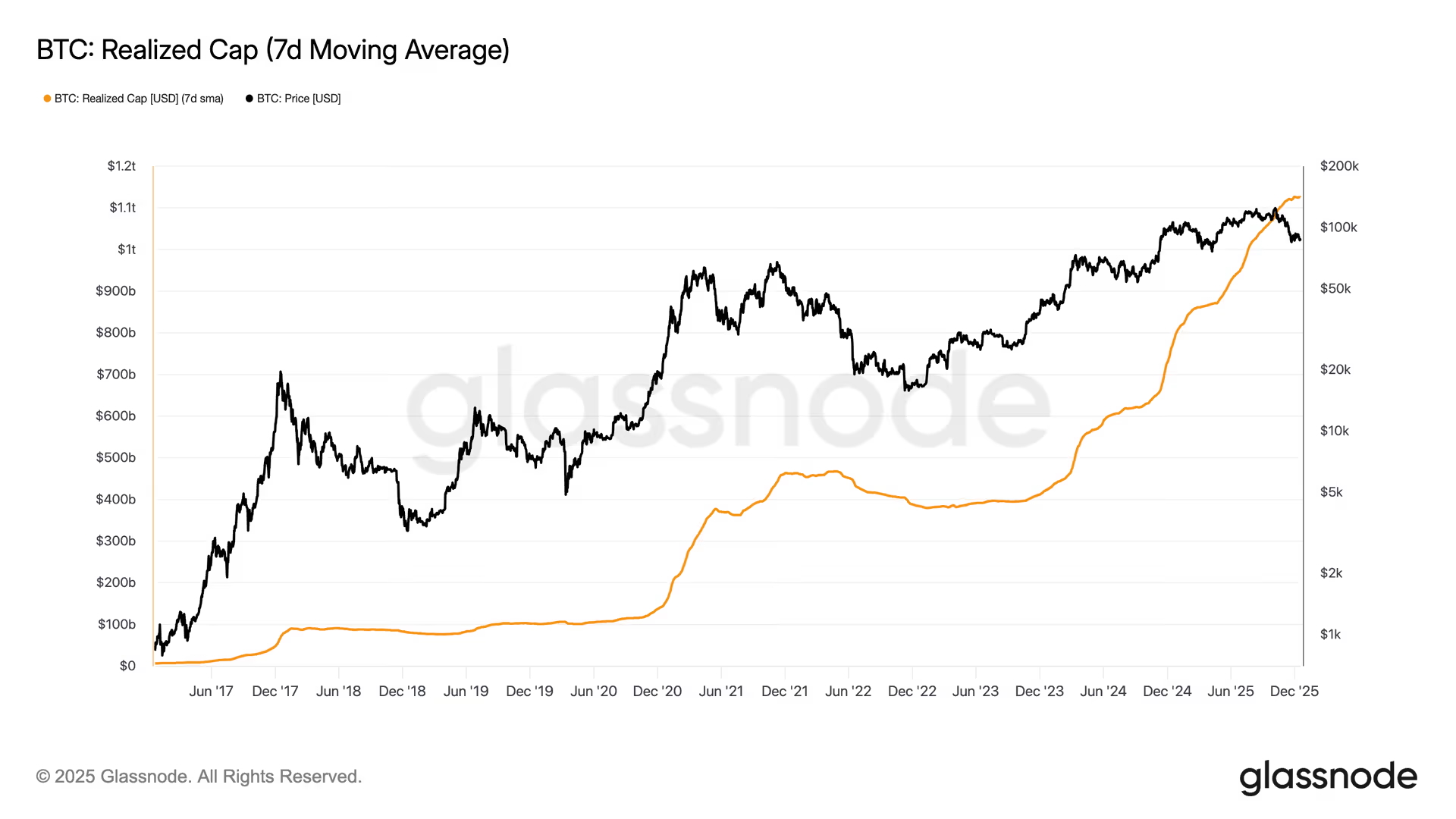
Unlike the commonly watched “Market Cap” (current price x total circulating supply), this on-chain indicator is more valuable for reference. “Realized Cap” is calculated by summing the last on-chain transaction price of each Bitcoin, removing the influence of short-term speculation, and reflecting the “actual cost basis” invested by investors and the “real fund inflow” situation.
In other words, when the total market value fluctuates wildly with price swings, the Realized Cap remains high and stable, indicating that holders are reluctant to sell and that there has been no large-scale loss realization.
Based on data from blockchain analytics firm Glassnode, even when Bitcoin plunged more than 30% from its October all-time high, the “Realized Cap” not only did not fall but continued to rise during the correction period, only recently stabilizing around $1.125 trillion.
This trend is reminiscent of the “tariff panic” outbreak in April this year. At that time, Bitcoin briefly dipped to $76,000, but on-chain fund levels did not retreat, and the price rebounded strongly to new highs.
In contrast, during the 2022 bear market, as prices collapsed, investor confidence shattered, and many capitulated, causing the Realized Cap to decline from $470 billion to $385 billion. However, the current market does not show such panic-driven “mass exodus” or “collective surrender” behavior.
Therefore, analysts are beginning to question the so-called “4-year cycle” theory that is revered in the crypto world.
“4-Year Cycle” Narrative Shaken, Surprises in 2026?
Asset management firm Bitwise Europe Research Director Andre Dragosch believes that Bitcoin is very likely to break free from the “4-year cycle” constraints and experience an unexpected surge in 2026.
He explains that against the backdrop of a resilient global economy, continued rate cuts by major central banks, a steepening yield curve, and expanding overall liquidity, such an environment often weakens the US dollar, and historical experience shows that a “weak dollar” is beneficial for risk assets like Bitcoin.
In my view, Bitcoin’s current price is seriously undervalued relative to the current macroeconomic environment, comparable to the recession during the COVID-19 pandemic and the market panic triggered by the FTX collapse. But now, the US shows no signs of recession, and instead, signals of renewed growth can be seen.
_
Disclaimer: This article is for market information only. All content and opinions are for reference only and do not constitute investment advice. They do not represent the objective views and positions of BlockCast. Investors should make their own decisions and transactions. The author and BlockCast are not responsible for any direct or indirect losses resulting from investor transactions.
_
Tags: 2026GlassnodeRealized CapAnalysisCryptoMarket CapPriceInvestmentBitcoinMarket Trend
Disclaimer: The information on this page may come from third parties and does not represent the views or opinions of Gate. The content displayed on this page is for reference only and does not constitute any financial, investment, or legal advice. Gate does not guarantee the accuracy or completeness of the information and shall not be liable for any losses arising from the use of this information. Virtual asset investments carry high risks and are subject to significant price volatility. You may lose all of your invested principal. Please fully understand the relevant risks and make prudent decisions based on your own financial situation and risk tolerance. For details, please refer to
Disclaimer.
Related Articles
XRP Supply Shift: Whales Add 200 Million Tokens as Price Eyes $1.50 - U.Today
XRP has seen a significant increase in whale activity, with 200 million XRP bought recently, while network activity and wallet numbers reach new highs. A "golden cross" signals potential price rises, as the SEC clarifies crypto asset regulations.
UToday1h ago
Bitcoin Breaks Below $71,000, Ethereum Falls Below $2,200! Nearly $300 Million in Liquidations Across the Network in 4 Hours, Inflation, Conflict, and Political Deadlock "Triple Kill" Crypto Market
The crypto market experienced a sharp decline on the evening of the 18th, with Bitcoin falling below $71,000 and Ethereum dropping to $2,200. The causes include U.S. PPI data exceeding expectations, which reduced the likelihood of Federal Reserve rate cuts; escalating Middle East conflicts increasing geopolitical risks; and gridlock in the U.S. Congress over crypto regulations. Market sentiment was severely damaged, with 110,000 people liquidated in just 4 hours, resulting in losses of $300 million.
動區BlockTempo3h ago
Here’s Where Gold Price Could Go After the FOMC Decision
Gold is in a bearish trend, forming a waterfall pattern with lower highs and lows. Watch the 4905 level; a break could lead to a drop toward 4841. Upcoming FOMC announcements may cause volatility, impacting price movements.
CaptainAltcoin3h ago
A Certain CEX Survey: 74% of Institutions Expect Cryptocurrency Market to Rebound in the Next 12 Months, Allocation Willingness Continues to Strengthen
Despite the crypto market's pullback since last year, the latest survey shows that institutional investor confidence remains solid, with 73% planning to increase digital asset allocation by 2026, and 74% expecting market recovery over the next 12 months. Most institutions prefer to invest through regulated instruments while focusing on regulatory clarity and risk management.
GateNews4h ago
Shiba Inu (SHIB) Shows Warning Signs as Price Hints at Another Dip
Shiba Inu price has returned to a delicate zone after several failed attempts to push higher. Recent price action shows SHIB struggling to break above a descending resistance line. That pattern has started raising concerns about another short-term decline.
Market observers began paying
CaptainAltcoin4h ago


