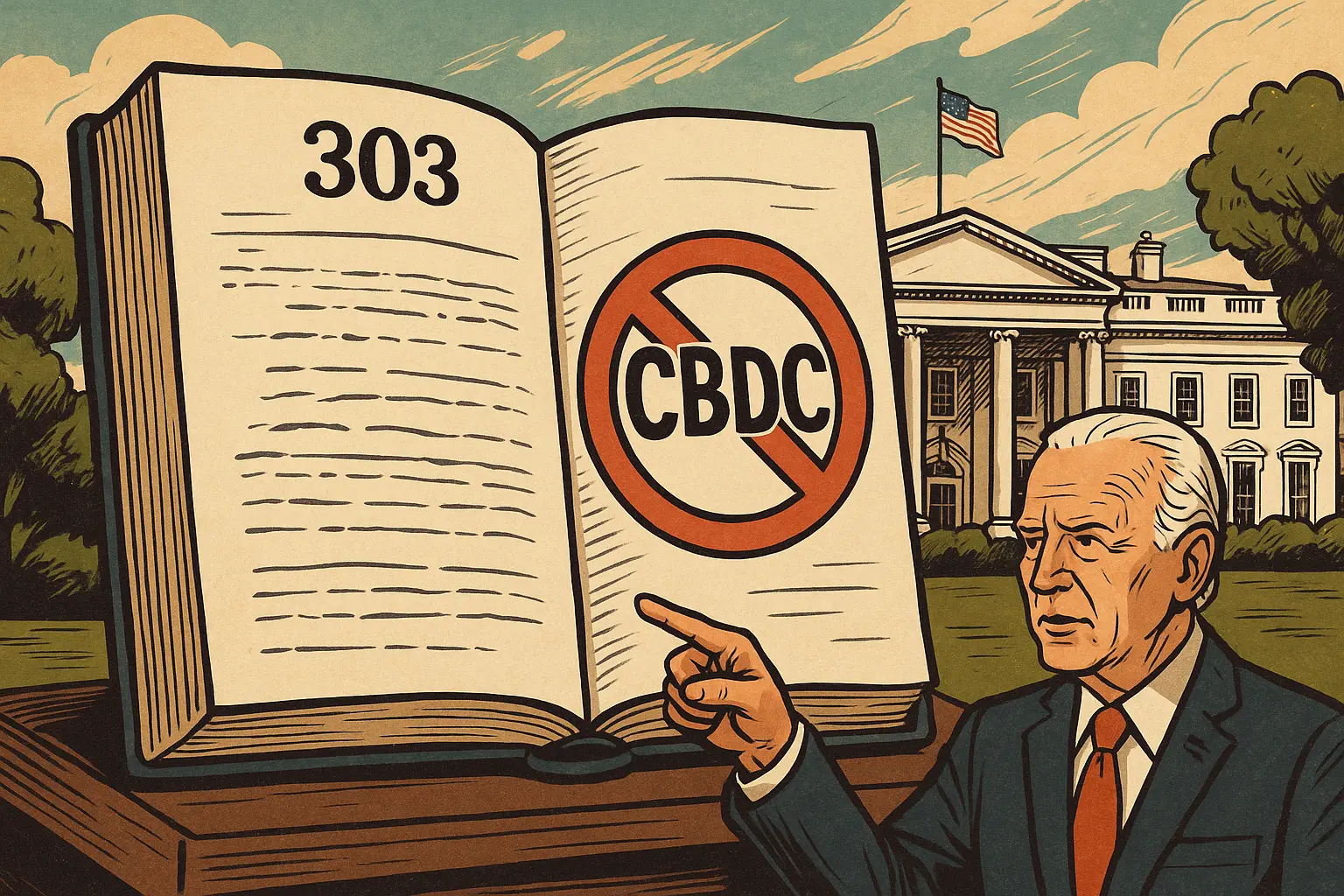
The U.S. Senate Banking, Housing, and Urban Development Committee on Monday introduced the “21st Century Housing Roadmap Act.” This bipartisan bill, spanning 303 pages and focused on reducing housing costs in the U.S., quietly includes a provision banning the Federal Reserve from issuing central bank digital currencies (CBDCs). The clause is only two pages long within the bill. The White House subsequently issued an administrative policy statement explicitly supporting the entire bill and specifically endorsing the CBDC ban clause.
Details of the CBDC Ban and Legal Framework
The embedded CBDC ban in the housing bill has clear operational boundaries at the legal level:
Core Prohibition: “The Federal Reserve Board of Governors or Federal Reserve Banks shall not directly or indirectly issue or create central bank digital currencies, or any digital assets substantially similar to CBDCs, through financial institutions or other intermediaries.”
Sunset Clause: The ban is effective until December 31, 2030. Before this date, the Federal Reserve is bound by the restrictions outlined above.
Exceptions: The bill provides an exemption for private “dollar-denominated” currencies that are “fully preserving the privacy protections of physical currency.” This exception effectively leaves room for the development of private stablecoins.
Background: Why Does the Housing Bill Include a CBDC Clause?
The main legislative goal of the “21st Century Housing Roadmap Act” is to help more American families achieve homeownership by reducing regulatory barriers, lowering construction costs, and expanding housing supply—all without increasing new fiscal spending. Committee Chair Scott mentioned in a statement that the bill aims to create more opportunities for families like single mothers raised in North Charleston, South Carolina; Warren emphasized that the bill consolidates bipartisan consensus on housing policy and takes a step toward limiting corporate landlords from squeezing out family housing opportunities.
Notably, embedding CBDC bans into other legislation is not a new practice:
- Similar clauses have been proposed in previous bills.
- The U.S. House of Representatives passed a standalone CBDC ban bill last year.
However, so far, none of these legislative efforts have completed the full legislative process in Congress.
White House Support Statement and Broader Anti-CBDC Policy Context
The White House issued an administrative policy statement supporting this housing bill, with two sections explicitly endorsing the CBDC ban clause. The statement emphasizes that preventing the development of CBDCs is a current priority for the administration. This stance aligns with the early-term approach of the Trump administration, which used executive orders to restrict CBDC development.
From a policy perspective, U.S. concerns about CBDCs mainly focus on the potential expansion of government surveillance over financial transactions and the erosion of individual financial privacy. The exemption for private stablecoins (like USDT, USDC) is viewed by some advocates as a way to resist government-led digital currencies while maintaining a diverse digital dollar ecosystem.
Frequently Asked Questions
Q: Does this CBDC ban mean the U.S. is permanently abandoning plans for a digital dollar?
A: No, it is not a permanent ban. The bill includes a clear sunset clause, with the ban expiring on December 31, 2030. After that date, unless extended by new legislation, the ban will automatically lapse. Additionally, the bill is currently a proposal and must go through full legislative procedures—vote by the Senate, review by the House, and presidential signing—before becoming law.
Q: Are private stablecoins (like USDT, USDC) affected by this ban?
A: According to the exception clause, private dollar-denominated digital currencies that are “permitted without a license” and “fully preserve the privacy protections of physical currency” are not subject to the ban. This design effectively limits government-led CBDCs while leaving room for private stablecoins, which some interpret as an indirect support for the private digital dollar ecosystem.
Q: Why did bipartisan lawmakers agree to include a CBDC ban in the housing bill?
A: The CBDC ban is seen as one of the few cryptocurrency policies capable of crossing party lines. Republicans tend to oppose CBDCs from the perspective of limiting government power and protecting private property, while some Democrats (like Warren) are cautious about government surveillance and favor privacy protections. The overlap of these positions makes the ban a suitable clause to include in bipartisan legislation.
Disclaimer: The information on this page may come from third parties and does not represent the views or opinions of Gate. The content displayed on this page is for reference only and does not constitute any financial, investment, or legal advice. Gate does not guarantee the accuracy or completeness of the information and shall not be liable for any losses arising from the use of this information. Virtual asset investments carry high risks and are subject to significant price volatility. You may lose all of your invested principal. Please fully understand the relevant risks and make prudent decisions based on your own financial situation and risk tolerance. For details, please refer to
Disclaimer.


